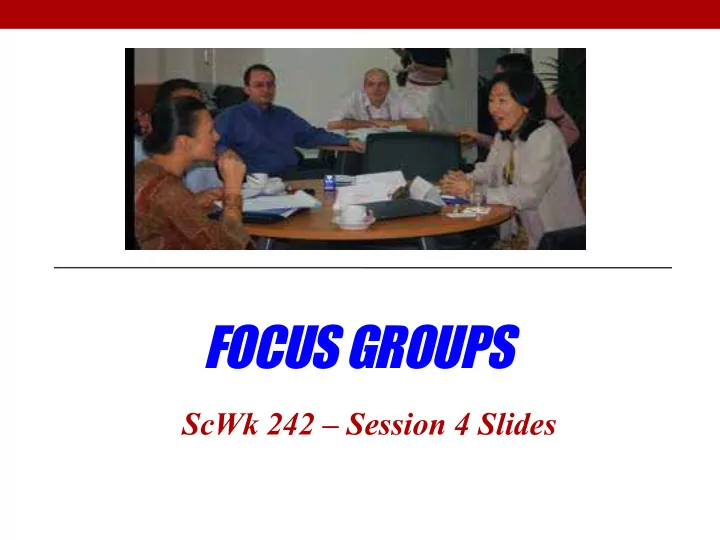
FOCUS GROUPS ScWk 242 Session 4 Slides 2 When to Use Focus - - PowerPoint PPT Presentation
FOCUS GROUPS ScWk 242 Session 4 Slides 2 When to Use Focus Groups? Definition inition: F : Foc ocus g us groups a oups are a a sm small g ll group of oup of a a se sele lecte ted popula d population tha tion that a t are a
When to Use Focus Groups?
Definition inition: F : Foc
- cus g
us groups a
- ups are a
a sm small g ll group of
- up of a
a se sele lecte ted popula d population tha tion that a t are a ask sked ope d open- n- ende nded que d questions in a stions in a disc discussion type ussion type atm tmosphe
- sphere to g
to gene nerate te da data
- ta. T
. The hey should: y should:
Ø In
Involv
- lve a
a c carefully pla fully planne nned disc d discussion ussion
Ø Atte
ttempt to obta pt to obtain pe in perceptions of ptions of a a de define ined inte d interest a st area
Ø Be c
carrie ried out in a d out in a pe perm rmissiv issive, non- , non- thr threate tening e ning envir vironm
- nment
nt
2
A A Focus
- cus Gr
Group
- up Is
Is . . . . .
Who
Ø Usually has approximately
seven to ten people in them
Ø With common characteristics
relating to the discussion topic How
Ø Conducted by a trained
interviewer (moderator, facilitator).
3
Limita Limitations tions of
- f Focus
- cus Gr
Groups
- ups
Ø Risk of biases introduced by the
moderator(s)
Ø Domineering and/or passive
participants
Ø Usually does not provide depth of
information compared to other methods, such as key informant interviews
4
Moder Moderator’ tor’s s Role
- le
Ø Stays relaxed and sets tone Ø Introduces and guides the discussion Ø Actively and carefully listens Ø Does NOT participate, or share views, or
engage in the discussion
Ø Does NOT editorialize comments Ø Promotes everyone’s participation Ø Is non-judgmental and respectful
5
Ad Additional ditional Moder Moderator tor Roles
- les
Ø Is familiar enough with the questions that
she can ask them in a conversational manner
Ø Gives an appreciative welcome and close
that acknowledges the participants for giving their time and ideas
Ø If possible, the moderator should have a
connection to the group
6
Notetak Notetaker’ er’s R Role
Ø Tests and places the audio recording equipment
Note: it helps to talk to participants beforehand to gauge and quiet the speakers
Ø Comes prepared with pens and paper Ø Sits in the room during the entire discussion
where they can see & hear the participants
Note: do not sit by the facilitator
Ø Sketches participant seating arrangement
Note: use identifiers other than names
7
Ad Additional ditional Notetak Notetaker er R Roles
Ø Tries to be aware of correct recording during
the focus group session
Ø Serves as the timekeeper Ø Does not join in conversation - avoids
nodding or reaction
Ø Identifies themes, follow-up questions, body
language, confusion, nonverbal communication (especially when no one is speaking), facial expressions, gestures, signs
- f agreement, disagreement, frustration,
concern, etc.
8
Mor More e Notetak Notetaker er R Roles
Ø After the discussion, the notetaker checks
notes for legibility and gaps
Ø The notetaker and moderator should meet
soon after the focus group to review the experience
Ø You should try to be a “fly on the wall”
during the discussion and simply observe
Ø If no one knows you are there, you are
doing a good job!
9
Getting Getting Star Started ted
Ø Set up the room according to number of people Ø Introduction points to write on flip chart
Helpful Tips:
- Your comments are confidential. We are taking notes, but not
- names. Please be respectful of others and the opinions given.
- Please speak up so we all can hear you.
- Everyone gets a chance to talk.
- There are no wrong answers; all comments are important.
- Please let me know if you have any questions
10
Ad Additional ditional Star Start-Up t-Up Sug Suggestions gestions
Ø Moderator introduces herself/himself, the
notetaker, and the study
Ø Thanks everyone for coming today Ø Reviews the group’s purpose and goals Ø Explains how the meeting will proceed, and
how members can contribute
Ø Sets the tone by asking an opening question
(such as, “tell us a little bit about yourself”)
11
During During the the Discussion: Discussion:
- Be aware of voice recorder function and fidelity, making sure
that soft-spoken individuals speak loud enough, and minimizing any noise that might interfere with the recording
- Use “Moderator Probes” when needed for clarification
- Facilitate the discussion so that everyone is included
- Remind yourself not to share own views on a participant’s
remarks (including “That’s a good point”) as this response may bias the response of the other participants
- Be aware of how you’re sitting. Make sure that you face
everyone in the group and do not start to lean towards one part of the group that seems more animated and engaged.
- Don’t be afraid of silence. Give participants the chance to
think about their answers.
12
Use Use of
- f Moder
Moderator tor Pr Probes
- bes
- Be aware of recording: better to use non-verbal prodding while
someone is talking.
- Be neutral: don’t react for or against anyone’s statement
- Body language: nodding head, continued eye contact
- Vocalizations: “uh, huh…”; “yes…oh, okay…”
- Reflecting back: “what I understood you to say was…”; “Let
me see if I understood you correctly…”
- Clarification: “I’m not sure I understand… can you tell me
more…”; “Can you tell me more about why you think it is important”
- Substitution: “How often do you…”
- Other examples: “Is there anything else…”; “Could you
explain that to me… I want to be sure I understand…”
- Timing: Listen for natural breaks in the conversation or
repetition before you move on to the next question.
13
Closing Closing Steps Steps
Ø When all questions have been asked, ask if
anyone has any other comments to make
Ø Summarize key points based on focus group
discussion
Ø Have we missed anything? Ø Audio taping ends Ø Tell the group about next steps that will occur
and what they can expect to happen
Ø Thank the group for coming Ø Give incentives for participation (if applicable)
14
Fo Focus Group Analysis Tips
When analyzing focus group data, consider…
Ø Words Ø Context Ø Internal consistency Ø Frequency or extensiveness of comments Ø Intensity of the comments Ø Specificity of responses Ø Find the biggest ideas generated
15
Comment Comment on
- n the
the Follo
- llowing
wing Ima Images ges
16