SLIDE 1 Page 1 of 7
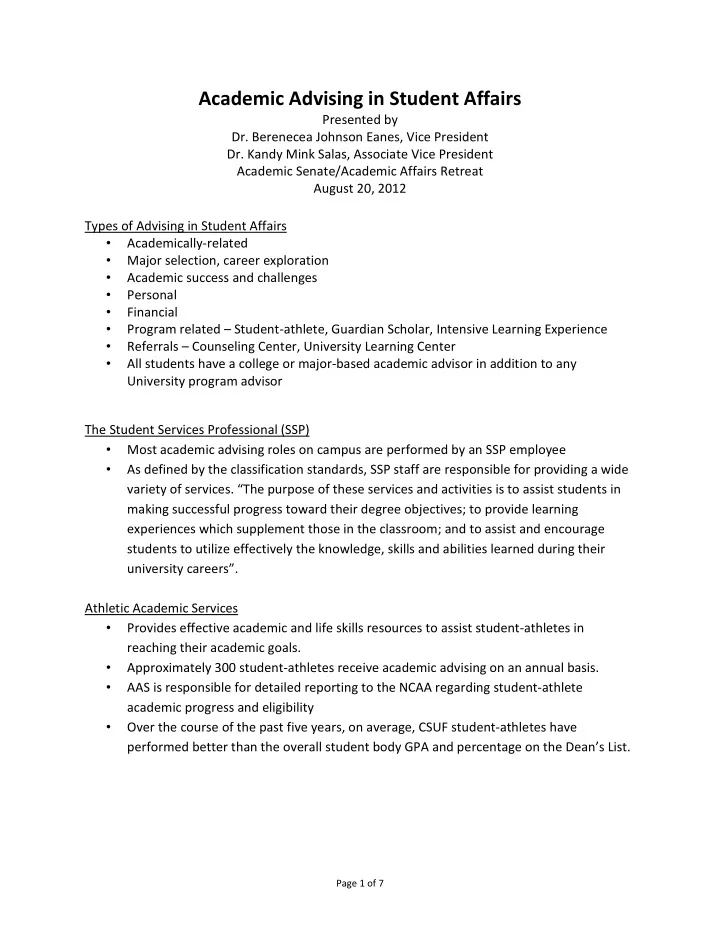
Academic Advising in Student Affairs
Presented by
- Dr. Berenecea Johnson Eanes, Vice President
- Dr. Kandy Mink Salas, Associate Vice President
Academic Senate/Academic Affairs Retreat August 20, 2012 Types of Advising in Student Affairs
- Academically-related
- Major selection, career exploration
- Academic success and challenges
- Personal
- Financial
- Program related – Student-athlete, Guardian Scholar, Intensive Learning Experience
- Referrals – Counseling Center, University Learning Center
- All students have a college or major-based academic advisor in addition to any
University program advisor The Student Services Professional (SSP)
- Most academic advising roles on campus are performed by an SSP employee
- As defined by the classification standards, SSP staff are responsible for providing a wide
variety of services. “The purpose of these services and activities is to assist students in making successful progress toward their degree objectives; to provide learning experiences which supplement those in the classroom; and to assist and encourage students to utilize effectively the knowledge, skills and abilities learned during their university careers”. Athletic Academic Services
- Provides effective academic and life skills resources to assist student-athletes in
reaching their academic goals.
- Approximately 300 student-athletes receive academic advising on an annual basis.
- AAS is responsible for detailed reporting to the NCAA regarding student-athlete
academic progress and eligibility
- Over the course of the past five years, on average, CSUF student-athletes have
performed better than the overall student body GPA and percentage on the Dean’s List.
SLIDE 2 Page 2 of 7
Student Academic Services Educational Opportunity Program (EOP)
- Provides access to higher education and academic support to first generation students
who face economic and educational barriers.
- EOP serves between 1500 and 1700 students each academic year and regularly meets
with approximately 500 active (first year or probationary) students.
- Programs include specific New Student Orientation, Summer Bridge, LINKS Peer
Mentoring program, various scholarship program
- In the 2011-2012 academic year, EOP students were less likely to be academically
disqualified (1.78%)than the general student population Intensive Learning Experience (ILE)
- Monitors the progress of students fulfilling remedial course requirements via intensive
counseling and academic advising
- Topics such as class planning, study skills, campus resources, and time
management are covered in advising sessions
- ILE meets with approximately 700 students in the fall semester and 450 students in the
spring semester; while monitoring an additional 800 students who do not require in- person appointments but who take an on-line success course.
- Currently monitoring the impact of ESP on ILE
Student Support Services (SSS)
- This federally-funded TRIO program provides educational services such as advising and
tutoring to low income, first generation, and students with disabilities.
- In the 2010-2011 academic year, SSS provided services to 160 participants, 90% of
whom completed the year in good academic standing. Guardian Scholars
- Provides comprehensive assistance to students exiting the foster care system in
developing educational and interpersonal skills necessary to become self-supporting, competent professionals in their selected fields.
- 37 Guardian Scholars received financial, academic, and social support in the 2010-2011
academic year.
- Advising is required for all Guardian Scholars supplementing the support they
receive from Academic Advisement Center and specialized programs such as EOP.
- In 2011-2012, the Guardian Scholars program maintained a 100% persistence
rate with 17% graduating and 83% retained into the 2012-2013 academic year.
SLIDE 3 Page 3 of 7
- The overall persistence rate (over a15 year period) is 69%, high for a
student population that has a higher probability of becoming incarcerated or homeless. Disabled Student Services (DSS)
- The Office of Disabled Student Services provides co-curricular and academic advising
which empower students with disabilities to achieve academic and personal self- determination
- In the 2011-2012 academic year, the DSS office provided approximately 575 participants
with a variety of advising support; including academic advising and class scheduling.
- All DSS students are required to meet with their counselor at the start of each
semester to receive academic and co-curricular support.
- More than 75% of the DSS cohort receives some avenue of advising throughout
the year from various office staff. New Student Orientation (NSO)
- NSO provides general education and major advisement to incoming students at their
- rientation. The Academic Advisement Center and each College is responsible for
providing the type of advising needed.
- In addition, many FTF students choose to attend the Student Life Orientation where
they receive advising on financial management, civility at CSUF, responsible decision making, and getting involved on campus.
- Each year, NSO supports 4,200 incoming freshmen and 1,800 transfer students.
Approximately 2,000 freshmen participate in the Student Life Orientation. New Student Programs (NSP)
- NSP connects students to the campus through tours, referrals, and leadership
- development. In collaboration with the Academic Advising Center and through services
such as Freshman Programs, University 100, and the Early Alert Prevention Program, NSP supports students in developing character, critical thinking skills, and interpersonal competence with specialized workshops and drop-in advising.
- In the 2011-2012 academic year, Freshman Programs supported 519 students, all
- f which also attended NSO.
- On average, 40 students each semester participate in walk-in advising provided
by NSP. In addition, academic advising topics are covered in class sessions of UNIV 100
SLIDE 4 Page 4 of 7
Career Center
- The Career Center provides walk-in and scheduled counseling as well as informational
workshops for undeclared students and those exploring their major and career
- pportunities
- Career Center on-line services provided 4556 sessions and 6602 searches in 2011-2012
- In the 2011-2012 academic year, the Career Center provided:
- 4477 advising-related counseling sessions to 2487 students
- 108 advising-related workshops and class presentations to 2692 students
(primarily to University 100 students)
- Advising-related services include topics such as major and career exploration,
advising on graduate school, and assistance with internships Ronald E. McNair Program
- This federally-funded TRIO program provides educational services such as advising,
mentoring and instruction to low income, first generation, and underrepresented students who have the goal of completing a Ph.D.
- In the 2010-2011 academic year, the McNair Program provided services to 25
participants.
- 30% of McNair students from CSUF have completed or are in the process of completing
a Ph.D.
- Of the 162 scholars who have participated since 2000; 11 have earned their Ph.D. while
38 are currently in a Ph.D. program. Adult Reentry Center (ARC)
- The Adult Reentry Center (ARC) at California State University, Fullerton is dedicated to
issues of the Adult Learner and the successful completion of his/her educational goals. The center serves as a resource to the CSUF community in providing an educational environment for adult learners’ success and retention.
- During the 2011-2012 academic year, 960 people received in-office or phone advising
regarding re-entering college; averaging 6-8 per day.
- Of the people served, 59% were female with 41% male. In addition, there was
an increase in serving underrepresented populations with 38% Latino, 2% African American, 2% Middle Eastern, and 47% White. Assistant Deans
- Assistant Deans for Student Affairs in each College meet with students both individually
and in groups to assist them in achieving their personal, academic, and professional goals.
SLIDE 5 Page 5 of 7
- In the Colleges of the Arts, Communications, Engineering & Computer Science, Health &
Human Development, Humanities & Social Sciences, and Natural Sciences & Mathematics, the Assistant Deans support academic success through structured and informal academic advising with students.
- The Mihaylo College of Business and Economics has a centralized advising system
and the College of Education focuses advising efforts at the department level.
- Probation advising is one of the functions of some of the Assistant Deans. Examples
include:
- David McKenzie, Assistant Dean in the College of Humanities and Social Sciences,
provides 2-3 probation workshops, attended by approximately 50 students, each calendar year. He also provides disqualification advising for an average of 15 students per year.
- Dr. Rochelle Woods, Assistant Dean in the College of Natural Science and
Mathematics, meets individually with an average of 125-150 students on probation each fall, with an increase to 225 students in the spring semester.
- Dr. Lea Beth Lewis, Assistant Dean in the College of Health and Human
Development, provides probation advising to approximately 145 student annually
- Andi Sims, Assistant Dean in the College of the Arts, works in collaboration with
department faculty to meet individually with approximately 50 students each semester who are on probation.
- All Assistant Deans that do probation advising serve on the Campus-wide Probation
Advisement Team
- All Assistant Deans provide assistance in some way in the planning and implementation
- f New Student Orientation and Student Life Orientation
- Assistant Deans are involved in follow up contacts with first year students who do not
register for second semester
- Assistant Deans are available to meet with students to provide general advising and this
very often leads to academic advising conversations and referrals. Topics such as the withdrawal process, grade changes, incompletes process, stop-out policy, etc. are often discussed. Irvine Campus
- Student Affairs staff and faculty provide both major and general education advising to
students
- During the 2011-2012 academic year, 1,765 students received academic advising at the
Irvine Campus
SLIDE 6 Page 6 of 7
Academically Related Advising Committee
- Created in 2010, the Student Affairs Academically-related Advising Committee consists
- f the Assistant Deans and Student Affairs Directors who have responsibility for some
form of academic advising
- The Chairs of the group are Dr. Meredith Basil, Director of Athletic Academic Services
and David McKenzie, the Assistant Dean in H&SS
- The purposes of the group are:
- Share best practices in advising and counseling
- Share campus-wide information on academic advising issues
- Liaison with the Academic Advisement Center
- Provide staff development opportunities when appropriate
Research & Literature on Academic Advising in Student Affairs
- Literature in the field – see below
- Literature review shows that the most impactful practices for first generation, low
income, disadvantaged students are:
- Academic and social integration, relationships
- Academic preparedness, given high school experience
- Cultural adaptation, avoiding isolation, alienation
- Involving parents and other family members
- Easing the financial burden
- Successful initial transition
- High expectations
SLIDE 7
Page 7 of 7
Academic Advising in Student Affairs Resources Barbuto, J. E., Story, J. S., Fritz, S. M. & Schinstock, J. L. (2011). Full range advising: Transforming the advisor-advisee experience. Journal of College Student Development, 52, (6), 656-670, Nov- Dec 2011. Dean, L. (Ed.) (2009). CAS professional standards for higher education. (pp. 36 -43). Washington, D.C.: Council for the Advancement of Standards in Higher Education. Drake, J. K. (2011). The role of academic advising in student retention and persistence. About Campus, 16, (3), 8-12, Jul-Aug 2011. Engle, J., Bermeo, A. & O'Brien, C. (2006). Straight from the source: What works for first generation college students. Washington D.C.: Pell Institute for the Study of Opportunity in Higher Education. Gordon, V. N. (2006). Career advising: An academic advisor’s guide. San Francisco: Jossey-Bass. Gordon, V.N., Habley, W.R. & Grites, T.J. (Eds.). (2008). Academic advising: A comprehensive handbook, 2nd Edition. San Francisco: Jossey-Bass. Hurt, R. L. & McLaughlin, E. J. (2012). An applied introduction to qualitative research methods in academic advising. NACADA Journal, 32, (1), 63-71, Spr 2012. National Academic Advising Association (NACADA). http://www.nacada.ksu.edu/ Ward, L., Siegel, M. J. & Davenport, Z. (2012). First generation college students: Understanding and improving the experience from recruitment to commencement. San Francisco: Jossey-Bass. Zhang, N. (Ed.) (2011). Rentz's student affairs practice in higher education, 4th Edition. Springfield, IL: Charles C. Thomas. KMS08/16/12