ABE: Providing a Low Delay Introduction within Best Effort - - PDF document

abe providing a low delay
SMART_READER_LITE
LIVE PREVIEW

ABE: Providing a Low Delay Introduction within Best Effort - - PDF document

ABE: Providing a Low Delay Introduction within Best Effort Multimedia applications can perform well under a wide-range of loss (repair) Delay often the major impediment for P. Hurley, M. Kara, J. Le Boudec, and P. Thiran interactive MM


slide-1
SLIDE 1

1

ABE: Providing a Low Delay within Best Effort

  • P. Hurley, M. Kara, J. Le Boudec, and P. Thiran

ICA, Swiss Federal Institute of Technology, Lausanne, Switzerland Sprint ATL, California Department of Computer Science, University of Leeds, UK

IEEE Network Magazine May/June 2001

Introduction

  • Multimedia applications can perform well

under a wide-range of loss (repair)

  • Delay often the major impediment for

interactive MM applications

  • Internet is “best-effort” with one QoS of traffic

for all

– DiffServ requires monitoring of classes

  • Want to keep it simple, but add support for

delay sensitive MM traffic

Alternative Best Effort (ABE)

Outline

  • Introduction

(done)

  • The ABE Service

(next)

  • Implementation
  • Simulation Results
  • Related Work
  • Conclusions

Outline

  • Introduction

(done)

  • The ABE Service

– Definition (next) – Green does not hurt blue – Router requirements – Inter-working and Migration

  • Implementation
  • Simulation Results
  • Related Work
  • Conclusions

Definition

  • ABE packets are either green or blue

– (Neutral colors, green for “go”) – Application chooses to make packets green – Default is blue

  • Green packets get low, bounded delay
  • Green does not hurt blue

– Blue has same or better throughput even if green traffic

  • All ABE packets in same best-effort class

– Traditional congestion control – All blue gets more throughput than all green

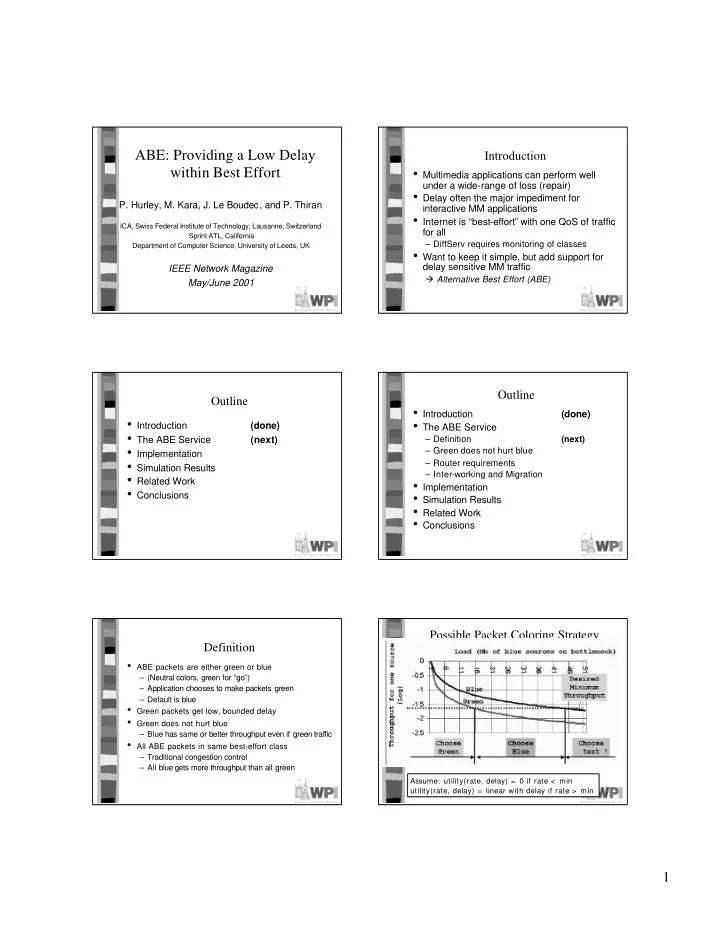
Possible Packet Coloring Strategy

Assume: utility(rate, delay) = 0 if rate < min utility(rate, delay) = linear with delay if rate > min

slide-2
SLIDE 2

2

Discussion

  • Interactive applications send mix of blue and green

– “Probe” packets to determine region

  • Traditional applications send all blue

– Care more about throughput

  • Note, says nothing about TCP-friendly

– Still same problem as with best-effort – Green makes it no worse since doesn’t hurt blue

  • Backbones have low delay, so likely ABE in

peripheral routers

  • Delay bound offered depends upon hops

– Assume 2-6 low-speed hops – Delay 100-150 msec total, maybe 50 for network – Per-hop delay about 5-20 msec

Outline

  • Introduction

(done)

  • The ABE Service

– Definition (done) – Green does not hurt blue (next) – Router requirements – Inter-working and Migration

  • Implementation
  • Simulation Results
  • Related Work
  • Conclusions

Green Does Not Hurt Blue

  • When there is green traffic in addition to

traditional blue traffic, we must have

– Local transparency to blue – Throughput transparency to blue

Local Transparency to Blue

  • Consider a traditional router that treated all

packets equal (no ABE)

  • Should have same delay as traditional router
  • If blue not dropped with traditional router,

then not dropped with ABE router

  • If TCP friendly:
  • What might happen to throughput for green?

Need throughput transparency

Throughput Transparency to Blue

  • If green flow is TCP friendly, should get less
  • r equal throughput as blue flows
  • Hard to implement exactly since hard to

measure

– Hard to measure TCP friendly, even! – Consider it to be a loose requirement

  • Implement by making sure green has higher

loss ratio

Outline

  • Introduction

(done)

  • The ABE Service

– Definition (done) – Green does not hurt blue (done) – Router requirements (next) – Inter-working and Migration

  • Implementation
  • Simulation Results
  • Related Work
  • Conclusions
slide-3
SLIDE 3

3

Router Requirements

  • Provide low, bounded delay to green
  • Provide local transparency to blue
  • Provide throughput transparency to blue
  • Preserve packet sequence within blue and

green

– May be out of order across colors

  • Keep green packet loss as low as possible

– Make green attractive as possible

Outline

  • Introduction

(done)

  • The ABE Service

– Definition (done) – Green does not hurt blue (done) – Router requirements (done) – Inter-working and Migration (next)

  • Implementation
  • Simulation Results
  • Related Work
  • Conclusions

Interworking and Migration

  • Can add one

router at a time

  • Let customers

switch to gradually

  • Should not

impact other routers

Outline

  • Introduction

(done)

  • The ABE Service

(done)

  • Implementation

(next)

– Duplicate Scheduling with Deadlines – Properties of (DSD)

  • Simulation Results
  • Related Work
  • Conclusions

Implementation

  • Could try modified FCFS:

– For blue, enqueue normally – For green, drop if delay > max – (What is a problem with this?)

  • Instead, use separate queues

– But still work conserving

  • Deadlines associated with each packet

– Dequeue color that has earlier deadline – If both, use a control function for fairness

Duplicate Scheduling with Deadlines (DSD)

DSD Overview

slide-4
SLIDE 4

4

DSD Example

Buff = 7 Max d = 3 Serve: G1, B2, B3, B4 Drop: G2 (deadline missed), B6 (buffer full)

Duplicate Scheduling with Deadlines

Serve: G3, B5, B7, 4g, B8 and B9 Buff = 7 Max d = 3

DSD Modifications

  • Only enqueue green packet if length of green

queue + blue packets with deadline less than d < d

– So, would not have enqueued G2

  • If either can be served, if [0,1] < g then pick

green else blue

– g=1, favor green, g=0 favor blue – (g=1 in example)

  • Can also use active queue management

(AQM) for congestion monitoring

Properties of DSD

  • Buffer always less than Buff because of

virtual queue

  • All blue packets served by deadlines, so

same as or earlier than best-effort

  • All green packets served before d, else

dropped

Outline

  • Introduction

(done)

  • The ABE Service

(done)

  • Implementation

(done)

  • Simulation Results

(next)

  • Related Work
  • Conclusions

Simulation

  • Done in NS-2
  • Show green does not hurt blue
  • Show green benefits from low delay
  • Show loss rates for both types
  • Compare to reference condition, flat best-

effort FCFS (droptail) router

slide-5
SLIDE 5

5

Simulation Setup

  • blue are TCP
  • Reno, green are TCP-Friendly [BB00]
  • Some simulations have one additional green source

that is unresponsive CBR

  • packet size 1000 bytes
  • delay max = 0.04 seconds
  • simulations run for 300 seconds

50 ms (why?)

Throughput - Equal

10 blue, 10 green all TCP

  • friendly

Queuing Delay - Equal

Loss: (ABE, BE) green: (4.97%, 3.3%) blue: (3.2%, 2.5%)

Throughput - Unequal

10 blue, 6 green all TCP

  • friendly

Throughput – CBR

10 blue, 1 green CBR

Throughput – CBR + Friendly

10 blue, 10 green TCP

  • friendly, 1

green CBR

slide-6
SLIDE 6

6

Throughput – Mixed Green + Blue

  • 10 blue, 10 green

TCP

  • friendly, 1

green CBR

  • Green does 80%

green and 20% blue

Outline

  • Introduction

(done)

  • The ABE Service

(done)

  • Implementation

(done)

  • Simulation Results

(done)

  • Related Work

(next)

  • Conclusions

Related Work

  • IntServ

– admission control plus reservation – Per-flow accounting and charging – Doesn’t scale – May perform on edge only

  • DiffServ

– Aggregates (classes) of flows – Scales better

Related Work

  • Low delay service

– Crowcroft et al (also gets more throughput) – EF provides low delay and low loss – SIMA has level for how ‘real-time’ traffic is

  • Low delay class

– Dovrolis et al – AF – Assured Forwarding

  • All require changes to existing price
  • structures. Incremental deployment difficult.

Conclusion

  • ABE

– Supports low delay – No reservation or signaling required

  • Choice of green or blue up to application
  • One ABE implementation presented (DSD)
  • Simulation and implementation suggest:

– Green benefits from lower delay – Blue not harmed – Under a variety of conditions

Future Work?

slide-7
SLIDE 7

7

Future Work

  • Applications that use green

– Adaptively

  • PQ benefits of ABE to MM
  • Implementation overhead of ABE
  • More colors for more MM applications:

– dark green, light green, neon green …

  • More colors for more blue applications

– Web, Email, Telnet, File Transfer