A T A Tale ale of of Tw Two o Intersec ersectio ions ns - - PowerPoint PPT Presentation

a t a tale ale of of tw two o intersec ersectio ions ns
SMART_READER_LITE
LIVE PREVIEW

A T A Tale ale of of Tw Two o Intersec ersectio ions ns - - PowerPoint PPT Presentation

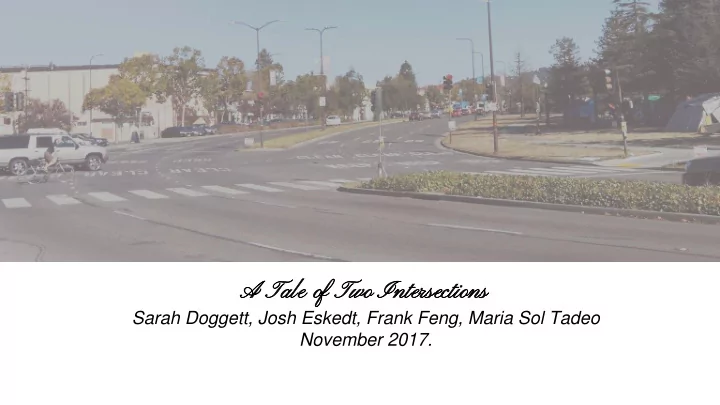
A T A Tale ale of of Tw Two o Intersec ersectio ions ns Sarah Doggett, Josh Eskedt, Frank Feng, Maria Sol Tadeo November 2017. Agenda 1. Goal 2. Existing Conditions 3. Corridor Treatment 4. Intersection Alternative 1: Roundabout 5.


slide-1
SLIDE 1

A T A Tale ale of

  • f Tw

Two

  • Intersec

ersectio ions ns

Sarah Doggett, Josh Eskedt, Frank Feng, Maria Sol Tadeo November 2017.

slide-2
SLIDE 2

Agenda

  • 1. Goal
  • 2. Existing Conditions
  • 3. Corridor Treatment
  • 4. Intersection Alternative 1: Roundabout
  • 5. Intersection Alternative 2: Protected Intersection
  • 6. Transit Considerations
  • 7. Minor Intersection Design
  • 8. Turning Analysis
  • 9. Urban Design

10.Parking 11.Evaluation 12.Questions

slide-3
SLIDE 3

Goal

For intersections at Adeline St and MLK Jr Way and at Adeline St and Stanford Ave

  • Improve safety for all users
  • Increase ease of use for pedestrians and cyclists -
  • Complement Adeline St redesign by removing these two intersections as barriers to pedestrians and

cyclists

slide-4
SLIDE 4

Existing Conditions

  • Six lanes
  • Protected diagonal parking
  • Sidewalk far away from the street

Corridor Treatment

slide-5
SLIDE 5

What we picked

  • Adeline-MLK
  • Adeline-MLK-Stanford
  • Will tie intersections into option B

in Adeline Corridor Study

Corridor Treatment

slide-6
SLIDE 6

Why Road Diet?

“With the demise of the streetcar in the late 1940s, the right of way was repurposed. Today, up to 38,000 vehicles a day use the street and Adeline has become one of Berkeley’s busiest (and widest)

  • thoroughfares. The challenge today is to

“humanize” the street so that Adeline can

  • nce again … [be] safer, more attractive,

and more comfortable. It can also create new open spaces, community gathering places, and development opportunities

  • n repurposed land ... Where development

takes place, affordable housing and other “public benefit” uses will be a priority (City of Berkeley, 2017).”

Source: Fehr and Peers, 2015; Highway Capacity Manual, Transportation Research Board, 2010.

Corridor Treatment

Segment Phase # Lanes Capacity Volume Present 6 54000 37800 Future 4 36000 >37800? Adeline Between MLK (South) and MLK (North) Corridor Auto Volumes and Capacities

slide-7
SLIDE 7

Proposed section for Adeline

Corridor Treatment

slide-8
SLIDE 8

Roundabout Advantages

  • Safer: similar collision rate but lower

collision severity

  • Fewer motor vehicle stops: reduced

emission and fuel consumption

  • Require no signaling equipment: less

chance of malfunction

  • Beautification: improved urban

landscape

Source: (1) ASCE Webinar “Analysis of Roundabouts” Jason D. Pack and Fred Choa, Oct. 2011 (2) NCHRP 672

Intersection Design Alternative 1: Roundabout

slide-9
SLIDE 9

Feasibility Analysis

Source: (1) Federal Highway Administration, “Roundabouts, an Informational Guide”, 2010 (2) Highway Capacity Manual, 2010.

Assume:

  • Negligible truck

volume

  • Minimal U-turn

Intersection Design Alternative 1: Roundabout

slide-10
SLIDE 10

Feasibility Analysis

Assume:

  • Negligible truck

volume

  • Minimal U-turn

Intersection Design Alternative 1: Roundabout

Source: (1) Federal Highway Administration, “Roundabouts, an Informational Guide”, 2010 (2) Highway Capacity Manual, 2010.

slide-11
SLIDE 11

Feasibility Analysis

Assume:

  • Negligible truck

volume

  • Minimal U-turn

Configuration does not work Not enough ROW Intersection Design Alternative 1: Roundabout

Source: (1) Federal Highway Administration, “Roundabouts, an Informational Guide”, 2010 (2) Highway Capacity Manual, 2010.

slide-12
SLIDE 12

Feasibility Analysis

Assume:

  • Negligible truck

volume

  • Minimal U-turn

Intersection Design Alternative 1: Roundabout

Source: (1) Federal Highway Administration, “Roundabouts, an Informational Guide”, 2010 (2) Highway Capacity Manual, 2010.

slide-13
SLIDE 13

Feasibility Analysis

Assume:

  • Negligible truck

volume

  • Minimal U-turn

Configuration works BUT not enough ROW Intersection Design Alternative 1: Roundabout

Source: (1) Federal Highway Administration, “Roundabouts, an Informational Guide”, 2010 (2) Highway Capacity Manual, 2010.

slide-14
SLIDE 14
slide-15
SLIDE 15

Protected Intersection

  • Bicycles can make a safe right turn without

interacting with traffic

  • Right turning cars have a better visual of

crossing ped and bikes

  • The crossing distance is reduced

Alta planning (2015) Alta planning (2015)

Intersection Design Alternative 2: Protected Intersection

slide-16
SLIDE 16

Proposed Adeline/MLK

Intersection Design Alternative 2: Protected Intersection

slide-17
SLIDE 17

Design

  • Bikelane and sidewalk at the same

level

  • Removing parking
  • Central medians

Intersection Design Alternative 2: Protected Intersection

slide-18
SLIDE 18

Design

Special lane to accommodate bus stop Right turn prohibition on Adeline Intersection Design Alternative 2: Protected Intersection

slide-19
SLIDE 19

Proposed Adeline/MLK/Stanford

  • Road Diet => 6 to 4 lanes

Intersection Design Alternative 2: Protected Intersection

slide-20
SLIDE 20

Particular features

  • Continuous Bike lanes
  • Protected intersection. Riders can

make right turns without leaving the intersection

  • Bike lanes at the same level as the

sidewalk Intersection Design Alternative 2: Protected Intersection

slide-21
SLIDE 21

Particular features

  • New crosswalk on south MLK
  • Reduced crossing distances
  • Every crossing is ADA Compliant

Intersection Design Alternative 2: Protected Intersection

slide-22
SLIDE 22

Bus Stop

We propose a raised Bus Stop:

  • Make boarding accessible for everyone
  • Make transit faster

Taking care of transit will encourage active transportation

NACTO web

Transit Considerations

slide-23
SLIDE 23

Alcatraz Ave

Minor Intersection

slide-24
SLIDE 24

Alcatraz Ave

Minor Intersection

slide-25
SLIDE 25

Harmon St

Minor Intersection

slide-26
SLIDE 26

Harmon St

Minor Intersection

slide-27
SLIDE 27

Adeline/MLK/Stanford: WB-50 Intermediate Semi

Turning Analysis

slide-28
SLIDE 28

Adeline/MLK: WB-50 Intermediate Semi

Turning Analysis

slide-29
SLIDE 29

Alcatraz Ave Intersection: 40 ft. Fire Truck

Turning Analysis

slide-30
SLIDE 30

Harmon St Intersection: 40 ft. Fire Truck

Turning Analysis

slide-31
SLIDE 31

Bus Stop: 40 ft Bus

Turning Analysis

slide-32
SLIDE 32

Parking Design

Parallel Parking

  • Stall Dimension: 18 ft by 8 ft
  • Gap: 5 ft (with disabled parking having larger gap for convenient access)
  • Solid delineator separating parking from traffic
  • 5-ft buffer to account for door opening, cargo unloading, sidewalk access

Parking

slide-33
SLIDE 33

Parking Reduction

Parking

slide-34
SLIDE 34

Implementation

  • Monitoring
  • TDM Program

○ Transit pass

  • Parking Benefit District
  • Performance-based Pricing

○ SF Park

Parking

slide-35
SLIDE 35

Public Plaza at Adeline/MLK/Stanford

Inspirations:

Source: https://globaldesigningcities.org/publication/glob al-street-design-guide/streets/pedestrian- priority-spaces/pedestrian-plazas/case-study- plaza-program-new-york-city-usa/ Source: https://kchealthyincentives.files.wordpress.com/ 2013/08/138376.jpg Source: http://www.sf- planning.org/ftp/BetterStreets/docs/FINAL_6_St reetscape_Elements.pdf

Urban Design

slide-36
SLIDE 36

Importance of Street Furniture

“Site furnishings announce that pedestrians are welcome and that the street is a comfortable place to be. These amenities provide a functional service to the pedestrian and provide visual detail that makes a place comfortable and interesting” - Better Streets, SF Planning

Source: http://groundplaysf.org/wp- content/uploads/Plaza_Materials_Catalog_V.4-15- 2016_lr.pdf

Urban Design

slide-37
SLIDE 37

Opportunities for Public Art

  • Sculptures with seating
  • pportunities
  • Fountains
  • Murals
  • Decorative utilities, trash

cans, water fountains

Source: http://www.sf- planning.org/ftp/BetterStreets/docs/FINAL_6_Streets cape_Elements.pdf Source: https://thebolditalic.com/how-

  • akland-is-turning-trash-cans-into-art-

22766925b7a5 Source: http://www.sf- planning.org/ftp/BetterStreets/docs/FINAL_6_Streetscap e_Elements.pdf Source: http://www.urbangardensweb.com/wp- content/uploads/2013/08/fountain- fotomaurer11_MG_5102.jpg

Urban Design

slide-38
SLIDE 38

Clearly Defined Edges

Source: http://www.sf- planning.org/ftp/BetterStreets/docs/FINAL_6_Stree tscape_Elements.pdf Source: http://www.reliance- foundry.com/site/reliance- foundry/images/gallery/removable- bollard-walkway.jpg

  • Removable

bollards around the dead end of 63rd access to provide limited vehicle access to plaza (e.g. for Farmer’s Market)

  • Combination of

bioretention planters and decorative bollards to define edges of plaza

Source: https://nacto.org/publication/urban-street-stormwater-guide/stormwater- elements/green-stormwater-elements/bioretention-planter/

Urban Design

slide-39
SLIDE 39

Stormwater Management Elements

  • Floating island bioretention

planters in most of the buffer zones between cars and the bike lane

  • Also provides physical

barrier between cars and bikes

Source: https://nacto.org/publication/urban-street-stormwater-guide/stormwater-elements/green- infrastructure-configurations/floating-island-planter/

Urban Design

slide-40
SLIDE 40

More Stormwater Elements

In wider areas, such as the bulb outs at intersections, we can place hybrid bioretention planters Bioretention swales will be placed along the sidewalks between Alcatraz and Fairview

Source:https://nacto.org/publication/urban-street-stormwater-guide/stormwater- elements/green-stormwater-elements/bioretention-swale/ Source:https://nacto.org/publication/urban-street-stormwater-guide/stormwater- elements/green-stormwater-elements/hybrid-bioretention-planter/

Urban Design

slide-41
SLIDE 41

Why LTS?

Source: Berkeley Bicycle Plan Public Survey Source: City of Berkeley BMP 2017

3 components:

  • LTS, Segment
  • LTS, Intersection

approach

  • LTS, Crossing

Evaluation - Bicycles

slide-42
SLIDE 42

LTS, Segment

Source: Mekuria et al., 2012

In our corridor,

  • 4 auto lanes
  • 9-ft one-way bike lane
  • Speed Limit < 25mph
  • May experience moderate to frequent blockage in the

commercial area but may be mitigated by the buffer

Buffered By

Evaluation - Bicycles

slide-43
SLIDE 43

LTS, Intersection Approach

In our corridor,

  • Both signalized protected intersection

eliminate right-turn conflict

  • At unsignalized Adeline/Harmon,

enough buffer (18ft) is provided for RT vehicles to yield to pedestrians and cyclists

Source: Mekuria et al., 2012

Evaluation - Bicycles

slide-44
SLIDE 44

LTS, Crossings

At proposed Adeline/Harmon,

  • Speed Limit < 25mph
  • 4 auto lanes
  • 2 bike lanes ≈ 1 auto lane

Source: Mekuria et al., 2012

Evaluation - Bicycles

slide-45
SLIDE 45

What about other modes?

Source: LOS and LTS Slides: CY 216

Evaluation - Other Modes

PLOS?

  • Not sensitive to curb ramps, crosswalk markings, median refuge

islands, and other common treatments

  • Not sensitive to sidewalk quality or smoothness
  • Crossing not sensitive to curb radii

MMLOS?

  • The Berkeley BMP stated that MLOS is still under development (2017).
  • Past HCM method focuses on speed, delay, and space
  • NCHRP 3‐70 and other research suggest there are other factors
  • Auto volumes important to bike & ped service quality
slide-46
SLIDE 46

Conclusions

  • More space for pedestrians
  • Bike lanes at sidewalk level
  • Protected crossings
  • Raised Bus stops to make boarding

easier and dwell time shorter

  • New public space
slide-47
SLIDE 47

Questions?