
SLIDE 1
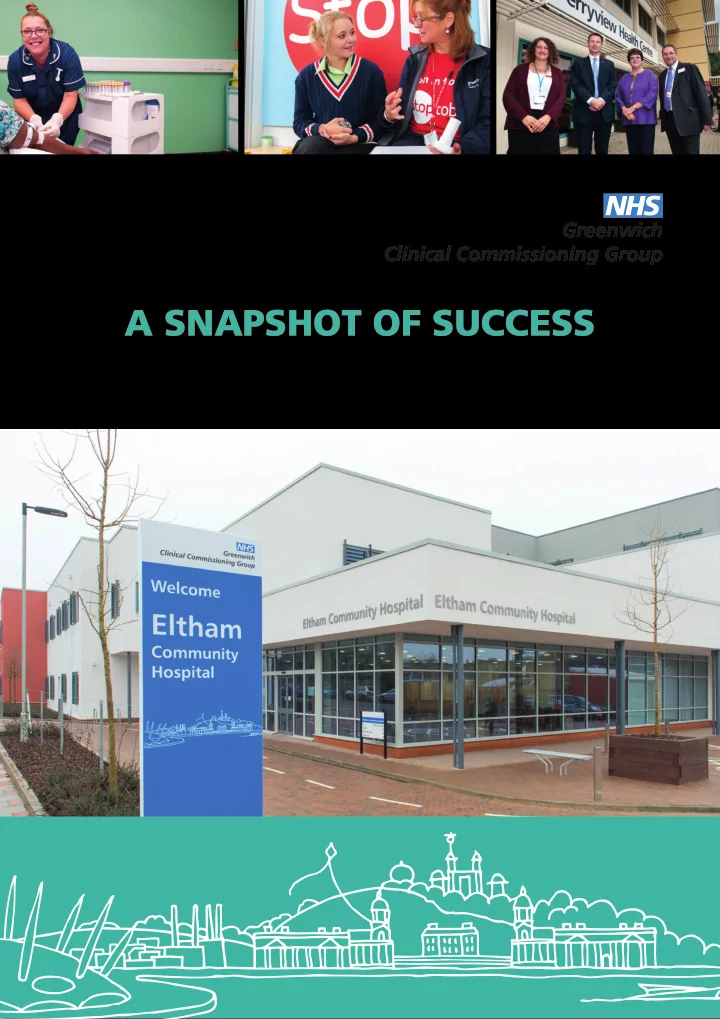
A SNAPSHOT OF SUCCESS
Highlights of 2014/15
A SNAPSHOT OF SUCCESS Highlights of 2014/15 Sun Sat Fri Thu Wed - - PDF document
A SNAPSHOT OF SUCCESS Highlights of 2014/15 Sun Sat Fri Thu Wed Tue Mon Over 96% of We opened 40 40 people with new intermediate suspected care beds cancer were in Eltham receiving their Community fi rst consultant Hospital
Highlights of 2014/15
We opened 40 new intermediate care beds in Eltham Community Hospital providing care for patients closer to home Over 96% of people with suspected cancer were receiving their fi rst consultant appointment within
two weeks
Patients received their cancer diagnosis and commenced their fi rst treatment within
Sun Mon Tue Wed Thu Fri Sat
Improved the diagnosis rate for dementia to
and are now in the process of improving the services provided to support people who have received this diagnosis The Care Home Support Team has been extended into mental health to improve care for frail elderly patients Reduced the emergency caesarean section rate and launched the direct access and
service ‘Call the Midwife’ for pregnant women There were no ‘Never Events’ reported in the last nine months of 2014/15 at Lewisham and Greenwich NHS Trust
NB: Never Events are serious, largely preventable, patient safety incidents that should not occur if the available preventative measures have been implemented.
Welcome to NHS Greenwich Clinical Commissioning Group’s second integrated report. In my first year as Chair I have been delighted to be a part of the team that has opened a brand new community hospital in Eltham. This wonderful modern facility is enabling us to provide excellent care closer to home and is a real asset for local people in Greenwich. You can read all about it on Page 20 and there is a film on our website www.greenwichccg.nhs.uk Working with our partners in the Royal Borough of Greenwich (RBG), we have also seen a reduction in the number of people dying from smoking related
across the borough to help people give up smoking. We have gone from one of the worst boroughs in London for smoking to one of the best, which is really good news for local people. You can read more about the borough’s innovative approach and what this has achieved on page 17. Another partnership success story is the award- winning approach of Greenwich Coordinated Care. This successful integration of health and social care services has been achieved through joint working with RBG, Oxleas NHS Foundation Trust, Lewisham and Greenwich NHS Trust, GPs and the voluntary sector. It has reduced hospital admissions, improved delayed discharges from hospital, and helped more people to stay in their own home, or be cared for in a short-term residential facility in the community when they need a little extra support. The resulting reduction in hospital admissions means that our performance now features in the top 10% of all CCGs nationally. This was a ‘test and learn’ pilot and we are now evaluating the results and seeing what is the best way to take this work forward. As a GP, I am particularly proud of the support we have provided to our GP members this year:
geographically aligned groups, known as ‘syndicates’. These all have an elected GP as a syndicate lead. A ‘pathfinder’ fund enabled the practices in each syndicate to work together and support projects around improving prescribing, introducing more health checks to identify risk factors for people in respect of long term conditions, and to improve and harmonise data coding in practices, so that people with ongoing health needs can be followed up appropriately
included subjects such as customer care, data, IT and care navigation. The CCG is an active participant in the emerging community education provider network (CEPN) which has funds from Health Education England to develop a workforce fit for the future. We are also a member of the Institute for Integrated Care with the University of Greenwich and Oxleas NHS Foundation Trust. These are particularly important as we work to provide more and more services in the community. I am excited about the
many of the building blocks in place this year to ensure we can meet the challenges ahead and continue to provide excellent high quality care for our local community. Dr Ellen Wright Chair
4
NHS Greenwich Clinical Commissioning Group was established on 1 April 2013 as a result of the Health and Social Care Act 2012. It is a membership
community and mental health services for the local population of Greenwich. Its aim is to secure the best possible healthcare services for people in Greenwich, specifi cally in community settings and in hospitals as necessary.
Guy’s and St Thomas’
NHS Foundation Trust
King’s College Hospital
NHS Foundation Trust
Lewisham and Greenwich
NHS Trust
Oxleas
NHS Foundation Trust
We buy services for you from a number of hospitals: and to integrate and improve your services we work with a number of key partners:
King’s Health Partners – one of only fi ve Academic Health Sciences Centres in England, formed of a partnership between King’s College London, Guy’s and St. Thomas’ NHS FT, King’s College Hospital NHS FT and South London and Maudsley NHS FT. NHS England (NHSE) – which commissions specialised hospital services, and most primary care services, including GP services and dentistry. From April 2015 we are moving to new co-commissioning arrangements for GP services with NHSE.
50.4% female & 49.6% male 282,550
Greenwich Residents
In 2010 Greenwich was ranked the 19th most deprived Local Authority in England. In January 2015 around 282,094 people were registered with Greenwich GPs, 95% of which are Greenwich residents. Greenwich has a greater proportion of children and young people under the age of 19 and a higher population of aged 45+ males with fewer age 45+ females than other London and deprivation comparators. The white ethnic group is the largest at 62.5%. Of the BME group Black Africans are the largest at 13.8%. Other white accounts for the next largest at 8.3% attributable to in- migrants from the A8 nations of Eastern Europe.
5
Working with our partners and using a broad range of data from a number of sources, we have looked at the health needs of local people and the challenges they face. The two diagrams show the headlines from the Greenwich Joint Strategic Needs Assessment and the key factors that impact the health of people in Greenwich.
6 High Burden Low Burden Improving Worsening
Life Expectancy (M/F) Preventable Mortality (CVD, COPD) Smoking Prevalence Physical Inactivity Variation in LTC Clinical Outcomes & Undetected Disease Slope index of inequality in LE (Male) Infant Mortality Childhood Immunisation Rates Suicide Rate Obesity (Children & Adults) Preventable Mortality (Cancer, Liver Disease) Excess Mortality in those with Serious Mental Health Excess Winter Deaths Slope index of inequality in LE (female) Population Vaccination Coverage (HPV) Treatment Completion for TB
Population
people under 19
population
national average
Health behaviours
cant alcohol consumption
Disease and disability
Improving health outcomes Reducing health inequalities Simplifying clinical care pathways Encouraging self-management Improving collaboration Connecting services to primary care Right services, right place, right time Judicious use of integration and competition A free: responsive; high quality service; available to all; delivered in partnership; with accountability and; value for money
NHS Greenwich principles NHS principles Heath and wellbeing strategy Local priorities Drivers
Patients have rights Driven by patients Statutory regulations Secure the best health and wellbeing for children and young people including vulnerable children Secure the best health and wellbeing for adults and older people including vulnerable adults Improve the health and wellbeing of the most disadvantaged Increase life expectancy for men in Greenwich Promote the health and wellbeing of new populations in Greenwich Ensure public policy supports good health Make healthy choices easier Invest resources wisely and in partnership (commissioning and joint commissioning) Communicate with the public Develop the full potential of our workforce 1 2 3 4 5 6 7 8 9 10 Risks
Lack of funding Local health economy Changing provider landscape Staying healthy and health promotion A whole system approach for children and young people Improving mental health care Improving long term conditions care Coordinating the provisionThis model shows you what determined our joint health and wellbeing strategy with RBG. Our plans for 2014/15 reflected these priorities and eight clinically led transformation programmes were established to focus on these key areas: Planned Care; Unscheduled Care; Cancer and End of Life; Children and Maternity; Mental Health; Primary Care; Staying Healthy; Long Term Conditions The local joint Health and Wellbeing Strategy has recently been refreshed and going forward will focus on four key priorities:
One new significant workstream will be a focus on carers, which recent research has shown is needed.
7
Our Governing Body agreed our corporate objectives in 2014/15 were to:
services to meet the needs of local people which improve health outcomes and reduce inequalities
voice is heard so that we improve the quality
diverse needs of our population
driven organisation with effective member engagement, that can attract and retain excellent staff, deliver effective governance and its full statutory and financial duties
rich environment to inform commissioning decisions at CCG, Transformation Steering Group, Syndicate and practice level
healthcare and delivering more integrated services for the population of Greenwich delivered by sustainable providers through partnership working with RBG, local providers, the community and voluntary sector.
We are now refreshing our clinical strategy and identifying our new commissioning intentions. We will be involving you in all of this work to ensure you have a say in their development and that they will be meeting local people’s needs. All of our local plans are aligned to the south east London commissioning strategy. All six CCGs in south east London and their co-commissioners from NHS England, London region, NHS providers and the six borough councils have been working on this since October 2013 and this has been known as ‘Our Healthier South East London’ Full details can be seen here http://www.ourhealthiersel.nhs.uk/ We would value your views on the issues set
If you do not have access to the internet, please do let us know and we can send you a paper copy of the issues paper.
8
The CCG has put in place robust systems and processes to ensure it discharges its duties appropriately. The Governing Body is supported by a range of committees, executive groups and those that give assurance, as shown in the diagram below. The Quality Committee supports the Governing Body and works to secure continuous improvement in the quality of services and in outcomes for patients. It looks particularly at clinical effectiveness, patient safety and patient experience. It holds all
progress on improvement action plans. This work takes into account key national reports and findings, such as those in respect of The Francis Report, Berwick and Winterbourne. It is also informed by user feedback, such as findings of patient surveys, the Friends and Family Test, Healthwatch Greenwich and the Patient Reference Group’s shared intelligence, complaints and MP letters and quality alerts submitted by our GP practices. The Quality Committee will also review the findings
Commission (CQC) and Monitor, and make sure any learning from serious incidents is acted on by providers. The Quality and Governance Directorate has achieved a tremendous amount this year across all disciplines and you will see many examples of this throughout this report. They will continue to work hard to ensure Greenwich residents receive high quality, safe services 9
With GPs at the heart of decision making, Greenwich CCG is making better informed clinically led decisions, making sure every penny of public money will be spent in the best way to maximise healthcare for the people of Greenwich. The business model diagram below describes some of the key features of our work. The commissioning cycle is at the centre and consists of three key stages; strategic planning, procuring services and the monitoring and evaluation of these services. The impact of what we do can be evaluated in terms of health outcomes and how effectively we use public resources. 10
£184.973m 54% £40.154m 12% £14.334m 4% £47.789m 14% £29.755m 9% £3.583m / 1% £7.749m / 2% £6.497m / 2% £7.399m / 2%
54% - Acute Services 12% - Primary Care Services
11
54% - Acute Services 12% - Primary Care Services 4% - Continuing Care Services 14% - Mental Health Services 9% - Community Services 2% - Surplus 2% - Other Corporate Costs 2% - Running Costs 1% - Other Programme Services
Although we don’t own any properties we do take into account the NHS Carbon Reduction Strategy for
reduction
In line with the NHS Carbon Reduction Plan the local plans focus on the same areas. A summary of some of the key actions within the Carbon Reduction Plan are detailed below:
Energy and carbon management: Greenwich CCG seeks to reduce its own energy and carbon footprint. Capital developments e.g. Eltham Community Hospital and Heart of East Greenwich Low carbon travel, transport and access: Greenwich CCG has implemented a range of new services,
to the home. In terms of staff and visitor travel, a flat rate is operated for business mileage and also accounts for different modes of transport such as cycling. Procurement and food: Greenwich CCG’s main strategy to influence the carbon footprint of NHS services is use of its procurement framework which addresses environmental issues. All contracts for healthcare services include clauses requiring providers to demonstrate their measured progress on climate change adaptation, mitigation and sustainable development, including performance against carbon reduction management plans. Water: Efficient use of water is embedded in new capital
the Eltham Community Hospital include harvesting of rainwater. Within head office premises, bottled water has been replaced by a system to filter tap water for drinking. Waste: Recyclable waste is appropriately disposed of on its premises and active strategies to reduce waste are explored. Designing the built environment: All new buildings are to be designed to withstand climate change and be low carbon. This is reflected in the Eltham and Heart of East Greenwich
will accord with the latest emerging planning policies that seek to minimise carbon dioxide emissions by a 44% improvement on the 2006 Building Regulations and by at least 20% through:-
to urban greening e.g. green walls and soft landscaping.
12
Providers are also taking forward plans to reduce the carbon impact of existing estate, with a detailed programme of works being implemented by Oxleas NHS Foundation Trust in respect of the community services estate (previously part of the former PCT estate).
remote working capability are in place
with stakeholders under Local Strategic Partnerships, in particular the Royal Borough of Greenwich
setting a target for 10% reduction of 2007 levels by 2015. Greenwich CCG has been taking forward those elements of the plan within its commissioning remit
to achieve the NHS target and take advantage of schemes which support investment in energy efficiency initiatives
still further. The building is modern and fit-for-purpose and we will be reducing travelling time still further for both our partners, RBG, and ourselves by being co-located there. 13
Citizens UK We have worked together to establish networks groups looking at mental health and diabetes. Young people and their families have contributed to the new specification for the Children and Adolescent Mental Health Services (CAMHS). They are working with us and our partners to develop a Young Person’s Mental Health Charter and a new way of engaging digitally with young people. These ideas have come directly from the young people themselves and we are now working with partners and a practice network on diabetes awareness. Greenwich Action for Voluntary Service They work with us on a number of steering groups and are a good link for us with the local voluntary
can ask us questions on behalf of their membership and they share intelligence from their members on issues and concerns. They have played a vital role in the development of Greenwich Coordinated Care. Public meetings Every two months we hold our Governing Body meetings in public. There is a public question and answer session for 45 minutes at the beginning
15 minutes at the end for questions that relate specifically to subjects covered in the meeting. We have also run events to share the emerging issues
people’s feedback. This is ongoing and will ensure local people have a say in the direction this work takes. 14 Healthwatch Greenwich They are the consumer champions for patients and the public and hold us to account. They sit on a number of our committees, such as Quality and Market Management and Procurement to ensure your views are represented. We meet regularly with them to keep them up to date on what we are planning and they challenge us when they think we are not getting things right. We also commission them to do engagement work on our behalf, for example, getting local people’s views on access to
Carers Carers are a key priority. Working with our partners, RBG, we have run ‘Care Together’
advice and practical help in looking after their
social isolation and loneliness. Attended by 18 different local/community organisations it looked at the gaps in service provision in Greenwich. This has led to the development of a charity led Social Isolation Strategy Group. Our diverse communities:
Working together with the Learning Disabilities Partnership Group and Advocacy in Greenwich, the CCG looked at how patients could get help when they don’t understand their medication. The idea of a pharmacy card was
highlighting their need for additional help. This launched at the ‘Big Health Check Up Day’ and has received a very positive response. Over 3000 cards have been printed and more have been requested. With the Stroke Association we held an event with the Nepalese community on ‘Know your Medicines’. The community told us that they also had issues with accessing services. This has been followed up with an ‘Improving Patient Access Pilot’ and investment in practice staff training and the production of a Greenwich Good Access Guide.
Patient Reference Group (PRG) The PRG is made up of representatives from Practice Patient Participation Groups, GAVS, Healthwatch Greenwich, Citizens UK and other voluntary sector groups. They have helped us to develop our engagement strategy and hold us to account for how we involve patients and the public in our decision making.
The Recovery College, hosted by Bridge Mental Health, opened its doors last autumn and we celebrated the offi cial opening on World Mental Health Day on 10 October 2014. The College is based in the centre of Woolwich and currently provides over 400 students with a wide range of free educational courses designed to enhance mental health and wellbeing and aid their recovery from mental ill health. The College supports students in developing skills for recovery and wellbeing and creating shared learning experiences. It is an educational rather than therapeutic approach and the focus is very much on what each student wants to achieve. Accordingly, students are not asked for details
policy allows the college to meet the needs of a diverse range of people with lived experience of mental health, their friends, family, carers and practitioners, as well as others, such as employers and employees with an interest in mental health and wellbeing. Collaboration is a founding ethos of Recovery College Greenwich, and has resulted in a truly co-designed and co-produced educational
ve (80 per cent) of college staff have lived experience of mental health problems and they collaborate as peer trainers, or tutors, with students to deliver courses, leading to improved recovery outcomes. Carolina, a student at the College, said: “The Recovery College has made me realise I have even more potential and given me the confi dence to achieve much more. The tutors are so caring and people with mental health issues need places like this College in order to grow.” Successful partnership working has enabled the College to help students achieve positive
College has delivered workshops on a range of wellbeing topics from assertiveness to self-esteem and regularly signposts students to relevant services in the borough that may aid the student’s recovery. Several students have accessed employment and training opportunities through partnership working and have progressed to work or college training as a result. Greenwich GPs are increasingly signposting patients to courses at the College. In the past year, Recovery College Greenwich has built a solid foundation from which to grow and make an even greater impact on the wellbeing of the people of Greenwich. For more information call 020 8294 7909
Call us:
Volunteer with the college
How do I get involved? 1 Start discovering
Tell us what you want to do next
5
Take your next steps
Move on to something Take another course
6
Choose your course
Come in for a chat & a cup of tea
2
Join in
4
Graduate
3
16
A high priority for Greenwich for many years has been to help people give up smoking. A legacy
workers were given free tobacco, something which in part, contributed to high levels of smoking in the borough. The CCG has worked in partnership with the Royal Borough of Greenwich (RBG) and others to reduce smoking among the population. Smoking prevalence rates have fallen signifi cantly in the last few years among the adult population, from 24.1 in 2010 to 16.6 in 2013. This reduction is far faster than other parts of the country and means Greenwich has gone from having one of the highest to one of the lowest rates of smoking in just a few years. This has been achieved by CCG funding and having a focused approach to tackling tobacco in partnership. Greenwich has long advocated that no single measure of tobacco control, in isolation, will drive down smoking prevalence. The CCG and RBG both remain committed to investing across all of the tobacco control agenda from preventing young people starting smoking in the fi rst place, to strong investment in the regulation of tobacco and supporting smokers to successfully quit. Since the stop smoking services were set up in 2000, the number of smokers supported to quit has grown year on year - more than 1,900 were helped in Greenwich in the year 2013-2014. Figures for 2014/15 are still pending. The appeal of football has also proved successful in drawing people into stop smoking services through a highly innovative and public engaging
by Charlton Athletic Community Trust (CACT). The programme targets hard to reach smokers who may not normally be in contact with health
1-1 support and groups, which are run at The Valley, Charlton’s home ground. The social marketing high profi le campaigns, such as ‘Stoptober’, which drive smokers into services, have been delivered so successfully locally that CACT and the stop smoking team made contact with 27,000 people, just in a 9 week period in 2013. There is still much work to do to encourage people to give up, but the CCG and its partners have demonstrated that breaking down barriers and silos in the NHS can transform everyone’s futures and life chances.
17
Greenwich Coordinated Care is one of 14 schemes named as ‘pioneers’ by the Government in the development of integrated health and social care, helping to share best practice among health and social care colleagues nationally. It is a partnership with RBG, Oxleas NHS Foundation Trust, Lewisham and Greenwich NHS Trust, GPs and the voluntary
within the care and health sectors, from Government ministers and from healthcare experts. This has included winning Gold in the Transformation in Health and Social Care category at the Improvement and Effi ciency Awards 2014 hosted by the Improvement and Effi ciency Social Enterprise (iESE), which promotes innovation and effi ciency in the public sector, and the top award for innovation in social care at the Municipal Journal Achievement Awards 2014. The success of this new way of working has prompted many offi cial visits both from within the UK and across the world.This has included visits from the Secretary of State for Health, The Rt Hon Jeremy Hunt MP, Rt Hon Oliver Letwin MP, Minister for Government Policy and Chancellor of the Duchy of Lancaster, Rt Hon Eric Pickles MP, Secretary of State for Communities and Local Government and the Rt Hon Norman Lamb MP, Minister for Care Services. They were very impressed by the work of the team and the difference it is making to local people with complex long term conditions. (Please note some ministerial portfolios have changed since these visits.) Experience from Greenwich since 2011 suggests that this integrated approach helps the elderly population maintain their independence longer, with fewer people requiring services after the completion of their pathway, fewer delayed discharges and reduced length of stay in intermediate care, as well as preventing A&E attendances and emergency admissions. Our new approach aims to give people time and support to regain their independence wherever possible. This work started in Eltham as a ‘test and learn’ pilot and has been rolled out more widely to Thamesmead and Woolwich. We are now reviewing the fi ndings from these pilots and will use the fi ndings to determine the best way to take this work forward in the future.
18
The Care Co-ordinators
The GreenFInCHES project is run by the CCG’s Care Homes Support Team. Thanks to the hard work of the team, the number of residents in Greenwich care homes who experience a fall has dropped dramatically - in one care home, the number of residents experiencing falls dropped by more than half over the course of a year, from 38 falls in 2013/14 to 17 falls in 2014/15. A training programme was developed by the team for care home staff to look at different ways of helping a resident avoid a fall. This meant asking care home staff to:
home and to conduct a risk assessment
improve a resident’s balance
check
medical problems, such as low blood pressure, blood glucose and Urinary Tract Infections or in respect of their medication. To raise awareness of a resident’s susceptibility to falling for staff and friends and family, a picture of a Greenfi nch is put on the door of the resident’s room. This project has led to a 57% reduction in the number of falls in the four care homes the team has worked with. Along with training for care home staff, the team now plan to offer a pilot 10-week bespoke falls- reduction exercise programme. The exercises, led by a physiotherapist, are aimed at helping residents strengthen muscles and improve balance to reduce their risk of falls.
19
Our greatest achievement in early 2015 was the
It is a purpose-built NHS hospital bringing together primary, secondary, community and social care under one roof. The hospital enables the delivery of high quality, integrated clinical and community services that meet the needs of people across the borough of Greenwich. The fi rst patients were welcomed to the two intermediate care wards at the new community hospital in March, marking the arrival of the fi rst
services that are now being provided from this new state-of-the-art facility. Located in Passey Place, Eltham, London SE9 5DQ. This modern two storey building is now home to a wide range of services:
Eltham Medical Practice
We are very proud of this wonderful new development and local people are already telling us the difference it is making. Formoredetailsonthefacilitiesthen pleasegoto: http://www.greenwichccg.nhs.uk/Local- Services/Pages/Eltham.aspx
20
Above: The Grand Opening of Eltham Community Hospital. Left to Right: Cllr Denise Hyland, Leader, RBG Dr Nayan Patel, GP Clinical Commissioner, CCG Mrs Dinah Fergusson Cllr David Gardner, Cabinet Member for Health and Adult Social Care, RBG Mr Clive Efford, MP for Eltham Annabel Burn, Chief Offi cer, CCG Nicola Theron, Community Health Parnerships Local Area Director Mr Clive Efford, MP for Eltham, offi cially opens the new community hospital with Nicola Theron, Community Health Parnerships Local Area Director
51% of the Greenwich population is at risk of future illness as a result of smoking, obesity or lack of exercise and 33% have one or more long term conditions. We will continue to work with our partners to tackle the social conditions that predispose people to ill health. Our GP practices have an important role to play in supporting local people to stay healthy, to recover quickly from acute illness and to live well with long term conditions. We will continue to work with them to develop and provide more of this care and support for their patients in their own communities. This report is just a snapshot of what the CCG has achieved over the last year and what we will be building on for the future. You can see much more detail in the full annual report for 2014/15 on our website. You can also review our commissioning intentions for 2016/17 and our developing Clinical Strategy here http://www.greenwichccg.nhs.uk/About-Us/Governing-body/Pages/Governing-Body-Meetings.aspx We would value your views, so do get in touch. If you do not have access to the internet and would like a paper copy then do please call us on 020 3049 9000. 1% EoL 3+ LTC (8%) Early Stages of LTC (24%)
People experiencing inequalities or putting their health at risk (51%) Health & Wellbeing Group (16%) 2,534 registered patients 19,972 registered patients 60,094 registered patients 131,339 registered patients 39,418 registered patients
‘Christmas Tree’ model for Greenwich CCG
21
All key recommendations contained within the Winterbourne View report have been completed, even for those people in the most difficult of circumstances
Reduced the rate of avoidable pressure ulcers, with a significant reduction in Grade 3 pressure ulcers of 29% in the last six months of the year and there have been no avoidable Grade 4 pressure ulcers since November 2013
Lewisham and Greenwich NHS Trust had completed
plans and was on target to complete the rest within the set timeframe In 2014/15 we met all of our statutory financial duties, and delivered our agreed surplus There have been no community acquired cases and only two hospital acquired cases of MRSA this year
There were
below the target of no more than 63 cases set by NHS England, and work continues to reduce this still further
33 new community- based clinics for blood testing and anti-coagulation services opened this year, giving patients shorter waiting and travelling times for their tests
29%
Maintained patients’ privacy and dignity with no mixed sex accommodation breaches at Queen Elizabeth Hospital
63 59
Engagement with our member GPs is vital and ensures our members’ clinical expertise is informing our decisions. Seven elected GP commissioners are on the Governing Body and the 41 practices are divided into four geographical syndicates/networks. Each of these has an elected lead GP . They meet regularly with the GP Governing Body members and the senior management team to ensure continued two-way communication.
23
eduction e
NHS Greenwich Clinical Commissioning Group
31-37 Greenwich Park Street Greenwich London SE10 9LR
For more information on how you can get involved visit our website www.greenwichccg.nhs.uk
You can also email us at: greccg.nhsgreenwichccg@nhs.net @NHSGreenwichCCG If you would like a copy of this document in another language
020 3049 9000 or email: greccg.nhsgreenwichccg@nhs.net Date published: September 2015
On 2 November 2015 we are moving to: The Woolwich Centre Wellington Street Woolwich, SE18 6ND