A Simple Example 35/123 Pustejovsky - Brandeis Computational Event - - PowerPoint PPT Presentation

a simple example
SMART_READER_LITE
LIVE PREVIEW

A Simple Example 35/123 Pustejovsky - Brandeis Computational Event - - PowerPoint PPT Presentation

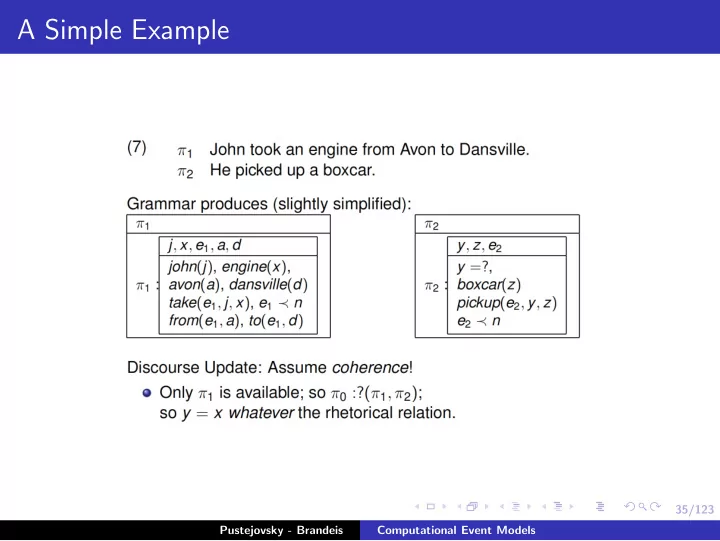
A Simple Example 35/123 Pustejovsky - Brandeis Computational Event Models The Final SDRS 36/123 Pustejovsky - Brandeis Computational Event Models Some Lexical Semantics 37/123 Pustejovsky - Brandeis Computational Event Models An Example


slide-1
SLIDE 1

35/123

A Simple Example

Pustejovsky - Brandeis Computational Event Models
slide-2
SLIDE 2

36/123

The Final SDRS

Pustejovsky - Brandeis Computational Event Models

slide-3
SLIDE 3

37/123

Some Lexical Semantics

Pustejovsky - Brandeis Computational Event Models

slide-4
SLIDE 4

38/123

An Example of Narrative

Pustejovsky - Brandeis Computational Event Models

slide-5
SLIDE 5

39/123

Minimal SDRS

Pustejovsky - Brandeis Computational Event Models

slide-6
SLIDE 6

40/123

TimeML: Temporal Ordering of Events

Verhagen (2005), Pustejovsky (2017)

how a temporal closure component can be embedded in a temporal annotation environment. Temporal closure takes known temporal relations in a text and derives new implied relations from them, in effect making explicit what was implicit. A temporal closure component helps to create an annotation that is complete and consistent.

Pustejovsky - Brandeis Computational Event Models

slide-7
SLIDE 7

41/123

Temporal Ordering of Events

Pustejovsky - Brandeis Computational Event Models

slide-8
SLIDE 8

42/123

Temporal Ordering of Events

Pustejovsky - Brandeis Computational Event Models

slide-9
SLIDE 9

43/123

Temporal Ordering of Events

Pustejovsky - Brandeis Computational Event Models

slide-10
SLIDE 10

44/123

Temporal Ordering of Events

Pustejovsky - Brandeis Computational Event Models

slide-11
SLIDE 11

45/123

Temporal Ordering of Events

Pustejovsky - Brandeis Computational Event Models

slide-12
SLIDE 12

46/123

Temporal Ordering of Events

Pustejovsky - Brandeis Computational Event Models

slide-13
SLIDE 13

47/123

Temporal Ordering of Events

Pustejovsky - Brandeis Computational Event Models

slide-14
SLIDE 14

48/123

Computing Event Ordering

Events in isolation with their subevent structure (individual dynamic event graphs) Ordering over multiple events in text or discourse

Pustejovsky - Brandeis Computational Event Models

slide-15
SLIDE 15

49/123

Same Information as a Labeled Transition System Graph

Pustejovsky - Brandeis Computational Event Models

slide-16
SLIDE 16

50/123

Making Relation Annotation More Informative

Narrative Container is the default interval containing the events being discussed in the text, when no explicit temporal anchor is given. (1) Put events in temporal containers. (2) Order events relative to temporal anchors. (3) Some temporal containers may be implicit. (4) Temporal containers may be style or genre specific.

Pustejovsky - Brandeis Computational Event Models

slide-17
SLIDE 17

51/123

Document Creation Time 1/2

10-26-1989 1 Philip Morris Co., New York, adopted a defense measure designed to make a hostile takeover prohibitively expensive. 2 The giant foods, tobacco and brewing com- pany said it will issue common-share purchase rights to shareholders of record Nov. 8.

Pustejovsky - Brandeis Computational Event Models

slide-18
SLIDE 18

52/123

Document Creation Time 1/2

4-10-2011 Local officials reported yesterday that a car exploded in down- town Basra.

Pustejovsky - Brandeis Computational Event Models

slide-19
SLIDE 19

53/123

TimeBank Annotation Style

DCT= t1, val=10-04-2011 t2 = yesterday, val=09-04-2011 e1 = report e2 = explode TLINK1 = before(e1,t1) TLINK2 = before(e2,t1) TLINK3 = includes(t2,e1)

Pustejovsky - Brandeis Computational Event Models

slide-20
SLIDE 20

54/123

The Missing Temporal Relation

TLINK4 = includes(t2,e2) e2 = explode t2 = yesterday, val=09-04-2011

Pustejovsky - Brandeis Computational Event Models

slide-21
SLIDE 21

55/123

Document Creation Time 2/2

9-02-1989 An Orlon spokesman said that the Board rejected Margo’s lat- est takeover bid.

Pustejovsky - Brandeis Computational Event Models

slide-22
SLIDE 22

56/123

TimeBank Annotation Style

DCT= t1, val=09-02-1989 e1 = say e2 = reject TLINK1 = before(e1,t1) TLINK2 = before(e2,t1) TLINK3 = before(e2,e1)

Pustejovsky - Brandeis Computational Event Models

slide-23
SLIDE 23

57/123

Missing Temporal Relations

Reference to a Default Narrative Container (DNC) t2 = DNC, val=09-02-1989 TLINK4 = includes(t2,e1) TLINK5 = includes(t2,e2) e1 = say e2 = reject

Pustejovsky - Brandeis Computational Event Models

slide-24
SLIDE 24

58/123

Narrative Container

Narrative Container is the default interval containing the events being discussed in the text, when no explicit temporal anchor is given. Narrative Time is the current temporal anchor for events in a document, and can change as the reader moves through the narrative. Narrative Scope describes the timespan described in the document, with the left marker defined by the earliest event mentioned, and the right by the event furthest in the future.

Pustejovsky - Brandeis Computational Event Models

slide-25
SLIDE 25

59/123

Narrative Container 2/3

April 25, 2010 7:04 p.m. EDT -t0 S1: President Obama paid-e1 tribute Sunday -t1 to 29 work- ers killed-e2 in an explosion -e3 at a West Virginia coal mine earlier this month- t2, saying-e4 they died-e5 “in pursuit of the American dream.” S2: The blast-e6 at the Upper Big Branch Mine was the worst U.S. mine disaster in nearly 40 years.

Pustejovsky - Brandeis Computational Event Models

slide-26
SLIDE 26

60/123

Narrative Container 3/3

t2 "earlier this month" t1 "Sunday" e3 explosion e5 "died" e1 "paid" e2 "killed" e4 "saying" t0 DCT e6 "blast" t0 DCT t1 "Sunday" e2 "killed" t2 earlier this month e5 "died" e6 "blast" e1 "paid" e4 "saying" e3 explosion

A B

Figure: A: Times and events as appearing in the text; B: events grouped into their appropriate Narrative Times.

Pustejovsky - Brandeis Computational Event Models