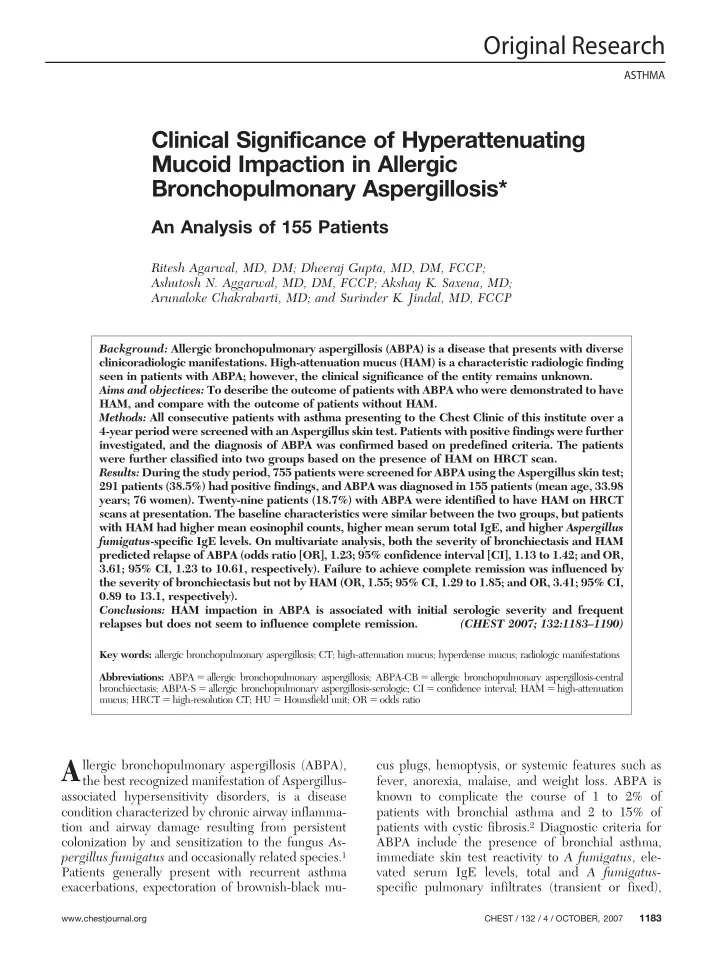

Clinical Significance of Hyperattenuating Mucoid Impaction in Allergic Bronchopulmonary Aspergillosis*
An Analysis of 155 Patients
Ritesh Agarwal, MD, DM; Dheeraj Gupta, MD, DM, FCCP; Ashutosh N. Aggarwal, MD, DM, FCCP; Akshay K. Saxena, MD; Arunaloke Chakrabarti, MD; and Surinder K. Jindal, MD, FCCP
Background: Allergic bronchopulmonary aspergillosis (ABPA) is a disease that presents with diverse clinicoradiologic manifestations. High-attenuation mucus (HAM) is a characteristic radiologic finding seen in patients with ABPA; however, the clinical significance of the entity remains unknown. Aims and objectives: To describe the outcome of patients with ABPA who were demonstrated to have HAM, and compare with the outcome of patients without HAM. Methods: All consecutive patients with asthma presenting to the Chest Clinic of this institute over a 4-year period were screened with an Aspergillus skin test. Patients with positive findings were further investigated, and the diagnosis of ABPA was confirmed based on predefined criteria. The patients were further classified into two groups based on the presence of HAM on HRCT scan. Results: During the study period, 755 patients were screened for ABPA using the Aspergillus skin test; 291 patients (38.5%) had positive findings, and ABPA was diagnosed in 155 patients (mean age, 33.98 years; 76 women). Twenty-nine patients (18.7%) with ABPA were identified to have HAM on HRCT scans at presentation. The baseline characteristics were similar between the two groups, but patients with HAM had higher mean eosinophil counts, higher mean serum total IgE, and higher Aspergillus fumigatus-specific IgE levels. On multivariate analysis, both the severity of bronchiectasis and HAM predicted relapse of ABPA (odds ratio [OR], 1.23; 95% confidence interval [CI], 1.13 to 1.42; and OR, 3.61; 95% CI, 1.23 to 10.61, respectively). Failure to achieve complete remission was influenced by the severity of bronchiectasis but not by HAM (OR, 1.55; 95% CI, 1.29 to 1.85; and OR, 3.41; 95% CI, 0.89 to 13.1, respectively). Conclusions: HAM impaction in ABPA is associated with initial serologic severity and frequent relapses but does not seem to influence complete remission. (CHEST 2007; 132:1183–1190)
Key words: allergic bronchopulmonary aspergillosis; CT; high-attenuation mucus; hyperdense mucus; radiologic manifestations Abbreviations: ABPA allergic bronchopulmonary aspergillosis; ABPA-CB allergic bronchopulmonary aspergillosis-central bronchiectasis; ABPA-S allergic bronchopulmonary aspergillosis-serologic; CI confidence interval; HAM high-attenuation mucus; HRCT high-resolution CT; HU Hounsfield unit; OR odds ratio
A
llergic bronchopulmonary aspergillosis (ABPA), the best recognized manifestation of Aspergillus- associated hypersensitivity disorders, is a disease condition characterized by chronic airway inflamma- tion and airway damage resulting from persistent colonization by and sensitization to the fungus As- pergillus fumigatus and occasionally related species.1 Patients generally present with recurrent asthma exacerbations, expectoration of brownish-black mu- cus plugs, hemoptysis, or systemic features such as fever, anorexia, malaise, and weight loss. ABPA is known to complicate the course of 1 to 2% of patients with bronchial asthma and 2 to 15% of patients with cystic fibrosis.2 Diagnostic criteria for ABPA include the presence of bronchial asthma, immediate skin test reactivity to A fumigatus, ele- vated serum IgE levels, total and A fumigatus- specific pulmonary infiltrates (transient or fixed),
Original Research
ASTHMA
www.chestjournal.org CHEST / 132 / 4 / OCTOBER, 2007
1183