General dynamic equation (GDE) For particles with volumes v v+dv the - - PDF document

general dynamic equation gde
SMART_READER_LITE
LIVE PREVIEW

General dynamic equation (GDE) For particles with volumes v v+dv the - - PDF document

General dynamic equation (GDE) For particles with volumes v v+dv the number concentration at time t is n(v,t)dv Lets look at a spatially homogeneous volume of air dn ( v , t ) dn ( v , t ) dn (


slide-1
SLIDE 1

General dynamic equation (GDE)

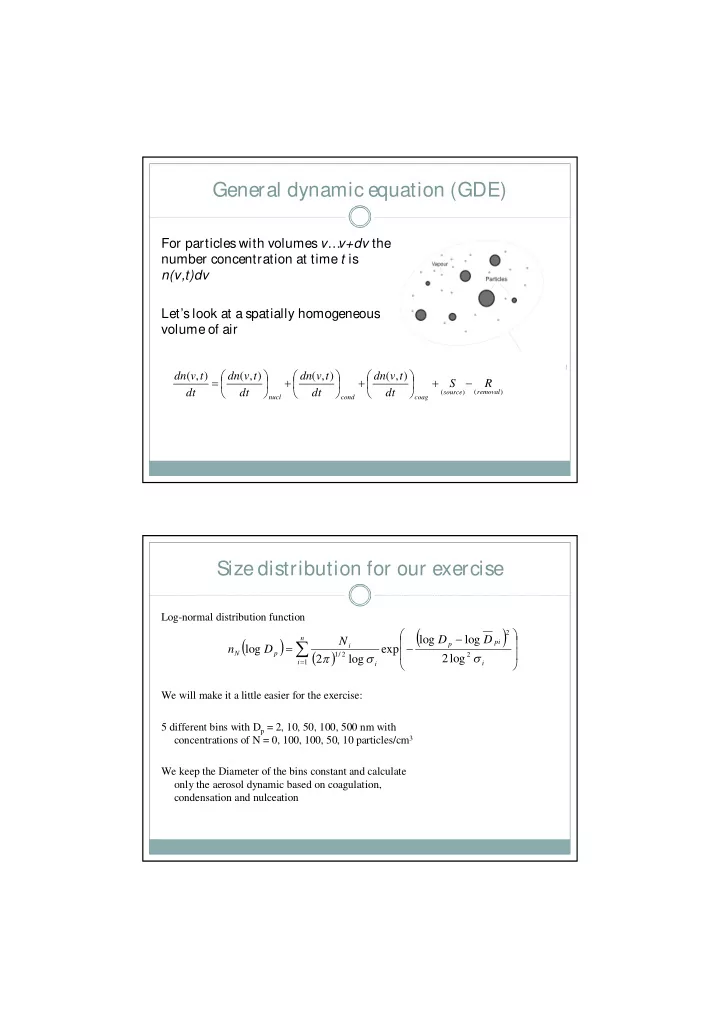
For particles with volumes v… v+dv the number concentration at time t is n(v,t)dv Let’s look at a spatially homogeneous volume of air

) ( ) (

) , ( ) , ( ) , ( ) , (

removal source coag cond nucl

R S dt t v dn dt t v dn dt t v dn dt t v dn

  • Size distribution for our exercise

Log-normal distribution function We will make it a little easier for the exercise: 5 different bins with Dp = 2, 10, 50, 100, 500 nm with concentrations of N = 0, 100, 100, 50, 10 particles/cm3 We keep the Diameter of the bins constant and calculate

  • nly the aerosol dynamic based on coagulation,

condensation and nulceation

  • n

i i pi p i i p N

D D N D n

1 2 2 2 / 1

log 2 log log exp log 2 log

slide-2
SLIDE 2

Consider particles in volume range v… v+dv Coagulation

slide-3
SLIDE 3

Coagulation Coagulation

slide-4
SLIDE 4

Coagulation Coagulation in GDE

du u v n u n u v u dt dn

v coag

) ( ) ( ) , ( 2 1

  • du

v n u n v u ) ( ) ( ) , (

  • Particles of volumev are produced by collision of two particles

whose combined volume is v (we denote them u and v-u). Particles of volumev are lost by collision with all sized particles.

slide-5
SLIDE 5

Coagulation coefficient Coagulation coefficient

where

k = 1,381 x 10-23 J K-1 (Boltzmann constant)

slide-6
SLIDE 6

Condensation Condensation

slide-7
SLIDE 7

Condensation Condensation

slide-8
SLIDE 8

Condensation in GDE

Particles of volumev can form when smaller particles grow or larger particles shrink to sizev. Particles of volumev are lost when condensation grows them to larger sizes or evaporation shrinks them to smaller sizes. Let us denote Then

) (v q dt dv

  • )

, ( ) , ( ) , ( t v n t v q v t t v n

cond

  • Condensation flux

Condensation flux of gas phase compound i onto a particle with diameter dp

)) ( )( , ( 2

, p i eq i i p i i p

d c c d v D d dt dv

  • As

and

2 p

d dt dv

p

d dt dv

for small particles for large particles

  • 8

3 lim

p d

d

p

  • 1

lim

  • p

d

slide-9
SLIDE 9

Kelvin effect

)) ( )( , ( 2

, p i eq i p i i p

d c c d v D d dt dv

  • p

R RT M Ke

  • 2

exp

Exercise

Particle diameter growth rates by our organic vapour and sulphric acid: Org_cond = 0.1 * -pinene * (OH, O3, NO3) Particle diameter growth rates by condensation of our organic vapour dDp/dt = 4 * mi * bi * Di * C / Dp / ri C is the concentration of our condensing gas in molecules/cm3 mi are the molecular mass (Org_cond = 136 g/mol, H2SO4 = 98 g/mol) bi is a correction factor for the mass flux: 10-13 Di are the diffusion coefficients: 0.2 cm2/s ri are the liquid density: 1 g/cm3 After each time step we calculate the growth in comparison with our fixes size bins and assume that this growth fraction of the particles per second in % (multiplied by 100) are moved to the next size

  • bin. If everything is correct in your calculation with gas concentrations of the condensing species

in the range up to the power of 6-8 you should move 10 to 50 percent of the particles in one hour to the next bin for the smallest size.

slide-10
SLIDE 10

Nucleation in GDE

Nucleation forms new particles (typically) at only one size v* and at formation rate J(v,t). In our case we will use the nucleation rate proportional to sulphuric acid with J = A * [H2SO4] with A = 10-8 per second We include this particle in the lowest size bin and assume that all of them will grow to bigger sizes

Aerosol removal

1) dry deposition 2) nucleation scavenging (~ in-cloud scavenging) 3) impaction scavenging (~ below-cloud scavenging)

wet deposition

slide-11
SLIDE 11

Dry deposition

Close to the surface deposition flux F = -vdC Deposition velocity vd is most strongly affected by particle size and the roughness of the surface

forest crop water

Dry deposition velocity

where r a = aerodynamic resistance (determined by turbulence) r b= quasi-laminar layer resistance (determined by particle properties and surface characteristics) r c= canopy resistance (chemical reactions, perturbation

  • f quasi-laminar layer)

vs = particle settling velocity (determined by size) Resistance equations complex, several "simplified" parameterisations for large scale models available

s c b a d

v r r r v

  • 1
slide-12
SLIDE 12

CLOUD WATER

Chemical reactions

RAIN, S NOW

Chemical reactions

GAS EOUS AIR POLLUTION PARTICULATE AIR POLLUTION WET DEPOS ITION

Dissolution Collection by rain drops Collection by rain drops Formation of cloud droplets; collisions Chemical reactions

Wet deposition

Nucleation scavenging removes in practice all activated particles larger than a certain cut-off size. Large scale models typically use a cut-off ~100-300 nm dry size in grid boxes where precipitation is formed.

In-cloud scavenging

slide-13
SLIDE 13

Scavenging minimum at accumulation mode –smaller particles collected due to Brownian motion – larger particles collected due to their inertia Scavenging rate where collision efficiency is

Below-cloud scavenging

drop p drop drop t drop p

N d D E D U D d ) , ( ) ( 4 ) (

2

  • 2

/ 3 * * 3

3 / 2 ) Re 2 1 ( 1 4 Re 16 . Re 4 . 1 Re 4

  • S

St S St Sc Sc Sc E

  • Summary

– Time evolution of atmospheric aerosol particles described with general dynamic equation (GDE) – Although mathematical formulations possible to find for all processes, it is usually impossible to solve all processes simultaneously time splitting – Factors limiting accurate solution – incomplete information available (esp. emissions) – subgrid scale processes (clouds, emissions,… ) – impossible to describe continuous size distribution in a model (see next lecture!)