A Novel Chemical Pathway for Ti Production Z. Zak Fang PI: Low - - PowerPoint PPT Presentation

a novel chemical pathway for
SMART_READER_LITE
LIVE PREVIEW

A Novel Chemical Pathway for Ti Production Z. Zak Fang PI: Low - - PowerPoint PPT Presentation

A Novel Chemical Pathway for Ti Production Z. Zak Fang PI: Low cost Ti Ti-slag, Syn. powder rutile, Lead Institution: University of Utah Utah-HAMR Boeing and Alcoa Ti Partners: Process Spherical Ti alloy powder Alkaline roasting


slide-1
SLIDE 1

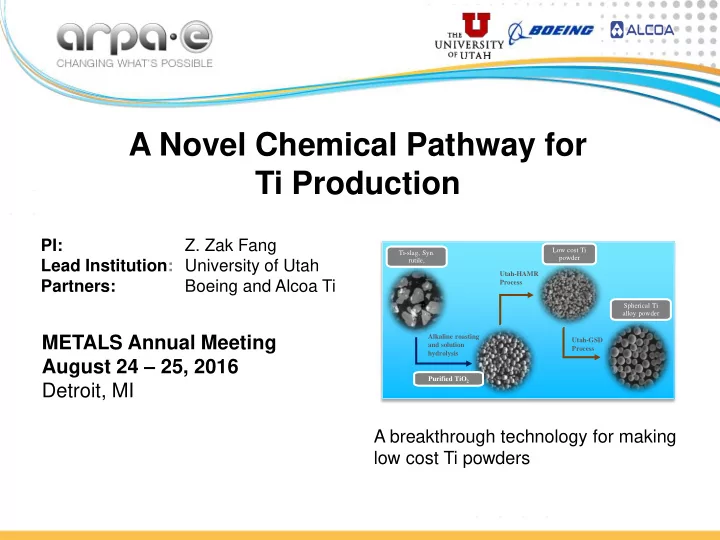
METALS Annual Meeting August 24 – 25, 2016 Detroit, MI

PI:

  • Z. Zak Fang

Lead Institution: University of Utah Partners: Boeing and Alcoa Ti

A Novel Chemical Pathway for Ti Production

Ti-slag, Syn. rutile, Low cost Ti powder Purified TiO2 Utah-HAMR Process Alkaline roasting and solution hydrolysis Spherical Ti alloy powder Utah-GSD Process

A breakthrough technology for making low cost Ti powders

slide-2
SLIDE 2

Agenda

  • Team Intro
  • Technical Concept
  • Technical Progress to date
  • TEA Highlights
  • Demo Requirements
  • Future Goals/Closing Thoughts
  • Q&A

1

slide-3
SLIDE 3

Utah Low Cost Ti

2

University of Utah

  • Dr. Ali Yousefiani,

Technical Fellow, Boeing Research & Technology

  • Dr. Don Li,

Senior Manager, R&D, Alcoa Ti The flagship research University in the state of Utah.

Project Summary

 Ti sponge (primary metal) is expensive (~$10/Kg Ti sponge). Ti powder is more expensive ($30-80/Kg CP-Ti powder). Spherical Ti alloy powder for 3D printing is extremely expensive ($200-500/Kg).  A new chemical pathway was found and demonstrated in a lab scale that can produce normal non-spherical Ti powder at 1/3 or less of its current cost. The process is termed hydrogen assisted magnesiothermic reduction of TiO2 (HAMR)  A novel process (GSD) is also developed to make spherical Ti alloy powder for additive manufacturing at a fraction of the cost of the current technologies.  Both HAMR and GSD processes are now at TRL

  • 4. They are ready for scale up.
  • Produce 10Kg of powder for industrial partners to

assess the product quality and market potentials

  • Develop a continuation plan to secure funding for

pilot production research

Current goals

slide-4
SLIDE 4

Current Processes for Production of Titanium

Ti-slag, Syn. rutile, UGS, …

Ti powder Ti - sponge Purified TiO2 Other R&D processes Armstrong process / ITP Electrochemical FFC process / Metalysis Kroll HDH Other R&D processes

TiCl4

slide-5
SLIDE 5

Utah Processes from UGS to TiO2 and from TiO2 to Ti

Ti-slag, Syn. rutile, UGS, …

Ti powder Purified TiO2

Mg reduction & deoxygen

Solution hydrolysis

Alkaline roasting

Hydrogen assisted Mg reduction of TiO2 (HAMR)

slide-6
SLIDE 6

Challenges – Solutions

Ref.: Ying Zhang, Z. Zak Fang, et al. Thermodynamic Destabilization of Ti-O Solid Solution by H2 and Deoxygenation of Ti Using Mg, JACS, 2016, 138: 6916-6919.

 TiO2 is extremely stable  H2 cannot reduce TiO2  Mg cannot reduce TiO2 to lower than 2wt%O

600 800 1000 1200 1400

  • 260
  • 240
  • 220
  • 200
  • 180
  • 160

TiO2 MgO

Oxygen potential, kcal./mole O2 Temperature, C

2 0.05 0.1 0.5 1 1.5 0.3 0.03 0.2 0.01 0.02

TiO CaO Oxygen wt% in Ti-O solutions

 Scientific discovery: Hydrogen destabilizes Ti-O, making the reaction of Mg with Ti-O from being thermodynamically unfavorable to being favorable.  Mg reduction in H2 atmosphere  Reduction in molten salt – kinetics  Two step process: reduction and deoxygenation

Challenges Science Technology

Mg Reduction Heat Treatment De-oxygenation Densified TiH2 Ti or Ti hydride Powder Purified TiO2 Porous TiH2

Hydrogen assisted magnesiothermic reduction (HAMR)
slide-7
SLIDE 7

Impurity contents in final Ti powder

The ASTM standard for general purpose Ti sponge is met!

The HAMR Process and Product

Weight percent (%) Mg Al Fe Si Cl O N C H Final Ti powder <0.1 <0.03 <0.10 <0.04 <0.1 <0.12 <0.02 <0.03 <0.03 ASTM-B299-13 (GP Ti sponge) 0.5 0.05 0.15 0.04 0.2 0.15 0.02 0.03 0.03

Purified TiO2 As-reduced TiH2 Deoxygenated Ti

slide-8
SLIDE 8

TEA Highlights

Estimated energy consumption and CO2 emission of HAMR process compared with Kroll process

10 20 30 40 50 60 70 80 10 20 30 40 50 60 70 80 kWh/Kg-Ti kWh/Kg-Ti kg-CO2/Kg-Ti kg-CO2/Kg-Ti Kroll Energy HAMR Energy . Kroll CO2 HAMR CO2

Emissions (kg-CO2/kg-Ti) Energy (kWh/kg-Ti)

Kroll vs HAMR Energy and CO2 Emissions

Mg Electrolysis Spray-dry MgCl2 Mg Distillation Mg Reduction Process Chlorination Synthetic Rutile / TiO2 pigment .

slide-9
SLIDE 9

Spherical Ti64 powder for 3D Printing

 Ti is a popular metal for 3D printing.  Spherical Ti powder needed for 3D printing is prohibitively expensive ($250-500/Kg)  Current plasma atomization processes suffer from low yield and expensive feed stock material for atomization

 GSD process is inherently high yield. Particle size distribution can be customized.  GSD process uses low cost feed stock (e.g. scrap metal).  Low oxygen – owing to a breakthrough deoxygenation technology developed as a part of this program.

Current processes and challenges

The new Utah GSD (granulation-sintering-deoxygenation process)

Using GSD process, cost of powder is estimated at $20-50/Kg depending on feed stock material, as opposed to $250-500/Kg.

slide-10
SLIDE 10

TEA Highlights

CP-Ti powder market

3D printing Powder Ti billets

Market Needs

slide-11
SLIDE 11

TEA Highlights

Product Current market price (approx.) Projected price based on the new technology HAMR CP-Ti GSD Spherical Ti

Ti sponge (Kroll process) $8-12 /Kg N/A N/A Ti powder $30-60/Kg (HDH CP-Ti powder) $7-15/Kg (depend on scale) N/A Ti billet (preform for mill products) $30-40/Kg (sponge-ingot-billet) $15-25/Kg (powder-compaction- sintering) N/A Spherical Ti powder $250-500/Kg N/A $50-150/Kg (depending on scale)

Projected prices based on new technology vs. current market prices based on Kroll process

slide-12
SLIDE 12

Demo Requirements

 Start-up company to focus

  • n pilot scale and

commercialization  Short term to start with GSD spherical Ti alloy powder for additive manufacturing  Long term goal to commercialize HAMR CP- Ti powder for current powder markets and eventually Ti billet market

Commercialization strategy -

 Current at TRL 4. Aiming to reach TRL 7 through a development pilot scale project.  Pilot scale plant aims to produce powder at 10Kg/day.  Develop sufficient quantity of materials to be qualified by customers and the industry  Demonstrate the engineering feasibility of the process and be ready for large scale production

Pilot scale development

slide-13
SLIDE 13

Future Goals / Closing Thoughts

 Two novel processes are developed for making 

Conventional Ti powder for a wide range of applications  Spherical Ti alloy powder for additive manufacturing

 The new processes reduce costs of production by greater than 50%  Current at TRL 4. Aiming to reach TRL 7 through a pilot scale development project.  Seeking funding for scale up development project  A start-up will be the vehicle of commercialization, in collaboration with the U of Utah.  Focus on commercializing spherical Ti powder for AM/3D printing in the plus-up project phase  In long term, commercialize HAMR pure Ti powder for Ti billet markets

slide-14
SLIDE 14

QUESTIONS?

13

slide-15
SLIDE 15

TEA Highlights

Principle Feed material Reducing agent Product quality Morphology Challenge Status Kroll Thermal chemical 2Mg+TiCl4=2MgCl2+Ti TiCl4 Mg Low to extremely low impurity Sponge and sponge fine Distillation is energy- intensive Commercial FFC Electrochemical TiO2+4e-=Ti+2O2- TiO2 e- O: 0.29%* C: 0.07% Ca: 0.13% Partially sintered porous powder Scaling-up** Pilot plant HAMR Thermal chemical Mg+TiO2+H2=Ti-H-O +MgO Ti-H-O+Mg+H2=Ti-H +MgO TiO2 Mg O:<0.12% C: <0.02% Mg: <0.10% Discrete HDH-like powder Consistency needs to be demonstrated. Kg scale lab-tested

Comparison of the Utah-HAMR process to Kroll and FFC Processes

* According to limited information in public literature. Company internal reality could be different.

slide-16
SLIDE 16

Demo Requirements

  • What does the demo phase of this project look like?

– Scale – Cost Range – Projected Outcomes

  • What partnership needs, if any, does your research require?

– Note: this can be omitted if you don’t feel comfortable telling the group exactly where you are at the moment.

slide-17
SLIDE 17

Future Goals / Closing Thoughts

  • What is the ultimate end goal for this project?
  • Where do you see yourselves in 5 years? 10?
  • What is the prospective impact of this project from an industry

perspective? Energy perspective? CO2?

  • What would you like the audience to take away from this

presentation?

slide-18
SLIDE 18

TEA Highlights