A micro-scale perspective on a km-scale problem Microphysically - - PowerPoint PPT Presentation

a micro scale perspective on a km scale problem
SMART_READER_LITE
LIVE PREVIEW

A micro-scale perspective on a km-scale problem Microphysically - - PowerPoint PPT Presentation

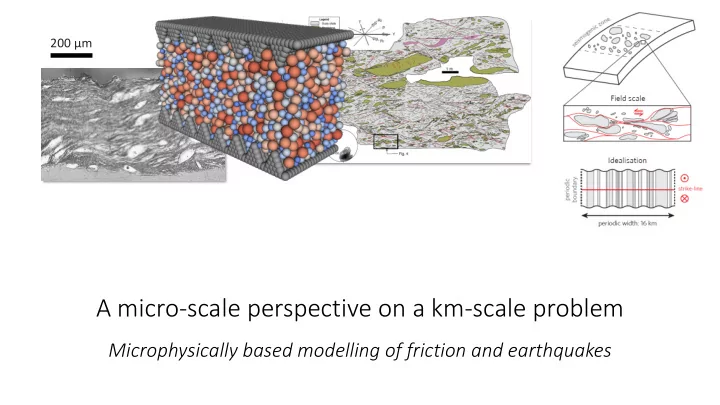
200 m A micro-scale perspective on a km-scale problem Microphysically based modelling of friction and earthquakes Brace & Byerlee (1966) Dieterich (1972) Dieterich (1978) Rate & State Friction Scholz (2002) # + - ln # % #


slide-1
SLIDE 1

A micro-scale perspective on a km-scale problem

Microphysically based modelling of friction and earthquakes

200 µm
slide-2
SLIDE 2

Dieterich (1972) Brace & Byerlee (1966) Dieterich (1978)

slide-3
SLIDE 3
slide-4
SLIDE 4

Rate & State Friction

!(#, %) = !∗ + * ln # #∗ + - ln #∗% ./ 0% 01 = 2(%, #, … )

Scholz (2002)

slide-5
SLIDE 5

!"" = !∗ + & − ( ln + +∗

& − ( = −0.005

slide-6
SLIDE 6

!"" = !∗ + & − ( ln + +∗

slide-7
SLIDE 7

!"" = !∗ + & − ( ln + +∗

& − ( > 0 & − ( < 0 & − ( > & − ( < 0

slide-8
SLIDE 8

Quick summary

  • Modelling and analysis relies on rate-and-state friction
  • RSF is empirical formulation => problem for extrapolation
  • We need models based on physical principles
slide-9
SLIDE 9

Coming up…

  • 1. Lab observations of fault friction, micro-scale processes
  • 2. Basic concepts behind microphysical models
  • 3. Applications in seismic cycle modelling
slide-10
SLIDE 10

Part 1: Lab observations

slide-11
SLIDE 11

Velocity-step tests

Velocity Shear stress

slide-12
SLIDE 12

Velocity-step tests

Velocity Shear stress !

"

!

#

$" $#

% ln !

#

!

"

( ln !

#

!

"

∆$ = % − ( ln !

#

!

"

slide-13
SLIDE 13

Velocity-step tests

Chester (1994)

slide-14
SLIDE 14

Microstructures

Shimamoto (1986)

slide-15
SLIDE 15

Microstructures

Bos et al. (2000)

slide-16
SLIDE 16
slide-17
SLIDE 17

Microstructures

Niemeijer & Spiers (2007)

slide-18
SLIDE 18
slide-19
SLIDE 19

Microstructures

Dynamic weakening

slide-20
SLIDE 20

Micro-scale processes

Pressure solution

Barker & Kopp (1991)

slide-21
SLIDE 21

Micro-scale processes

Pressure solution

Bos et al. (2000)

slide-22
SLIDE 22

Micro-scale processes

Granular flow

slide-23
SLIDE 23

Recap Part 1

  • Velocity dependence of friction is not a constant
  • Several deformation regimes
  • Microstructural changes between deformation regimes
  • At least 2 micro-scale processes
slide-24
SLIDE 24

Part 2: Microphysical models

slide-25
SLIDE 25

Basic ingredients

  • 1. Pressure solution

=> Time-dependent compaction

  • 2. Granular flow

=> Slip-dependent dilatation

  • 3. Microstructure

=> Porosity

  • 4. Boundary conditions

=> Constant !", #

$%

slide-26
SLIDE 26

Model geometry (CNS model)

Niemeijer & Spiers (2007) Chen & Spiers (2016)

slide-27
SLIDE 27

Model equations

!" !# = % &

'( − ℎ

̇ ,(- + ̇ ,/0 !1 !# = − 1 − 1 ̇ 3(- + ̇ 3/0

̇ ,(- = 4"5(1) ̇ ,/0 = ̇ ,/0

∗ exp " 1 − <∗ tan @ − A <∗ + tan @

B C A + " tan @ ̇ 3(- = 4A5(1) Pressure solution: Granular flow: ̇ 3/0 = − tan @ ̇ ,/0

Main ODE

slide-28
SLIDE 28

Steady-state behaviour

Ductile creep

(zero porosity)

Increasing porosity

slide-29
SLIDE 29

Transient behaviour

slide-30
SLIDE 30

Recap Part 2

  • Quantified micro-scale processes
  • Incorporated constitutive relations into spring-block model
  • Steady-state and transient frictional behaviour = OK
  • Microphysical model explains lab results
slide-31
SLIDE 31

Part 3: Seismic cycle modelling

slide-32
SLIDE 32

Skipping 6 orders

github.com/ydluo/qdyn

slide-33
SLIDE 33
slide-34
SLIDE 34

Earthquakes!

slide-35
SLIDE 35

Earthquakes!

Van den Ende, Chen, Ampuero, Niemeijer (2018, Tectonophysics) See:

slide-36
SLIDE 36

Into the field

Faulkner et al. (2003) Fagereng (2011a,b) Kimura et al. (2012) and others…

slide-37
SLIDE 37

Back to safety…

Asperities: “slow” pressure solution Matrix: “fast” pressure solution

slide-38
SLIDE 38

Earthquakes!

slide-39
SLIDE 39

Earthquakes!

“Regular” earthquakes (Mw < 6) Slow slip events “Anomalous” earthquakes

slide-40
SLIDE 40

Why anomalous earthquakes?

Stable creep Unstable slip

slide-41
SLIDE 41

Why anomalous earthquakes?

slide-42
SLIDE 42

Why anomalous earthquakes?

slide-43
SLIDE 43

Recap Part 3

  • Interplay between pressure solution and granular flow gives

earthquakes

  • Variations in pressure solution kinetics leads to complex slip behaviour
  • Massive instability facilitated by flow-to-friction transition
slide-44
SLIDE 44

Perspectives

1.

Microphysically-based (numerical) modelling offers new avenues for studying earthquake and slow slip mechanics

2.

Incorporating micro-scale processes and physical principles facilitates collaboration between experimental- and field geologists, and modellers

3.

Far future: earthquake hazard assessment and forecasting based on physical/chemical considerations