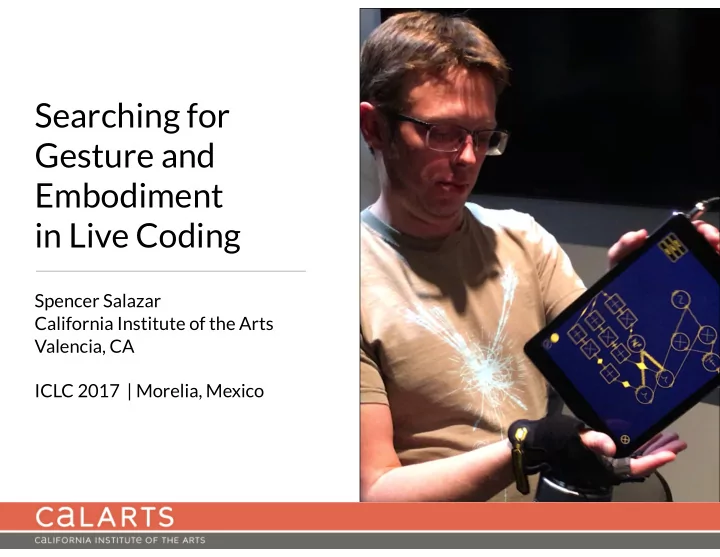
SLIDE 1
Searching for Gesture and Embodiment
in Live Coding
Spencer Salazar California Institute of the Arts Valencia, CA ICLC 2017 | Morelia, Mexico
SLIDE 2
Overview
Tension between live coding, gesture,
embodiment, and electronic music production Historical approaches to addressing this tension Reshaping of source code media A continuation of these ideas:
Auraglyph
SLIDE 3
Live coding, Gesture, and Embodiment
At first glance, live coding and gesture seem at odds Levels of indirection Continuous control Physical and visual dimensions of music performance Performer / Audience
SLIDE 4
Gesture
“bridge between movement and meaning”
(presumably, that of a musical nature) Jensenius et al.,
“Musical Gestures: Concepts and Methods in Research,”
in Musical Gestures: Sound, Movement, and Meaning.
SLIDE 5
Gesture
Most attempts to define gesture admit keyboard activities Many definitions admit activities not visible to an audience
SLIDE 6
(Aside)
The notion of gesture in musical performance most likely needs reconsideration in the context of live coding (But not right now)
SLIDE 7
Embodiment
“[I]ndividual sensorimotor capacities […]
embedded in a more encompassing
biological, psychological and cultural context.”
Varela, Thompson, and Rosch, 1991,
The Embodied Mind: Cognitive Science and Human Experience.
SLIDE 8
Tensions
Pursuit of “more humanly active live coding”
Collins 2011, “Live Coding of Consequence,” Leonardo
SLIDE 9
Tensions
“A live coder […] is under pressure to do
something interesting in the moment” “[Abstraction and scheduling] can lead
to a lack of immediacy in how the
performer’s actions relate to the music”
Stowell and McLean 2013,
“Live music-making: a rich open task requires a rich open interface,”
Music and Human-Computer Interaction.
SLIDE 10
Tensions
Embodiment in live coding surfaces in… “the physical interaction of our body […] with the machine” “how […] a programming language shapes our thinking about concepts and algorithms”
(and the programming language is shaped
by available hardware and end goals)
Baalman 2016, “Embodiment of Code,” Proc. ICLC
SLIDE 11
Assumptions/Oversights
Assumption:
We care about musical gesture in live coding Not considering:
Embodiment of audience
(e.g. dance)
SLIDE 12
Tensions
Typing gestures not linked directly to music Rather, linked to production of a set of
instructions for producing music
SLIDE 13
Argument
Existing mechanisms for imparting gesture and embodiment in live coding are unsatisfactory Proposal
Consider extensions to plain text as the
universal medium for programming code
SLIDE 14 Prelude: ChucK on iPad
Salazar and Wang 2014, “miniAudicle for iPad:
Touchscreen-based music software programming,” Proc. ICMC
SLIDE 15
Gestural Dynamics of Mobile Touch Devices
SLIDE 16
Gestural Dynamics of Mobile Touch Devices
(Not so good for entering text) (We’ll get back to that)
SLIDE 17 Algorithm and Gesture
Algorithmic processes constrained
by what is readily formulated and encoded Gestural processes constrained by what is readily carried
- ut by a body in the physical world
SLIDE 18
Algorithm and Gesture
Intent Code Audible Result
SLIDE 19
Algorithm and Gesture
Intent Code Audible Result Algorithm
SLIDE 20
Algorithm and Gesture
Intent Code Audible Result Algorithm
SLIDE 21
Algorithm and Gesture
Intent Gesture Audible Result
SLIDE 22
Algorithm and Gesture
Intent Gesture Audible Result
Embodied Cognition
SLIDE 23
Algorithm and Gesture
(Ok but what if algorithm is the intent?)
SLIDE 24
Text as Abstraction
Code exists in many forms Programmer’s intent High/low-level languages Abstract syntax trees and
intermediate representations (Virtual) Machine code
SLIDE 25
Alternative Abstractions
Dataflow programming
PureData, Max/MSP, Reaktor, Kyma, TouchDesigner, etc.
Scratch, TouchDevelop
(Resnick et al. 2009, Tillmann et al. 2011)
Lisping Field
(OpenEnded Group)
Processing (tweak mode)
SLIDE 26
Alternative Abstractions
Dataflow programming
PureData, Max/MSP, Reaktor, Kyma, TouchDesigner, etc.
Scratch, TouchDevelop
(Resnick et al. 2009, Tillmann et al. 2011)
Lisping Field
(OpenEnded Group)
Processing (tweak mode)
SLIDE 27
Alternative Abstractions
Dataflow programming
PureData, Max/MSP, Reaktor, Kyma, TouchDesigner, etc.
Scratch, TouchDevelop
(Resnick et al. 2009, Tillmann et al. 2011)
Lisping Field
(OpenEnded Group)
Processing (tweak mode)
SLIDE 28
Alternative Abstractions
Dataflow programming
PureData, Max/MSP, Reaktor, Kyma, TouchDesigner, etc.
Scratch, TouchDevelop
(Resnick et al. 2009, Tillmann et al. 2011)
Lisping Field
(OpenEnded Group)
Processing (tweak mode)
SLIDE 29
Alternative Abstractions
Dataflow programming
PureData, Max/MSP, Reaktor, Kyma, TouchDesigner, etc.
Scratch, TouchDevelop
(Resnick et al. 2009, Tillmann et al. 2011)
Lisping Field
(OpenEnded Group)
Processing (tweak mode)
SLIDE 30
Alternative Abstractions
Dataflow programming
PureData, Max/MSP, Reaktor, Kyma, TouchDesigner, etc.
Scratch, TouchDevelop
(Resnick et al. 2009, Tillmann et al. 2011)
Lisping Field
(OpenEnded Group)
Processing (tweak mode)
SLIDE 31
Alternative Abstractions
Dataflow programming
PureData, Max/MSP, Reaktor, Kyma, TouchDesigner, etc.
Scratch, TouchDevelop
(Resnick et al. 2009, Tillmann et al. 2011)
Lisping Field
(OpenEnded Group)
Processing (tweak mode)
SLIDE 32
Sketching Live Code
Auraglyph is a modular music patching system with sketching metaphor Hand-drawn figures -> reified into programming nodes Touch and drawn figures also used for control
Salazar 2017, Sketching Sound: Gestural Interaction in Expressive Music Programming
SLIDE 33
Auraglyph
Goal
“physical” connection to sound processes
SLIDE 34
Gestural Support
Scrubbing parameters Writing parameters directly Organizing/patching Step sequencer, waveform editor, orientation sensor,
pen x/y/pressure
(secondary to coding activities) PULSE (2016)
SLIDE 35
Gestural Support
Multiple simultaneous gestures
(multiple performers) Physical dexterity Dynamic, real-time feedback
PULSE (2016)
SLIDE 36
Gestural Support
Sense of 3D space Performer’s activities are fairly transparent to audience (if projected) Visual interest for audience
PULSE (2016)
SLIDE 37
Auraglyph in Practice
How has this played out?
SLIDE 38
PULSE (2016)
SLIDE 39
Electronic Arts Ensemble (2017)
SLIDE 40
A sonic ritual for Auraglyph (2017)
SLIDE 41
Looking Forward
Live coding beyond the laptop Merging layers of abstraction:
Text, graphical, dataflow, timeline, ?
SLIDE 42
Conclusion
Tension between live coding, gesture, and embodiment Many paths for addressing this tension Auraglyph: sketch-based dataflow live coding In the future?
SLIDE 43
Thanks!
Spencer Salazar
https://spencersalazar.com/
ssalazar@calarts.edu Questions?