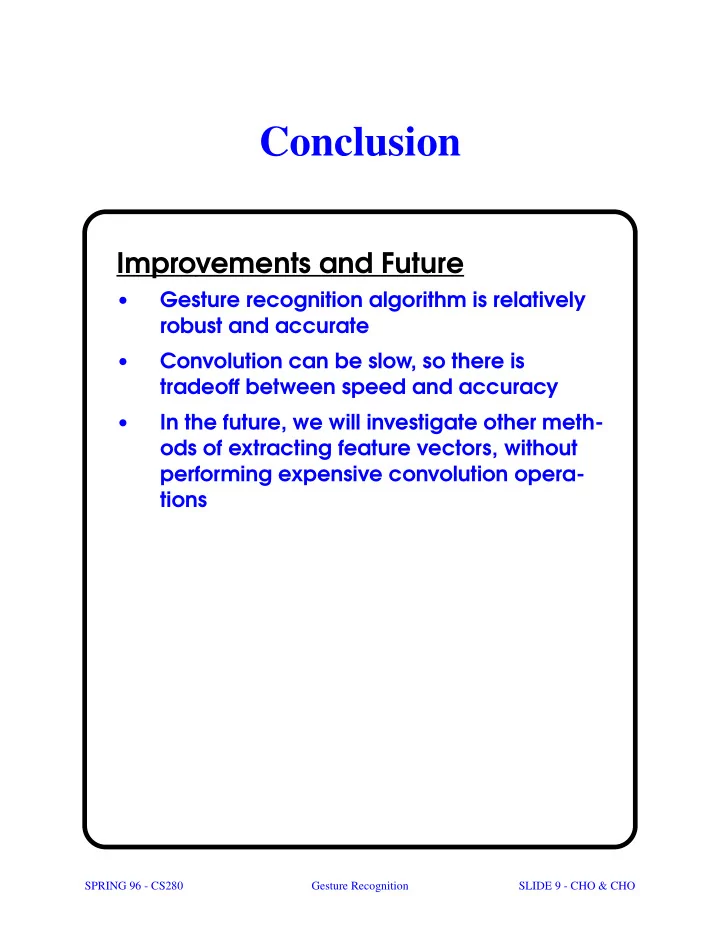
Conclusion Improvements and Future Gesture recognition algorithm - - PDF document

conclusion
SMART_READER_LITE
LIVE PREVIEW

Conclusion Improvements and Future Gesture recognition algorithm - - PDF document

Conclusion Improvements and Future Gesture recognition algorithm is relatively robust and accurate Convolution can be slow, so there is tradeoff between speed and accuracy In the future, we will investigate other meth- ods of


slide-1
SLIDE 1

SPRING 96 - CS280 Gesture Recognition SLIDE 9 - CHO & CHO

Improvements and Future

  • Gesture recognition algorithm is relatively

robust and accurate

  • Convolution can be slow, so there is

tradeoff between speed and accuracy

  • In the future, we will investigate other meth-
  • ds of extracting feature vectors, without

performing expensive convolution opera- tions

Conclusion

slide-2
SLIDE 2

SPRING 96 - CS280 Gesture Recognition SLIDE 8 - CHO & CHO Frame Rate: 0.4 frames per second

HAND A ATTEMPT

  • NO. 1

HAND A ATTEMPT

  • NO. 2

HAND A UNDER LESS

LIGHTING

HAND B WITH HAND A

TEMPLATE

FORWARD 90% 70% 100% 74% RIGHT 96% 100% 72% 88% LEFT 60% 92% 50% 82% OPEN 86% 80% 72% 82% CLOSE 98% 100% 100% 96% AVERAGE 84.0% 88.4% 78.8% 84.4%

HAND TYPES GESTURE

Accuracy Measurement for Gesture Recognition

slide-3
SLIDE 3

SPRING 96 - CS280 Gesture Recognition SLIDE 7 - CHO & CHO

Application

  • The user can interact with the virtual envi-

ronment by hand gestures

  • The virtual hand mimics the gesture of the

user’s hand

  • Hand Gesture Commands:

Finger pointing up == Moves the virtual hand forward Finger pointing slant== Changes the direction of the virtual hand Closed Hand == Grab an object Open Hand == Release an object

  • In the initialization phase, the user supplies

the template gestures.

  • During the recognition phase, the system

matches the sample against the template gestures.

Virtual Reality Explanation

slide-4
SLIDE 4

SPRING 96 - CS280 Gesture Recognition SLIDE 6 - CHO & CHO

(5) Open Hand (6) Upper Left

Application 2 of 2

Forward (4) Up Release Turn Left

slide-5
SLIDE 5

SPRING 96 - CS280 Gesture Recognition SLIDE 5 - CHO & CHO

Application 1 of 2

Forward Grab Turn Right (2) Close Hand (3) Upper Right (1) Up

slide-6
SLIDE 6

SPRING 96 - CS280 Gesture Recognition SLIDE 4 - CHO & CHO

Composite Image Explanation

  • We calculated the local orientations at 0,

45, 90 and 135 degrees by convolving the image with appropriate 2-D Gaussian derivative filters.

  • We used threshold to eliminate the back-

ground noise

  • In the figure:

Grey == Background White == Local Orientation of 0 Degree Red == Local Orientation of 45 Degrees Green == Local Orientation of 90 Degrees Blue == Local Orientation of 135 Degrees

  • The Orientation Histogram is derived by

counting the white pixels, red pixels, etc.

  • Classification by finding the nearest neigh-

bor with the smallest Euclidean distance to the sample

Composite Imaging Explanation

slide-7
SLIDE 7

SPRING 96 - CS280 Gesture Recognition SLIDE 3 - CHO & CHO

Composite Image

ORIGINAL IMAGE COMPOSITE VERTICAL 45 DEGREES HORIZONTAL 135 DEGREES

slide-8
SLIDE 8

SPRING 96 - CS280 Gesture Recognition SLIDE 2 - CHO & CHO

Motivation and Recognition

Motivation

  • The user can interact with the virtual envi-

ronment using hand gestures.

  • No Special Hardware Necessary, except for

the Camera.

  • No Special Hand Markings Necessary

Recognition

We wanted a recognition algorithm that is:

  • Relatively simple and fast, which can run in

real-time on a workstation

  • Robust against changing lighting condi-

tions

  • Translation Invariant
  • Maintain accuracy, even when different

hands are used We decided to use orientation histogram as the feature vector for gesture classification, since it

slide-9
SLIDE 9

SPRING 96 - CS280 Gesture Recognition SLIDE 1 - CHO & CHO

Virtual Reality Simulation using Hand Gesture Recognition

by Young Cho and Franklin Cho