
SLIDE 1
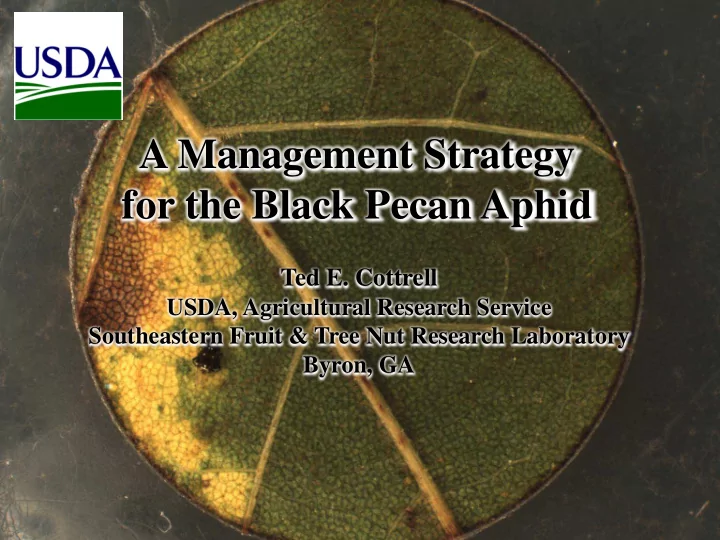
A Management Strategy for the Black Pecan Aphid Ted E. Cottrell - - PowerPoint PPT Presentation
A Management Strategy for the Black Pecan Aphid Ted E. Cottrell USDA, Agricultural Research Service Southeastern Fruit & Tree Nut Research Laboratory Byron, GA Aphids that Feed on Pecan Foliage Black Aphid Yellow Aphids
Black Pecan Aphid Yellow Pecan Aphid Blackmargined Aphid
(BPA) (YPA) (BMA)
If you have a population of ‘yellow’ pecan aphids, you rarely have black pecan aphid issues at that time. Beware - low populations of ‘yellow’ aphids before mid-July can lead to early black pecan aphid problems, especially on susceptible cultivars.
Seasonal Trends of Pecan Aphid Populations
1975 Proceedings of the TPGA
Increasing populations of yellow pecan aphids lead to increasing populations of natural enemies that eventually suppress the yellow aphids but more importantly, help to hold the BPA in check.
Images courtesy of numerous photographers (Bugwood.org)
Images courtesy of numerous photographers (Bugwood.org)
Leaf Age No Senescence Ethylene-dependent Senescence Ethylene-independent Senescence Leaf Age Auxin
Gibberellic Acid
Cytokinin Ethylene
Jasmonic Acid ABA
Salicylic Acid
Early Season Late Season
Senescence Retarding Bioregulators Senescence Promoting Bioregulators
Declining Levels of Senescence- Delaying Plant Bioregulators Increasing Levels of Senescence-Promoting Plant Bioregulators Natural Enemies Crash Pecan Foliage is Primed for BPA to Explode
Leaf Age No Senescence Ethylene-dependent Senescence Ethylene-independent Senescence Leaf Age Auxin
GA
Cytokinin Ethylene
Jasmonic Acid ABA
Salicylic Acid
Early Season Late Season
Controlling the pecan weevil AND managing BPA
Treatments and Application Dates Trtmnt Jul 15 & Aug 4 Aug 19 Aug 23 Aug 31 Sep 14 Sep 28
Standard PG 10 Imdclprd 3oz Carbaryl 5qt Floncmd 2.8oz Bifenthrn 6.4 oz Imdclprd 3oz Carbaryl 5qt Floncmd 2.8oz Bifenthrn 6.4 oz Imdclprd 2.8 oz Abamectin 10 oz ProGibb 10 oz rate PG 10 PG 10 Carbaryl 5qt PG 10 Bifenthrn 6.4 oz PG 10 Carbaryl 5qt PG 10 Bifenthrn 6.4 oz PG 10 Abamectin 10 oz ProGibb 20 oz rate PG 10 PG 20 Carbaryl 5qt PG 20 Bifenthrn 6.4 oz PG 20 Carbaryl 5qt PG 20 Bifenthrn 6.4 oz PG 20 Abamectin 10 oz Control
5 10 15 20 25 30 35 40 45 1-Jul 15-Jul 29-Jul 12-Aug 26-Aug 9-Sep 23-Sep 7-Oct
ProGibb 20 oz ProGibb 10 oz Control Standard
Aphids per Leaf
Standard Control ProGibb 10 oz ProGibb 20 oz
10 20 30 40 50 60 70 ProGibb 20 oz ProGibb 10 oz Standard Control % Chlorotic Leaf Area B B B A
Standard Control ProGibb 10 oz ProGibb 20 oz
10 20 30 40 50 60 70 ProGibb 20 oz ProGibb 10 oz Standard Control % Chlorotic Leaf Area B B B A
20 40 60 80 100 120 140 1-Jul 15-Jul 29-Jul 12-Aug 26-Aug 9-Sep 23-Sep 7-Oct
ProGibb 20 oz ProGibb 10 oz Control Standard
Aphids per Leaf
Standard Control ProGibb 10 oz ProGibb 20 oz
10 20 30 40 50 60 70 ProGibb 20 oz ProGibb 10 oz Standard Control % Chlorotic Leaf Area B B B A
Standard Control ProGibb 10 oz ProGibb 20 oz
10 20 30 40 50 60 70 ProGibb 20 oz ProGibb 10 oz Standard Control % Chlorotic Leaf Area B B B A
10 20 30 40 50 60 70 80 90 100 9/15/2016 10/17/2016
% Chlorotic Leaflet Area
Month Black Pecan Aphid Concern Level Management Action
April to mid-June NONE – VERY LOW None Mid-June to Mid-July If low/moderate yellow aphid populations are present - VERY LOW If no yellow aphid populations present, beware early black pecan aphid – CAUTION! None BPA control likely needed Mid-July – Late Sept BPA increase is imminent – WARNING!! BPA control needed Early Oct – Frost None None
ProGibb LV Plus
Mid-July: 10 oz ProGibb LV Plus
Mid-August: If spraying for pecan weevil, 10 oz ProGibb LV Plus and an
10 oz ProGibb LV Plus, an aphicide and a miticide (if needed). Mid-September: If spraying for pecan weevil, 10 oz ProGibb LV Plus, an aphicide and a miticide (if needed).
Remember: For the aphicides, switch between products with different IRAC numbers for resistance management.