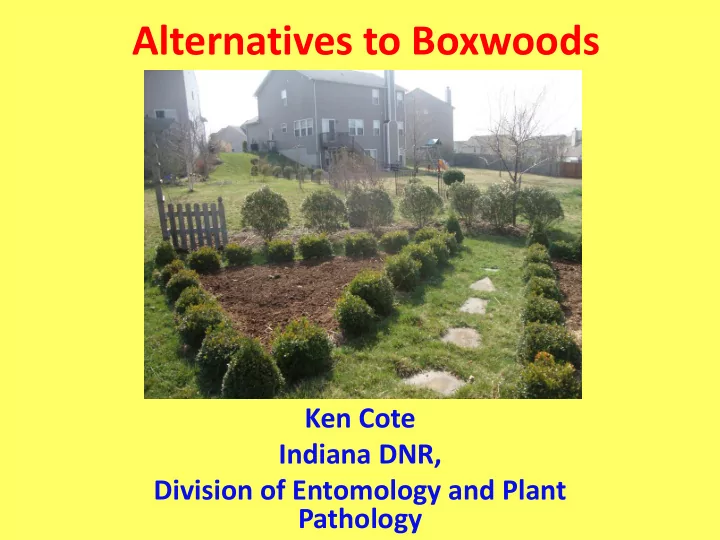
SLIDE 1
Alternatives to Boxwoods
Ken Cote Indiana DNR, Division of Entomology and Plant Pathology
SLIDE 2 Overview
- Boxwood Blight Symptoms and Signs
- Boxwood Blight Survey
- Uses and forms of other plants
- How can you protect your nursery
SLIDE 3 What is Boxwood Blight
psuedonaviculatum
- Warm Moist Conditions
- Temps 41-86⁰F, 77⁰F
Optimum
- Above 91⁰F kills mycelia
- Microsclerotia are
produced.
- Survive up to 5 years in leaf
debris.
SLIDE 4 Where is boxwood Blight
– OH, PA, NY, VA, NC, MD, OR, CT, MA, RI – Canada (BC, ON)
- Not yet found in Indiana.
SLIDE 5
Symptoms
Plants develop small, black leaf spots Rapid progression symptoms resulting in leaf drop and small black stem cankers.
SLIDE 6 Infected plants on residential property
www.ct.gov/caes
Sharon Douglas, Connecticut Ag Experiment Station
SLIDE 7 Leaf Spots
www.ct.gov/caes
Sharon Douglas, Connecticut Ag Experiment Station
SLIDE 8 Blighted leaves, stem lesions, and defoliation.
www.ct.gov/caes
Sharon Douglas, Connecticut Ag Experiment Station
SLIDE 9 Black stem cankers and lesions
www.ct.gov/caes
Sharon Douglas, Connecticut Ag Experiment Station
SLIDE 10 Foliar symptoms: note leaf debris
www.ct.gov/caes
Sharon Douglas, Connecticut Ag Experiment Station
SLIDE 11 Infected boxwood and pachysandra
www.ct.gov/caes
Sharon Douglas, Connecticut Ag Experiment Station
SLIDE 12 Symptoms on pachysandra in landscape
www.ct.gov/caes
Sharon Douglas, Connecticut Ag Experiment Station
SLIDE 13 Volutella Blight Looks Similar
dieback
injured plants
Blight and Volutella can occur at same time
Melodie Putnam, 2008
SLIDE 14 Boxwood Blight Survey
- 67 locations
- 34 Nursery Dealers
- 33 Certified Nurseries.
- No symptoms found out of 46,000 plus plants
inspected
- Too hot for disease in 2012.
SLIDE 15
Boxwood Blight Counties Survey 2012
SLIDE 16 Boxwood Blight Survey Cultivars Found
- Green Mtn.
- Cranberry Creek
- North Starr
- Northern Charm
- Suffruticosa
- Chicagoland Green
- Baby Gem
- Gordo
- Golden Dream
- Franklin Gem
- Green Gem
- Green Borders
- Green Velvet
- Green Tower
- Variegated English
- Korean
- Rotundifolia
- Shadow Sentry
- Vadar Valley
- Winter Beauty
- Winter Gem
- Winter Green
SLIDE 17 Boxwood Blight Survey
Boxwoods from: 13 states, 1 Canadian Province CA, IL,IN, KY, MI, OK, TN, and WI. Boxwoods found from:
Ohio, Oregon, Pennsylvania
Canada
SLIDE 18 What if Boxwood Blight Gets Here?
- Sites will be managed under our clean plant
laws.
- Landowners will be requested to follow best
management practices to contain spread.
- Deep burial or burning.
- Protect adjacent, asymptomtic plants with
fungicides.
- Fungicides are labeled for Cylindrocladium,
more research is needed.
SLIDE 19
When Choosing Alternatives to Boxwood:
Consider Plant Form Consider Plant Function Consider Plant Adaptability
SLIDE 20
PLANTS SIMILAR IN SHAPE
SLIDE 21 Inkberry Holly Ilex glabra
- Salt tolerant
- Adaptable to wet
conditions
to chlorosis
problem
Magic
SLIDE 22
Green Magic Inkberry Holly
SLIDE 23
Shamrock Inkberry Holly
SLIDE 24
Leaf Retention Issues
SLIDE 25 Japanese Holly Ilex crenata
- Best look alike
- Hardiness varies among
cultivars
soils
hardy)
SLIDE 26
Uknown Cultivar of Japanese Holly
SLIDE 27
Chlorosis in high pH sutiations
SLIDE 28
Sky pencil: good replacement of Graham Blandy Boxwood
SLIDE 29
Ilex crenata ‘Chesapeake’
SLIDE 30 Dwarf Forms of Norway Spruce Picea abies
- Many forms available
- Highly adaptable
- Probably one of the
better spruces for IN
- Mites can be a problem
- Bagworm
SLIDE 31
Picea abies ‘Pumila’
SLIDE 32 Dwarf Alberta Spruce Picea glauca ‘Conica’
forms, conical forms
- Tolerant of shearing
- Topiary forms available
in trade
and shearing than boxwood
magnets
SLIDE 33
Other closely related forms
SLIDE 34 Blue Hollies Ilex x meserveae
Indiana soils
- Prefer acid, but doing
- kay at many unlikely
locations
- Tolerant of shearing
- Especially cultivar
China Girl or China Boy
SLIDE 35
China Girl Holly
SLIDE 36 Little Rascal Holly Ilex x Mondo
form
deal of experience with this plant
parking lot plantings
SLIDE 37 Globe Arborvitae Thuja occidentalis
Hetz Midget
that require little maintenance
- Mites and bagworm
- Drought injury in 2012
SLIDE 38
Thuja occidentalis ‘Bobazam’
SLIDE 39 Yew cultivars Taxus sp.
- Many forms available
- May already be over
used?
shearing and some shade tolerance
can be issues in wet soils
SLIDE 40 Boxleaf Euonymus Euonymus japonica ‘Microphyllus’
appearance
hardy in northern IN
crown gall can be a problem
soil
SLIDE 41
Not Euonymus!
SLIDE 42
PLANTS FOR HEDGES AND PARTERRES
SLIDE 43 Bayberry Myrica pennsylvanica
- Coarser in texture
- Highly adaptable
- Tolerates shearing
- More pH adaptable
than Inkberry holly
in Indiana
trade
SLIDE 44
Bayberry Hedge
SLIDE 45
Stoloniferous
SLIDE 46 English Ivy Hedera helix
- Take sun or shade
- Can be sheared into
many shapes
spider mites when used in this manner
SLIDE 47 Lavendar Lanvendula cultivars
- Tolerant of shearing
- Cultivars like Hidcote
and Munstead stay fairly low
than Grey Green Santolina
wet soils
summer
SLIDE 48 How Can I Protect My Nursery?
- Segregate boxwoods from states that have
the blight
- Make sure nursery has been inspected for
blight
- Hold plants for 4 weeks, inspect once a week
for symptoms
- Place plants on landscape fabric so debris can
be easily collected
SLIDE 49 How Can I Protect My Nursery?
- Obtain a fungicide history on boxwood
imported to nursery from high risk states
- Avoid over head irrigation
- Maintain spacing for good air circulation
- Avoid pruning or working in wet plants
- Disinfect pruning shears and other tools with
70% ETOH, 10% Bleach, Lysol, Zero Tol or Green Shield.
SLIDE 50 How Can I Protect My Nursery?
- Disinfect all pots with 10% bleach before
repotting boxwoods
- Do not compost dead boxwoods or bring
boxwoods back to nursery cull piles
- Clean all tools and boots between job sites
that have boxwoods
- Remember, there is an asymptomatic stage
SLIDE 51 What to do for suspect shipments
- Contact your DNR nursery inspector
- We will get laboratory confirmation for you
- Symptomatic plants, containers and
associated soil need to be mitigated
- Asymptomatic plants will need to be treated
with a fungicide and monitored
SLIDE 52 DNR Contact Information
- 1-866- NO EXOTIC
- 317-232-4120 DNR
Entomology
- Ken Cote 812-332-2241
- kcote@dnr.in.gov