
SLIDE 1
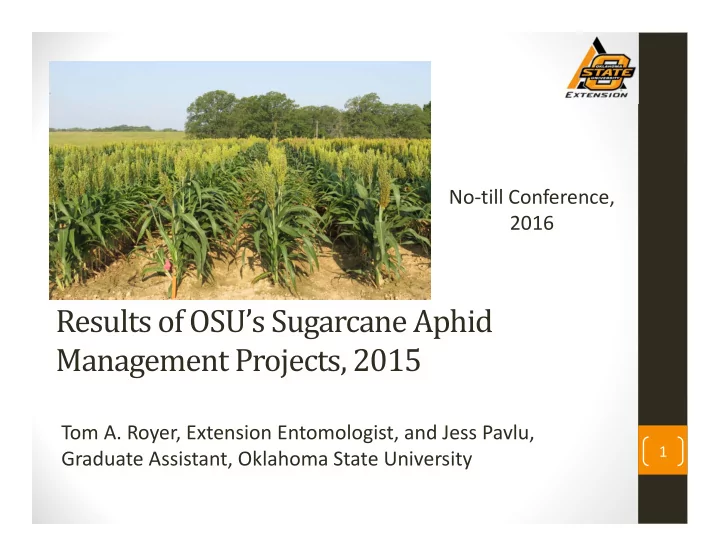
Results of OSU’s Sugarcane Aphid Management Projects, 2015
Tom A. Royer, Extension Entomologist, and Jess Pavlu, Graduate Assistant, Oklahoma State University No‐till Conference, 2016
1
Results of OSUs Sugarcane Aphid Management Projects, 2015 Tom A. - - PowerPoint PPT Presentation
No till Conference, 2016 Results of OSUs Sugarcane Aphid Management Projects, 2015 Tom A. Royer, Extension Entomologist, and Jess Pavlu, 1 Graduate Assistant, Oklahoma State University Sugarcane Aphid History in US A known pest of
Tom A. Royer, Extension Entomologist, and Jess Pavlu, Graduate Assistant, Oklahoma State University No‐till Conference, 2016
1
sorghum and sugarcane in growing regions of Africa, Asia, Australia, and parts of Central and South America (Singh
Photo Courtesy of Dr. Pat Porter, Texas A&M Agrilife, Lubbock
2
been known as a pest in sugarcane in Florida (1977), Louisiana (1999), and more recently in Texas.
seemed to “shift” from sugarcane to sorghum in the U.S., although in
it was more known as a pest of sorghum.
Photo Courtesy of Dr. Pat Porter, Texas A&M Agrilife, Lubbock
3
Counties with Melanaphis sacchari in sorghum
2013 2013 and 2014 2014
Courtesy of Robert Bowling, Texas Agrilife Extension, Corpus Christi 4
5
Identifying Characters “Typical Infestation”
Descriptions prepared by Ed Bynum and Patrick Porter, Texas Agrilife Extension. 6
they reproduce asexually via parthenogensis (live birth, all female).
12 days
68 young on average.
Photo Courtesy of Dr. Pat Porter, Texas A&M Agrilife, Lubbock
7
(Japanese silvergrass)
8
ratoon sorghum and johnsongrass
Oklahoma, but johnsongrass could serve as a continuous source of aphid populations during the growing season.
9
soon after plant emergence, but significant population increases often occur after panicle emergence
changes in the plant’s physiology especially as the panicle emerges.
Photo Courtesy of Dr. Pat Porter, Texas A&M Agrilife, Lubbock
10
feed on abaxial surface of the basal leaves.
substantial amounts
is a source of sooty mold on the leaves
11
12
so they are more susceptible to diseases and lodging
harvest operations.
13
14
Christi)
effectively managing this aphid.
resistance into commercial lines (USDA).
sorghums, and compare effectiveness of natural enemies on resistant and susceptible lines.
15
16 Variety Aphids 7 Days Aphids 14 Days Yield/bu/A KS 585 (S) 1138 373 29.8 TAMU TX 430 (S) 1098 425 31.8 (+2) TAMU TX 2783 (R) 12 8 43.6 (+13.8) SP 7715 1 2 40.2 (+10.4) GX 15371 5 7 38.9 (+9.1) SP 6929 26 69 38.7 (+8.9) SPX 17613 1 1 38.4 (+8.6)
DG772b NA NA NA NA 1‐2 DKS 37‐07 NA 1 1 1 1 Pulsar NA NA NA NA 1 SP 7715 1 NA NA 1 1‐2 SP 6929 2 NA NA S 1‐2 SP 73B12 1 NA NA 1 1‐2 K73J65 2 NA NA NA NA SP X 17613 1 NA NA NA NA Medium‐Full Season Sorghum Hybrids with Sugarcane Aphid Load similar to or less than RTX2783 (Resistant Check) 1 = Aphid load less than or equal to RTX2783 2 = Aphid load higher than that on RTX2783 but statistically lower than RTX430 (susceptible check) S = Susceptible (Does not separate from RTX430) 17
a crucial role for effectively managing this aphid.
season, early full season, late short season) for initial aphid colonization, population build‐up and yield.
planting date.
18
for control of outbreaks.
19
20 Chemical Rate lb ai/A % Control 14 DAT* Yield/bu/A Transform WG 0.0235 95.9 104.03 (+ 26) Transform WG 0.031 87.1 99.42 (+21) Transform WG 0.047 97.1 98.51 (+20) Lorsban 4E 1.0 < 50% NS 72.08 (‐6.4) Lorsban 4E 0.5 <60% NS 86.47 (+8) Dimethoate 2.6 EC 0.5 < 15% 75.02 (‐3.4) Stallion EC 0.252 Higher than Check 77.26 (‐1.2) Untreated 78.43 *Average of 1181 aphids per leaf in Untreated Check, 14 DAT
21 Chemical Rate lb ai/A % Control 14 DAT* Yield/bu/A Sivanto 0.0235 60.0 57.4 (+ 14.4) Transform WG 0.031 28.2 56.6 (+13.6) Centric 1.0 76.0 51.8 (+8.8) Lorsban Advanced 0.5 No control 46.2 (+3.2) Lorsban Advanced + Dimethoate 2.6 EC 0.5 34.5 42.3 (‐3.4) Untreated 43.0 *Average of 952 aphids per leaf in Untreated Check, 14 DAT
22
23 Planting Treatment Threshold % Control 14 DAT* Yield/bu/A Early 500 62% 29.3 (+ 11.7) Early 250 61% 30.1 (+12.5) Early 125 47% 27.5 (+9.9) Early 50 No control 25.6 (+ 8.0) Early 0.5 17.6 Late 500 Late 250 Late 125 Late 50 Late Untreated
24
sampling decision tool for consultants and producers to accurately scout and classify fields that need treatment in a timely fashion
thresholds, proper timing, and aphid distribution
presence/absence to make sampling efficient but accurate.
enemies can play a role in reducing aphid pressure.
25
26
Bowling, and Allen Knutson, Texas Agrilife Research and Extension
Arkansas
Louisiana State University
27
What Will Its Impact Be for Oklahoma Sorghum Producers? Tom A. Royer, Extension Entomologist AND Jess Pavlu, Research Assistant Oklahoma State University
28
29
Photo Courtesy of Dr. Pat Porter, Texas A&M Agrilife, Lubbock
30