A key aspect in helping to recover? Towards User Requirements (Use - - PowerPoint PPT Presentation

a key aspect in helping to recover
SMART_READER_LITE
LIVE PREVIEW

A key aspect in helping to recover? Towards User Requirements (Use - - PowerPoint PPT Presentation

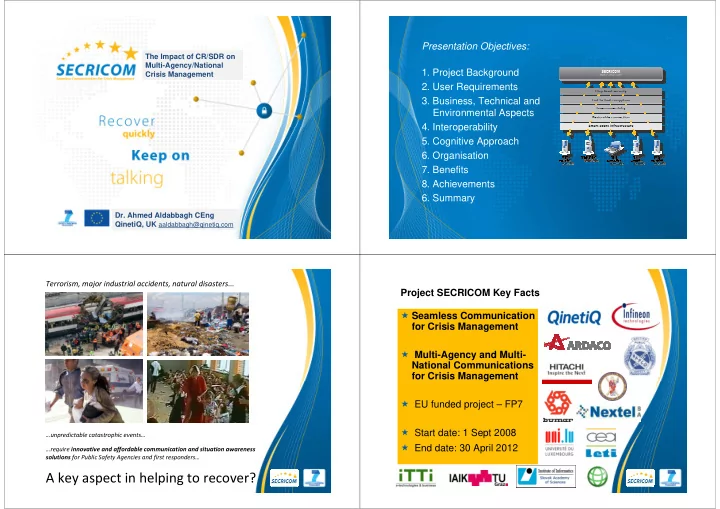
Presentation Objectives: The Impact of CR/SDR on Multi-Agency/National 1. Project Background Crisis Management 2. User Requirements 3. Business, Technical and Environmental Aspects 4. Interoperability 5. Cognitive Approach 6. Organisation


slide-1
SLIDE 1
  • Dr. Ahmed Aldabbagh CEng

QinetiQ, UK aaldabbagh@qinetiq.com The Impact of CR/SDR on Multi-Agency/National Crisis Management

Presentation Objectives:

  • 1. Project Background
  • 2. User Requirements
  • 3. Business, Technical and

Environmental Aspects

  • 4. Interoperability
  • 5. Cognitive Approach
  • 6. Organisation
  • 7. Benefits
  • 8. Achievements
  • 6. Summary

Terrorism, major industrial accidents, natural disasters...

…unpredictable catastrophic events… …require innovative and affordable communication and situation awareness solutions for Public Safety Agencies and first responders…

A key aspect in helping to recover?

Project SECRICOM Key Facts Seamless Communication for Crisis Management Multi-Agency and Multi- National Communications for Crisis Management EU funded project – FP7 Start date: 1 Sept 2008 End date: 30 April 2012

slide-2
SLIDE 2

User Requirements

Towards User Requirements (Use Case Study)

1.2 Preservation of Life - Public

1.2.1 Treatment of injured 1.2.2 Identification of vulnerable people at risk 1.2.3 Nomination of Hospitals to Receive casualties 1.2.4 Evacuation 1.2.5 Establish Evacuee and survivor reception areas 1.2.6 Information to Public

1.2.1.1 Identify locations of Injured people 1.2.1.2 Identification of Resources 1.2.1.3 Establishment of triage areas 1.2.1.4 Provision of transport to hospitals 1.2.1.5 Provision of transport of specialist medical teams to incident 1.2.1.6 Obtain specialist advice (inc. Government) regarding treatment
  • f noxious
chemical injuries 1.2.1.1.1 Receive updates from partner agencies at scene 1.2.1.1.2 Receive information from public re locations
  • f injured people
1.2.1.1.3 Monitor media and
  • ther external
Information sources 1.2.1.2.1 Monitor and review unit & equipment deployed 1.2.1.2.2 Monitor threat to deployed personnel 1.2.1.2.3 Obtain progress reports from deployed resources 1.2.1.3.1 Be advised by partner agencies 1.2.1.3.2 Review appropriate contingency plans, site plans, maps etc (archive data) 1.2.1.3.1 Obtain information from units on site 1.2.1.4.1 Be advised by partner agencies re ingress & egress routes, RV & marshalling points 1.2.1.4.2 Identification of hospitals for casualty reception 1.2.1.4.3 Identification of hospitals for specialist injuries 1.2.1.4.4 Identify availability, location and capability of suitable resources & equipment etc 1.2.1.5.2 Be advised by partner agencies re ingress & egress routes, RV & marshalling points 1.2.1.5.3 Identify availability, location and capability of suitable resources, vehicles & equipment etc 1.2.1.6.1 Provide Information from incident scene to specialist advisor 1.2.1.6.2 Review agency archive data records 1.2.1.6.3 Obtain information from chemical plant 1.2.1.6.4 Obtain relevant information from partner agencies 1.2.2.1 Identify location of risk areas 1.2.2.2 Identify individuals within risk areas 1.2.3.2.1 Safely deploy appropriate resource 1.2.3.1 Monitor numbers of casualties received by each hospital nominated for incident 1.2.3.2 Identification of hospitals with capacity for casualty reception 1.2.4.1 Nominate areas Designated for evacuation 1.2.4.2 Notification to public 1.2.4.2.1 Briefings to media 1.2.4.2.2 Brief units on scene To warn public 1.2.4.1.1 Undertake risk assessment & identify evacuation areas 1.2.4.3 Briefing to resources 1.2.4.3.1 Deployment of appropriate resources to required locations for escort 1.2.4.3.2 Deployment of appropriate resource for security patrols 1.2.4.4 Provision of suitable transport 1.2.4.4.1 Be advised by partner agencies re ingress & egress routes, RV & marshalling points 1.2.4.5 Nominate evacuee & survivor reception areas 1.2.4.4.2 Obtain appropriate number of buses, coaches and trains 1.2.4.5.1 Review appropriate contingency plans, site plans, maps etc (archive data 1.2.5.1 Review appropriate contingency plans, site plans, maps etc (archive data) 1.2.5.2 Call out staff to resource centres 1.2.5.3 Monitor numbers
  • f persons
received 1.2.5.4 Monitor equipment used/available for centres 1.2.5.5 Provide details
  • f persons
received to casualty bureau 1.2.5.2.1 Brief staff 1.2.5.2.2 Establish future resource plan and commence mobilisation 1.2.5.3.1 Have fall back sites readied 1.2.5.3.2 Review appropriate contingency plans, site plans, maps etc (archive data) 1.2.5.4.1 Establish equipment replacement system 1.2.6.1 Multi agency Strategic level agreement 1.2.6.1.1 Situation awareness assessment 1.2.6.1.2 Specialist health advice 1.2.6.1.3 Agency’s Public reassurance Statements (internal draft) 1.2.6.1.4 Deployed units informed of content of public statements 1.2.6.1.1.1 Analysis of agency progress reports and logs 1.2.1.2.4 Deploy resources to required locations 1.2.1.5.1 Identification of known specialist doctors to deal with injures

Command and Control Situational Awareness

IER Exercise - Key Findings

  • Voice is predominant (~50%) with Messaging next (~25%)
  • More voice at Operational level and decreasing up the CofCmnd
  • Data is concentrated at Strategic level and decreasing down the CofCmnd

– Need for data, image and video capabilities at the Operational level

  • Intra-agency communications is key at all levels of command
  • Inter-agency communications account for nearly a quarter of all IERs
  • Situation Awareness (SA) is the greatest proportion of IERs (~59%)

– Ratio of C2:SA is approx 3:2 driven by need for audit trail leading to versions of the same IER voice & data

  • Voice remains most significant IER data type for both

C2 and SA, with SA demands a greater use of data types

High-Level Business Drivers

  • Enabling agencies, when required, to be securely

networked using existing and differing legacy communication systems for effective interoperability

– Including across international borders

  • Enhancing resilience in support of business

continuity during crisis response

  • Enrichment of business information service

types for more effective operations (video, imagery, web, etc)

  • Cost reduction through convergence of

services onto one common IP infrastructure
slide-3
SLIDE 3

Aspects of Crisis Management

  • Business Aspects
  • Technology Aspects
  • Environment Aspects
  • Organisation Aspects

Business, Technical and Environmental Aspects

Business: Stakeholders

Gas Police Fire Health NGOs Transport Electric Water Local Authorities Coast Guard Telecoms Armed Forces Govt Agencies

International Border Business

  • Multi-Agency
  • Multi-National

Cohesive stakeholder collaboration is vital for effective large scale crisis management

slide-4
SLIDE 4

Business: Multi-Agency Operations and the Implications

  • Different technology maturity levels – non interoperability?
  • Different operating procedures – non-compatibility?
  • Very vertical CofCmnd – slow information exchange?

Business: Multi-National Operations and the Implications

  • Variation in procurement

– Cycles – Time scales and – Budgets. – Difficult to predict capabilities, and hence forward plan?

  • Variation in doctrines & regulations

– Inefficient business interoperability? Technical

  • Assumption: Networks

and comms may be partially or completely destroyed in a crisis zone.

  • Need the ability

for networks and comms establishment amongst participating agencies and nations

  • Variation in technology amongst agencies?
  • Justification of cost?

Variability in Technology and Procedures and the Implications

?

Different agencies collaborating during different crisis leads to variability in effective capability from crisis to crisis Implications on planning and overall effectiveness?

slide-5
SLIDE 5

Implications of Multi-National and Multi-Agency Operations on Crisis Management

The variability in technology and business procedures leads to

– Reduced collaboration effectiveness – Increased risk to life saving operations Environment

Costing time and hence life

Organisation: Public Safety & Security Complex and fragmented landscape

– Many agencies with own local requirements – Multiple domains – Fragmented CofCmnd – New technologies incredibly complex with interoperability issues

EA for Public Safety & Security: OSSAF

The Open Safety & Security Architecture Framework aims to align stakeholders within a PS&S organisation and helps to achieve effective transformation, leading to the following benefits:

  • Agility: Responsive technology to evolving needs of the user
  • Interoperability: at the forefront and not an afterthought
  • Cost Reduction: Investments rationalised across multiple

agencies/providers and different generations of systems

  • Decision Support: Strong support for Programme Management
  • Information Management: Better distribution of

information, throughout the chain of command

  • Higher Mission Effectiveness: Achieve better access

to information and common SOPs

slide-6
SLIDE 6

Interoperability

Interoperability is Key

SECRICOM Definition: The capability of two or more

  • rganisations or discrete

parts of the same

  • rganisation to exchange

decision-critical information and to use the information that has been exchanged. Interoperability ranges from

  • rganisational to technical

aspects all of which must be ‘harmonised’ in

  • rder to achieve full

interoperability. Layers of Interoperability SECRICOM Scope: The technical aspects of Interoperability

Variability in Technical and Operational Capabilities; and Interoperability

Convergence is a key efficient enabler of Interoperability

Technical Interoperability From an agency perspective, new systems should provide for:

  • “Intra-agency interoperability”

i.e. new technology works with the agency’s: – Current technology, and – Future technology

  • “Inter-agency interoperability”

i.e. new technology works with other agencies’: – Current technology, and – Future technology

slide-7
SLIDE 7

Cognitive Approach

Convergence as the Approach

Need for Flexible, Business-focused IT Solution Capable of Delivering Diverse Business Applications over Different Communication Systems, Devices and Standards with Resilience to support Business-continuity during Critical and Non-critical Business Operations

Cognitive Networking

  • IP Network-of-networks combines together wired, wireless,

fixed, ad hoc and mobile networks

  • Multi-bearer edge
  • Multi-bearer capable end equipment

Cognitive

  • Management of the

– Business demand to support operations, and – Supply of the communication resource

  • Business continuity is the goal
slide-8
SLIDE 8

Cognitive IP Network-of-Networks

  • Self-planning
  • Self-configuration
  • Self-optimising
  • Self-testing
  • Self-healing
  • Self-maintenance
  • Management of

business demand and supply of communication resource

  • Minimise Cost

– CAPEX – OPEX

Cognitive Radio

  • Ability to pass IPv4/6 traffic, preferably ‘natively’
  • Ability to operate over any infrastructure: mobile, fixed, satellite

and in the following modes:

– Single bearer, and – Multi-bearer: key for interoperability with other agencies

  • Ability to manage user traffic in dynamic multi-bearer availability
  • Ability to operate independently of any infrastructure
  • Ability to use multiple frequencies/bands to match to

the operational environment

– Tunnels, caves and corridors: Waveguide effect – Fires: evidence of fire blocking RF needs to be investigated

  • The ability to use repeaters at key points with CR

capability between the WAN (i.e. with repeaters and also IP Network-of-Networks) and user equipment

Cognitive Radio Architecture (IP)

Cognitive radio as an element of cognitive networks, IET Cognitive Radio Communications Seminar, London, October 2010.

SECRICOM CR/SDR Testbed

  • Extensible
  • Re-Configurable
  • Based on

– Layer 3 model – Server-client

  • Supports infrastructure and infrastructure-less

modes

slide-9
SLIDE 9

Benefits

SECRICOM’s Benefits

  • Increased number of first responders

– Trusted use of Mobile Telephony – Voice communication/instant text messaging – Exchange of imagery and hand-drawings

  • Enhanced information for better operation

– Faster info gathering accessible from mobile devices – Intelligent resource management

  • No eaves-dropping

– Chip-based security – End-to-End encryption – Network monitoring centre

  • Resilient communication service

– Multi-bearer based for resilience – Network monitoring centre

SECRICOM: Access Devices, Bearers and Services

A n y S e c u r e S e r v i c e f r

  • m

A n y A g e n c y

  • v

e r A n y B e a r e r v i a A n y A c c e s s D e v i c e

Achievements within a User Framework

slide-10
SLIDE 10

Achievements to Date

  • Multi-national and multi-agency information exchange over

multi-bearers over commercial networks and COTS products

  • SECRICOM capabilities proven to function effectively in a multi-

agency and multi-national live Civil Protection Exercise (CBRN)

  • Resilient PTT voice over IP using a network-of-networks

underpinned by SECRICOM’s multi-bearer router

  • Use of commercial networks: PTT voice calls conducted

between a Tablet/PCs in the UK and mobile Smart Phones on a Slovak Mobile network

Achievements to Date

  • Range of integrated user devices

– Legacy radios (UHF/VHF): Walkie-Talkies and Citizen-Band Radios – PCs, Laptops, Mobile Phones, PDAs, Tablets

  • Range of integrated/converged information services

– Real-time: PTT Voice, Telephony, Video, Mapping – Data: Imagery, Chat, Web, File Transfer, etc.

  • Range of integrated communication systems

– Satellite and deployable networks – Internet, wireless (WiFi, 3G and GSM) and wired technologies (Broadband, LANs).

  • Vendor independence through the integration of

different devices: PCs, Laptops, Mobile Phones, PDAs and Tablets

Demonstration/Exercise Activities

  • UK 2010
  • CP NATO 2010
  • BAPCO 2010
  • BAPCO 2011

Summary

  • User requirements

– Multi-agency and multi-national – Impact on business, technical, environmental, organisation

  • Convergence and flexibility are key enablers for

interoperability

  • Cognitive networking

– Management of demand & supply for business continuity – Cognitive IP network-of-networks – Cognitive IP radio and its architecture

  • Benefit: towards any secure service from any

Agency over any bearer via any access device

  • Project achievements