Challenge toward Lower Aspect Ratio Challenge toward Lower Aspect - - PowerPoint PPT Presentation

challenge toward lower aspect ratio challenge toward
SMART_READER_LITE
LIVE PREVIEW

Challenge toward Lower Aspect Ratio Challenge toward Lower Aspect - - PowerPoint PPT Presentation

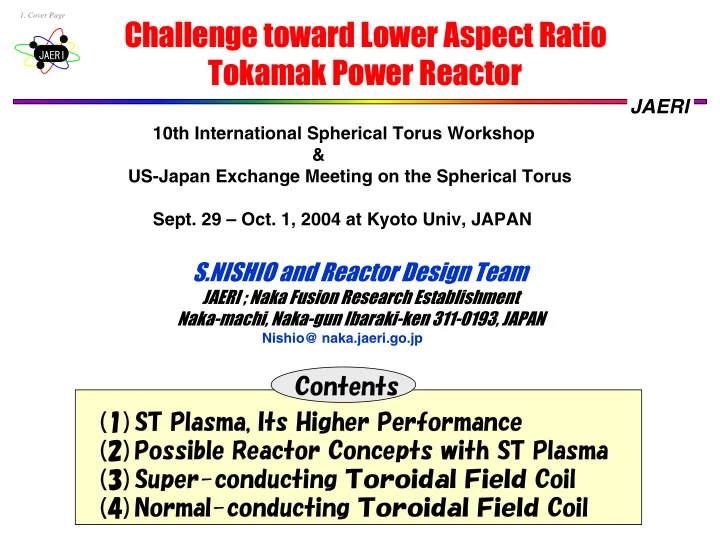
1. Cover Page Challenge toward Lower Aspect Ratio Challenge toward Lower Aspect Ratio JAERI Tokamak Tokamak Power Reactor ower Reactor JAERI 10th International Spherical Torus Workshop & US-Japan Exchange Meeting on the Spherical Torus


slide-1
SLIDE 1
  • 1. Cover Page

JAERI

JAERI

Challenge toward Lower Aspect Ratio Challenge toward Lower Aspect Ratio Tokamak Tokamak Power Reactor

  • wer Reactor

S.NISHIO and Reactor Design Team

JAERI ; Naka Fusion Research Establishment Naka-machi, Naka-gun Ibaraki-ken 311-0193, JAPAN

Nishio@ naka.jaeri.go.jp

(1)ST Plasma, Its Higher Performance (2)Possible Reactor Concepts with ST Plasma (3)Super-conducting Toroidal Field Coil (4)Normal-conducting Toroidal Field Coil Contents

10th International Spherical Torus Workshop & US-Japan Exchange Meeting on the Spherical Torus

  • Sept. 29 – Oct. 1, 2004 at Kyoto Univ, JAPAN
slide-2
SLIDE 2
  • 2. Why

Compact?

JAERI

JAERI

Sensitive Parameters ?

Plasma Beta & Toroidal Coil Neutron Wall Load & Power Core Components

A Craving for Compact & Lightweight

slide-3
SLIDE 3
  • 3. CS-less

JAERI

JAERI

Discard of Center Solenoid Coil Discard of Center Solenoid Coil

CS Coil Support Wheel

In due time, they fall into disuse !!

slide-4
SLIDE 4
  • 4. To VECTOR

JAERI

JAERI

To VECTOR To VECTOR

( A~4 ) ( A~4 ) ( A~ 2 ) ( A~ 2 )

CS-less

Maximum Field, BMAX (T) Center Post Radius, RCP (m) Average Current Density, iAVE (A/mm2)

5 10 15 20 25 20 40 60 80 100 0.5 1 1.5 2 2.5

COIL

1.5 1 2 2 2 4 6 8 10 3 3 4 4 5 5 ST Region Conventional Region

Normalized Beta, βN Ellipticity, κ A s p e c t R a t i

, A

R.L. Miller et al.,

  • Phys. Plasma 4(4), April 1997

PLASMA

Weight Power Density

VECTOR

slide-5
SLIDE 5
  • 5. This is

VECTOR

JAERI

JAERI

This is the VECTOR. This is the VECTOR. Simple Vacuum Boundary

18.2 m Replacement Unit

Simple Maintenance Scheme

Plasma Major Radius : RP = 3.2 m Plasma Minor Radius : aP = 1.4 m Plasma Ellipticity : κ = 2.35 Plasma Current : IP = 14 MA Normalized Beta : βN = 5.7 Fusion Power : PF = 2.5 GW Neutron Wall Load : Pn = 5 MW/m2 Field on axis : B0 = 5 T Reactor Weight : W = 8800 Ton Weight Power Dens. : p = 280 kW/ton

slide-6
SLIDE 6
  • 6. Where is VECTOR

JAERI

JAERI

Where is VECTOR ? Where is VECTOR ?

18.2m VECTOR

30 m

ITER 26m ARIES-RS

20 m

ARIES-ST

slide-7
SLIDE 7
  • 7. Light TFC

Why CS-less TFC is so lightweight ? Why CS-less TFC is so lightweight ?

JAERI

JAERI

TFC weight is in proportion to the stored energy !

slide-8
SLIDE 8
  • 8. Tough

Structure

CS-less TFC Concept, Its characteristics. CS-less TFC Concept, Its characteristics.

JAERI

JAERI

The “Solid” is stronger than the “Barrel” by 5 times.

σθ= -(RB/t)pB σr~0 σr= σθ= -pP Isotropic Support

p P 2R P p B 2R B t

Barrel Structure ( conventional ) Solid Post Structure ( Apple Shape ) Same Area : 2 πRBt= πRP2 Same Load : W = 2πRBpB= 2πRPpP Wedge Support

slide-9
SLIDE 9
  • 9. TFC Design

Flow

Design Flow of SC-ST TF Coil Design Flow of SC-ST TF Coil

JAERI

CP Area Superconducting Filament Area Design Current Density of Filament TFC Ampere-turns TFC Shape Stored Energy Terminal Voltage

  • f TFC System

Conductor Current Electromagnetic Force Structural Material Area Allowable Current Decay Rate Joule Heating Stabilizer Area Cooling Channel Area Insulator Area Plasma Design Neutronics Design Area

Center Post One Sector

Cooling Channel Bi2212 Strands Pb Insulator Structural Material Conductor

JAERI

Optimization of TFC Material Compositon

slide-10
SLIDE 10
  • 10. Plasma Design Flow

JAERI

JAERI

Plasma Design Flow Plasma Design Flow

1.5 1 2 2 2 4 6 8 10 3 3 4 4 5 5 ST Region Conventional Region

Normalized Beta, βN Ellipticity, κ Aspect Ratio,A

Shield Thickness, ∆ Ellipticity, κ Plasma Temp. Plasma Current, I

P

Radius of Center Post Current Density

  • Max. Field, B

Max

Field on Axis, B Minor Radius, a

P

Plasma Power Balance Plasma Dens. MHD Safety Factor, q

Ψ

Confinement, HHy2=1.8 Plasma Dens., n/nGW =1.0 NO YES Plasma Major Radius, R

P

Where is optimum point?

slide-11
SLIDE 11
  • 11. Summary

JAERI

JAERI

Summary Summary

(i) Heavy tokamak is caused by heavy TFC. (ii) CS-less leads to lightweight tokamak. (iii) ST power reactor with NC TFC is skeptical.

Urgent Issue

  • High δ plasma equilibrium
  • Break-down & Current ramp-up
slide-12
SLIDE 12

Parameter Space

JAERI

JAERI