
Slide 1 / 144
Electrochemistry
Slide 2 / 144
· Electrochemistry deals with relationships between reactions and electricity · In electrochemical reactions, electrons are transferred from one species to another. · Provide insight into batteries, corrosion, electroplating, spontaneity of reactions
Electrochemistry Slide 3 / 144 Electrochemical Reactions
· In electrochemical reactions, electrons are transferred between various reactant and product species in reactions. · As a result, oxidation state/number of one or more substances/species change · Oxidation number is the formal charge on the atom when it is connected to other atoms. · In order to keep track of what species loses electrons and what gains them, we assign oxidation numbers/oxidation states to individual atoms.
Slide 4 / 144 Oxidation Numbers
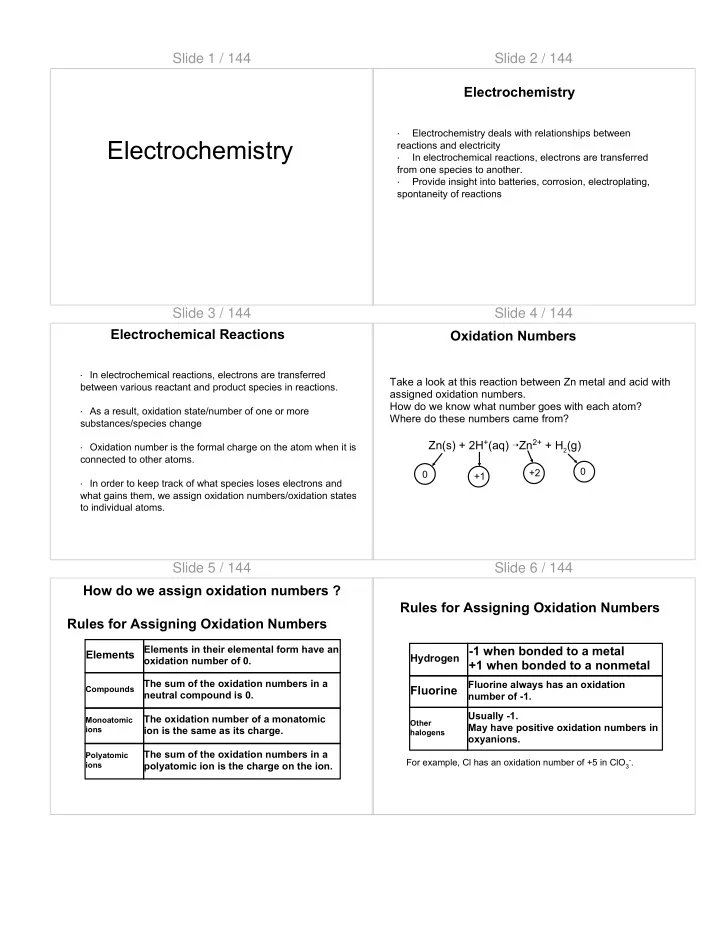
Zn(s) + 2H+(aq) ➝Zn2+ + H2(g)
+1 +2
Take a look at this reaction between Zn metal and acid with assigned oxidation numbers. How do we know what number goes with each atom? Where do these numbers came from?
Slide 5 / 144 Rules for Assigning Oxidation Numbers
Elements
Elements in their elemental form have an
- xidation number of 0.
Compounds The sum of the oxidation numbers in a
neutral compound is 0.
Monoatomic ions
The oxidation number of a monatomic ion is the same as its charge.
Polyatomic ions
The sum of the oxidation numbers in a polyatomic ion is the charge on the ion.
How do we assign oxidation numbers ? Slide 6 / 144
Hydrogen -1 when bonded to a metal
+1 when bonded to a nonmetal Fluorine
Fluorine always has an oxidation number of -1.
Other halogens
Usually -1. May have positive oxidation numbers in
- xyanions.
Rules for Assigning Oxidation Numbers
For example, Cl has an oxidation number of +5 in ClO3
- .