A Hybrid Material Point Method for Frictional Contact with Diverse - - PowerPoint PPT Presentation

a hybrid material point method for frictional contact
SMART_READER_LITE
LIVE PREVIEW

A Hybrid Material Point Method for Frictional Contact with Diverse - - PowerPoint PPT Presentation

A Hybrid Material Point Method for Frictional Contact with Diverse Materials Xuchen Han , Theodore Gast, Qi Guo, Stephanie Wang, Chenfanfu Jiang and Joseph Teran MPM is hybrid Lagrangian/Eulerian Particles: constitutive modeling - the


slide-1
SLIDE 1

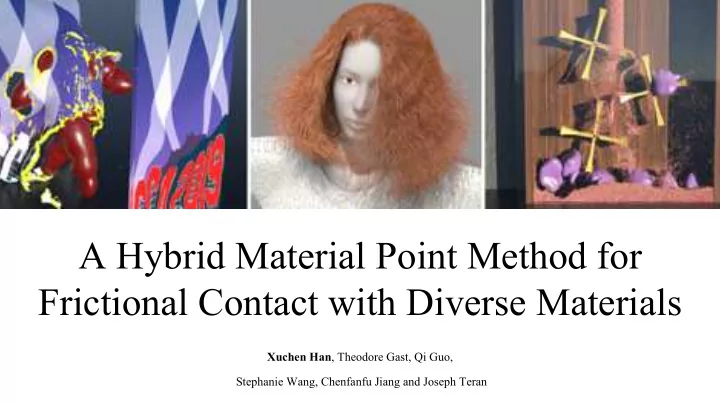
A Hybrid Material Point Method for Frictional Contact with Diverse Materials

Xuchen Han, Theodore Gast, Qi Guo, Stephanie Wang, Chenfanfu Jiang and Joseph Teran
slide-2
SLIDE 2
slide-3
SLIDE 3
slide-4
SLIDE 4

MPM is hybrid Lagrangian/Eulerian

  • Particles: constitutive modeling - the physics
  • Transfer: quadrature rule, collision detect,

topology change

  • Grid handles: the Galerkin DOFs, BC,

discretization

slide-5
SLIDE 5

Stomakhin et al. 2013 Ram et al. 2015 Klar et al. 2016 Stomakhin et al. 2015 Yue et al. 2015 Daviet et al. 2016 Gast et al. 2015 Gao et al. 2018 Wolper et al. 2019 Pradhana et al. 2018

slide-6
SLIDE 6

Elastic potential Element wise energy density Deformation gradient Grid node force Grid node position Particle position

MPM for meshed objects

slide-7
SLIDE 7

Jiang et al. 2017 Jiang et al. 2017 Guo et al. 2018 Guo et al. 2018

slide-8
SLIDE 8

Drawbacks of MPM

Numerical Friction

Δ"Grid = 0.1Δ"Mesh Δ"Grid = Δ"Mesh Δ"Grid = 0.01Δ"Mesh

Grid Dependency

slide-9
SLIDE 9

MPM Collision Prevention

  • Type I: Collision modes penalized via potential energy
  • Type II: Smooth interpolation
slide-10
SLIDE 10

Type I Collision Resolution

slide-11
SLIDE 11

Traction in a continuum

slide-12
SLIDE 12

Traction in a continuum

+

  • Cauchy stress
slide-13
SLIDE 13

Friction and plasticity

Normal force Frictional force Coulomb friction Traction

slide-14
SLIDE 14

Friction and plasticity

Yield surface

slide-15
SLIDE 15

MPM Our method

slide-16
SLIDE 16

MPM Our method

slide-17
SLIDE 17

MPM Collision Prevention

  • Type I: Collision modes penalized via potential energy
  • Move the DOFs to the Lagrangian Mesh
slide-18
SLIDE 18

MPM Collision Prevention

  • Type I: Collision modes penalized via potential energy
  • Type II: Smooth interpolation
slide-19
SLIDE 19

Type II Collision Resolution

slide-20
SLIDE 20

MPM Collision Prevention

  • Type I: Collision modes penalized via potential energy
  • Type II: Smooth interpolation

Modify

slide-21
SLIDE 21

Hybrid MPM

/0 = /1

⋆ − /1

45 /0 ⋅ /1 < 0: Δ/1 = 91:1 ;1 + ;4= ∥ /? ∥, −A 91 ;1 /? ∥ /? ∥ Δ/B = /B

CDE − /B ∗ = ∑ 1

H

˜ B1Δ/1

H

˜ B1 =

HB1;1 ∑0HB0;0 /? = /0 − /0 ⋅ :1:1

/1

/0

/1

:1

DOF Quadrature

slide-22
SLIDE 22

Hybrid MPM

  • 1) Lagrangian Update
  • 2) Transfer to grid
  • 3) Transfer to collision particles
  • 4) Apply impulses
  • 5) Update positions
slide-23
SLIDE 23

Type II Collision Resolution

slide-24
SLIDE 24

Modify Type II Collision

slide-25
SLIDE 25

Δ"Grid = 0.1Δ"Mesh Δ"Grid = Δ"Mesh Δ"Grid = 0.01Δ"Mesh

Modify Type II Collision

Our Method MPM

slide-26
SLIDE 26

Coupling with granular Material

MPM (186s/frame) Our Method (66s/frame)

slide-27
SLIDE 27

220s/frame 73s/frame

slide-28
SLIDE 28

Strands

Curve Surface

slide-29
SLIDE 29
slide-30
SLIDE 30

Strands

Jiang et al. (2017) Our Method

slide-31
SLIDE 31

Strands: Method (Continuous)

  • Decompose motion into J = JK ∘ JM
  • O = OKOM and OK = OK,POK,Q
  • Strand energy: Ψ = ΨM(OK,P) + ΨUPV(OM)
  • ΨUPV(OM) consists of stretching, twisting, and bending potentials, see [Bergou et al. 2010]
  • ΨM(OK,P) is the St.Venant-Kirchhoff Hencky energy, chosen for the ease of plasticity return

mapping

slide-32
SLIDE 32

Strands: Method (Discrete)

  • Strand energy: Ψ = ΨM(OK,P) + ΨUPV(OM)
  • ΨUPV(OM) Lagrangian
  • ΨM(OK,P) MPM
  • Clean up with geometric collision algorithm

/B

∗ = /B C + ΔW XB UPV

;B

Type to enter a caption. Similar to Bridson et al. [2002]

slide-33
SLIDE 33

Strands Comparison

McAdams et al. (2009) Our Method

More than 500 thousand missed collisions 120 missed collisions 156 seconds/frame 55 seconds/frame

slide-34
SLIDE 34

Results

slide-35
SLIDE 35

Results

slide-36
SLIDE 36

Results

slide-37
SLIDE 37

Results

slide-38
SLIDE 38

Results

slide-39
SLIDE 39

Results