A Frictional Roller Coaster Constructing from Design Troy Roller - - PowerPoint PPT Presentation

a frictional roller coaster
SMART_READER_LITE
LIVE PREVIEW

A Frictional Roller Coaster Constructing from Design Troy Roller - - PowerPoint PPT Presentation

A Frictional Roller Coaster Constructing from Design Troy Roller Coaster, Toverland, Netherlands | height = 104 ft | speed = 54 mph | Cost = ???? Do you have any idea of the cost of roller coaster projects? El Toro Six Flags Great Adventure,


slide-1
SLIDE 1

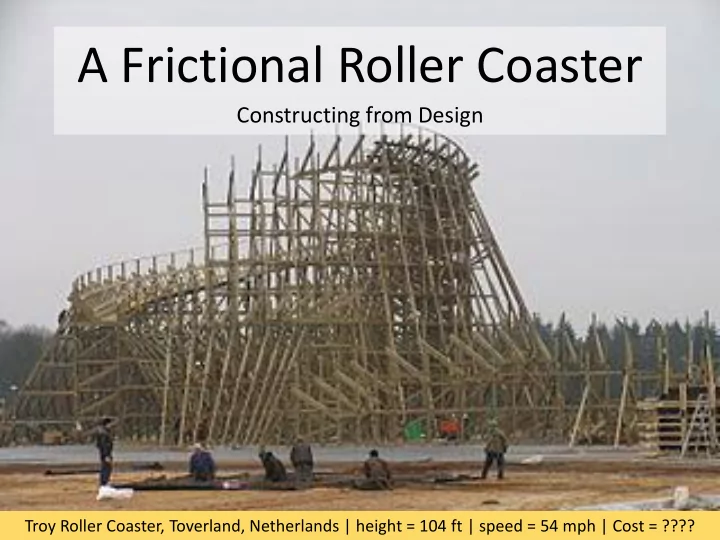
Troy Roller Coaster, Toverland, Netherlands | height = 104 ft | speed = 54 mph | Cost = ????

A Frictional Roller Coaster

Constructing from Design
slide-2
SLIDE 2

Do you have any idea of the cost

  • f roller coaster projects?
slide-3
SLIDE 3

El Toro

Six Flags Great Adventure, Jackson, NJ

Height: 181 ft Speed: 70 mph Length: 4,400 ft

Guess the cost…

slide-4
SLIDE 4

Thunder Dolphin

Tokyo Dome City Attractions, Tokyo, Japan

Height: 260 ft Speed: 81 mph Length: 3,497 ft

Guess the cost…

slide-5
SLIDE 5

Millennium Force

Cedar Point Park, Sandusky, OH

Height: 310 ft Speed: 93 mph Length: 6,995 ft

Guess the cost…

slide-6
SLIDE 6

Steel Dragon 2000, Mie Prefecture, Japan | Height = 318 ft | Speed = 95 mph | Cost = $52M

Roller coasters are expensive and complex projects… Have you ever worked a school roller coaster project?

slide-7
SLIDE 7
slide-8
SLIDE 8

…and to have a lot of fun?

Are you ready for a school roller coaster project?

slide-9
SLIDE 9

Project requirements and constraints:

  • Work as real-world professional engineers do

—from design to final product

  • Use the physics you learned in the previous

lesson, A Tale of Friction

  • Define your roller coaster’s path as a

differentiable function

  • Do the necessary calculations to prove that your

coaster is going to work, before building it Are you ready for all this fun?

Your Engineering Challenge

slide-10
SLIDE 10

Project Guidelines

  • Design your coaster’s path using at least 5

differentiable functions; to simplify the calculations, use parabolas

  • The piecewise function produced must be differentiable
  • Work in teams of 3 or 4 members
slide-11
SLIDE 11
  • Your design dimensions must be appropriate to the flexibility of

the material you use to build the model: foam pipe insulation

  • 1.5-in external diameter pipe insulation material is suggested
  • That means, no very sharp curves or loops
  • Mount the roller coaster on a big enough flat surface;

a 3 x 4-ft cardboard sheet is recommended

Project Guidelines

slide-12
SLIDE 12

𝑤𝑔 = 𝑤𝑗

2 − 2𝑕 ∙ (𝑔 𝑦𝑔 − 𝑔 𝑦𝑗 ) − 4

7 ∙ 𝑕 ∙ 𝑔 𝑦𝑔 − 𝑔(𝑦𝑗)

  • Use this formula

to determine the maximum height the marble will reach after rolling from a high point on the upward-opening parabolas (The velocity of the marble at this maximum height is zero)

Project Guidelines

slide-13
SLIDE 13
  • Use the height the marble reaches at the end of

an upward-opening parabola to determine the height of the vertex for the next downward-

  • pening parabola
  • At path beginning, the initial marble velocity must be zero
  • At path end, the final velocity must also be zero (or almost)

Project Guidelines

slide-14
SLIDE 14
  • Use Excel to make the required computations and

produce a graph of the designed path

  • Use the velocity formula to test the functionality of

the entire designed path; the velocity must be greater than zero at every point on the path, except at the ends

Project Guidelines

slide-15
SLIDE 15
  • Find the piecewise function for the designed

path

                                       96 90 ) 96 ( 5 90 ) 84 ( ) 70 ( 8 ) 56 ( ) 38 ( 13 ) 20 ( ) (

2 64 5 7 534 2 16 1 7 534 7 456 2 17 2 7 456 9 400 2 16 1 9 400 9 284 2 116 13 9 284 2 16 1

x x x x x x x x x x x x x f

  • Use points from this function to build

your model

Project Guidelines

slide-16
SLIDE 16
  • Test your model. Then make conclusions about your

design and your model:

  • Is it behaving as expected? If not, why?
  • What were the failures?
  • What problems did you have during construction?
  • How did you solve them?
  • Make a class presentation of your model, design

process, computations, construction process, and conclusions

  • Support your presentation with a slide show or video.
  • A standalone presentation earns extra points.
  • See details in rubric handout

Project Guidelines

slide-17
SLIDE 17

Have fun with this real-world engineering challenge project!