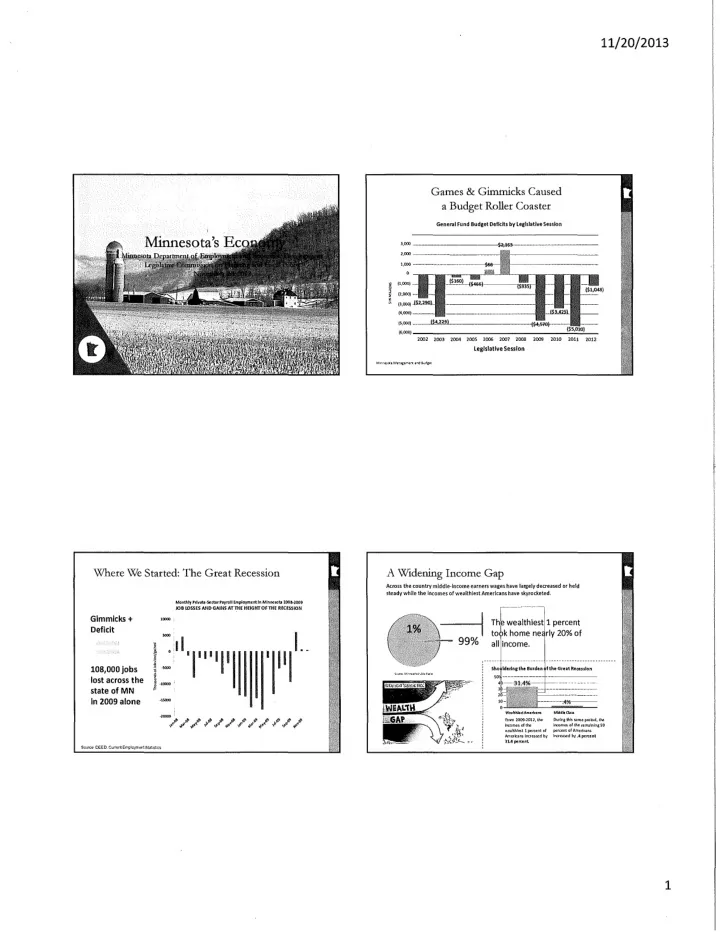
11/20/2013 Games & Gimmicks Caused a Budget Roller Coaster - - PDF document

11 20 2013
SMART_READER_LITE
LIVE PREVIEW

11/20/2013 Games & Gimmicks Caused a Budget Roller Coaster - - PDF document

1\ea\thle~etlpercentof lncomesoftherem~\nlng9 lrw:ome~ofthe Dufngti1>So>me~>iod,the (6,0)-=~- 11/20/2013 Games & Gimmicks Caused a Budget Roller Coaster General Fund Budget Deficits by legislative Session !1,000)


slide-1
SLIDE 1

\V'here \Ve Started: The Great Recession

Gimmicks+ Deficit 108,000 jobs lost across the state of MN in 2009 alone

Mr.lnthly Prlv;rW·So!ctorPayroll Employment In M!noesobi lOOS-2009 JOB lOSSES AND GAINS AT THE HEIGHT OF THE RECESSION

11/20/2013

!1,000)

Games & Gimmicks Caused a Budget Roller Coaster

General Fund Budget Deficits by legislative Session

(4,000)---11111111-----------lllllll--''

(S,OOO) __

l'-"'<£11----------{

(6,0)-=~-

2002 2003 2004 2005 2005 2007 2003 2009 2010 2011 2012

Legislative Session

A Widening Income Gap

Across the country middle-Income earners wages have largely decreased or held steady while the incomes of wealth lest Americans have skyrocketed.

frcm 2009-1012,the Dufngti1>So>me~>«iod,the lrw:ome~ofthe lncomesoftherem~\nlng9 1\ea\thle~etlpercentof percentofAmericans Americans increased by Increased by .4 pe~ent 3L4pertent

1

slide-2
SLIDE 2

How Did It Help Minnesotans?

Generated $1.2 Billion in Revenue that:

b

  • ~!~!~-~-~-~-~!1_~-~-~-~-~!'.~:!~!1

__________________ _

~

Repaid $2.6 billlon to Minnesota schools (School Shift)

1116111 ----------------------------------------------------------------

........ Made historic Investments In education at every level

~-

~

  • ~!.?J.'~.'!-~7_3s_rt1!1!?.~-~!-'.~-~-s-~:P!-'.~£Y?:~-~:2()17_

___

Created a stable economic environment that has jumpstarted the economy

I

11/20/2013

How Did We Do It?

Leveling the Playing Field for the Middle Class

UltlttilttiU -

UltttttUUU

lltlttttttt

II

t

ilttttlitttttt

Ulttttttllllt ttlllltlttlttt ttttllltttlill -

it

Governor Dayton and this Legislature put families first and delivered fairness by asking the wealthiest 2 percent to pay a little

  • ---more In Income taxes- 98 percent
  • f Minnesotans saw no Income

tax Increase.

Games & Gimmicks Caused a Budget Roller Coaster

Actual;~nd

Pro)e<:ted General Fund Budgets by Legislative Session

(S,000)-($"4;570t----ll!illi--------------

(S,000)------{::0$5::;,0:=20;;<)

____________

_ 2008 2009 2010 2011 2012 2013 2014 2015 2016 2017

legislative Session

2

slide-3
SLIDE 3

Investments in our Competitiveness

  • lvlinnesota Investment Fund - $30m
  • Minnesota Job Creation Fund - $24m
  • lvlinnesota Global Competitiveness Initiative - S1.5m
  • Community Redevelopment - S6m
  • Adult Workforce Competitive Grant Program - $3.3m
  • Youth Workforce Competitive Grant Program- $5.7m

Minnesota FastTRAC Adult Career Pathways - $3m

1:

@

Jumpstarting Our Economy

,

Since 2011, Minnesota has added 122,200 new jobs

AND over 200 business expansions

More Jobs on the Way

11/20/2013

I

i,:

3

slide-4
SLIDE 4

Moving Minnesota's Economy Forward

Where We Are: E-12 Education

Where We Lead the Way Where We Must Improve

» Invested $606 million for Minnesota schools (AU-Day K, Early Learning Scholarships, LGA, Spedal Ed Reform)

11/20/2013

~

Digging Out: Paying Back Our Schools

~

~

Total borrowed from Minnesota's kids in the "schoolshlftn $3.000 $2.78

$2500 $2.48 $2.000 $1500

$L18 $1.000

$0.500

$0.000

Nov.2011

  • Feb. 2012

Nov.2012

$BOOM $0 Feb.1013 Feb.2014

Where We Are: Higher Education

Where We Are On Troclt

Where We Must Do Better

»Invested $250 million for Higher Ed, Financial Aid and

Tuition Freete

4

slide-5
SLIDE 5

Educating a World-Class Workforce

Jobs and Investment follow talent. Minnesota has historically had one of the best educated and most innovative workforces. That starts with ensuring Minnesota Kids and their famllles have access to a world-class education. Governor Dayton and this legislature has: Made ail-day kindergarten a realrty for every Minnesota child-~ families $2.500 a year. Provided $606 million to E-12 schools to make sure communities have the tools they need to keep class sizes small, lower property taxes, and ensure every Minnesota get gets a world-class education that prepares them to compete In a 21st century economy. Invested In earty learning to narrow the achievement gap, lay the foundation for success, and deliver a 16:1 return on Investment for taxpayers. Delivered the la11est financial aid Increase In a aeneratlon that will help

~

100,000 students and middle-class families pay for college and froze tuition at state colleges and universities.

Moving Minnesota Schools Forward: Investing Every Year- No Excuses, No Exceptions

'"'

""'

15%

""''

5%

Reforming Government Through Smart Improvements

LEAN CONTINUOUS IMPROVEMENT- Efforts to streamline government

  • perations over the last two years have saved taxpayers an estimated

ill.miiiilm

REFORM 2020- Smart reforms that change how we pay for long-term care services. Providing Minnesotans coordinated, preventive, In-home care to seniors and persons with disabilities that will help avoid costly nursing care and save an estimated S1llJnlJIJ:2n, IT CONSOUOATION -In 2011 streamlined the state's IT systems and consolidated resources. These efforts have saved taxpayers~ and counting and have made Minnesota a national leader in public sector IT consolidation.

11/20/2013 5

slide-6
SLIDE 6

Strengthening Health Care Through Reform

I" HOW WE ARE GETTING STARTED

1950 10 15

20i

25 ' [~6

30' Enacted MNsure: to provide het~lth eare access to over 1 million Minnesotans and save consumers and estimated $1 billion by 2016 Expanded coverqe to 400,000 uninsured Minnesotans which will lower insur.mce premiums for all Minnesotans and save taxpayer5 hundreds of millions of dollars

Minnesota Per-capita Income Rank Among 50 States

2012

1970 1980

19~·

n~

·-r

!ill

it~

lli]l

15

!

1960

17

~

1 Rose from 91% of national average I

We're on the Right Track

"The February 2013 Economic Fore,cast shows that Minnesota's economy continues tO outperform the national economy, thanks to an improving labor market that results in higher-than-expected state revenue collections."

  • MN Budget Project

11/20/2013

6

slide-7
SLIDE 7

11/20/2013

Total Employment Over the Past 14 years

2,800,000

Change by Sector Through Recession and Recovery

60,000 50,000 40,000 10,0001 20,000 10,000

I

  • ~60,0

128,000,000 2010 2012 2000 2002 2006 2008

E I I

I

[7.@1 I I ~ "'

i

~

~

'

  • 10,000'

e

~

i

~

i

2

' g

!

s

~

j

i

  • 20,000

I

~

j

~

i

,

·30,000

"i

~ ~ '

i

  • ~.,.,
~

Unemployment Has Improved Layoffs .Have Diminished

}'~

\'v\_

""

45,000 40,000 35,000 30,000 25,000 20,000 15,000 10,000

'·""

"'"'

1010

7

slide-8
SLIDE 8

And Opportunities/Vacancies Are Up

I I

I

Minnesotans Unemployed For > 26 \Veeks

2002 2003 2004 2005 2006 2007 2003 2009 2010 2011 2012 20U

11/20/2013

So Employment, Unemployment, Vacancies and Layoffs Are At (Or Near) Pre-Recessionary Levels But Top-Level Numbers Conceal Some Persistent Underlying Concerns

  • Long Term Unemployment Persist
  • Demographic Disparities
  • Substantial Underemployment

Improvement Across Sub-groups is Mixed 8

slide-9
SLIDE 9

11/20/2013

Labor Markets Remain Challenging For Youth

'Underemployment' Persists

UR(16-19) 2001 2004

zoos

2006 2001

zooa

2009

zoto zou zou zou

Education Across Job Types

Half of MN's Workforce is Underemployed

100%

10,531

90%

"""

80% 70% EZ,w:

Number Share

60% 19,651 Graduate

Proper.!Y

__ educated/

em_j>loyed

1,465,27~

43.6"!.

'"" ,..

..

Bachelors

Over-educated/Under-employed 1,657,10 49.3°/.

  • 1 Associates

Under-educated 239,517 7.1'/.

30%

i

Iii Some College

20%

l3,!16S

,, HSorless

10%

""

,~,

  • Total

3,361,89E 100.0'/.

HSorless Some College Associates

Bachelors

Graduate

Categories of Jobs By Entry Level Educational Requirements

9

slide-10
SLIDE 10

In Review ....

  • By many measures our labor markets have fully recovered

from the 'Great Recession'

  • But some groups continue to face extreme challenges,

including (but not limited to) the long term unemployed, youth, racial minorities and many with post-secondary education.

  • Regaining a 'full' utilization of our labor resources and

human capital will take much longer than returning to pre-recessionary levels of employment and unemployment.

11/20/2013 10