Need for Speed Tokyo Drift: Hotwheels Edition (A Drifting Control - - PowerPoint PPT Presentation

need for speed tokyo drift hotwheels edition a drifting
SMART_READER_LITE
LIVE PREVIEW

Need for Speed Tokyo Drift: Hotwheels Edition (A Drifting Control - - PowerPoint PPT Presentation

Need for Speed Tokyo Drift: Hotwheels Edition (A Drifting Control Case Study) Eric Wong and Frederick Chen Motivation Pop culture Motivation Pop culture Drifting competitions Motivation Pop culture Drifting competitions Adverse


slide-1
SLIDE 1

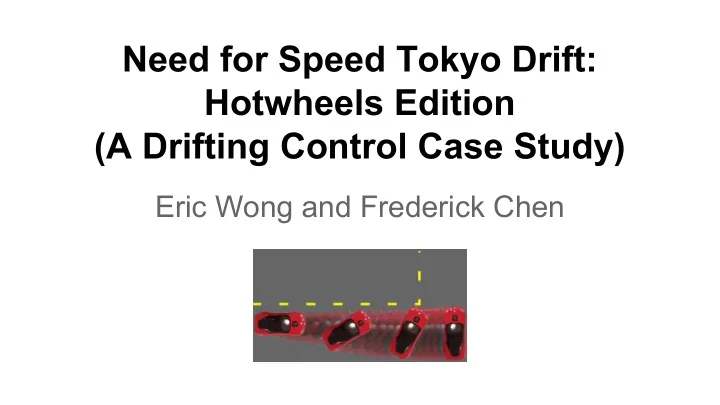
Need for Speed Tokyo Drift: Hotwheels Edition (A Drifting Control Case Study)

Eric Wong and Frederick Chen

slide-2
SLIDE 2

Motivation

Pop culture

slide-3
SLIDE 3

Motivation

Drifting competitions Pop culture

slide-4
SLIDE 4

Motivation

Adverse conditions (snow, rain) Drifting competitions Pop culture

slide-5
SLIDE 5

Motivation

Adverse conditions (snow, rain) Drifting competitions Pop culture

Goal: Understand and create models that work when traction is lost

slide-6
SLIDE 6

Literature Survey

Stability control

  • Ackermann, 1997
  • Liebemann et al.
  • Kiyotaka et al., 2009
slide-7
SLIDE 7

Literature Survey

Formal verification

  • Eyisi et al., 2013 (adaptive cruise

control)

  • Loos & Platzer, 2011 (crossing

intersections) Stability control

  • Ackermann, 1997
  • Liebemann et al.
  • Kiyotaka et al., 2009
slide-8
SLIDE 8

Literature Survey

Simulation-based drifting

  • Ellefsen, 2012
  • Jakobsen, 2011

Formal verification

  • Eyisi et al., 2013 (adaptive cruise

control)

  • Loos & Platzer, 2011 (crossing

intersections) Stability control

  • Ackermann, 1997
  • Liebemann et al.
  • Kiyotaka et al., 2009
slide-9
SLIDE 9

Literature Survey

Simulation-based drifting

  • Ellefsen, 2012
  • Jakobsen, 2011

Formal verification

  • Eyisi et al., 2013 (adaptive cruise

control)

  • Loos & Platzer, 2011 (crossing

intersections) Stability control

  • Ackermann, 1997
  • Liebemann et al.
  • Kiyotaka et al., 2009

Simulations don’t prove reliability of the system!

slide-10
SLIDE 10

Research Questions

  • 1. Can we make and formally verify a

reliable controller that safely drifts to the desired range direction?

  • 2. How close can we get to the desired

direction?

slide-11
SLIDE 11

Drifting motion

slide-12
SLIDE 12

Drifting motion

slide-13
SLIDE 13

Drifting motion

slide-14
SLIDE 14

Drifting motion

slide-15
SLIDE 15

Linear + Circular Motion

slide-16
SLIDE 16

Linear + Circular Motion

slide-17
SLIDE 17

Model Differential Equations

linear motion

slide-18
SLIDE 18

Model Differential Equations

linear motion circular motion on unit circle

slide-19
SLIDE 19

Model Differential Equations

linear motion circular motion on unit circle angular velocity (turning rate)

slide-20
SLIDE 20

Model Differential Equations

linear motion circular motion on unit circle angular velocity (turning rate) We use KeYmaera, a hybrid verification tool for hybrid systems that supports differential dynamic logic to model and prove our properties

slide-21
SLIDE 21

Model Differential Equations

linear motion circular motion on unit circle angular velocity (turning rate)

Controller decision How fast should we turn in order for dx to land in the interval (dxl,dxu)?

We use KeYmaera, a hybrid verification tool for hybrid systems that supports differential dynamic logic to model and prove our properties

slide-22
SLIDE 22

Taylor Series Bounds

Taylor series bounds provide provable differential invariants

slide-23
SLIDE 23

Taylor Series Bounds

Taylor series bounds provide provable differential invariants Use these bounds to find a good angular velocity

slide-24
SLIDE 24

Our Controller Guarantees

  • 1. Our controller is guaranteed to not drift off the road
  • 2. Our controller is guaranteed to drift to a direction

with within an arbitrary range (dxl, dxu)

slide-25
SLIDE 25

Our Controller Guarantees

  • 1. Our controller is guaranteed to not drift off the road
  • 2. Our controller is guaranteed to drift to a direction

with within an arbitrary range (dxl, dxu) Additional Assumption: (dxl, dxu) must satisfy

slide-26
SLIDE 26

Additional Assumption

The minimum range enforced by this condition is reasonably small

dxl = -0.5 : 23.19 degrees dxl = 0.0 : 9.78 degrees dxl = 0.5 : 2.89 degrees

Increasing the order of the Taylor series approximation relaxes this constraint, feasible up to order 8, due to closed form solutions for degree 4 polynomials

slide-27
SLIDE 27

Conclusions

1. Can we make and formally verify a controller that drifts safely to the desired direction? 2. How close can we get to the desired direction?

slide-28
SLIDE 28

Conclusions

1. Can we make and formally verify a controller that drifts safely to the desired direction? 2. How close can we get to the desired direction? Formally verified controller that stays on the road and drifts to within the target range of direction

slide-29
SLIDE 29

Conclusions

1. Can we make and formally verify a controller that drifts safely to the desired direction? 2. How close can we get to the desired direction? Formally verified controller that stays on the road and drifts to within the target range of direction Using a 4th order Taylor approximation our controller can get reasonably small intervals of desired turn, with the potential to go up to an 8th order approximation if necessary

slide-30
SLIDE 30

Parallel Park

slide-31
SLIDE 31

Future Work

Additional Variables to Closer Model Reality

slide-32
SLIDE 32

Future Work

Additional Variables to Closer Model Reality Planning for Unexpected Loss of Traction

slide-33
SLIDE 33

Future Work

Additional Variables to Closer Model Reality Planning for Unexpected Loss of Traction Acceleration while drifting

slide-34
SLIDE 34

Questions?