
SLIDE 1
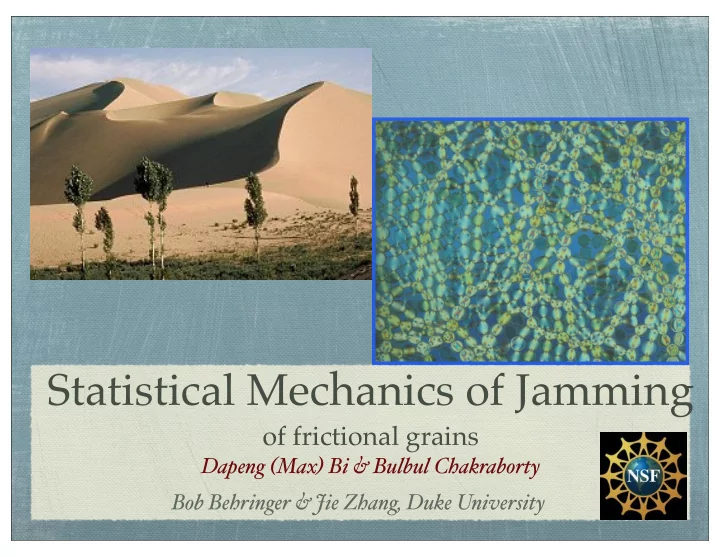
Statistical Mechanics of Jamming
- f frictional grains
Bob Behringer & Jie Zhang, Duke University Dapeng (Max) Bi & Bulbul Chakraborty
Statistical Mechanics of Jamming of frictional grains Dapeng ( Max ) - - PowerPoint PPT Presentation
Statistical Mechanics of Jamming of frictional grains Dapeng ( Max ) Bi & Bulbul Chakraborty Bob Behringer & Jie Zhang, Duke University Jamming A wide variety of systems, including granular media, colloidal suspensions and molecular
Bob Behringer & Jie Zhang, Duke University Dapeng (Max) Bi & Bulbul Chakraborty
“A wide variety of systems, including granular media, colloidal suspensions
and molecular systems, exhibit non-equilibrium transitions from a fluid-like to a solid-like state characterized solely by the sudden arrest of their dynamics.” (Trappe et al, Nature, 411, 772 (2001))
Dry Granular: A special class since a solid can only be produced through
external stress
Increasing volume fraction
Jamming is the transition between them: is this a phase transition? Jammed (resists shear) Unjammed phase flows like a liquid
Granular: Shear can lead to jamming !
Quasistatic shear Solidity stems from applied stress itself
Jammed Unjammed Jammed Unjammed
Shear Jammed Fragile
S J
b
Includes Anisotropic states Only Isotropically Jammed States
(Cates et al, PRL, 81, 1841 (1998))
2 3 4 5 6 0.0 0.2 0.4 0.6 0.8 1.0
f ff P f
0.2 0.4 0.6 0.8 1.0 1.2 0.3 0.4 0.5 0.6 0.7 0.8 0.9 1.0
k fNR threshold
f > k favg Define k-networks
The fraction of non- rattlers can be used to distinguish between two types of states
(Cates et al, PRL, 81, 1841 (1998))
Phase Diagram Fragile Shear-Jammed Yield-Stress line
SJ states have finite yield stress at unjamming (first
Quasistatic cyclic strain creating jammed packings
Quasistatic Steps
100 200 300 400 500 600 700 0.6 0.7 0.8 0.9 1.0
0.3 0.3
ξy/Ly for f > 0 cluster ξy/Ly for f > favg cluster ξx/Lx for f > favg cluster
fNR
SJ states
fNR = 0.83
Response of shear -jammed states Is Point J a special point? Fabric and Stress Relationship Statistical Framework: Force and torque balance are of paramount importance Concept of a Stress Temperature (Angoricity)
(x, 0) (x, L) (x + ∆x, 0) (x + ∆x, L)
(0, y) (0, y + ∆y) (L, y + ∆y) (L, y)
Cleanest with periodic boundary conditions
Thermal System
Thermal reservoir (E,V,N)
The distribution of energy is then given by: P(Em) = 1 Z Ω(Em, Vm, m)e−βEm
Granular materials (athermal)
All blue lines have same
r F
y
L
x (x0)
f ν
x (x0)
r f
x ν (x)
r F
x −
r f
x ν (x)
r F
x
All blue strips have the same “temperature” wrt to fluctuations
Need to consider a collection of 1d systems
The probability distribution of stresses in this subsystem
( ) ( )
x (x0)
Force tile for a grain with 5 contacts area director Increasing density: tiles become more isotropic
temperature-like quantity, named angoricity
principle
Bumpy Particles (with Corey O’Hern)
0.80 0.81 0.82 0.83 0.84 0.85 0.0 0.1 0.2 0.3 0.4 0.5
2 3 4 5 0.0 0.1 0.2 0.3 0.4
(N/m)
b a
Anisotropy of fabric vs Shear Stress Minimum anisotropy of SJ states
F()
0()
< J
Inaccessible region, no SJ states
slope=0()
F()
≥ J
Increasing non-rattler fraction
2 3 4 5 6 0.0 0.2 0.4 0.6 0.8 1.0
f ff P f
ǫmin φ
Z = 3 Z = 3.1
0.05 0.10 0.15 0.20 0.79 0.80 0.81 0.82 0.83 0.84 0.85
φ = 0.798
ǫmin
0.5 1.0 1.5 2.0 2.5
0.05 0.10 0.15 0.20 0.25 0.30 0.0 0.2 0.4 0.6 0.8 1.0
Fraction of non-rattlers Shear Stress Forward Shear
Pressure is not just a function of packing fraction Stresses are determined by fraction of non-rattlers
Anisotropic jammed states occur in frictional systems at packing fractions well below the isotropic jamming threshold The fraction of non-rattlers emerges as parameter that controls the behavior of force networks, and therefore the rigidity Two qualitatively different classes of states: For infinitely rigid grains, fragile states cannot sustain any load that is not along there force-network axis. Both are fragile jammed states. Yield stress of SJ states vanishes discontinuously (Hayakawa, simulations) The observed anisotropic jamming is a reflection of dilatancy: under constant area conditions, shearing leads to jamming