A Formulation of Fast Carry Chains Suitable for Efficient - - PowerPoint PPT Presentation

a formulation of fast carry chains suitable for efficient
SMART_READER_LITE
LIVE PREVIEW

A Formulation of Fast Carry Chains Suitable for Efficient - - PowerPoint PPT Presentation

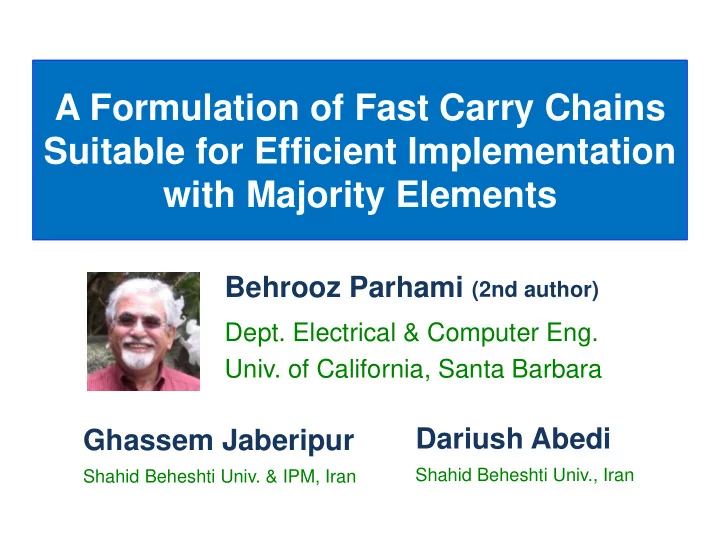
A Formulation of Fast Carry Chains Suitable for Efficient Implementation with Majority Elements Behrooz Parhami (2nd author) Dept. Electrical & Computer Eng. Univ. of California, Santa Barbara Dariush Abedi Ghassem Jaberipur Shahid


slide-1
SLIDE 1

A Formulation of Fast Carry Chains Suitable for Efficient Implementation with Majority Elements

Behrooz Parhami (2nd author)

  • Dept. Electrical & Computer Eng.
  • Univ. of California, Santa Barbara

Ghassem Jaberipur

Shahid Beheshti Univ. & IPM, Iran

Dariush Abedi

Shahid Beheshti Univ., Iran

slide-2
SLIDE 2

Continual Reassessment of Designs

  • Change in cost/delay models with advent of ICs

Transistors became faster/cheaper; wires costlier/slower

  • Adaptation to CMOS, domino logic, and the like

Optimal design for one technology not best with another

  • Power and energy-efficiency considerations

Voltage levels and number of transitions became important

  • Quantum computing and reversible circuits

Fan-out; managing constant inputs and garbage outputs

  • Nanotech and process uncertainty / unreliability

Designs for a wide range of circuit parameters and failures

  • Novel circuit elements and design paradigms

From designs optimized for FPGAs to biological computing

  • B. Parhami

ARITH‐23: Fast Carry Chains with Majority Elements Slide # 002

slide-3
SLIDE 3

Threshold, Majority, Median

Threshold logic extensively studied since the 1940s Majority is a special case with unit weights and t = (n + 1)/2 For 0-1 inputs, majority is the same as median sum = w1x1 + w2x2 + w3x3 For 3-input majority gate: w1 = w2 = w3 = 1; t = 2 “Fires” if weighted sum of the inputs equals or exceeds the threshold value Axioms defining a median algebra

  • B. Parhami

ARITH‐23: Fast Carry Chains with Majority Elements Slide # 003

slide-4
SLIDE 4

Emerging Majority-Based Technologies

  • Quantum-dot cellular automata (QCA)

The basic cell has four electron place-holders (“dots”)

  • Single-electron tunneling (SET)

Based on controlled transfer of individual electrons

  • Tunneling phase logic (TPL)

Capacitively-coupled inputs feed a load capacitance

  • Magnetic tunnel junction (MTJ)

Uses two ferromagnetic thin-film layers, free and fixed

  • Nano-scale bar magnets (NBM)

Scaled-down adaptation of fairly old magnetic logic

  • Biological embodiments of majority function

Basis for neural computation in human / animal brains

  • B. Parhami

ARITH‐23: Fast Carry Chains with Majority Elements Slide # 004

slide-5
SLIDE 5

Three QCA cell configurations

Null “1” “0”

(1,1,0) 1   (0,1,0)  

QCA M gates with 2 sets of inputs A robust QCA Inverter

Quantum-dot Cellular Automata (QCA)

The basic cell has four electron place-holders (“dots”)

  • B. Parhami

ARITH‐23: Fast Carry Chains with Majority Elements Slide # 005

slide-6
SLIDE 6

Single-Electron Tunneling (SET)

Inputs a b c a (a,b,c) a

SET circuits for M (left) and inversion (right) [28] Based on controlled transfer of individual electrons

  • B. Parhami

ARITH‐23: Fast Carry Chains with Majority Elements Slide # 006

slide-7
SLIDE 7

Tunneling Phase Logic (TPL)

Clock 1 Clock 2 Pump Pump

a b c (a,b,c)

The basic TPL gate implements the minority function _ inv(a) = a = minority(a, 0, 1) Capacitively-coupled inputs feed a load capacitance

  • B. Parhami

ARITH‐23: Fast Carry Chains with Majority Elements Slide # 007

slide-8
SLIDE 8

Magnetic Tunnel Junction (MTJ)

Majority gate in MTJ logic

WE WE c b a c b a c b a c b a

c b a

+I

  • I

≡ Uses two ferromagnetic thin-film layers, free and fixed

  • B. Parhami

ARITH‐23: Fast Carry Chains with Majority Elements Slide # 008

slide-9
SLIDE 9

Nano-scale Bar Magnets (NBM)

Two types of nanomagnet wires

1 1 1

Out

1 1

Out

1 1

Out

1 1

Out

Voting with nanomagnets Scaled-down adaptation

  • f fairly old

magnetic logic

  • B. Parhami

ARITH‐23: Fast Carry Chains with Majority Elements Slide # 009

slide-10
SLIDE 10

With generate and propagate ∨ signals: With group-generate : and group-propagate : signals: : ∨ :

  • :, : : ∨ ::, ::

∨ ∨ ∨ 0 1 Carry generation using a majority gate:

The Carry Recurrence and Operator

, ,

  • B. Parhami

ARITH‐23: Fast Carry Chains with Majority Elements Slide # 010

bi ai ci ci+1

slide-11
SLIDE 11

The Full-Adder (FA) Building Block

⨁ ⨁

bi ai ci ci+1 si FA

FA has been widely studied and optimized Implementation with seven 2-input gates:

a b c ci+1 si

i i i

  • B. Parhami

ARITH‐23: Fast Carry Chains with Majority Elements Slide # 011

slide-12
SLIDE 12

Majority-Gate Implementations of FA

, , , , , , , , Blind mapping: Seven partially utilized M-gates, 2 inverters: Three fully-utilized M gates, 2 inverters:

ai bi ci ci+1 Si

1 a b a b

PUM FUM

  • B. Parhami

ARITH‐23: Fast Carry Chains with Majority Elements Slide # 012

c out Si ai bi ci

1 1 1

slide-13
SLIDE 13

Parallel-Prefix Kogge-Stone-Like CGN

KS with

c1 c2 c3 c4 c5 c6 c7 cout

(a1,b1) (a0,b0) (a2,b2) (a3,b3) (a4,b4) (a5,b5) (a6,b6) (a7,b7) (cin,1)

: :

M-based implementations

  • f the building blocks:

: :

Blind mapping Total of 73 PUM gates

  • B. Parhami

ARITH‐23: Fast Carry Chains with Majority Elements Slide # 013

1 1 1

slide-14
SLIDE 14

8-bit CGN: CDP: 5 M FUMs: 13 M total: 28 [61% fewer M-gates than with blind mapping] PUMs: 15 FUM%: 53

1 3 4 1 1 5 6 1 1 2 2 3 3 4 4 5 5 6 6 1 7 7 7 8 (7:3) (7:5) in 1 2 3 (4:3) (4:3) (6:3) (6:5) (6:3) 3 3 5 (6:5) 4 5 6 7 (5:3) (5:3) 1

Exploiting Fully Utilized M-Gates:

First Attempt by Pudi et al.

  • B. Parhami

ARITH‐23: Fast Carry Chains with Majority Elements Slide # 014

slide-15
SLIDE 15

Two-bit CGN with 1 M CDP in ci-to-ci+2 path

a

1

b

i

a b

i i+1 i+1

gi pi pi gi ci ci+1 ci+2

Total for 8-bit adder: 24

, , , , , ,

Conventional (2M delay, 2 FUM):

, , , ,

Exploiting Fully Utilized M-Gates:

Second Attempt by Perri et al.

2-bit CGN: CDP: 1 M FUMs: 4 M total: 6 PUMs: 2 FUM%: 67 [67% fewer M-gates than with blind mapping]

  • B. Parhami

ARITH‐23: Fast Carry Chains with Majority Elements Slide # 015

slide-16
SLIDE 16

Our Compromise Solution

(1M carry-path delay, 3 FUM)

, , , , , , : , , : , , :, :,

Think of : and :, as representing 2-bit inputs and Example:

1 ⟹ 1 ⟹ 1 and 1 ⟹ 1

  • B. Parhami

ARITH‐23: Fast Carry Chains with Majority Elements Slide # 016

slide-17
SLIDE 17

Twin M-gate:

(A,B) (Ar,Br) (Al,Bl) Al Ar Br A B Bl

(:,

:): (, , :, , , :

Properties:

Γ

: Γ :

П: П: :, :,

Associativity: : :, :, :, : :, :,

:

Γ

: A: :

П: :

:

Γ

: Γ :

П: П:

Majority group generate and propagate:

(, ): (, , , , ,

Generalizing the Compromise Solution

  • B. Parhami

ARITH‐23: Fast Carry Chains with Majority Elements Slide # 017

slide-18
SLIDE 18

(a1,b1) (a0,b0) (a2,b2) (a3,b3) (a4,b4) (a5,b5) (a6,b6) (a7,b7) cin

c1 c2 c3 c4 c5 c6 c7 cout

(a0,b0) (a1,b1) (a2,b2) (a3,b3) (a4,b4) (a5,b5) (a6,b6) (a7,b7) cin

c1 c2 c3 c4 c5 c6 c7 cout

KS-Like and LF-Like M-Based CGNs

(with Cin)

  • B. Parhami

ARITH‐23: Fast Carry Chains with Majority Elements Slide # 018

slide-19
SLIDE 19

(a1,b1) (a0,b0) (a2,b2) (a3,b3) (a4,b4) (a5,b5) (a6,b6) (a7,b7) cin

c1 c2 c3 c4 c5 c6 c7 cout

(A1:0,B1:0) (A2:1,B2:1) (A3:2,B3:2) (A4:3,B4:3) (A5:4,B5:4) (A6:5,B6:5) (A7:6,B7:6) (A7:4,B7:4) (A6:3,B6:3) (A5:2,B5:2) (A4:1,B4:1) (a1,b1) (a0,b0) (a2,b2) (a3,b3) (a4,b4) (a5,b5) (a6,b6) (a7,b7) cin

c1 c2 c3 c4 c5 c6 c7 cout

KS-Like M-Based CGNs

(with Cin) (% of FUM: 100)

  • B. Parhami

ARITH‐23: Fast Carry Chains with Majority Elements Slide # 019

slide-20
SLIDE 20

(a0,b0) (a1,b1) (a2,b2) (a3,b3) (a4,b4) (a5,b5) (a6,b6) (a7,b7) cin (A7:6,B7:6) (A5:4,B5:4) (A3:2,B3:2) (A1:0,B1:0) (A6:4,B6:4) (A7:4,B7:4)

c1 c2 c3 c4 c5 c6 c7 cout

(a0,b0) (a1,b1) (a2,b2) (a3,b3) (a4,b4) (a5,b5) (a6,b6) (a7,b7) cin

c1 c2 c3 c4 c5 c6 c7 cout

LF-Like M-Based CGNs

(with Cin) (% of FUM: 100)

  • B. Parhami

ARITH‐23: Fast Carry Chains with Majority Elements Slide # 020

slide-21
SLIDE 21

(a1,b1) (a0,b0) (a2,b2) (a3,b3) (a4,b4) (a5,b5) (a6,b6) (a7,b7) cin (a9,b9) (a8,b8) (a10,b10) (a11,b11) (a12,b12) (a13,b13) (a14,b14) (a15,b15) c1 c2 c3 c4 c5 c6 c7 c8 c9 c10 c11 c12 c13 c14 c15 cout

Scaling up to 16-bit KS-Like Design

  • B. Parhami

ARITH‐23: Fast Carry Chains with Majority Elements Slide # 021

slide-22
SLIDE 22

QCA Implementation: 8-Bit LF-Like

  • B. Parhami

ARITH‐23: Fast Carry Chains with Majority Elements Slide # 022

slide-23
SLIDE 23

Delay

(clock zone)

PUM* FUM* Total M New KS-like 6 30 30 New LF-like 6 20 20 [13] 9 28 7 35 [15] 9 15 13 28

Comparison with Previous Work

(8-bit CGN)

* Partially / Fully-Utilized M-Gates

  • B. Parhami

ARITH‐23: Fast Carry Chains with Majority Elements Slide # 023

slide-24
SLIDE 24

Conclusions and Future Work

  • Best M-based carry-network designs to date

– More efficient use of (fully utilized) M-gates – Applicable to a variety of PPN design styles – Benefits over naïve designs and prior attempts

  • Majority-friendly tech’s becoming important

– Improve, assess, and fine-tune implementations – Extend designs to several other word widths – Obtain generalized cost / latency formulas – Pursue design methods for other technologies

  • B. Parhami

ARITH‐23: Fast Carry Chains with Majority Elements Slide # 024

slide-25
SLIDE 25

Questions or Comments?

parhami@ece.ucsb.edu http://www.ece.ucsb.edu/~parhami/ jaberipur@sbu.ac.ir

  • B. Parhami

ARITH‐23: Fast Carry Chains with Majority Elements Slide # 025