FAST TWO-OPERAND ADDITION A. Conventional number system. - - PowerPoint PPT Presentation

fast two operand addition a conventional number system
SMART_READER_LITE
LIVE PREVIEW

FAST TWO-OPERAND ADDITION A. Conventional number system. - - PowerPoint PPT Presentation

1 FAST TWO-OPERAND ADDITION A. Conventional number system. Carry-propagate adders (CPA) Switched carry-ripple adder Carry-skip adder Carry-lookahead adder Prefix adder Carry-select adder and conditional-sum adder


slide-1
SLIDE 1

1

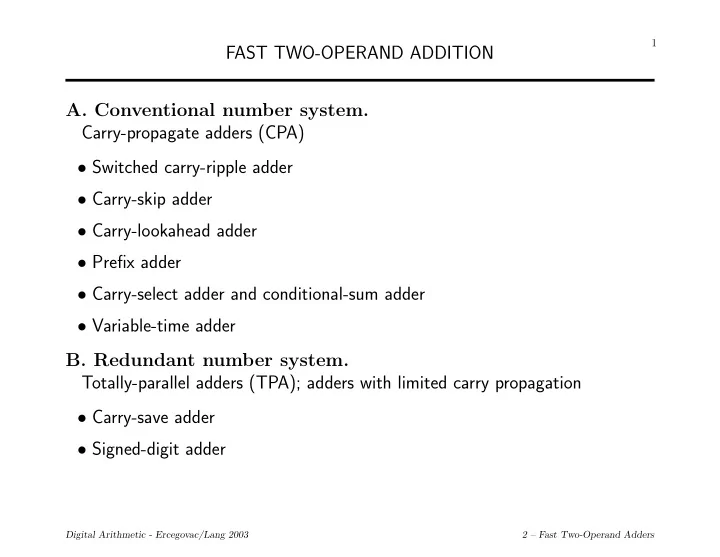
FAST TWO-OPERAND ADDITION

  • A. Conventional number system.

Carry-propagate adders (CPA)

  • Switched carry-ripple adder
  • Carry-skip adder
  • Carry-lookahead adder
  • Prefix adder
  • Carry-select adder and conditional-sum adder
  • Variable-time adder
  • B. Redundant number system.

Totally-parallel adders (TPA); adders with limited carry propagation

  • Carry-save adder
  • Signed-digit adder

Digital Arithmetic - Ercegovac/Lang 2003 2 – Fast Two-Operand Adders

slide-2
SLIDE 2

2

n-BIT ADDITION x + y + cin = 2ncout + s The solution: s = (x + y + cin) mod 2n cout =

      

1 if (x + y + cin) ≥ 2n 0 otherwise = ⌊(x + y + cin)/2n⌋

Digital Arithmetic - Ercegovac/Lang 2003 2 – Fast Two-Operand Adders

slide-3
SLIDE 3

3

ADDER X n Y n S n cout cin

(a)

FA

(b)

xi yi si ci ci+1

Figure 2.1: (a) An n-bit adder. (b) 1-bit adder (full adder module).

Digital Arithmetic - Ercegovac/Lang 2003 2 – Fast Two-Operand Adders

slide-4
SLIDE 4

4

1-BIT ADDITION

  • Primitive module full adder (FA)

xi + yi + ci = 2ci+1 + si with solution si = (xi + yi + ci) mod 2 ci+1 = ⌊(xi + yi + ci)/2⌋

Digital Arithmetic - Ercegovac/Lang 2003 2 – Fast Two-Operand Adders

slide-5
SLIDE 5

5

ADDITION: TWO-STEP PROCESS

  • 1. Obtain carries (carry at i depends on j ≤ i)

– non-trivial to do fast

  • 2. Compute sum bits (local function)

c n

  • ut

c = c 0=

in

c

n-1 c

xn-1 yn-1 sn-1 xi yi ci si

Step 1: Obtain carries Step 2: Compute sum bits

x1 y1 c1 s1 x0 y0 c0 s0

X n Y n

Figure 2.2: Steps in addition.

Digital Arithmetic - Ercegovac/Lang 2003 2 – Fast Two-Operand Adders

slide-6
SLIDE 6

6

CARRY-OUT CASES Case xi yi xi + yi ci+1 Comment 1 kill (stop) carry-in 2 1 1 ci propagate carry-in 1 1 ci propagate carry-in 3 1 1 2 1 generate carry-out Case 1 (Kill): ki = x′

iy′ i = (xi

yi)′ Case 2 (Propagate): pi = xi ⊕ yi Case 3 (Generate): gi = xiyi Then ci+1 = gi pici = xiyi (xi ⊕ yi)ci Alternative (simpler) expression: ci+1 = gi + aici Since ai = k′

i we call it ”alive”

Digital Arithmetic - Ercegovac/Lang 2003 2 – Fast Two-Operand Adders

slide-7
SLIDE 7

7

CARRY CHAINS Two types: 1-carry chain consisting of carry=1 0-carry chain consisting of carry=0 i 9 8 7 6 5 4 3 2 1 xi 1 1 1 1 1 1 yi 1 1 1 p k p p p g p p p k a a a a a a a a ci+1 0 ← 0 1 ← 1 ← 1 ← 1 0 ← 0 ← 0 ← 0

Digital Arithmetic - Ercegovac/Lang 2003 2 – Fast Two-Operand Adders

slide-8
SLIDE 8

8

Generalization to group of bits cj+1 = g(j,i) p(j,i)ci = g(j,i) a(j,i)ci

  • r, for i = 0

cj+1 = g(j,0) p(j,0)c0 = g(j,0) a(j,0)c0 Recursive combining of subranges of variables: g(f,d) = g(f,e) p(f,e)g(e−1,d) = g(f,e) a(f,e)g(e−1,d) a(f,d) = a(f,e)a(e−1,d) p(f,d) = p(f,e)p(e−1,d)

Digital Arithmetic - Ercegovac/Lang 2003 2 – Fast Two-Operand Adders

slide-9
SLIDE 9

9

Generalization (cont.)

(b)

gL aL gR aR gout aout

GA

g(f,e) a(f,e) g(e-1,d) a(e-1,d) f e e-1 d g(f,d) a(f,d)

(a)

GA

Figure 2.3: Computing (g(f,d), a(f,d)).

Digital Arithmetic - Ercegovac/Lang 2003 2 – Fast Two-Operand Adders

slide-10
SLIDE 10

10

BASIC CARRY-RIPPLE ADDER (CRA)

FA =cn

cout = c in c 0 y 0 x 0 c 1 y n-1 x n-1 sn-1 s0

FA

y i x i ci+1 ci si

FA

Figure 2.4: Carry-ripple adder.

TCRA = (n − 1)tc + max (tc, ts)

Digital Arithmetic - Ercegovac/Lang 2003 2 – Fast Two-Operand Adders

slide-11
SLIDE 11

11

Implementations of full-adder

(a)

ci

(c)

si xi yi ci ci+1 p

i

g’

i Half Adder (HA) HA (b)

si xi yi ci ci+1 p

i

g

i

xi x’

i

yi y’

i

x’

i

y’

i c’ i

yi xi ci x’

i y’ i

c’

i

yi xi si xi yi xi ci ci yi ci+1 c’

i+1

Figure 2.5: Implementation of full-adder. (a) Two-level network. (b) Multilevel network with xor, and and or gates; (c) Multilevel implementation with xor and nand gates.

Digital Arithmetic - Ercegovac/Lang 2003 2 – Fast Two-Operand Adders

slide-12
SLIDE 12

12

SWITCHED CARRY-RIPPLE (Manchester) ADDER

ci ci+1

CC CC CC CC CC

c

in

c1 c2 cout

(a) (b)

pi ki gi

GKP

"1" "0"

ci ci+1

CC (Chain Control)

xi yi xi yi x1 y1 x0 y0 yn-1 x n-1 yn-2 x n-2 cn-1 Figure 2.6: Switch carry-ripple network (Manchester circuit)

Digital Arithmetic - Ercegovac/Lang 2003 2 – Fast Two-Operand Adders

slide-13
SLIDE 13

13

CARRY-SKIP ADDER

1

m-bit Carry-Ripple Adder (group j)

MUX

m m m CSK-m adder (a) CSK-m ADDER m m m CSK-m ADDER m m m CSK-m ADDER m m m (b) Module 0 Module j Module (n/m - 1)

P(j)

x(j) y(j) s(j)

cin

(j)

cout

(j)

cin

(j+1)

Figure 2.7: Carry-skip adder: (a) A group with carry bypass. (b) n-bit CSK adder.

Digital Arithmetic - Ercegovac/Lang 2003 2 – Fast Two-Operand Adders

slide-14
SLIDE 14

14

CARRY CHAINS IN CARRY-SKIP ADDER

position

15

t

c4 c8

4 6

4 8 12

c1 c3 c7 c2 2 c6 c10 c11

1 1 1 1 1 1 1 1 1 1 1 1 1 1 1 1 X Y

c16 c14 c13 c15

group 3 group 2 group 1 group 0

group size m = 4 carry-skip path carry-ripple path

c9 c5 c12

Figure 2.8: Carry chains in carry-skip adder: A case with several carry chains.

Digital Arithmetic - Ercegovac/Lang 2003 2 – Fast Two-Operand Adders

slide-15
SLIDE 15

15

m-bit Carry-Ripple Adder

c

n

c sn-1

MUX MUX MUX (a) (b) position 15 t 4 6 4 8 12 c1 c3 c2 2 c5 8 1 1 1 1 1 1 1 1 1 1 1 1 1 1 1 1 1 X Y group 3 group 2 group 1 group 0 c4 c6 c7 c8 c9 c10 c11 group size m = 4 carry-skip path carry-ripple path c12 c13 c14 c15 c16

Figure 2.9: (a) Critical path in carry-skip adder. (b) The worst-case situation for n = 16.

Digital Arithmetic - Ercegovac/Lang 2003 2 – Fast Two-Operand Adders

slide-16
SLIDE 16

16

WORST-CASE DELAY TCSK = mtc + tmux + ( n m − 2)tmux + (m − 1)tc + ts = (2m − 1)tc + ( n m − 1)tmux + ts

Digital Arithmetic - Ercegovac/Lang 2003 2 – Fast Two-Operand Adders

slide-17
SLIDE 17

17

PROBLEM WITH CLEARING OF CARRIES

m-bit Carry-Ripple Adder (group j) P(j) cin

(j)

cout

(j)

cin

(j+1) Figure 2.10: Carry-skip adder using AND-OR for bypass

Digital Arithmetic - Ercegovac/Lang 2003 2 – Fast Two-Operand Adders

slide-18
SLIDE 18

18

GROUP SIZE IN CARRY-SKIP ADDERS Fixed-size: mopt = (tmux

2tc n)1/2 (minimum delay)

Topt ≈ (8tmuxtcn)1/2 Variable-size: Group size Group i M-1 mi M - number of groups

Figure 2.11: Optimal distribution of group sizes in carry-skip adder.

Digital Arithmetic - Ercegovac/Lang 2003 2 – Fast Two-Operand Adders

slide-19
SLIDE 19

19

CARRY-LOOKAHEAD ADDER(CLA)

CLA k-1

m m m

x

(k-1) y (k-1)

s

(k-1)

CLA 1

m m m

CLA

m m m

x

(0)

x

(1)

y

(0)

y

(1)

s

(0)

s

(1)

cm c2m

CLA j

m m m

x

(j)

y

(j)

s

(j)

k=n/m

c0 cn

Figure 2.12: One-level carry-lookahead adder

Digital Arithmetic - Ercegovac/Lang 2003 2 – Fast Two-Operand Adders

slide-20
SLIDE 20

20

CARRY-LOOKAHEAD MODULE

CARRY LOOKAHEAD GENERATOR (CLG-4)

c 4 y 1 x 1 y 2 x 2 y 3 x 3 c 0 G A g3 p 3 p 2 p 1 p 3 p 2 p 1 p 0 c 3 c 2 c 1 s 3 s 2 s 1 s 0 g0 p 0 y 0 x 0 gap a0 gap a1 gap a2 gap a3 g1 g2

CLA-4

Figure 2.13: Carry-lookahead adder module (m = 4).

Digital Arithmetic - Ercegovac/Lang 2003 2 – Fast Two-Operand Adders

slide-21
SLIDE 21

21

CARRY-LOOKAHEAD GENERATOR

G

c0

CLG-4

a3

a2

g2 g3 g1 a1 g0 a0 c4 c3 c2 c1

A

Figure 2.14: 4-bit carry-lookahead generator CLG-4.

Digital Arithmetic - Ercegovac/Lang 2003 2 – Fast Two-Operand Adders

slide-22
SLIDE 22

22

TWO-LEVEL CARRY-LOOKAHEAD ADDER

2 2 2 2 2 2 2 2 4

s7

4

s6

4

s5

4

s4

4

s3

4

s2

4

s1

4

s0

CLA-4

x7

4 CLA-4

x6

4 CLA-4

x5

4 CLA-4

x4

4 CLA-4

x3

4 CLA-4

x2

4 CLA-4

x1

4 CLA-4

x0

4 G

7

A7 G

6

A6 G

5

A5 G

4

A4 G

3

A3 G

2

A2 G

1

A1 G A0 CLG-4 CLG-4

y7

4

y6

4

y5

4

y4

4

y3

4

y2

4

y1

4

y0

4 c0 carries to CLA-4 modules carries from CLG-4 modules critical path

c

(5)=c20

c

(1)=c4

c

(2)=c8

c

(3)=c12

c

(4)=c16

c

(1)=c4

c

(2)=c8

c

(3)=c12

c

(4)=c16

c

(5)=c20

c

(6)=c24

c

(7)=c28

c

(6)=c24

c

(7)=c28

c

(8)=c32

* * Carry-out is not used * * * * * * * Figure 2.15: Two-level carry-lookahead adder (n = 32)

Digital Arithmetic - Ercegovac/Lang 2003 2 – Fast Two-Operand Adders

slide-23
SLIDE 23

23

2 2 2 2 2

s3

2

s2

2

s1

2

s0

CLA-2

x3

2 CLA-2

x2

2 CLA-2

x1

2 CLA-2

x0

2 G

(1)

3 A

(1)

3

G

(1)

2 A

(1)

2

G

(1)

1

A

(1)

1

G

(1)

0 A

(1)

y3

2

y2

2

y1

2

y0

2 c0 carries from CLG-2 modules

c

(1)=c2

c

(2)=c4

c

(3)=c6

* Carry-out is not used * * * * c

(1)=c2

CLG-2

c

(3)=c6

CLG-2 CLG-2

c4 c8

G

(2)

0 A

(2)

G

(1)

1 A

(1)

1

c4

Figure 2.16: Three-level carry-lookahead adder (n = 8, m = 2).

Digital Arithmetic - Ercegovac/Lang 2003 2 – Fast Two-Operand Adders

slide-24
SLIDE 24

24

Prefix adders

(b)

gL aL gR aR gout aout

GA

left2 right2 left1 right1

(a)

GA g(left2,right1) a(left2,right1)

2 2 2

g(right2,right1) a(right2,right1) g(left2,left1) a(left2,left1)

Figure 2.17: Composition of spans in computing (g, a) signals.

Digital Arithmetic - Ercegovac/Lang 2003 2 – Fast Two-Operand Adders

slide-25
SLIDE 25

25

g0 a0 , ( ) g1 a1 , ( ) c0

2 2 2 2

gR gL aL

( ) ,

gout gL aL gR

= +

gL aL

( ) ,

gout gL aL gR

= +

gR aR

( ) ,

aout aL aR

=

gout aout

( ) ,

g6 a6 , ( ) g2 a2 , ( ) g3 a3 , ( ) g4 a4 , ( ) g5 a5 , ( ) g7 a7 , ( ) c1 c2 c8

XOR

p7 s7

XOR

p6 s6 c5

XOR

p5 s5 c4

XOR

p4 s4 p3 s3 c3

XOR

p2 s2

XOR

p1 s1

XOR

p0 s0

XOR

c0 from position (-1) g(6,5) g(4,3) g(2,1) g(6,3) g(5,3) g(2,-1) g(1,-1) g(0,-1) g(6,-1) =c7 c6 a(6,5) a(6,3)

2

a(5,3) a(4,3) a(2,1)

Figure 2.18: 8-bit prefix adder. (Modules to obtain pi, gi, and ai signals not shown.)

Digital Arithmetic - Ercegovac/Lang 2003 2 – Fast Two-Operand Adders

slide-26
SLIDE 26

26

g0 a0 , ( ) g1 a1 , ( ) c0

2 2 2 2

gR gL aL

( ) ,

gout gL aL gR

= +

gL aL

( ) ,

gout gL aL gR

= +

gR aR

( ) ,

aout aL aR

=

gout aout

( ) ,

g6 a6 , ( ) g2 a2 , ( ) g3 a3 , ( ) g4 a4 , ( ) g5 a5 , ( ) g7 a7 , ( ) g(6,5) a(6,5) c8

XOR

p7 s7

XOR

p6 s6

XOR

p5 s5

XOR

p4 s4 p3 s3

XOR

p2 s2

XOR

p1 s1

XOR

p0 s0

XOR

g(1,-1) g(6,-1) =c7 c1 c2 c6 c5 c4 c3 c0 a(4,3) g(4,3) g(2,1) g(0,-1) g(2,-1) a(2,1) g(3,-1) g(4,-1) g(5,-1)

Figure 2.19: 8-bit prefix adder with maximum fanout of three and five levels. (Modules to obtain pi, gi, and ai signals not shown.)

Digital Arithmetic - Ercegovac/Lang 2003 2 – Fast Two-Operand Adders

slide-27
SLIDE 27

27

c1 c2 c8 c7

XOR

p7 s7 c6

XOR

p6 s6 c5

XOR

p5 s5 c4

XOR

p4 s4 p3 s3 c3

XOR

p2 s2

XOR

p1 s1

XOR

p0 s0

XOR

c0 g0 a0 , ( ) g1 a1 , ( ) g7 a7 , ( ) buffer

2 2 2 2

gR gL aL

( ) ,

gout gL aL gR

= +

gL aL

( ) ,

gout gL aL gR

= +

gR aR

( ) ,

aout aL aR

=

gout aout

( ) ,

g(5,4) a(6,5) g(7,6) g(6,5) a(7,6) a(5,4) g(4,3) g(3,2) g(2,1) g(1,0) g(0,-1) a(4,3) a(3,2) a(2,1) a(1,0) g(7,4) g(6,3) g(5,2) g(4,1) g(3,0) g(2,-1) g(1,-1) g(7,0) g(7,-1)

* *

* a(j,k) not labeled

Figure 2.20: 8-bit prefix adder with minimum number of levels and fanout of two.(Modules to obtain pi, gi, and ai signals not shown.)

Digital Arithmetic - Ercegovac/Lang 2003 2 – Fast Two-Operand Adders

slide-28
SLIDE 28

28

CONDITIONAL ADDER (COND ADDER)

COND ADDER

m+1 m m m+1

(b) x y (c0

m , S0)

(c1

m , S1)

1

m-BIT ADDER

m+1

(a)

m-BIT ADDER

m+1 m m

(c0

m , S0)

(c1

m , S1)

x y

COND ADDER Two adders use shared circuits Figure 2.21: (a) Obtaining conditional outputs. (b) Combined conditi onal adder.

Digital Arithmetic - Ercegovac/Lang 2003 2 – Fast Two-Operand Adders

slide-29
SLIDE 29

29

CARRY-SELECT ADDER

MUX

m-BIT ADDER

m+1 m

c0 cn

MUX m+1 MUX m+1 k=n/m

x (1) y (1) x (i) y (i) x (k-1) y (k-1)

COND- ADDER

m+1 m+1

COND- ADDER

m+1 m+1

COND- ADDER

m+1 m+1

x (0) y (0)

m m m m m m m m

s (k-1) s (i) s (1) s (0)

Figure 2.22: Carry-select adder.

Digital Arithmetic - Ercegovac/Lang 2003 2 – Fast Two-Operand Adders

slide-30
SLIDE 30

30

CONDITIONAL-SUM ADDER

MUX MUX X L YL X R YR cR

1

SR

1

cR SR

n/2+1 n/2+1 n/2 n/2 n/2 n/2 n/2 COND-ADDER COND-ADDER

(cL

1 SL 1

,

) n/2+1

(cL

0 SL

,

) n/2+1 n/2 n/2 n/2 n+1 n+1

(c0 S 0 ,

)

(c1 S 1 ,

)

Figure 2.23: Doubling the number of bits of the conditional sum.

Digital Arithmetic - Ercegovac/Lang 2003 2 – Fast Two-Operand Adders

slide-31
SLIDE 31

31

16-bit CONDITIONAL-SUM ADDER

5

ADDER

X3-0 Y3-0 c0 MUX MUX MUX s 15-8 MUX

5 4 4

s 7-4 s 3-0 c4 c8

9

c16

5 5

X15-12 Y15-12

COND- ADDER COND- ADDER

X11-8 Y11-8

5 5

X7-4 Y7-4

COND- ADDER

5

Figure 2.24: 16-bit conditional-sum adder (m = 4).

Digital Arithmetic - Ercegovac/Lang 2003 2 – Fast Two-Operand Adders

slide-32
SLIDE 32

32

TEMPLATE s0

3 s0 2 s0 1 s0

c0

4

c0

2

Step 2 s1

3 s1 2 s1 1 s1

c1

4

c1

2

s0

3 s0 2 s0 1 s0

c0

4

Step 3 s1

3 s1 2 s1 1 s1

c1

4

Figure 2.25: Conditional-sum addition for eight bits with m = 1: (a) Template. (b) E xample.

Digital Arithmetic - Ercegovac/Lang 2003 2 – Fast Two-Operand Adders

slide-33
SLIDE 33

33

7 6 5 4 3 2 1 0 x 0 1 0 1 1 0 1 1 c0 = 0 y 0 1 0 1 0 1 0 1 s0 0 0 0 0 1 1 1 0 c0 0 1 0 1 0 0 0 1 Step 1 s1 1 1 1 1 0 0 0 c1 0 1 0 1 1 1 1 s0 1 0 1 0 1 1 0 0 c0 0 1 Step 2 s1 1 1 1 1 0 0 c1 0 1 s0 1 0 1 0 0 0 0 0 c0 0 1 Step 3 s1 1 0 1 1 c1 0 s 1 0 1 1 0 0 0 0

Digital Arithmetic - Ercegovac/Lang 2003 2 – Fast Two-Operand Adders

slide-34
SLIDE 34

34

PIPELINED ADDERS Increase throughput

y 0 x 0 s 0

FA

y 1 x 1 s 1

FA

y 2 x 2 s 2

FA

y 3 x 3 s 3

FA

c 0

  • latch

c4

Figure 2.26: Pipelined carry-ripple adder (for group size of 1 and n = 4)

Digital Arithmetic - Ercegovac/Lang 2003 2 – Fast Two-Operand Adders

slide-35
SLIDE 35

35

VARIABLE-TIME ADDER: Type 1

STFA ci

1

ci STFA c1

1

c1 STFA c0

1

c0 STFA cn-1

1

cn-1 F cn

1

cn STFA - full-adder module with self-timed carry circuit

Figure 2.27: Variable-time adder: Type 1.

Two carry signals: c0

i zero carry

c1

i one carry

with coding: c0

i c1 i

ci 0 not determined (yet) 1 1 1 1 1 does not occur

Digital Arithmetic - Ercegovac/Lang 2003 2 – Fast Two-Operand Adders

slide-36
SLIDE 36

36

VARIABLE-TIME ADDER: Type 1 cont. STFA module expressions: c0

i+1 = ki(c0 i

c1

i)

pic0

i = kic1 i + (pi

ki)c0

i

c1

i+1 = gi(c0 i

c1

i)

pic1

i = gic0 i

(pi gi)c1

i

si = pi ⊕ c1

i

ki = x′

iy′ i,

gi = xiyi, pi = xi ⊕ yi Addition time: based on actual delays, not worst-case Tvar−1 =

n−1

  • i=0 tc,i

Digital Arithmetic - Ercegovac/Lang 2003 2 – Fast Two-Operand Adders

slide-37
SLIDE 37

37

VARIABLE-TIME ADDER: Type 2

CSFA ci

1

ci CSFA c1

1

c1 CSFA c0

1

c0 CSFA cn-1

1

cn-1 F cn

1

cn CSFA - full-adder module with carry completion sensing

Figure 2.28: Variable-time adder: Type 2.

Carry chains initiated simultaneously CSFA module expressions: c0

i+1 = ki

pic0

i,

c1

i+1 = gi

pic1

i

Digital Arithmetic - Ercegovac/Lang 2003 2 – Fast Two-Operand Adders

slide-38
SLIDE 38

38

Example X 0 1 1 0 0 0 1 1 1 0 0 1 1 0 1 0 Y 1 0 1 0 1 1 0 0 1 1 1 0 0 1 1 0 + a a a b c c c c c d d d d d d e Prop.chains Completion signal: F =

n−1

  • i=0(c0

i

c1

i)

Addition time: proportional to log2(n)

Digital Arithmetic - Ercegovac/Lang 2003 2 – Fast Two-Operand Adders

slide-39
SLIDE 39

39

2’s COMPLEMENT AND 1s’ COMPLEMENT ADDERS

g0 a0 , ( ) g1 a1 , ( ) g6 a6 , ( ) g2 a2 , ( ) g3 a3 , ( ) g4 a4 , ( ) g5 a5 , ( ) g7 a7 , ( ) c1 c2 c7 c6 c5 c4 c3 c0

Prefix Network

end-around carry

(Notes: no cin input; last level consists

  • f "circle" modules)

p7

XOR

s7 p6 s6 p5 p0 s0

XOR XOR

s5

XOR

p4 s4

XOR

p3 s3

XOR

p2 s2

XOR

p1 s1

XOR

g(7,0) a(6,0) g(6,0) a(5,0) g(5,0) a(4,0) g(4,0) a(3,0) g(3,0) a(2,0) g(2,0) a(1,0) g(1,0)

Figure 2.29: Implementing ones’ complement adder with prefix network. (Modules to obtain pi, gi, and ai signals not shown.)

Digital Arithmetic - Ercegovac/Lang 2003 2 – Fast Two-Operand Adders

slide-40
SLIDE 40

40

ADDERS WITH REDUNDANT DIGIT-SET

CPA X[i] S[i] S[i+1] Redundant Adder X[i] S[i] S[i+1] (a) (b) redundant

cycle time depends on precision cycle time does not depend on precision

Figure 2.30: Accumulation with (a) non-redundant, and (b) redundant representation of sum.

Digital Arithmetic - Ercegovac/Lang 2003 2 – Fast Two-Operand Adders

slide-41
SLIDE 41

41

CARRY-SAVE ADDER

(b) FA (a) xi y

i zi

vci+1 vsi FA xi+1 yi+1 zi+1 vci+2 vs

i+1

FA xn-1 yn-1 zn-1 vs

n-1

FA x0 y0 z0 vc1 vs vc0 cin vcn= cout X Y Z CSA VC VS cin cout n n n n n (vc0= cin)

Figure 2.31: Carry-save adder: (a) Bit level. (b) Bit-vector level.

Digital Arithmetic - Ercegovac/Lang 2003 2 – Fast Two-Operand Adders

slide-42
SLIDE 42

42

EXAMPLE OF CARRY-SAVE OPERATION X 0 1 1 1 0 1 0 0 Y 0 0 1 1 1 0 1 1 Z 1 0 1 0 1 0 1 0 V S 1 1 1 0 0 1 0 1 (cout, V C) 0 0 1 1 1 0 1 0 1 digit value 0 1 2 2 1 0 2 0 2

Digital Arithmetic - Ercegovac/Lang 2003 2 – Fast Two-Operand Adders

slide-43
SLIDE 43

43

[4:2] ADDER

vsi FA FA FA FA vci FA vsi+1 vci+1 xi yi wi zi

Figure 2.32: [4:2] adder.

Digital Arithmetic - Ercegovac/Lang 2003 2 – Fast Two-Operand Adders

slide-44
SLIDE 44

44

HIGH RADIX CARRY-SAVE REPRESENTATION XS 1 0 1 1 0 1 1 0 0 XC 1 1 Y 0 1 0 0 0 1 1 1 1 VS 0 0 0 1 1 1 0 1 1 (cout,VC) 1 1

3-bit adder

XS: XC: Y: VS: VC:

3-bit adder

Figure 2.33: Radix-8 carry-save adder.

Digital Arithmetic - Ercegovac/Lang 2003 2 – Fast Two-Operand Adders

slide-45
SLIDE 45

45

SIGNED-DIGIT ADDITION

  • Uses signed-digit representation (redundant)

x =

n−1

  • 0 xiri

with digit set D = {−a, . . . , −1, 0, 1, . . . , a}

  • Limits carry propagation to next position
  • Addition algorithm:

Step 1: x + y = w + t xi + yi = wi + rti+1 Step 2: s = w + t si = wi + ti

  • No carry produced in Step 2

Digital Arithmetic - Ercegovac/Lang 2003 2 – Fast Two-Operand Adders

slide-46
SLIDE 46

46

SD ADDER

(a)

SDA X n Y n S n tn t0

TW

Step 1 Step 2

TW ADD TW ADD ADD (b) ADD TW

s0 si-1 si sn-1 sn tn xn-1 yn-1 xi yi xi-1 yi-1 x0 y0 t0 w0 t1 ti-1 wi-1 ti wi ti+1 tn-1 wn-1

Figure 2.34: Signed-digit addition.

Digital Arithmetic - Ercegovac/Lang 2003 2 – Fast Two-Operand Adders

slide-47
SLIDE 47

47

CASES CONSIDERED Case A : two SD operands; result SD Step 1: (ti+1, wi) =

              

(0, xi + yi) if −a + 1 ≤ xi + yi ≤ a − 1 (1, xi + yi − r) if xi + yi ≥ a (−1, xi + yi + r) if xi + yi ≤ −a

  • algorithm modified for r = 2

Case B : two conventional operands; result SD Case C : one conventional, one SD; result SD

Digital Arithmetic - Ercegovac/Lang 2003 2 – Fast Two-Operand Adders

slide-48
SLIDE 48

48

SIGNED-BINARY ADDITION: METHOD 1 (DOUBLE RECODING) RECODING 1: xi + yi = 2hi+1 + zi ∈ {−2, −1, 0, 1, 2} hi ∈ {0, 1}, zi ∈ {−2, −1, 0} qi = zi + hi ∈ {−2, −1, 0, 1} RECODING 2: qi = zi + hi = 2ti+1 + wi ∈ {−2, −1, 0, 1} ti ∈ {−1, 0}, wi ∈ {0, 1} THE RESULT: si = wi + ti ∈ {−1, 0, 1}

Digital Arithmetic - Ercegovac/Lang 2003 2 – Fast Two-Operand Adders

slide-49
SLIDE 49

49

METHOD 1 SD ADDER

si si-1 ti+1 wi-1 ti wi ti-1

TW TW ADD ADD

qi qi-1 h

i+1

zi-1 hi zi hi-1

HZ ADD ADD

Recoding 1 Recoding 2

HZ HZ

xi yi xi-1 yi-1 xi-2 yi-2

Figure 2.35: Double recoding method for signed-bit addition

Digital Arithmetic - Ercegovac/Lang 2003 2 – Fast Two-Operand Adders

slide-50
SLIDE 50

50

SIGNED BINARY ADDITION: METHOD 2 (Using Previous Digit) Pi =

              

0 if (xi, yi) both nonnegative (which implies ti+1 ≥ 0) 1 otherwise (ti+1 ≤ 0) xi + yi Pi−1 ti+1 wi 2

  • 1

1 0(ti ≥ 0) 1

  • 1

1 1(ti ≤ 0) 1

  • 1

0(ti ≥ 0)

  • 1
  • 1

1(ti ≤ 0)

  • 1

1

  • 2
  • 1

Digital Arithmetic - Ercegovac/Lang 2003 2 – Fast Two-Operand Adders

slide-51
SLIDE 51

51

METHOD 2 SD ADDER

si si-1 ti+1 wi-1 ti wi ti-1

TW ADD ADD TW

xi-2

TW P P

P

i-1

xi yi xi-1 yi-1 Pi-2 yi-2

Figure 2.36: Signed-bit addition using the information from previous digit

Digital Arithmetic - Ercegovac/Lang 2003 2 – Fast Two-Operand Adders

slide-52
SLIDE 52

52

Example X 0 1 1 1 1 1 0 1 1 Y 0 1 1 0 1 0 1 0 1 P 0 0 0 0 1 0 0 1 0 W 0 0 0 1 0 1 1 1 0 T 0 1 1 0 1 1 0 0 1 0 S 1 1 0 0 1 1 1 0 0

Digital Arithmetic - Ercegovac/Lang 2003 2 – Fast Two-Operand Adders

slide-53
SLIDE 53

53

BIT-LEVEL IMPLEMENTATION OF RADIX-2 ALGORITHMS

  • Case C: xi ∈ {0, 1},

yi, si ∈ {−1, 0, 1}

  • Code: borrow-save yi = y+

i − y− i , y+ i , y− i ∈ {0, 1}, sim. for si

  • xi + yi ∈ {−1, 0, 1, 2}: recode to (ti+1, wi), ti+1 ∈ {0, 1}, wi ∈ {−1, 0}

xi + y+

i − y− i = 2ti+1 + wi

xi + yi -1 0 1 2 wi

  • 1 0 -1 0

ti+1 0 0 1 1

Digital Arithmetic - Ercegovac/Lang 2003 2 – Fast Two-Operand Adders

slide-54
SLIDE 54

54

SWITCHING FUNCTIONS FOR ti+1 AND wi xi y+

i

y−

i

xi + yi ti+1 −wi 1

  • 1

1 1 1 1 1 1 1 1 1 1 1 1 1 1 1 1 2 1 1 1 1 1 1 1 wi = (xi ⊕ y+

i ⊕ (y− i )′)′

ti+1 = xiy+

i

xi(y−

i )′

y+

i (y− i )′

= ⇒ implemented using a full-adder and inverters (for variables subtracted)

Digital Arithmetic - Ercegovac/Lang 2003 2 – Fast Two-Operand Adders

slide-55
SLIDE 55

55

FA xi y+

i

y-

i

wi ti+1 s-

i

FA xi-1 y+

i-1 y- i-1

wi-1 t i s-

i-1

s+

i

s+

i-1

ti-1

Figure 2.37: Redundant adder: one operand conventional, one operand redundant, result redundant.

Digital Arithmetic - Ercegovac/Lang 2003 2 – Fast Two-Operand Adders

slide-56
SLIDE 56

56

BOTH OPERANDS REDUNDANT

  • Apply double recoding

FA wi ti+1 s-

i

FA wi-1 t i s-

i-1

s+

i

s+

i-1

ti-1 FA y+

i

x-

i

z i h

i+1

FA y+

i-1 y- i-1

z i-1 hi h

i-1

y-

i

x+

i-1 x- i-1

x+

i

{0,1} {-2,-1,0} {0,1} {-1,0} {0,1}

v i v i-1

Figure 2.38: Redundant adder: operands and result redundant

Digital Arithmetic - Ercegovac/Lang 2003 2 – Fast Two-Operand Adders

slide-57
SLIDE 57

57

SUMMARY Scheme Delay Area proportional to proportional to Linear structures: Carry ripple n n Carry lookahead (one level) n/m (kmm)(n/m) = kmn Carry select (one level) n/m (kmm)(n/m) = kmn Carry skip (one level) √n n Logarithmic structures: Carry lookahead (max. levels) 2 logm n (kmm)(n/m) = kmn Prefix logm n ((kmm) logm n)n Conditional sum log2(n/m) (km + log2(n/m))n Completion signal (avg. delay) (log2 n)/m kmm(n/m) = kmn Redundant const. n

Digital Arithmetic - Ercegovac/Lang 2003 2 – Fast Two-Operand Adders