EE 457 Unit 2b Fast Adders Carry-Lookahead Adders (Carry-Lookahead - - PowerPoint PPT Presentation

ee 457 unit 2b
SMART_READER_LITE
LIVE PREVIEW

EE 457 Unit 2b Fast Adders Carry-Lookahead Adders (Carry-Lookahead - - PowerPoint PPT Presentation

2b.1 2b.2 EE 457 Unit 2b Fast Adders Carry-Lookahead Adders (Carry-Lookahead Adder) FAST ADDERS 2b.3 2b.4 Ripple Carry Adder Critical Path Ripple Carry Adders Critical Path = Longest possible delay path Ripple-carry adders (RCA)


slide-1
SLIDE 1

2b.1

EE 457 Unit 2b

Fast Adders (Carry-Lookahead Adder)

2b.2

FAST ADDERS

Carry-Lookahead Adders

2b.3

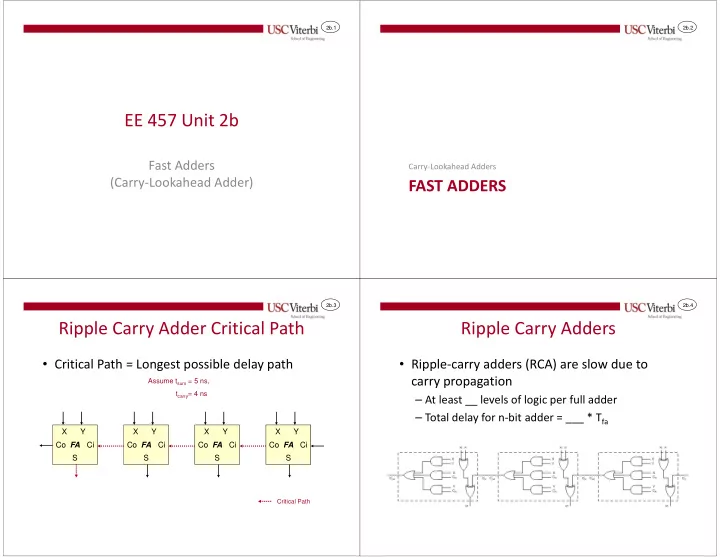
Ripple Carry Adder Critical Path

  • Critical Path = Longest possible delay path

X Y S Ci Co X Y S Ci Co FA FA X Y S Ci Co X Y S Ci Co FA FA

Critical Path

Assume tsum = 5 ns, tcarry= 4 ns

2b.4

Ripple Carry Adders

  • Ripple-carry adders (RCA) are slow due to

carry propagation

– At least __ levels of logic per full adder – Total delay for n-bit adder = ___ * Tfa

slide-2
SLIDE 2

2b.5

Fast Adders

  • Recall that any logic function can be implemented as a

____________ implementation

– SOP (AND-OR / NAND-NAND) implementation – POS (OR-AND / NOR-NOR) implementation

  • Rather than waiting for the previous carry,

[Ci+1 = ___________] can we compute the carry as a function of just the inputs

– Ci+1 = f(Xi,Xi-1,…X0,Yi,Yi-1,…Y0) – This requires gates with many inputs which is infeasible in modern technologies above 4 or 5 inputs – But, we can try to use this idea of generating multiple _______________ by looking at many inputs

2b.6

Fast Adders

  • To produce multiple carries in parallel, let us define some new

signals for each column of addition that indicate information about the carry-out regardless of carry-in:

– gi = ____________: This column will generate a carry-out whether or not ______________________ gi is true when Ai and Bi is 1 => gi = Ai • Bi – pi = _____________: This column will propagate a carry-in (if there is

  • ne) to the carry-out.

pi is true when Ai or Bi is 1 => pi = Ai + Bi

  • Using these signals, we can define the carry-out (ci+1) as:

ci+1 = __________

2b.7

Carry Lookahead Analogy

  • Consider the carry-chain like a long tube broken into
  • segments. Each segment is controlled by a valve

(propagate signal) and can insert a fluid into that segment (generate signal)

  • The carry-out of the diagram below will be true if g1

is true or p1 is true and g0 is true, or p1, p0 and c1 is true

2b.8

Carry Lookahead Logic

  • Define each carry in terms of pi, gi and the

initial carry-in (c0) and not in terms of ____ __________________________________

  • c1 = g0 + p0c0
  • c2 = g1 + p1c1 = __________________
  • c3 =
  • c4 =
slide-3
SLIDE 3

2b.9

4-Bit CLA

  • At this point we should probably stop as we have a _______ gate in our

equation

  • Let’s take our logic and build a 4-bit carry lookahead adder (CLA)

CLL

a3 b3 s3 a0 b0 s0 c0 a1 b1 s1 a2 b2 s2 p3 g3 c4 p2 g2 c3 p1 g1 c2 p0 g0 c1 c0 P G C4

Delay to produce s2

  • Delay for pi,gi = ____
  • Delay to produce c2 = ___
  • Delay to produce s2 = ___

= ___ gates (Compare to 8 gate delays for RCA) Is S3 produced later than S2? Is C3 the last signal produced?

2b.10

Carry Lookahead Adder

  • Use carry-lookahead logic

to generate all the carries in one shot and then create the sum

  • Example 4-bit CLA shown

below

2b.11

16-Bit CLA

  • At this point we should probably stop as we have a 5-input gate in our

equation

16-bit RCA Delay = _____ = ____ gate delays Delay of the above adder design = __________ = ___ gates Let us improve by looking ahead at a higher level to produce C16, C12, C8, C4 in _______________

A[15:12] B[15:12] A[11:8] B[11:8] A[7:4] B[7:4] A[3:0] B[3:0] S[15:12] S[11:8] S[7:4] S[3:0] C16 C4 C8 C12 C0

Define P and G as the overall Propagate and Generate signals for a set of 4 bits P = ____________________ G = ___________________________________________

PG PG PG PG What’s the difference between the equation for G here and C4 on the previous slides 2b.12

16-bit CLA Closer Look

  • Each 4-bit CLA only propagates its overall carry-in if each of the 4 columns propagates:

– P0 = p3• p2 •p1 •p0 – P1 = p7• p6 •p5 •p4 – P2 = p11• p10 •p9 •p8 – P3 = p15• p14 •p13 •p12

  • Each 4-bit CLA generates a carry if any column generates and the more significant columns

propagate

– G0 = g3 + (p3 •g2) + (p3 •p2 •g1)+(p3 •p2 •p1 •g0) – … – G3 = g15 + (p15 •g14) + (p15 •p14 •g13)+(p15 •p14 •p13 •g12)

  • The higher order CLL logic (producing C4,C8,C12,C16) then is realized as:

– (C4) =>C1 = G0 + (P0 •c0) – … – (C16) => C4 = G3 + (P3 •G2) + (P3 •P2 •G1) +(P3 • P2 • P1 • G0)+ (P3 •P2 •P1 •P0 •c0)

  • These equations are exactly the same CLL logic we derived earlier
slide-4
SLIDE 4

2b.13

16-Bit CLA

  • Understanding 16-bit CLA hierarchy…

CLL CLL CLL CLL C16 C4 C8 C12 C0 Delay = = ___ = Delay in producing Pi,Gi = ___ = Delay in producing Pi*,Gi* = ___ = Delay in producing C4,C8,C12,C16 = ___ = Delay in producing c15 = ___ = Delay in producing S15

P

CLL

p3 g3 c4 p2 g2 c3 p1 g1 c2 p0 g0 c1 c0 P* G* G P G P G P G G

c15

2b.14

64-Bit CLA

  • We can reuse the same CLL logic to build a 64-bit CLA

= ___ = Delay in producing S63 Is the delay in producing s63 the same as in s35? = ___ = Delay in producing S2 = ___ = Delay in producing S0 CLL CLL CLL CLL C16 C32 C48

P

CLL

p3 g3 c4 p2 g2 c3 p1 g1 c2 p0 g0 c1 c0 P G G P G P G P G G C52 C56 C60 c63 C36 C40 C44 C20 C24 C28 C4 C8 C12

C0

s35

= ___ = Delay in producing Pi,Gi = ___ = Delay in producing Pj*,Gj* = ___ = Delay in producing C48 = ___ = Delay in producing C60 = ___ = Delay in producing C63 = ___ = Delay in producing S63 = _____ Total Delay

Pi,Gi Pi*,Gi* Pi**,Gi**

2b.15

Extrapolating CLA Logic Levels

  • In the above designs we’ve assumed 5-input AND

and OR gates are reasonable allowing us to group in blocks of 4

– Define b = blocking factor = number of carries produced in parallel

  • The greater the blocking factor the smaller the depth
  • f logic (and vice-versa)
  • This leads us to reason that the delay of a CLA is

O(logbn)

  • If we could only use 3-input gates we’d need a

blocking factor of 2

2b.16

Blocking factor of 2

  • Each A box

generates

– pi = ai + bi – gi = ai • bi – si = ai⊕bi

  • Each B box

generates

– Pi = pi • pi-1 – Gi = gi+pi • gi-1 – ci+1=Gi + (Pi•ci)

slide-5
SLIDE 5

2b.17

  • Key lesson: In logic design trees are better

than chains!

2b.18

Credits

  • These slides were derived from Gandhi

Puvvada’s EE 457 Class Notes