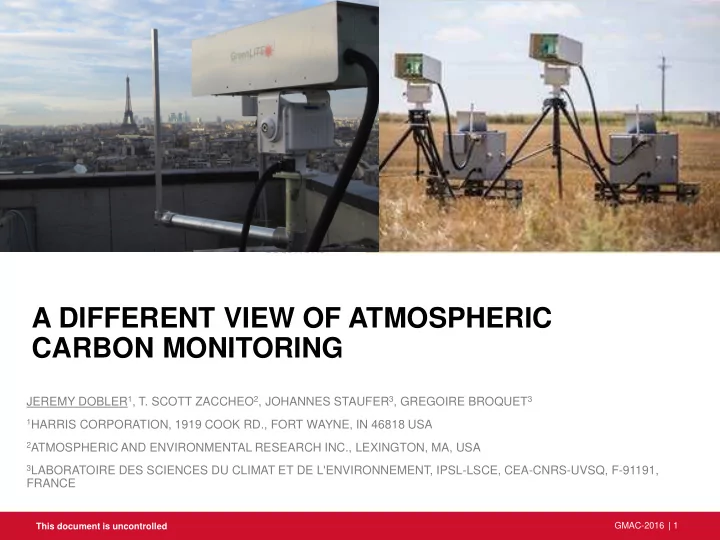
A DIFFERENT VIEW OF ATMOSPHERIC CARBON MONITORING JEREMY DOBLER 1 , - - PowerPoint PPT Presentation

a different view of atmospheric carbon monitoring
SMART_READER_LITE
LIVE PREVIEW

A DIFFERENT VIEW OF ATMOSPHERIC CARBON MONITORING JEREMY DOBLER 1 , - - PowerPoint PPT Presentation

Place image here (13.33 x 3.5) A DIFFERENT VIEW OF ATMOSPHERIC CARBON MONITORING JEREMY DOBLER 1 , T. SCOTT ZACCHEO 2 , JOHANNES STAUFER 3 , GREGOIRE BROQUET 3 1 HARRIS CORPORATION, 1919 COOK RD., FORT WAYNE, IN 46818 USA 2 ATMOSPHERIC AND


slide-1
SLIDE 1

| 1 GMAC-2016 This document is uncontrolled

Place image here (13.33” x 3.5”)

A DIFFERENT VIEW OF ATMOSPHERIC CARBON MONITORING

JEREMY DOBLER1, T. SCOTT ZACCHEO2, JOHANNES STAUFER3, GREGOIRE BROQUET3

1HARRIS CORPORATION, 1919 COOK RD., FORT WAYNE, IN 46818 USA 2ATMOSPHERIC AND ENVIRONMENTAL RESEARCH INC., LEXINGTON, MA, USA 3LABORATOIRE DES SCIENCES DU CLIMAT ET DE L'ENVIRONNEMENT, IPSL-LSCE, CEA-CNRS-UVSQ, F-91191,

FRANCE

slide-2
SLIDE 2

| 2 GMAC-2016 This document is uncontrolled

  • Provides 24/7 real-time measurements
  • Near-surface concentrations
  • 2-D view of the concentration and distribution of near-surface CO2.
  • Collaboration between the Harris Corporation and Atmospheric and

Environmental Research (AER)

  • System Design:
  • Employs differential absorption spectroscopy to measure integrated

column CO2 concentrations for a set of user defined paths 200m – 5 km in length (transceivers to retro reflectors)

  • Constructs 2-D distribution using sparse tomography over 0.25 to >25

km2

  • Original system developed for the DOE for detecting and

measuring CO2 leakage from geological storage sites

  • Field Deployments and Installations
  • Montana State University Zero Emissions Research and Technology

(ZERT) facility

  • The Illinois Basin - Decatur Project : Large scale GCS project
  • NOAA Boulder Atmospheric Observatory (BAO) tower
  • Paris FR
  • Ongoing work
  • Validation and extensions of approach to other trace gases, e.g. CH4

Greenhouse gas Laser Imaging Tomography Experiment - GreenLITE

Paris Deployment Time Varying Average CO2

2-D Spatial Distribution

slide-3
SLIDE 3

| 3 GMAC-2016 This document is uncontrolled

  • Initially developed to monitor ground

carbon storage sites

  • GreenLITE Approach: Retrieve CO2 (or
  • ther trace gas) column amount from

differences in observed optical depths for two closely spaced laser wavelengths over a defined atmospheric round trip path.

  • Repeat for many overlapping paths spanning

a plane.

  • Use intersecting retrieved column values to

estimate concentration distribution across the plane.

Estimating Column CO2 via Differential Laser Absorption Spectroscopy (LAS)

Basic Retrieval Recipe

  • 1. Simultaneously measure absorption of “On”-line wavelength λ (on absorption

feature of interest) and absorption of “Off”-line wavelength λ+ Δ (in the continuum)

  • 2. Fit estimated column value XCO2 to observed difference given path length

and local atmospheric state

  • 3. Retrieve spatial information through sparsely sampled tomography approach
slide-4
SLIDE 4

| 4 GMAC-2016 This document is uncontrolled

  • Basic iterative RT-based approach
  • 1. Ingest
  • Observed optical depths
  • In situ surface observations (T, RH and P)
  • 2. Model expected optical depth given path

configuration and T, RH and P

  • 3. Assess difference between model and

measured values

  • 4. Adjust CO2 column amount based on gradient
  • 5. Converge when model matches measured

values

  • Extended approach for chord length > 1 km over

varying topography

  • Minimize fit for a sum of fixed sub-chord

segments along the path with fixed lengths and varying atmospheric states.

  • Construct 2-D views using model-based

tomographic reconstruction approach

  • Describes underlying field as function of analytic

features and simple 2-D background gradient

Retrieving CO2 Concentrations from Optical Depth Measurements

LBLRTM RT Model

Observed ODs Observed T,RH and P Initial Guess 380ppm

Less Than Threshold Compute New CO2 Value

No Yes

Report CO2 Column Amount Update CO2 Value

slide-5
SLIDE 5

| 5 GMAC-2016 This document is uncontrolled

  • Autonomous, remotely operated set of

transceivers with multiple reflectors

  • Eye-safe 1571 nm, 5mW CW transmitter
  • Measures differential transmission and range
  • ver multiple intersecting paths
  • 3G/4G wireless data streaming
  • Interfaced directly with local weather station
  • Retrievals to XCO2 in near real-time on AWS
  • Near-real-time data dissemination via web

interface

  • Multiple tests (Harris and ZERT) and 6+

month continuous deployment (IBDP)

GreenLITE instrument concept overview of initial 1 km system

Online Wavelength 1571.1129 nm Offline Wavelength 1571.0629 nm Optical Transmit Power 5 mW (2.5 mW per ch.) Modulation Rate 19.2 – 24.6 kHz Modulation Waveform sinusoidal Sampling Rate 1.0 MHz Sampling Resolution 16 bits Transmitter Optics 25 mm Receiver Optics 25 mm Optics Configuration biaxial, fiber-coupled Detector InGaAs PIN TIA Gain 105 or 106 (programmed) Retroreflectors 50 mm Lock-in Period 10 sec (adjustable) Power 110 V, 60 Hz, 3 A Current design range 1 km

slide-6
SLIDE 6

| 6 GMAC-2016 This document is uncontrolled

  • System was upgraded for 5 km in 2015
  • 1” receive optics expanded to custom 6”
  • Laser power increased to ~25 mW
  • Larger Retro reflectors used
  • Tests conducted 8/31 – 9/11 at the NOAA Boulder

Atmospheric Observatory – Funded by NIST

  • Placed 5 retro reflectors on the BAO tower
  • Located at 47, 75, 97, 145, 197 m AGL
  • Collected ~5 hours worth of data from 2 km NW of

tower

  • Collected ~14 hours of data from 5 km NW of

tower

  • SNR of transmission ratio >6000 over 1 min

interval, (6) – 10 sec measurements

  • Preliminary data provided by NOAA from LI-COR

based system at 22 m, 100 m, and 300 m

  • Initial comparisons look promising
  • Trends match well temporally
  • We found an ~5 ppm bias between the tower

data and the LAS data with a STDEV of 0.5 ppm – further evaluation in process

  • Moving toward urban scales

Extended System Testing – Boulder Atmospheric Observatory

Online Wavelength 1571.1129 nm, 1571.1137 nm Offline Wavelength 1571.0629 nm, 1571.0637 nm Optical Transmit Power 25 mW (15 mW on 10 mW off) Modulation Rate 19.2 – 24.6 kHz Modulation Waveform sinusoidal Sampling Rate 1.0 MHz Sampling Resolution 16 bits Transmitter Optics 25 mm Receiver Optics 152 mm Optics Configuration coaxial, fiber-coupled Detector InGaAs PIN TIA Gain 105 or 106 (programmed) Retroreflectors 127 mm Lock-in Period 10 sec (adjustable) Power 110 V, 60 Hz, 3 A Current design range 1 km

slide-7
SLIDE 7

| 7 GMAC-2016 This document is uncontrolled

Deployment to Paris

Initial discussions for expanding the GreenLITE™ system to 5 km chords and deploying in Paris began in February 2015. Subcontractors Enviroearth, obtained permissions for operation in Paris, and establishing collaborations with LATMOS, Montparnasse ICADE, Paris Habitat, Elogie and CESE. Harris/AER designed and built the 5 km system in ~6 months and deployed to Boulder in August/Sept. Mounting hardware compatible with the locations, was designed and shipped with the instrument for initial installation in Paris during October. Harris completed the installation in the first week

  • f November and the system saw first light on

November 9th Two transceivers and 15 retro reflectors were installed Jussieu tower transceiver installation Typical reflector installation

slide-8
SLIDE 8

| 8 GMAC-2016 This document is uncontrolled

Paris Results Following COP21

As of 5/9/2016, we have collected over 4M raw samples, retrieved more than 2.4M ppm values passing QC, and generated >50k 2D reconstructions

  • ver Paris, France, in near-real time.

Comparisons with a Picarro located within a park just outside of the GreenLITE™ footprint confirms the large excursions from the models seen by GreenLITE™ are real.

Picarro data made available by Cité des Sciences et de l'Industrie (Marc Jamous, Jean-Christophe Theisen, Didier Philippe, Michel Maintenant, Sylvain Aulombard et Michel Pérez) , and the staff from LSCE who helped to setup the analyzer (M.Ramonet, M.Delmotte and M.de Florinier)

slide-9
SLIDE 9

| 9 GMAC-2016 This document is uncontrolled

Example: 36hr CO2 Time Sequence over Paris France

Dec 2, 2015 01:00GMT Dec 2, 2015 08:00GMT Dec 2, 2015 15:00GMT Dec 2, 2015 19:00GMT Dec 3, 2015 00:00GMT Dec 3, 2015 2am local 9am local 4pm local 8pm local 1am local 9am local

Measurements and reconstructions provide real-time dynamic of complex environments

2am 8am 4pm 8pm 1am 4pm 9am

slide-10
SLIDE 10

| 10 GMAC-2016 This document is uncontrolled

What is next?

Continuing operations in Paris until November 2016 – Results in a full year record and ability to evaluate diurnal and seasonal cycles – currently Harris funded Working with LSCE and LATMOS for additional in situ measurements in Paris for system evaluations Continuing evaluation of model comparisons and working toward inclusion of GreenLITE™ data in inversions Working on integration of a locked laser to improve performance Submitted CMS proposal with NOAA and OU to evaluate vertical column at BAO tower with augmentation from Picarro

  • n elevator to resolve integrated
  • column. Uses 1 km system

developed for DOE Also includes a null test at RRV Nevada for the 2-D reconstructions Working on a methane version for first analysis under Harris funding in 2016 Proposal submitted for a combined CO2 and CH4 system for US city deployment

slide-11
SLIDE 11

| 11 GMAC-2016 This document is uncontrolled

Questions