Session 6a: Bring us your coupons @Cornell ( Matthias Liepe , Yi Xie) - - PowerPoint PPT Presentation

session 6a bring us your coupons
SMART_READER_LITE
LIVE PREVIEW

Session 6a: Bring us your coupons @Cornell ( Matthias Liepe , Yi Xie) - - PowerPoint PPT Presentation

Session 6a: Bring us your coupons @Cornell ( Matthias Liepe , Yi Xie) TE host cavities with high surface fields ( 100 250 mT ) Q vs H Full T mapping of Bottom Plate 2 K Very good Hs/Hc ratios 1.4, 1.57 Pill box TE (Ready April)


slide-1
SLIDE 1

Session 6a: Bring us your coupons

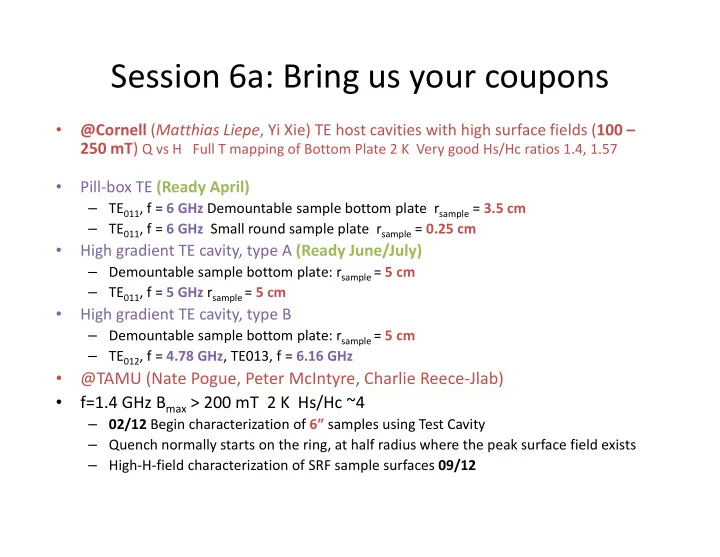
  • @Cornell (Matthias Liepe, Yi Xie) TE host cavities with high surface fields (100 –

250 mT) Q vs H Full T mapping of Bottom Plate 2 K Very good Hs/Hc ratios 1.4, 1.57

  • Pill‐box TE (Ready April)

– TE011, f = 6 GHz Demountable sample bottom plate rsample = 3.5 cm – TE011, f = 6 GHz Small round sample plate rsample = 0.25 cm

  • High gradient TE cavity, type A (Ready June/July)

– Demountable sample bottom plate: rsample= 5 cm – TE011, f = 5 GHz rsample= 5 cm

  • High gradient TE cavity type B
  • High gradient TE cavity, type B

– Demountable sample bottom plate: rsample= 5 cm – TE012, f = 4.78 GHz, TE013, f = 6.16 GHz

  • @TAMU (Nate Pogue, Peter McIntyre, Charlie Reece‐Jlab)

@TAMU (Nate Pogue, Peter McIntyre, Charlie Reece Jlab)

  • f=1.4 GHz Bmax > 200 mT 2 K Hs/Hc ~4

– 02/12 Begin characterization of 6” samples using Test Cavity – Quench normally starts on the ring, at half radius where the peak surface field exists – High‐H‐field characterization of SRF sample surfaces 09/12

slide-2
SLIDE 2

Session 6b: Existing Facilities

  • @SLAC (Tsyoshi Tajima‐LANL et al.) 2” diam. Disk

– 11.4 GHz 50 MW Klystron 11.4 GHz 50 MW Klystron – short pulses (≤ 2 μs) – can separate thermal effect from critical field – TE013‐mode Cu hemispherical host cavity (cryocooled) – Q vs T already compared for ref Nb vs MgB2 coating

slide-3
SLIDE 3

Coupon Experiments Coupon Experiments

  • Relatively low cost

y

– Multiple variants – fast turnaround 2 or 3 per week? – Community needs to guide priorities Q d till ibl ith hi h H /H – Q droop still possible with high Hs/Hc

  • Re‐use instrumentation – tmapping etc.
  • Small samples = easier to control
  • Small samples = easier to control

– Easier to characterize afterwards by microscopic techniques

  • Are they representative enough of “real” cavities?

– Flat sheet vs cavity Opportunity as well as hinderance – Opportunity as well as hinderance

slide-4
SLIDE 4

Session 6c: “Microscopic techniques”

  • @Jlab (Larry Phillips, Daniel Bowring) Local Electronic Mean Free Path Niobium

: measurement of Rs at various frequencies ωi

– Possible application to defect scanning in Nb sheet. pp g

  • Superconducting coaxial resonator in TEM modes.

– Resonator and variable coupler are S.C. Nb with sapphire – dielectric and are conduction cooled in vacuum to 2K. Measurements of Rsat various frequencies allows a tomographic reconstruction of Le(x) – Measurements of Rs at various frequencies allows a tomographic reconstruction of Le(x).

  • (Preliminary) finite element simulation using CST, electric field at ~28 GHz.
  • Any sufficiently high‐Q resonator material can be used instead of 2 K Nb.
  • Not as good as magnetometer for ferromagnetic defects.

– Simultaneous multiple frequencies provide better sensitivity.

  • @JLAB (Steven Anlage) Near‐field Microwave Microscopy Of Superconducting

Materials ‐ (Next Generation under development – utilize improvements in HD technology)

  • ~1 µm ‐ stimulate Nb surface with large (BRF ~200 mT) RF field and induce nonlinear response.
  • Micro‐Loops (50 T pulses achieved!)

Laser Scannin Microscop (Jl b ll b ti (K l h ) d FSU (Ab i ) h YBCO lt )

  • Laser Scanning Microscopy (Jlab collaboration (Karlsruhe) and FSU (Abraimov) have YBCO results)
  • New Possibilities? Large surface coating MO? Large area PCT