1 Conditional Independence Random Variable Two events E and F are - - PDF document

1
SMART_READER_LITE
LIVE PREVIEW

1 Conditional Independence Random Variable Two events E and F are - - PDF document

From Urns to Coupons Digging Deeper on Independence Coupon Collecting is classic probability problem Recall, two events E and F are called independent if There exist N different types of coupons Each is collected with some


slide-1
SLIDE 1

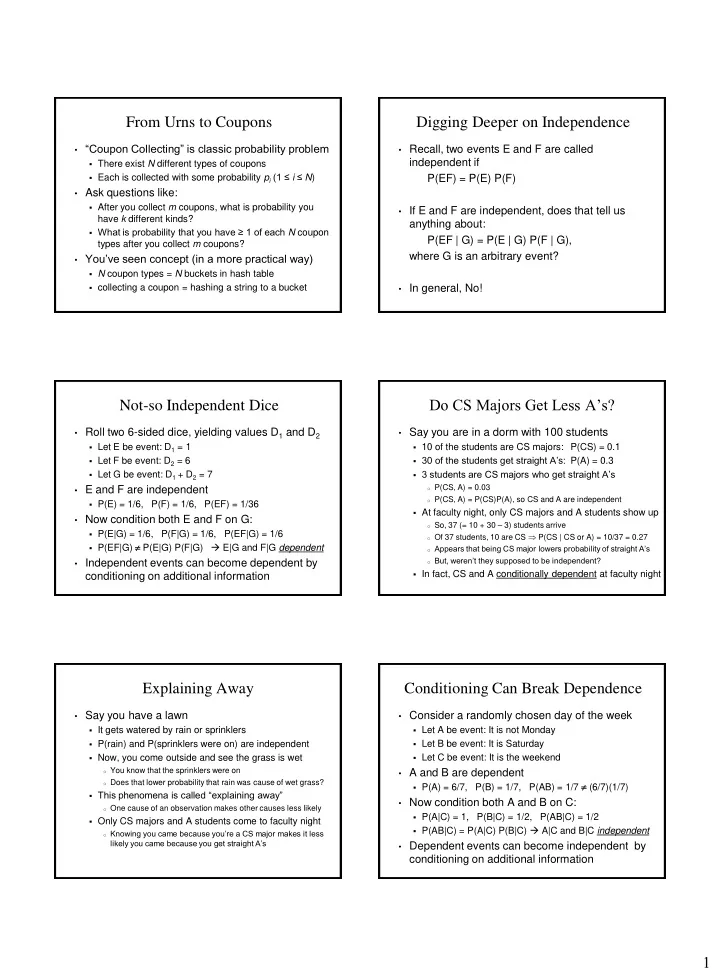
1 From Urns to Coupons

  • “Coupon Collecting” is classic probability problem
  • There exist N different types of coupons
  • Each is collected with some probability pi (1 ≤ i ≤ N)
  • Ask questions like:
  • After you collect m coupons, what is probability you

have k different kinds?

  • What is probability that you have ≥ 1 of each N coupon

types after you collect m coupons?

  • You’ve seen concept (in a more practical way)
  • N coupon types = N buckets in hash table
  • collecting a coupon = hashing a string to a bucket

Digging Deeper on Independence

  • Recall, two events E and F are called

independent if P(EF) = P(E) P(F)

  • If E and F are independent, does that tell us

anything about: P(EF | G) = P(E | G) P(F | G), where G is an arbitrary event?

  • In general, No!

Not-so Independent Dice

  • Roll two 6-sided dice, yielding values D1 and D2
  • Let E be event: D1 = 1
  • Let F be event: D2 = 6
  • Let G be event: D1 + D2 = 7
  • E and F are independent
  • P(E) = 1/6, P(F) = 1/6, P(EF) = 1/36
  • Now condition both E and F on G:
  • P(E|G) = 1/6, P(F|G) = 1/6, P(EF|G) = 1/6
  • P(EF|G)  P(E|G) P(F|G)

 E|G and F|G dependent

  • Independent events can become dependent by

conditioning on additional information

Do CS Majors Get Less A’s?

  • Say you are in a dorm with 100 students
  • 10 of the students are CS majors: P(CS) = 0.1
  • 30 of the students get straight A’s: P(A) = 0.3
  • 3 students are CS majors who get straight A’s
  • P(CS, A) = 0.03
  • P(CS, A) = P(CS)P(A), so CS and A are independent
  • At faculty night, only CS majors and A students show up
  • So, 37 (= 10 + 30 – 3) students arrive
  • Of 37 students, 10 are CS  P(CS | CS or A) = 10/37 = 0.27
  • Appears that being CS major lowers probability of straight A’s
  • But, weren’t they supposed to be independent?
  • In fact, CS and A conditionally dependent at faculty night

Explaining Away

  • Say you have a lawn
  • It gets watered by rain or sprinklers
  • P(rain) and P(sprinklers were on) are independent
  • Now, you come outside and see the grass is wet
  • You know that the sprinklers were on
  • Does that lower probability that rain was cause of wet grass?
  • This phenomena is called “explaining away”
  • One cause of an observation makes other causes less likely
  • Only CS majors and A students come to faculty night
  • Knowing you came because you’re a CS major makes it less

likely you came because you get straight A’s

Conditioning Can Break Dependence

  • Consider a randomly chosen day of the week
  • Let A be event: It is not Monday
  • Let B be event: It is Saturday
  • Let C be event: It is the weekend
  • A and B are dependent
  • P(A) = 6/7, P(B) = 1/7, P(AB) = 1/7  (6/7)(1/7)
  • Now condition both A and B on C:
  • P(A|C) = 1, P(B|C) = 1/2, P(AB|C) = 1/2
  • P(AB|C) = P(A|C) P(B|C)  A|C and B|C independent
  • Dependent events can become independent by

conditioning on additional information

slide-2
SLIDE 2

2 Conditional Independence

  • Two events E and F are called conditionally

independent given G, if P(E F | G) = P(E | G) P(F | G) Or, equivalently: P(E | F G) = P(E | G)

  • Exploiting conditional independence to generate

fast probabilistic computations is one of the main contributions CS has made to probability theory

Random Variable

  • A Random Variable is a real-valued function

defined on a sample space

  • Example:
  • 3 fair coins are flipped.
  • Y = number of “heads” on 3 coins
  • Y is a random variable
  • P(Y = 0) = 1/8

(T, T, T)

  • P(Y = 1) = 3/8

(H, T, T), (T, H, T), (T, T, H)

  • P(Y = 2) = 3/8

(H, H, T), (H, T, H), (T, H, H)

  • P(Y = 3) = 1/8

(H, H, H)

  • P(Y ≥ 4) = 0

Binary Random Variables

  • A binary random variable is a random variable

with 2 possible outcomes

  • n coin flips, each which independently come up heads

with probability p

  • Y = number of “heads” on n flips
  • P(Y = k) = , where k = 0, 1, 2, ..., n
  • So,
  • Proof:

k n k

p p k n

         ) 1 ( 1 ) 1 (          

  n k k n k

p p k n 1 1 )) 1 ( ( ) 1 (              

  n n n k k n k

p p p p k n

Simple Game

  • Urn has 11 balls (3 blue, 3 red, 5 black)
  • 3 balls drawn. +$1 for blue, -$1 for red, $0 for black
  • Y = total winnings
  • P(Y = 0) =
  • P(Y = 1) =

= P(Y = -1)

  • P(Y = 2) =

= P(Y = -2)

  • P(Y = 3) =

= P(Y = -3)

165 55 3 11 1 5 1 3 1 3 3 5                                           165 39 3 11 1 3 2 3 2 5 1 3                                           165 15 3 11 1 5 2 3                          165 1 3 11 3 3                 

Probability Mass Functions

  • A random variable X is discrete if it has countably

many values (e.g., x1, x2, x3, ...)

  • Probability Mass Function (PMF) of a discrete

random variable is:

  • Since

, it follows that: where X can assume values x1, x2, x3, ...

1 ) (

1

  i i

x p ) ( ) ( a X P a p          

  • therwise

) ( ... , 2 , 1 for ) ( ) ( x p i x p a X P

i

PMF For a Single 6-Sided Die

X = outcome of roll p(x) 1/6

slide-3
SLIDE 3

3 PMF For a Roll of Two 6-Sided Dice

X = total rolled p(x) 6/36 5/36 4/36 3/36 2/36 1/36

Cumulative Distribution Functions

  • For a random variable X, the Cumulative

Distribution Function (CDF) is defined as:

  • The CDF of a discrete random variable is:

  

a x

x p a X F a F

all

) ( ) ( ) (        a a X F a F where ) ( ) (

CDF For a Single 6-Sided Die

X = outcome of roll p(x) 5/6 4/6 3/6 2/6 1/6

Expected Value

  • The Expected Values for a discrete random

variable X is defined as:

  • Note: sum over all values of x that have p(x) > 0.
  • Expected value also called: Mean, Expectation,

Weighted Average, Center of Mass, 1st Moment

) ( :

) ( ] [

x p x

x p x X E

Expected Value Examples

  • Roll a 6-Sided Die. X is outcome of roll
  • p(1) = p(2) = p(3) = p(4) = p(5) = p(6) = 1/6
  • E[X] =
  • Y is random variable
  • P(Y = 1) = 1/3, P(Y = 2) = 1/6, P(Y = 3) = 1/2
  • E[Y] = 1 (1/3) + 2 (1/6) + 3 (1/2) = 13/6

2 7 6 1 6 6 1 5 6 1 4 6 1 3 6 1 2 6 1 1                                          

Indicator Variables

  • A variable I is called an indicator variable for

event A if

  • What is E[I]?
  • p(1) = P(A),

p(0) = 1 – P(A)

  • E[I] = 1 P(A) + 0 (1 – P(A)) = P(A)

   

  • ccurs

if

  • ccurs

if 1

c

A A I

slide-4
SLIDE 4

4 Lying With Statistics

“There are three kinds of lies: lies, damned lies, and statistics” – Mark Twain

  • School has 3 classes with 5, 10 and 150 students
  • Randomly choose a class with equal probability
  • X = size of chosen class
  • What is E[X]?
  • E[X]

= 5 (1/3) + 10 (1/3) + 150 (1/3) = 165/3 = 55

Lying With Statistics

“There are three kinds of lies: lies, damned lies, and statistics” – Mark Twain

  • School has 3 classes with 5, 10 and 150 students
  • Randomly choose a student with equal probability
  • Y = size of class that student is in
  • What is E[Y]?
  • E[Y]

= 5 (5/165) + 10 (10/165) + 150 (150/165) = 22635/165  137

  • Note: E[Y] is students’ perception of class size
  • But E[X] is what is usually reported by schools!

Expectation of a Random Variable

  • Let Y = g(X), where g is real-valued function

  

  

j i j j j j

j y i x g i

x p y y p y Y E X g E

) ( :

) ( ) ( ] [ )] ( [

   

 

 

j i i j i i

j y i x g i j y i x g i

x p x g x p x g

) ( : ) ( :

) ( ) ( ) ( ) (

i i i

x p x g ) ( ) (

Other Properties of Expectations

  • Linearity:
  • Consider X = 6-sided die roll, Y = 2X – 1.
  • E[X] = 3.5

E[Y] = 6

  • N-th Moment of X:
  • We’ll see the 2nd moment soon...

b X aE b aX E    ] [ ] [

) ( :

) ( ] [

x p x

x p x X E

n n

Utility

  • Utility is value of some choice
  • 2 choices, each with n consequences: c1, c2,..., cn
  • One of ci will occur with probability pi
  • Each consequence has some value (utility): U(ci)
  • Which choice do you make?
  • Example: Buy a $1 lottery ticket (for $1M prize)?
  • Probability of winning is 1/107
  • Buy: c1 = win, c2 = lose, U(c1) = 106 – 1, U(c2) = -1
  • Don’t Buy: c1 = lose, U(c1) = 0
  • E(buy) = 1/107 (106 – 1) + (1 – 1/107) (-1)  -0.9
  • E(don’t buy) = 1 (0) = 0
  • “You can’t lose if you don’t play!”