
SLIDE 1
A Broadside Register
Broadside register
N N Clock Q D D Clock D D D Q0 Q1 Q2 Q(N-1) D0 D1 D2 D(N-1) 1
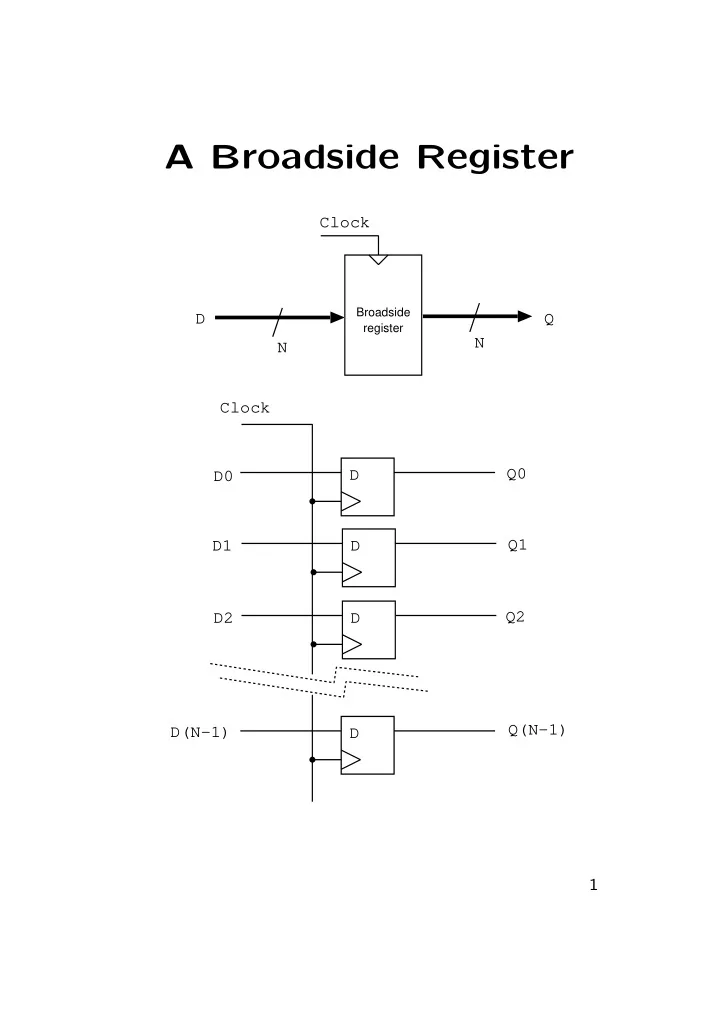
A Broadside Register Clock Broadside D Q register N N Clock - - PDF document
A Broadside Register Clock Broadside D Q register N N Clock Q0 D D0 Q1 D1 D Q2 D2 D Q(N-1) D(N-1) D 1 A broadside two-to-one multiplexor Select N N DT Y DF N MUX2 Select DT0 Y0 DF0 DT1 Y1 DF1 DT(N-1) Y(N-1)
Broadside register
N N Clock Q D D Clock D D D Q0 Q1 Q2 Q(N-1) D0 D1 D2 D(N-1) 1
MUX2 N N N Select DT DF Y Select Y0 Y1 Y(N-1) DT0 DF0 DT1 DF1 DT(N-1) DF(N-1)
2
Write Address Data in Data out A clock N N A Read Address B A Read Address A A Data out B N
3
The ROM takes A address bits named A0 to A<A-1> and produces data words of N bits wide. For example, if A=5 and D=8 then the ROM contains 2**5 which is 32 locations of 8 bits each. The address lines are called A0, A1, A2, A3, A4 and the data lines D0, D1, ... D7 Address In Data Out Enable Input (active low) Valid data
High-Z
High-Z The ROM’s outputs are high impedance unless the enable input is asserted (low). After the enable is low the
sufficiently long, valid data from that address comes out. The ROM contents are placed inside during manufacture or field programming. Data Out Address In Enable Input (active low) E Addr Data N A ROM PROM
EPROM Access Time Ouput Turnon Time
4
Address In Data Bus Enable Input (active low) Valid data High-Z High-Z Read Cycle - Like the ROM Write Cycle - Data stored internally Read or write mode select Address In Data Bus Enable Input (active low) Data must be valid here to be stored. High-Z High-Z Read or write mode select Data In and Out Address In Enable Input (active low) E Addr Data N A
R/Wb Read or write mode select
5
G D G D G D G D G D G D
Data
Address Input Binary to unary decoder
WE* CE*
enable G Q D Transparent latch schematic symbol D G Q Transparent latch implemented from gates. Unlike the edge-triggered flip-flop, the transparent latch passes data through in a transparent way when its enable input is high. When its enable input is low, the output stays at the current value.
6
Refresh Cycle - must happen sufficiently often!
A DRAM has a multiplexed address bus and the address is presented in two halves, known as row and column addresses. So the capacity is 4**A x D. A 4 Mbit DRAM might have A=10 and D=4. When a processor (or its cache) wishes to read many locations in sequence, only one row address needs be given and multiple col addresses can be given quickly to access data in the same row. This is known as ‘page mode’ access. EDO (extended data out) DRAM is now quite common. This guarantees data to be valid for an exteneded period after CAS, thus helping system timing design at high CAS rates.
Multiplexed Address Data Bus Valid data High-Z High-Z Read Cycle (write is similar) Read or write mode select Row Address Col Address Row Address Strobe (RAS) Row Address Strobe (CAS)
Row Address Strobe (RAS) Row Address Strobe (CAS) No data enters or leaves the DRAM during refresh, so it ‘eats memory bandwidth’. Typically 512 cycles of refresh must be done every 8 milliseconds. Data In and Out Multiplexed Address In Row Address Strobe (RAS) RAS MAddr Data N A
DRAM
R/Wb Read or write mode select Row Address Strobe (CAS) CAS
N.B DRAM will not be examinable for 1A.
7
33pF Ground 33pF 1M
Ground C R Vo Vin
8
VCO Clock distribution tree 264 MHz 33 MHz Divide 8 External clock input PLL Circuit Outside the chip Inside the chip
Ground C R Reset output Supply Active low Vo Vi
9
Ground R Control input High Voltage Supply EMF diode Power transistor
10
A B Output Output A B Gnd +5Volt supply rail Pullup Resistors Bounces Switch 11
Function Code 4 N N N Carry In ALU A-input B-input Output C N Z V Flags Clock Flags register
12
Function Code 4 8 Carry In 8 bit ALU A-input B-input Output 4 bit counter Register file 16 registers
4 A 8 D Carry Out Q Din 8 B A Clock source FUNCTION GEN Zero detect 8 FUNCTION GEN for F code for A input
13
Logic Symbol Internal Structure Block Diagram
Address Data N A System Clock Reset Input Interrupt Request Operation Request Read/Notwrite Wait I W R/Wb Opreq R Microprocessor Operation Request Read/notwrite Data Bus Address Bus Bus Control Clock ALU MUX Addresses Dual Port Register File Write Execution Unit Control Unit Instruction Register Instruction Decoder Control Wires To All Other Sections Mux 2 Program Counter Execution address incrementor Clock Clock Clock MUX2 Function code Load or Store
NB: Microprocessor internal details are not examinable for 1A.
System Clock Reset
PC
Reset
OPERAND EA IR
14
D Q GND VCC Broadside latch Broadside tri-state Microprocessor D0 D1 D2 Part of data bus Part of address bus A12 A13 A14 A15 R/Wbar OPREQ Pullup resistors Light emitting diodes (LEDs) Write to leds Read from switches D3 D4 D5 Switches
15
Control Unit Execution Unit + ALU Memory Static RAM 16 kByte UART Serial Port Address bus (16 bits) Data bus (8 bits) (Micro-)Processor Rs232 Serial Connection Register File (including PC) D0-7 D0-7 D0-7 Clock Reset R/Wb Memory Map decoder circuit Often a ‘PAL’ single chip device. A15 A14 A13 R/Wb R/Wb A0-13 Enb Enb Enb 1 K Byte ROM Read Only Memory A0-9 A0-2 R/Wb R/Wb ROM_ENABLE_BAR UART_ENABLE_BAR RAM_ENABLE_BAR D0-7
16
SIMM 4 SIMM 3 SIMM 2 SIMM 1 COM1 COM2 USB IDE-1 IDE-2 Floppy BIOS ROM Pentium CPU CACHE RAM PSU KYBD PCI1 PCI2 PCI3 ISA 16 BIT SLOTS BATTERY PRINTER Cache Control IDE & Floppy General glue Clock Regulator Main memory DRAM
17
Address Data device select /cs Strobe Read/Writebar r/wbar Acknowledge Parallel Data Busy D25 Parallel (Centronix) Port Strobe_bar Acknowledge Parallel Data Busy Valid Data For Transfer To Peripheral Device Ready for next data Parallel Port Interface Logic Flow control: New data is not sent while the busy wire is high. CPU BUS SIDE
18
DO D1 D2 D3 D4 D5 D6 D7 LOGIC 1 LOGIC 0 Start Bit (zero) Stop Bit (one) Address Data chip select /cs Serial Input Serial Output Baud Rate Generator Read/Writebar r/wbar Interrupt Int Voltage convertors 25-Way D connector for Serial Port. Most computers just use a 9 way connector these days.
Flow control: New data can be sent at any time unless either: additional signals are used to indicate clear to send
a software protocol is defined to run on top (Xon/Xoff) by reserving certain of the bytes.
19
+5 Volt Fuse Ground Clock wire Data Wire Power wire Ground wires PS/2 Connector 1 2 3 4 5 6 PS/2 Keyboard/Mouse Cable
20
FSM
Clock Mealy Outputs Inputs D Clock D D D Q0 Q1 Q2 Moore Outputs LOOP-FREE COMBINATORIAL LOGIC BLOCK I0 I1 I(M-1) M I2 CURRENT STATE FEEDBACK STATE FLOPS LOOP-FREE COMBINATORIAL LOGIC BLOCK LOOP-FREE COMBINATORIAL LOGIC BLOCK Moore Outputs Mealy Outputs Inputs
21
Clock Data in
Q oiutput
Q oiutput Data in Clock Hold time Propagation delay Setup time
22
Clock A B C D Setup Margin Period = 1/F Clock D Q D Q A B C D
23
D Q3 D Q2 D QA Clock
24
Data in
D Q D Q D Q D Q D Q D Q
Synchronous global clock signal Another input Yet another input An output Yet another output Another output still Large loop-free combinatorial logic function Data in
D Q D Q D Q D Q D Q D Q
Synchronous global clock signal Another input Yet another input An output Yet another output Another output still Loop-free combinatorial logic function - second half
Desired logic function Desired logic function - pipelined version. D Q D Q D Q D Q
Loop-free combinatorial logic function - first half
25
FSM
Mealy Outputs Inputs Moore Outputs
FSM
Mealy Outputs Moore Outputs
FSM
Inputs Clock Moore Mealy Inputs
26
D Q D Q D Q D Q Shift Register D Q D Q D Q D Q D Q Five Bit BroadsideRegister Divide by 5 counter Parallel data out Serial in Clock input
27
D Clock Data in Q Output Clock enable D Data in Q Output Clock enable Clock CE LOGIC SYMBOL AN EQUIVALENT CIRCUIT 1
28
D Master Clock D Synchronous subsystem requiring gated clock J K Enablebar Enable expression
29
Delay
Delay
Delay Data input Data output QA QB Clock
Delay Data input QB
Delay
Delay QB Delay
Delay QB Delay Clock
Delay Data input QB Delay
Delay QB Delay
Delay QB Delay Clock
30
Guard signal Command or info bus
Optional second D-type
31
FSM
Inputs Clock Input Moore Mealy
FSM
Mealy Outputs Moore Outputs Inputs
FSM
Mealy Outputs Moore Outputs Inputs Moore feedback to parent clock domain Feedforward of
32
33
DIE PIN PACKAGE BOND PAD CAVITY
Connections to and from core logic Pad power supply Pad Electronics Supply Pad Ground Rail Signal Bond Pad Edge of Die Power Rail Ground Pad CORE AREA
34
35
Standard Parts Semi Custom Full Custom Standard Cell Gate Array Integrated Circuits Masked ASICs Field Programmable Parts FPGA Array Logic (PALs) Commodity Parts General Chip Products
36
CLB SWITCH MATRIX CLB SWITCH MATRIX CLB SWITCH MATRIX CLB SWITCH MATRIX CLB SWITCH MATRIX CLB SWITCH MATRIX CLB SWITCH MATRIX CLB SWITCH MATRIX CLB CLB CLB CLB SWITCH MATRIX CLB CLB SWITCH MATRIX SWITCH MATRIX Bond pad IOB Bond pad IOB Bond pad IOB Bond pad Bond pad IOB Bond pad IOB Bond pad IOB
Edge of die
37
General inputs Combinatorial function generator D Q D Q Clock input First output Second Output Programmable multiplexers
38
Bond PAD Input buffer Input Output Tristate control Output enable Programmable multiplexor 1 Output buffer Connections to central array.
39
Power supply pin Clock signal Clock input General purpose inputs Product line Term line Output pad (can also be input). Output enable product line Ground pin. The cross points in these shaded regions are programmable points Macro- cell Macro- cell Macro- cell 1 2 3 4 5 6 7 8 9 10 11 12 13 14 15 16 17
40
Input buffer Clock Net I/O Pad Tristate
Programmable multiplexor D-type flip-flop D Q Main input S-of-P Output enable term Feedback to array
41
42
Delay (ns) Power per gate (mW). 0.1 1.0 10 100 1000 1 10 100 ECL TTL CMOS Lines of constant delay-power product 1980 1990 2000
device propagation power product delay (ns) (mW) (pJ)
74hc00 7 ns 1 mW 7 TTL 74f00 3.4 ns 5 mW 17 ECL sp92701 0.8 ns 200 mW 160
Parasitic input capacitance Track to substrate capacitance proportional to total track length (area) Driving Gate Driven gates
44
Simulator/HDL Call
4 input NAND gate with x2 drive
Schematic Symbol
NAND4X2(f, a, b, c, d);
ELECTRICAL SPECIFICATION
Switching characteristics : Nominal delays (25 deg C, 5 Volt, signal rise and fall 0.5 ns)
Inputs Outputs O/P Falling O/P Rising A B C D F F F F (ps) ps/LU ps ps/LU 142 161 165 170 37 37 37 37 198 249 293 326 33 33 33 34 Min and Max delays depend upon temperature range, supply voltage, input edge speed and process
: (One load unit = 49 fF) Parameters Input loading Drive capability Pin a b c d f Value 2.1 2.1 2.1 2.0 35 Load units Load units Units
a b c d f
Logical Function
F = NOT(a & b & c & d)
Library: CBG0.5um
X2
CELL PARAMETERS
45
46
D Q D Q D Q D Q D Q D Q D Q D Q D Q D Q D Q First operand A Second operand B Serial sum Y Carry Full adder +
D Q D Q D Q D Q D Q D Q Input operand A Serial product Y Carry Full adder +
47
8 8 8 DRAM
(Standard Part)
Isolating transformers Ring Connector VCO (analogue) Interrupt PAL Standard data buffers Address PAL Host Bus 12.5 MHz 100 MHz
48
Telephone line interface Off-hook relay Isolation transformer A-to-D D-to-A Main DSP processor Single-chip processor RS-232 line drivers Computer interface Led indicators Power supply conditioning Ring detector DSP ROM DSP RAM Directional isolator NV-RAM DC power input
49
DAC Carrier Oscillator 2.4 GHz Microcontroller Baseband Modem Antenna Data Interfaces RF Amps IF Amps ADC FLASH memory chip Digital Integrated Circuit Analog (RF) Integrated Circuit Line dri- vers Hop Controller
www.bluetooth.org www.csr.com Multi-chip module or mini PCB
50
D Clock Data in D Edge Pulse
51
Microprocessor (8 bit generally) RAM (e.g. 2 Kbytes) OTP EPROM (e.g. 8 Kbytes) Clock Osc Power Up reset Programmable IO Counters and Timers UART I/O wires OR external bus Reset capacitor Clock Serial TX and RX Internal A and D busses
52
53
Battery Scan multiplexed keyboard Single chip containing all semiconductors Clock capacitor Infra-red transmit diodes +
SCAN MULTIPLEXED DISPLAY MATRIX N bit COUNTER BINARY to UNARY DECODER Row Addr Data lilines (zero for on) CLOCK
55
Pixel RAM
SCAN MULTIPLEXED DISPLAY MATRIX N bit COUNTER BINARY to UNARY DECODER Row
A D Broadside tri-state buffer Write data Write address WE Write strobe bar MUX2 N 56
A to D convertor Look-up table ROM D to A convertor 16 16 65536 by 16 ROM Sample clock 44.1 kHz 12 inch speakers Amplifer A D
57
A to D convertor D to A convertor 16 16 Amplifer A D Static RAM 65536 by 16 bits 16 bit synchronous counter 16 RAMWE RAMOE ADOE Timing generator circuit ADOE RAMWE RAMOE Derived clock, 44.1 kHz 88.2 kHz Read cycle Write cycle Read cycle Clock 88.2 Clock 44.1 RAMWE RAMOE Counter Output
N-1 N N+1 RAM data pins Old sample replay New sample write
58
DO D1 D2 D3 D4 D5 D6 D7 LOGIC 1 LOGIC 0 Start Bit (zero) Stop Bit (one) Bit spacing is reciprocal of 31.25 kbaud, which is 32 microseconds. + 5V VCC
Open collector buffer 220R 220R GND 5V VCC LED Photo- transistor +
220R GND 5V VCC LED Photo- transistor +
220R
Merged midi output Midi input
Midi input zero Midi merge function to be designed Clock 1 MHz
module MERGER(out, in0,in1, clk);
59
Serial to par Remove status FIFO Queue Serial to par Remove status Queue Par to serial Insert running status Queue Meger core function Midi In 0 Midi In 1 Merged midi output 8 24 8 24 8 24 24 24 24
60
61
8 8 16 8 Composite Video YUV 24 bit RGB
8kx8 SRAM for tile conversion 256k video fifo frame buffer C-Cube CL550 JPEG coprocessor 24 bit to 24/16/8 bit RGB/YUV HiFi Audio Codec Xilinx 3190 ATM Cell constructor 2kx8 Dual Port SRAM for assembling whole cells Xilinx 3190 ATM interface control & AAL-5 frame generator 100 Mb/s TAXI interface Video Resizer NTSC/ PAL decoder
Fiber 8
80C654 Microcontroller for control / signalling
8 received ATM cells
62