Global Register Allocation Memory Hierarchy Management Register - - PowerPoint PPT Presentation

global register allocation
SMART_READER_LITE
LIVE PREVIEW

Global Register Allocation Memory Hierarchy Management Register - - PowerPoint PPT Presentation

Lecture Outline Global Register Allocation Memory Hierarchy Management Register Allocation via Graph Coloring Register interference graph Graph coloring heuristics Spilling Cache Management Compiler Design I


slide-1
SLIDE 1

Global Register Allocation

Compiler Design I (2011)

2

Lecture Outline

  • Memory Hierarchy Management
  • Register Allocation via Graph Coloring

– Register interference graph – Graph coloring heuristics – Spilling

  • Cache Management

Compiler Design I (2011)

3

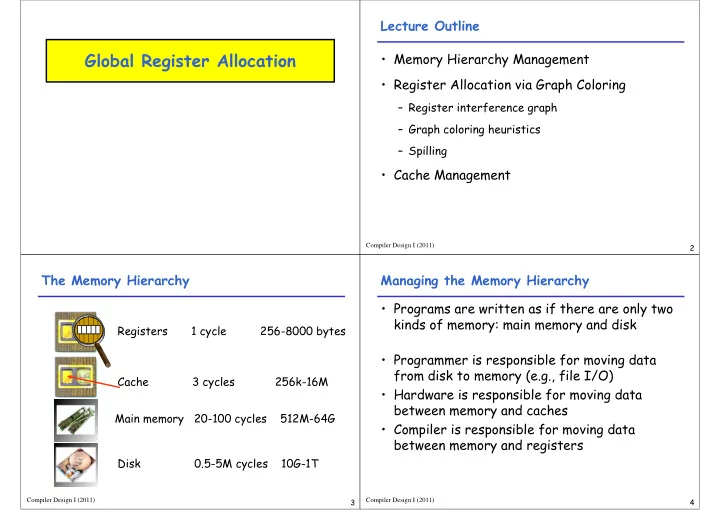
The Memory Hierarchy

Registers 1 cycle 256-8000 bytes Cache 3 cycles 256k-16M Main memory 20-100 cycles 512M-64G Disk 0.5-5M cycles 10G-1T

Compiler Design I (2011)

4

Managing the Memory Hierarchy

  • Programs are written as if there are only two

kinds of memory: main memory and disk

  • Programmer is responsible for moving data

from disk to memory (e.g., file I/O)

  • Hardware is responsible for moving data

between memory and caches

  • Compiler is responsible for moving data

between memory and registers

slide-2
SLIDE 2

Compiler Design I (2011)

5

Current Trends

  • Power usage limits

– Size and speed of registers/caches – Speed of processors

  • Improves faster than memory speed (and disk speed)
  • The cost of a cache miss is growing
  • The widening gap between processors and memory is

bridged with more levels of caches

  • It is very important to:

– Manage registers properly – Manage caches properly

  • Compilers are good at managing registers

Compiler Design I (2011)

6

The Register Allocation Problem

  • Recall that intermediate code uses as many

temporaries as necessary

– This complicates final translation to assembly – But simplifies code generation and optimization – Typical intermediate code uses too many temporaries

  • The register allocation problem:

– Rewrite the intermediate code to use at most as many temporaries as there are machine registers – Method: Assign multiple temporaries to a register

  • But without changing the program behavior

Compiler Design I (2011)

7

History

  • Register allocation is as old as intermediate

code

– Register allocation was used in the original FORTRAN compiler in the ‘50s – Very crude algorithms

  • A breakthrough was not achieved until 1980

– Register allocation scheme based on graph coloring – Relatively simple, global, and works well in practice

Compiler Design I (2011)

8

An Example

  • Consider the program

a := c + d e := a + b f := e - 1 with the assumption that a and e die after use

  • Temporary a

can be “reused” after “a + b”

  • Same with temporary e after “e -

1”

  • Can allocate a, e, and f all to one register (r1

):

r1 := r2 + r3 r1 := r1 + r4 r1 := r1

  • 1
slide-3
SLIDE 3

Compiler Design I (2011)

9

Basic Register Allocation Idea

  • The value in a dead temporary is not needed

for the rest of the computation

– A dead temporary can be reused

  • Basic rule:

Temporaries t1 and t2 can share the same register if at all points in the program at most one of t1 or t2 is live !

Compiler Design I (2011)

10

Algorithm: Part I Compute live variables for each program point:

a := b + c d := -a e := d + f f := 2 * e b := d + e e := e - 1 b := f + c

{b} {c,e} {b,e} {c,f} {c,f} {b,c,e,f} {c,d,e,f} {b,c,f} {c,d,f} {a,c,f}

Compiler Design I (2011)

11

The Register Interference Graph

  • Two temporaries that are live simultaneously

cannot be allocated in the same register

  • We construct an undirected graph with

– A node for each temporary – An edge between t1 and t2 if they are live simultaneously at some point in the program

  • This is the register interference graph

(RIG)

– Two temporaries can be allocated to the same register if there is no edge connecting them

Compiler Design I (2011)

12

Register Interference Graph: Example

  • For our example:

a f e d c b

  • E.g., b

and c cannot be in the same register

  • E.g., b

and d can be in the same register

slide-4
SLIDE 4

Compiler Design I (2011)

13

Register Interference Graph: Properties

  • It extracts exactly the information needed to

characterize legal register assignments

  • It gives a global (i.e., over the entire flow

graph) picture of the register requirements

  • After RIG construction, the register allocation

algorithm is architecture independent

Compiler Design I (2011)

14

Graph Coloring: Definitions

  • A coloring of a graph

is an assignment of colors to nodes, such that nodes connected by an edge have different colors

  • A graph is k-colorable

if it has a coloring with k colors

Compiler Design I (2011)

15

Register Allocation Through Graph Coloring

  • In our problem, colors = registers

– We need to assign colors (registers) to graph nodes (temporaries)

  • Let k = number of machine registers
  • If the RIG is k-colorable then there is a

register assignment that uses no more than k registers

Compiler Design I (2011)

16

Graph Coloring: Example

  • Consider the example RIG

a f e d c b

  • There is no coloring with less than 4 colors
  • There are various 34-colorings of this graph

r4 r1 r2 r3 r2 r3

slide-5
SLIDE 5

Compiler Design I (2011)

17

Graph Coloring: Example

  • Under this coloring the code becomes:

r2 := r3 + r4 r3 := -r2 r2 := r3 + r1 r1 := 2 * r2 r3 := r3 + r2 r2 := r2 - 1 r3 := r1 + r4

Compiler Design I (2011)

18

Computing Graph Colorings

  • The remaining problem is how to compute a

coloring for the interference graph

  • But:

(1) Computationally this problem is NP-hard:

  • No efficient algorithms are known

(2) A coloring might not exist for a given number of registers

  • The solution to (1) is to use heuristics
  • We will consider the other problem later

Compiler Design I (2011)

19

Graph Coloring Heuristic

  • Observation:

– Pick a node t with fewer than k neighbors in RIG – Eliminate t and its edges from RIG – If the resulting graph has a k-coloring then so does the original graph

  • Why:

– Let c1 ,…,cn be the colors assigned to the neighbors

  • f t

in the reduced graph – Since n < k we can pick some color for t that is different from those of its neighbors

Compiler Design I (2011)

20

Graph Coloring Simplification Heuristic

  • The following works well in practice:

– Pick a node t with fewer than k neighbors – Put t

  • n a stack and remove it from the RIG

– Repeat until the graph has one node

  • Then start assigning colors to nodes on the

stack (starting with the last node added)

– At each step pick a color different from those assigned to already colored neighbors

slide-6
SLIDE 6

Compiler Design I (2011)

21

Graph Coloring Example (1)

  • Remove a

a f e d c b

  • Start with the RIG and with k = 4:

Stack: {}

Compiler Design I (2011)

22

Graph Coloring Example (2)

  • Remove d

f e d c b

  • Start with the RIG and with k = 4:

Stack: {a}

Compiler Design I (2011)

23

Graph Coloring Example (3)

  • Now all nodes have fewer than 4 neighbors

and can be removed: c, b, e, f

f e c b Stack: {d, a}

Compiler Design I (2011)

24

Graph Coloring Example (4)

  • Start assigning colors to: f, e, b, c, d, a

b a e c r4 f r1 r2 r3 r2 r3 d

slide-7
SLIDE 7

Compiler Design I (2011)

25

What if the Heuristic Fails?

  • What if during simplification we get to a state

where all nodes have k or more neighbors ?

  • Example: try to find a 3-coloring of the RIG:

a f e d c b

Compiler Design I (2011)

26

What if the Heuristic Fails?

  • Remove a

and get stuck (as shown below)

f e d c b

  • Pick a node as a possible candidate for spilling

– A spilled temporary “lives” is memory – Assume that f is picked as a candidate

Compiler Design I (2011)

27

What if the Heuristic Fails?

  • Remove f

and continue the simplification

– Simplification now succeeds: b, d, e, c e d c b

Compiler Design I (2011)

28

What if the Heuristic Fails?

  • On the assignment phase we get to the point

when we have to assign a color to f

  • We hope that among the 4 neighbors of f

we used less than 3 colors ⇒

  • ptimistic coloring

f e d c b r3 r1 r2 r3 ?

slide-8
SLIDE 8

Compiler Design I (2011)

29

Spilling

  • Since optimistic coloring failed, we must spill

temporary f (actual spill)

  • We must allocate a memory location as the

“home”

  • f f

– Typically this is in the current stack frame – Call this address fa

  • Before each operation that uses f, insert

f := load fa

  • After each operation that defines f, insert

store f, fa

Compiler Design I (2011)

30

Spilling: Example

  • This is the new code after spilling f

a := b + c d := -a f := load fa e := d + f f := 2 * e store f, fa b := d + e e := e - 1 f := load fa b := f + c

Compiler Design I (2011)

31

Recomputing Liveness Information

  • The new liveness information after spilling:

a := b + c d := -a f := load fa e := d + f f := 2 * e store f, fa b := d + e e := e - 1 f := load fa b := f + c

{b} {c,e} {b,e} {c,f} {c,f} {b,c,e,f} {c,d,e,f} {b,c,f} {c,d,f} {a,c,f} {c,d,f} {c,f} {c,f}

Compiler Design I (2011)

32

Recomputing Liveness Information

  • New liveness information is almost as before
  • f

is live only

– Between a f := load fa and the next instruction – Between a store f, fa and the preceding instruction

  • Spilling reduces the live range of f

– And thus reduces its interferences – Which results in fewer RIG neighbors for f

slide-9
SLIDE 9

Compiler Design I (2011)

33

Recompute RIG After Spilling

  • The only changes are in removing some of the

edges of the spilled node

  • In our case f

now interferes only with c and d

  • And now the resulting RIG is 3-colorable

a f e d c b

r1 r3 r3 r2 r2 r2

Compiler Design I (2011)

34

Spilling Notes

  • Additional spills might be required before a

coloring is found

  • The tricky part is deciding what to spill
  • Possible heuristics:

– Spill temporaries with most conflicts – Spill temporaries with few definitions and uses – Avoid spilling in inner loops

  • Any heuristic is correct

Compiler Design I (2011)

35

Precolored Nodes

  • Precolored

nodes are nodes which are a priori bound to actual machine registers

  • These nodes are usually used for some

specific (time-critical) purpose, e.g.:

– for the frame pointer – for the first N arguments (N=2,3,4,5)

Compiler Design I (2011)

36

Precolored Nodes (Cont.)

  • For each color, there should be only one

precolored node with that color; all precolored nodes usually interfere with each other

  • We can give an ordinary temporary the same

color as a precolored node as long as it does not interfere with it

  • However, we cannot simplify or spill

precolored nodes; we thus treat them as having “infinite” degree

slide-10
SLIDE 10

Compiler Design I (2011)

37

Effects of Global Register Allocation Reduction in % for MIPS C Compiler

Program cycles total loads/stores scalar loads/stores boyer 37.6 76.9 96.2 diff 40.6 69.4 92.5 yacc 31.2 67.9 84.4 nroff 16.3 49.0 54.7 ccom 25.0 53.1 67.2 upas 25.3 48.2 70.9 as1 30.5 54.6 70.8 Geo M ean 28.4 59.0 75.4

Compiler Design I (2011)

38

Caches

  • Compilers are very good at managing registers

– Much better than a programmer could be

  • Compilers are not good at managing caches

– This problem is still left to programmers – It is still an open question whether a compiler can do anything general to improve performance

  • Compilers can, and a few do, perform some

simple cache optimization

Compiler Design I (2011)

39

Cache Optimization

  • Consider the loop

for (j = 1; j < 10; j++) for (i = 1; i < 1000; i++) a[i] *= b[i]

  • This program has a terrible cache

performance

– Why?

Compiler Design I (2011)

40

Cache Optimization (Cont.)

  • Consider now the program:

for (i = 1; i < 1000; i++) for (j = 1; j < 10; j++) a[i] *= b[i]

– Computes the same thing – But with much better cache behavior – Might actually be more than 10x faster

  • A compiler can perform this optimization

– called loop interchange

slide-11
SLIDE 11

Compiler Design I (2011)

41

Conclusions

  • Register allocation is a “must have”
  • ptimization in most compilers:

– Because intermediate code uses too many temporaries – Because it makes a big difference in performance

  • Graph coloring is a powerful register allocation

scheme (with many variations on the heuristics)

  • Register allocation is more complicated for

CISC machines