9/29/2016 UCSF Transplant 2016: Building Bridges to Excellence - - PDF document

9 29 2016
SMART_READER_LITE
LIVE PREVIEW

9/29/2016 UCSF Transplant 2016: Building Bridges to Excellence - - PDF document

9/29/2016 UCSF Transplant 2016: Building Bridges to Excellence OVERVIEW Current state of liver transplantation (LT) Liver Transplant for Hepatocellular for HCC Carcinoma (HCC): What is New? Lets push past the Milan criteria


slide-1
SLIDE 1

9/29/2016 1

Liver Transplant for Hepatocellular Carcinoma (HCC): What is New?

Neil Mehta, MD 9/29/16 UCSF Division of Gastroenterology and Hepatology

UCSF Transplant 2016: Building Bridges to Excellence

  • Current state of liver transplantation (LT)

for HCC

  • “Let’s push past the Milan criteria”
  • Refining selection criteria for LT
  • Updates in down-staging outcomes
  • Proposed UNOS policy changes
  • Risk factors for post-LT HCC recurrence
  • How often to perform surveillance?

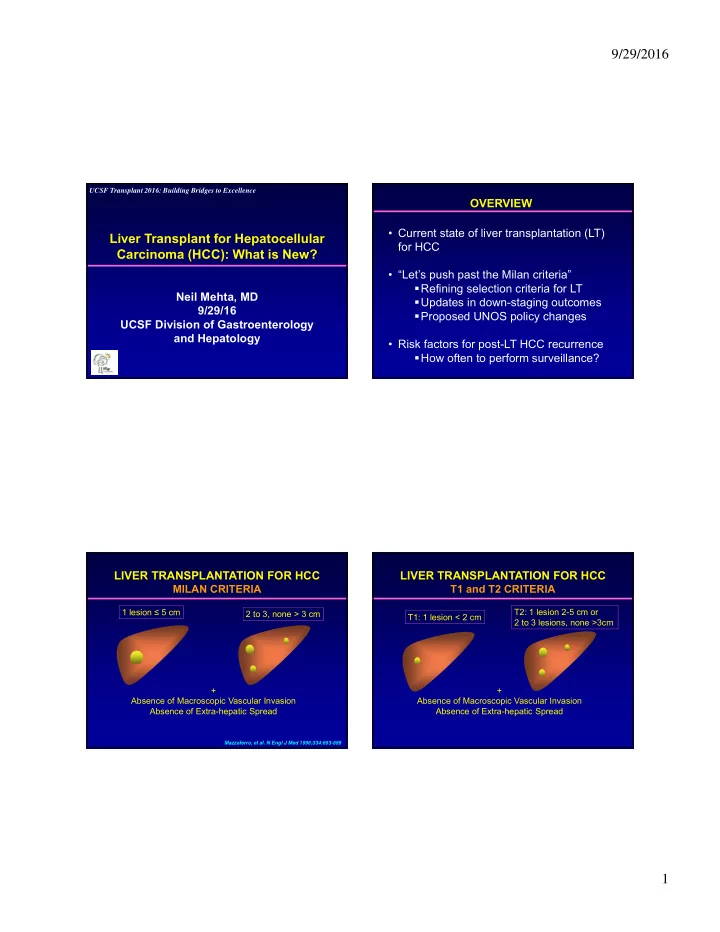
OVERVIEW LIVER TRANSPLANTATION FOR HCC

MILAN CRITERIA

Mazzaferro, et al. N Engl J Med 1996;334:693-699

+ Absence of Macroscopic Vascular Invasion Absence of Extra-hepatic Spread 1 lesion ≤ 5 cm 2 to 3, none > 3 cm

LIVER TRANSPLANTATION FOR HCC

T1 and T2 CRITERIA

+ Absence of Macroscopic Vascular Invasion Absence of Extra-hepatic Spread T1: 1 lesion < 2 cm T2: 1 lesion 2-5 cm or 2 to 3 lesions, none >3cm

slide-2
SLIDE 2

9/29/2016 2

RISING INCIDENCE OF LT FOR HCC UCSF DATA

0% 10% 20% 30% 40% 50% 60% 05 06 07 08 09 10 11 12 13 14 15

% of adult LT done for HCC Year 22 LT for HCC in 2006 15%

RISING INCIDENCE OF LT FOR HCC UCSF DATA

0% 10% 20% 30% 40% 50% 60% 05 06 07 08 09 10 11 12 13 14 15

% of adult LT done for HCC Year 22 LT for HCC in 2006 15% 72 LT for HCC in 2015

47%

  • HCC misdiagnosis
  • Outcome after liver transplant for HCC still

slightly worse than that for non-HCC indications 1

  • HCC patients receiving unfair advantage for

donors compared to non-HCC patients 2,3

1. Ioannou GN, et al. Gastroenterology 2008; 134:1342-1351 2. Washburn K, et al. Am J Transpl 2010;10:1652-7 3. Goldberg D, et al. Liver Transpl 2012;18:434-443

LIVER TRANSPLANT FOR HCC: PROBLEMS & CHALLENGES

2002-2007 N Adjusted * Patient Survival (%) HR (95% CI) 1 yr 2 yr 3 yr 4 yr No HCC 14351 1 88.3 83.8 80.8 78.0 HCC, no exception 592 1.58 (1.3-1.9) 83.5 72.6 67.8 67.8 HCC, MELD 4453 1.27 (1.1-1.4) 89.0 81.4 76.5 72.7 exception HCC, MELD 3595 1.33 (1.2-1.5) 88.3 80.4 74.8 70.7 exception (> 2 cm) *Adjusted for MELD score, underlying liver disease, age, gender, race/ethnicity, BMI and donor age (+ other donor factors)

Ioannou GN, et al. Gastroenterology 2008; 134:1342-1351

OUTCOME OF LIVER TRANSPLANT FOR HCC IN THE MELD ERA (2002-2007)

slide-3
SLIDE 3

9/29/2016 3

WAITLIST DROPOUT OR DEATH: HCC VS NON-HCC

20% 15% 10% 5% HCC MELD 22 Non-HCC MELD 21-23 P< 0.001

Goldberg D, et al. Liver Transpl 2012;18:434-443

Too sick Died P<0.001 P<0.001 HCC MELD 25 Non-HCC MELD 24-26 25% HCC MELD 28 Non-HCC MELD 27-29

  • Uniform diagnostic criteria (OPTN/ LIRADS)

+ standardized reporting

  • Only pts w/ T2 HCC and LI-RADS 5

lesions are eligible to receive priority listing LIVER TRANSPLANT FOR HCC: RECENT CHANGES

  • Uniform diagnostic criteria (OPTN/ LIRADS)

+ standardized reporting

  • Only pts w/ T2 HCC and LI-RADS 5

lesions are eligible to receive priority listing

  • LI-RADS 5: Definite HCC
  • LI-RADS 4: Probable HCC
  • LI-RADS 3: Indeterminate

LIVER TRANSPLANT FOR HCC: RECENT CHANGES

< 2 cm ≥ 2 cm 1-1.9 cm ≥ 2 cm < 1 cm

LIRADS 3 LIRADS 3 LIRADS 3 LIRADS 4 LIRADS 3 LIRADS 4 LIRADS 4 LIRADS 4 LIRADS 5 LIRADS 4 LIRADS 4 LIRADS 5 LIRADS 5 None One ≥ Two

“Washout” “Capsule” Threshold growth

LIRADs 4 LIRADS 3

Arterial phase hyper- enhancement Arterial phase hypo- or Iso- enhancement Diagnostic Criteria

LIVER IMAGING REPORTING AND DATA SYSTEM (LI-RADS)

LIVER MASS

slide-4
SLIDE 4

9/29/2016 4

< 2 cm ≥ 2 cm 1-1.9 cm ≥ 2 cm < 1 cm

LIRADS 3 LIRADS 3 LIRADS 3 LIRADS 4 LIRADS 3 LIRADS 4 LIRADS 4 LIRADS 4 LIRADS 5 LIRADS 4 LIRADS 4 LIRADS 5 LIRADS 5 None One ≥ Two

“Washout” “Capsule” Threshold growth

LIRADs 4 LIRADS 3

Arterial phase hyper- enhancement Arterial phase hypo- or Iso- enhancement Diagnostic Criteria

LIVER IMAGING REPORTING AND DATA SYSTEM (LI-RADS)

LIVER MASS

  • Uniform diagnostic criteria (OPTN/ LIRADS)

+ standardized reporting

  • 6-month mandatory waiting period before

MELD exception of 28

  • Cap at MELD of 34

LIVER TRANSPLANT FOR HCC: RECENT CHANGES DELAYED HCC-MELD EXCEPTION SCORE

Heimbach J, et al. Hepatology 2015;61:1643-1650

Delays in HCC-MELD exception HCC Transplant rates (per 100 person-years) Non-HCC Transplant rates (per 100 person-years) 108.7 30.1 3 months 65.0 32.5 6 months 44.2 33.9 9 months 33.6 34.8

Transplant would benefit Transplant not needed Do poorly after transplant

DECIDING WHO SHOULD BE TRANSPLANTED IN THE NEW MELD ERA FOR HCC

Within Milan Within Milan

Moving past “one-size fits all”

Mehta N, and Yao FY. Liver Transpl 2013;19:1055-1088

slide-5
SLIDE 5

9/29/2016 5

Transplant would benefit Transplant not needed Do poorly after transplant

DECIDING WHO SHOULD BE TRANSPLANTED IN THE NEW MELD ERA FOR HCC

Within Milan

  • Local regional therapy
  • Observation period/

Wait time Within Milan

Transplant would benefit Transplant not needed Do poorly after transplant

DECIDING WHO SHOULD BE TRANSPLANTED IN THE NEW MELD ERA FOR HCC

Within Milan

  • Local regional therapy
  • Observation period/

Wait time Tumor Down-staging Within Milan

Within Milan

Transplant would benefit Transplant not needed Do poorly after transplant

DECIDING WHO SHOULD BE TRANSPLANTED IN THE NEW MELD ERA FOR HCC

Within Milan

Transplant would benefit Transplant not needed Do poorly after transplant

DECIDING WHO SHOULD BE TRANSPLANTED IN THE NEW MELD ERA FOR HCC

Transplant not needed (or less urgent)

20%

slide-6
SLIDE 6

9/29/2016 6

1 lesion 2-3 cm Complete response to 1st treatment AFP after 1st treatment < 20 ng/mL

SUBGROUP WITH LOW DROPOUT RISK

Criteria for low dropout risk

Mehta N, et al. Liver Transpl 2013;19:1343-1353

1 lesion 2-3 cm Complete response to 1st treatment AFP after 1st treatment < 20 ng/mL

SUBGROUP WITH LOW DROPOUT RISK

Criteria for low dropout risk

Cumulative dropout risks of 1.3% at 1 year, and 1.6% at 2 years. Accounts for 20% of entire cohort

Mehta N, et al. Liver Transpl 2013;19:1343-1353

Cumulative Incidence 10 20 30 %

1 lesion 2-3 cm, complete 1st treatment response, AFP < 20 (n= 63) All other patients (n=254) Months after listing

26.5% 1.6% 21.6% 1.3%

Mehta N, et al. Liver Transpl 2013;19:1343-1353

Single Small Lesion Criteria

  • Candidates who initially present w/ single 2-3 cm lesion

must be treated with local-regional therapy (LRT) in order to be eligible for automatic MELD exception

  • If the lesion is completely treated after 1+ LRTs, the

candidate is not eligible for MELD exception until lesion recurs or develops a new lesion

  • If the lesion persists or recurs after 1+ LRTs, the candidate

is eligible for MELD exception

PROPOSED UNOS POLICY CHANGE

slide-7
SLIDE 7

9/29/2016 7

LIVER TRANSPLANTATION FOR HCC: OPTIMIZING SELECTION CRITERIA

Scenario: Your patient with a 3.5 cm HCC is at the top of the wait list and is expecting a liver offer at any time. Today in clinic he asks you what his expected outcomes are after transplant.

LIVER TRANSPLANTATION FOR HCC: OPTIMIZING SELECTION CRITERIA

5 yr post-LT survival: 75-80% 5 yr HCC recurrence: ~15% Scenario: Your patient with a 3.5 cm HCC is at the top of the wait list and is expecting a liver offer at any time. Today in clinic he asks you what his expected outcomes are after transplant.

LIVER TRANSPLANTATION FOR HCC: OPTIMIZING SELECTION CRITERIA

5 yr post-LT survival: ??? 5 yr HCC recurrence: ??? Scenario: Your patient with a 3.5 cm HCC is at the top of the wait list and is expecting a liver offer at any time. Today in clinic he asks you what his expected outcomes are after transplant.

Within Milan

Transplant would benefit Transplant not needed Do poorly after transplant

DECIDING WHO SHOULD BE TRANSPLANTED IN THE NEW MELD ERA FOR HCC

Do poorly after transplant??

10-20%

slide-8
SLIDE 8

9/29/2016 8

LIVER TRANSPLANTATION FOR HCC: OPTIMIZING SELECTION CRITERIA

3.5 cm Response to LRT

LIVER TRANSPLANTATION FOR HCC: OPTIMIZING SELECTION CRITERIA

3.5 cm Response to LRT AFP

LIVER TRANSPLANTATION FOR HCC: OPTIMIZING SELECTION CRITERIA

3.5 cm Response to LRT 7.5 cm AFP

LIVER TRANSPLANTATION FOR HCC: OPTIMIZING SELECTION CRITERIA

3.5 cm Response to LRT 7.5 cm AFP 5 yr post-LT survival: __% 5 yr HCC recurrence: __%

slide-9
SLIDE 9

9/29/2016 9

LIVER TRANSPLANTATION FOR HCC: DOWNSTAGING

3.5 cm 7.5 cm 5 yr post-LT survival: __% 5 yr HCC recurrence: __%

  • Down-staging: Reduction in the size of tumor(s)

using LRT to meet acceptable LT criteria

  • Tumor response to down-staging treatment is

based on radiographic measurement of the size

  • f viable tumors

Yao FY, et al, Liver Transpl 2011; Ravaioli et al. Am J Transpl 2008; Pomfret et al. Liver Transplant 2010; Bruix, J et al EASL Practice Guidelines, J Hepatology 2012

DOWN-STAGING

  • Inclusion criteria
  • 1 lesion > 5 cm and ≤ 8 cm
  • 2 or 3 lesions ≤ 5 cm w/ total tumor diameter ≤ 8 cm
  • 4 or 5 lesions ≤ 3 cm w/ total tumor diameter ≤ 8 cm
  • No vascular invasion on imaging
  • Candidates can undergo deceased-donor LT 3

months after down-staging if within Milan criteria

  • Candidates can undergo LDLT 3 months after

down-staging if within UCSF criteria*

*1 lesion <6.5cm or 2-3 lesions <4.5cm with total tumor diameter <8cm Yao et al. Hepatology 2008;48:819-827

UCSF DOWN-STAGING PROTOCOL

  • 122 consecutive patients with HCC treated under

UCSF down-staging protocol from 2002-11

  • Endpoint of down-staging: Residual tumor(s)

within Milan criteria

  • Down-staging group compared w/ 488

consecutive patients with initial HCC meeting T2 criteria listed for LT over same time period

  • Median time from 1st down-staging to LT 10

months

UCSF DOWN-STAGING

Yao et al. Hepatology 2015; 1968-77

slide-10
SLIDE 10

9/29/2016 10

K a p la n

  • M

e ie r p lo t o f T im e to d e a th

B y g ro u p L

  • g
  • R

a n k T e st P

  • V

a lu e is 0 .8 7 3 3 C

  • n

tro l d

  • w

n

  • sta

g in g

P ro p

  • rtio

n w ith

  • u

t d e a th

2 5 5 7 5 1

Y e a rs fro m th e d a te

  • f liv

e r tra n sp la n t 1 2 3 4 5

C

  • nt rol :

332 273 228 184 136 100 D

  • w

n-st agi ng: 68 58 50 42 34 29

POST-TRANSPLANT SURVIVAL

Years after Liver Transplant

Patient Survival %

332 273 228 184 136 100 68 58 50 42 34 29

Milan (T2) group (n= 332) Down-staging group (n= 68)

81% 80%

P=0.87

Median post-transplant follow-up 4.0 yrs K a p la n

  • M

e ie r p lo t o f T im e to re cu rre n ce

B y g ro u p L

  • g
  • R

a n k T e st P

  • V

a lu e is 0 .3 9 7 C

  • n

tro l d

  • w

n

  • sta

g in g

P ro p

  • rtio

n w ith

  • u

t re cu rre n ce

2 5 5 7 5 1

Y e a rs fro m th e d a te

  • f liv

e r tra n sp la n t 1 2 3 4 5

C

  • n

t ro l : 30 9 25 5 213 1 67 12 6 9 5 D

  • w

n-st a gi ng : 68 56 48 4 0 33 2 8

Years after Liver Transplant

332 265 213 167 126 95 68 56 48 40 33 28

Recurrence-free probability %

Down-staging group (n= 68) Milan (T2) group (n= 332) 91% 88% P=0.31

RECURRENCE-FREE PROBABILITY

  • The UCSF down-staging protocol has been

adopted by the rest of Region 5

  • Were our single center findings

reproducible?

MULTI-CENTER DOWN-STAGING

  • 187 patients at UCSF, CPMC, and Scripps
  • Successful down-staging: residual tumor(s)

within Milan criteria

  • 58% underwent LT a median of 13 months from

1st down-staging procedure

  • Favorable explant characteristics
  • 81% within Milan
  • 6% microvascular invasion
  • 1% poorly differentiated tumor grade

Mehta N et al. Hepatology 2014; 60 (Suppl):253A (AASLD 2014)

REGION 5 DOWN-STAGING RESULTS

slide-11
SLIDE 11

9/29/2016 11

POST-TRANSPLANT SURVIVAL

187 150 119 101 83 56

56.2% 84.0% 0.0 0.2 0.4 0.6 0.8 1.0 Years Post-Transplant P ro b a b ility

  • f S

u rv iv a l 1 2 3 4 5 95% 80%

109 98 85 70 56 46

Mehta et al. AASLD 2014

Median post-LT follow-up period 4 years

RECURRENCE-FREE PROBABILITY

0.0 0.2 0.4 0.6 0.8 1.0 Years Post-Transplant R e c u rre n c e F re e P ro b a b ility 1 2 3 4 5

109 95 83 68 55 44

95% 87%

Downstaging

  • Candidates that meet the UCSF/Region 5 down-

staging protocol and then complete LRT must be successfully down-staged into Milan criteria to receive a MELD exception

PROPOSED UNOS POLICY CHANGES LIVER TRANSPLANTATION FOR HCC: AFP

3.5 cm AFP 5 yr post-LT survival: __% 5 yr HCC recurrence: __%

slide-12
SLIDE 12

9/29/2016 12

0 12 24 36 48 60 72 84 96 Months after Liver Transplantation

68% 51% 39%

100 80 60 40 20

AFP <100 AFP 100-1000 AFP >1000

P < 0.001

Duvoux et al. Gastroenterology 2012;143:986-94 n=109 n=387 n=61

Survival rate (%)

AFP and Post-transplant Outcome- France

80% 52% y

AFP <1000 AFP >1000

p = 0.03

Hameed B. et al. Liver Transplantation 2014; 945-951

AFP and Post-transplant Outcome - UCSF

AFP AND POST-LT HCC SURVIVAL

Berry et al. Liver Transplantation 2013; 634-45

UNOS Database from 2002-11 (n=45,267)

AFP AND POST-LT HCC SURVIVAL

Berry et al. Liver Transplantation 2013; 634-45

UNOS Database from 2002-11 (n=45,267)

slide-13
SLIDE 13

9/29/2016 13

High AFP Threshold

  • Candidates with lesions meeting T2 criteria but

with an AFP >1000 are not eligible for a standardized MELD exception

  • If these lesions fall <500 after LRT, the candidate

is eligible for a standardized MELD exception

  • Candidates with an AFP level ≥500 at any time

point following LRT will be referred to the review board

PROPOSED UNOS POLICY CHANGES LIVER TRANSPLANTATION FOR HCC: OPTIMIZING SELECTION CRITERIA

3.5 cm Response to LRT 5 yr post-LT survival: __% 5 yr HCC recurrence: __%

RESPONSE TO LOCAL-REGIONAL THERAPY AS PROGNOSTIC FACTOR

Kim DJ, et al. Am J Transpl 2014; 1383-90

Recurrence Rate (%)

5% 18%

Recurrence Free Survival (%)

Months after liver transplantation

Within Milan, no risk factors Beyond Milan, no risk factors Within Milan, (+) risk factors Beyond Milan, (+) risk factors Lai Q, et al. Liver Transpl 2013;19:1108-1118 Risk factors

  • Radiologic tumor progression
  • AFP slope > 15 ng/mL/month
slide-14
SLIDE 14

9/29/2016 14

Recurrence Free Survival (%)

Months after liver transplantation

Within Milan, no risk factors Beyond Milan, no risk factors Within Milan, (+) risk factors Beyond Milan, (+) risk factors Lai Q, et al. Liver Transpl 2013;19:1108-1118 Risk factors

  • Radiologic tumor progression
  • AFP slope > 15 ng/mL/month

90%

Recurrence Free Survival (%)

Months after liver transplantation

Within Milan, no risk factors Beyond Milan, no risk factors Within Milan, (+) risk factors Beyond Milan, (+) risk factors Lai Q, et al. Liver Transpl 2013;19:1108-1118 Risk factors

  • Radiologic tumor progression
  • AFP slope > 15 ng/mL/month

42% 68% 90%

  • Current state of liver transplantation (LT)

for HCC

  • “Let’s push past the Milan criteria”
  • Refining selection criteria for LT
  • Updates in down-staging outcomes
  • Proposed UNOS policy changes
  • Risk factors for post-LT HCC recurrence
  • How often to perform surveillance?

OVERVIEW

  • Development cohort: 721 consecutive adult

patients with HCC within Milan criteria who underwent LT from 2002-12 (UCSF, Mayo Roch, Mayo Jax)

  • Validation cohort: 340 patients who underwent

LT with same inclusion criteria at University of Toronto

DEVELOPMENT AND VALIDATION COHORTS

slide-15
SLIDE 15

9/29/2016 15

RETREAT

Risk Estimation of Tumor REcurrence After Transplant

RECURRENCE RISK SCORE RETREAT SCORE

Predictor Points

AFP at LT 21-99 1 100-999 2 >1000 3 Micro-vascular Invasion Yes 2 Largest Viable Tumor Size (cm) + Number of Viable Lesions 1-4.9 1 5-9.9 2 >10 3

No RETREAT points scored for: AFP 0-20, no microvascular invasion, and explant pathology stage score of 0

Risk Estimation of Tumor REcurrence After Transplant (1 year)

C Concordance Statistic 0.77

RETREAT SCORE: 1 YR RECURRENCE

RETREAT Score

% % % % %

10 20 30 40 50 1 2 3 4 >5

%

_

N= 149 220 155 73 45 47

1.0% 4.0% 2.9% 11.4% 5.1% 39.3%

20 40 60 80 1 2 3 4 >5

Risk Estimation of Tumor REcurrence After Transplant (5 years)

C Concordance Statistic 0.77

RETREAT SCORE: 5 YR RECURRENCE

RETREAT Score

% % % % %

_

N= 149 220 155 73 45 47 2.9% 10.8% 8.0% 28.7% 13.7% 75.2%

slide-16
SLIDE 16

9/29/2016 16

  • RETREAT score predicted recurrence in

validation cohort better than Milan:

  • RETREAT C index of 0.82 (95% CI 0.77-0.86)
  • Milan C index of 0.70 (95% CI 0.63-0.76)

VALIDATION OF RETREAT SCORE

RETREAT Proposed surveillance regimen No surveillance (20% of the cohort)

USING RETREAT FOR HCC SURVEILLANCE AT UCSF

RETREAT Proposed surveillance regimen No surveillance (20% of the cohort) 1-3 HCC surveillance every 6 months for 2 years 4 HCC surveillance every 6 months for 5 years

USING RETREAT FOR HCC SURVEILLANCE AT UCSF

RETREAT Proposed surveillance regimen No surveillance (20% of the cohort) 1-3 HCC surveillance every 6 months for 2 years 4 HCC surveillance every 6 months for 5 years 5+ HCC surveillance every 3 months for 2 years; then every 6 months for years 2-5

USING RETREAT FOR HCC SURVEILLANCE AT UCSF

slide-17
SLIDE 17

9/29/2016 17

RETREAT Proposed surveillance regimen No surveillance (20% of the cohort) 1-3 HCC surveillance every 6 months for 2 years 4 HCC surveillance every 6 months for 5 years 5+ HCC surveillance every 3 months for 2 years; then every 6 months for years 2-5 Surveillance should be performed w/ multiphasic abdominal CT or MRI, chest CT, and AFP at the recommended interval.

USING RETREAT FOR HCC SURVEILLANCE AT UCSF

Within Milan

Transplant would benefit Do poorly after transplant

DECIDING WHO SHOULD BE TRANSPLANTED IN THE NEW MELD ERA FOR HCC

Do poorly after transplant??

10-20%

Within Milan

Transplant would benefit Do poorly after transplant

DECIDING WHO SHOULD BE TRANSPLANTED IN THE NEW MELD ERA FOR HCC

Do poorly after transplant??

1) High AFP 2) Poor response to LRT 10-20%

Within Milan

Transplant would benefit Transplant not needed

DECIDING WHO SHOULD BE TRANSPLANTED IN THE NEW MELD ERA FOR HCC

Transplant not needed (or less urgent)??

20%

slide-18
SLIDE 18

9/29/2016 18

Within Milan

Transplant would benefit Transplant not needed

DECIDING WHO SHOULD BE TRANSPLANTED IN THE NEW MELD ERA FOR HCC

Transplant not needed (or less urgent)??

20% 1) Single 2-3 cm lesion 2) Complete response to LRT 3) AFP <20

Within Milan

Transplant would benefit

DECIDING WHO SHOULD BE TRANSPLANTED IN THE NEW MELD ERA FOR HCC: IS THERE A PLACE FOR DOWN-STAGING?

Successful Down-staging

  • Special thanks to Dr. Francis Yao
  • Questions?
  • Neil.mehta@ucsf.edu

THANKS!

UCSF Transplant 2016: Building Bridges to Excellence