"9!12 Corporate Office , T, +91 44 30127000 The Thapar House - - PDF document

9 12
SMART_READER_LITE
LIVE PREVIEW

"9!12 Corporate Office , T, +91 44 30127000 The Thapar House - - PDF document

"9!12 Corporate Office , T, +91 44 30127000 The Thapar House I 37 Montieth Road F: +91 44 30127001 atrbase 1-/T. YEARS L1m1ted Egmore I Chennai I 600008 I India. www.waterbaseindia.com FEEDING GROWUH SINCE 1993 28 th


slide-1
SLIDE 1
  • The

"9!12

Corporate Office , T, +91 44 30127000

1-/T.

atrbase

  • Thapar House I 37 Montieth Road F: +91 44 30127001

L1m1ted YEARS Egmore I Chennai I 600008 I India. www.waterbaseindia.com

FEEDING GROWUH SINCE 1993

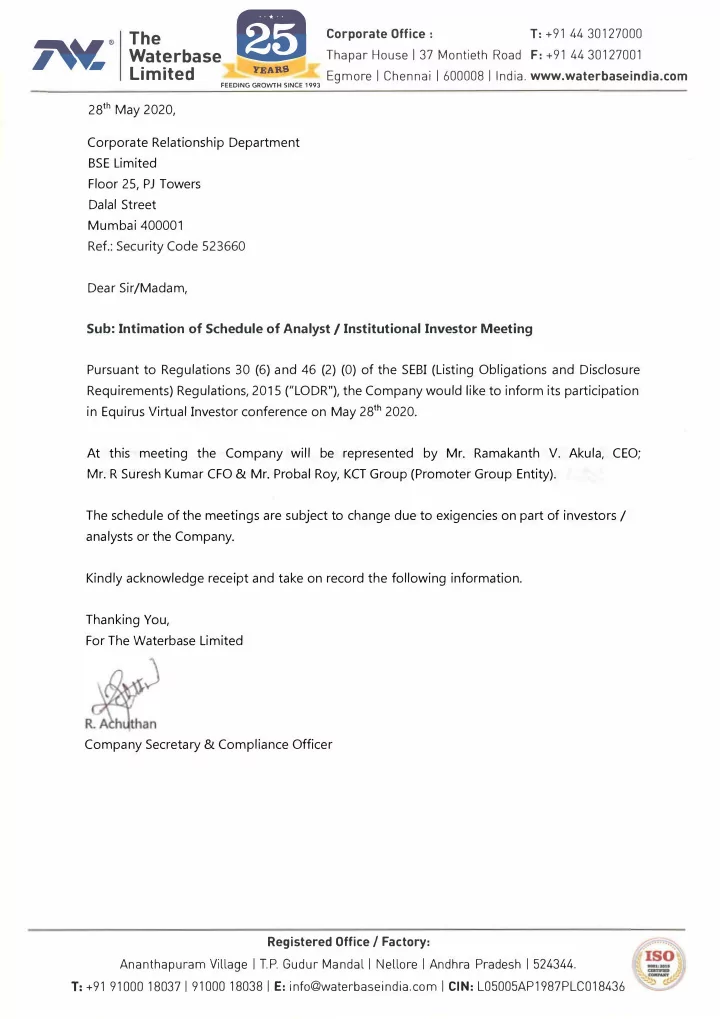
28th May 2020, Corporate Relationship Department BSE Limited Floor 25, PJ Towers Dalal Street Mumbai 400001 Ref.: Security Code 523660 Dear Sir/Madam, Sub: Intimation of Schedule of Analyst/ Institutional Investor Meeting Pursuant to Regulations 30 (6) and 46 (2) (0) of the SEBI (Listing Obligations and Disclosure Requirements) Regulations, 2015 ("LODR"), the Company would like to inform its participation in Equirus Virtual Investor conference on May 28th 2020. At this meeting the Company will be represented by Mr. Ramakanth V. Akula, CEO;

  • Mr. R Suresh Kumar CFO & Mr. Probal Roy, KCT Group (Promoter Group Entity).

The schedule of the meetings are subject to change due to exigencies on part of investors / analysts or the Company. Kindly acknowledge receipt and take on record the following information. Thanking You, For The Waterbase Limited Company Secretary & Compliance Officer

Registered Office/ Factory: Ananthapuram Village I T.P. Gudur Mandal I Nellore I Andhra Pradesh I 524344. T: +91 91000 18037 I 91000 18038 I E: info@waterbaseindia.com I CIN: L05005AP1987PLC018436

slide-2
SLIDE 2

Corporate Presentation

May 2020

slide-3
SLIDE 3

Safe Harbour Statement:

Certain statements in this presentation concerning our future plans and strategies growth prospects, etc. are forward looking statements, which involve a number of risks and uncertainties that could cause actual results to differ materially from those indicated in such forward-looking

  • statements. The risks and uncertainties relating to these statements

include, but are not limited to, fluctuations In earnings, our ability to manage growth, competitive intensity in our industry of operations including those factors which may affect our cost advantage, wage increases, our ability to attract and retain highly skilled professionals, sufficient availability of raw materials, our ability to successfully complete and integrate potential acquisitions, liability for damages on

  • ur contracts to supply products, the success of the companies in which

TWL has made strategic investments, withdrawal of governmental fiscal incentives, political instability, legal restrictions on raising capital or acquiring companies outside India, and unauthorized use of our intellectual property and general economic conditions affecting our

  • industry. TWL may, from time to time, make additional written and oral

forward-looking statements, including those in our reports to

  • shareholders. The Company does not undertake to update any forward

looking statement that may be made from time to time by or on behalf

  • f the company

2

slide-4
SLIDE 4

Industry Overview: Sustained Growth Momentum

Contents

Company Overview Growth Strategy Industry Overview Financial Overview Covid-19 Impact & Outlook

1 2 3 4 5 6

3

slide-5
SLIDE 5

Company Overview

slide-6
SLIDE 6

TWL – Niche Player in the high growth Aquaculture Industry in India

Installed Manufacturing capacity of Shrimp Feed

  • No. of Employees

March 2020

  • Yrs. In the

Industry Revenues In FY20 Debt – Equity As of Mar 31, 2020

5

0.1 324

Estimated size of Domestic Shrimp feed Industry

260

slide-7
SLIDE 7

Key Strengths

6

`

  • Several popular brands which are favoured by shrimp

farmers

  • Enjoys high recall and is seen to be synonymous with

quality and value

Strong Brands

  • Working with renowned companies and

research institutions in India and abroad for the benefit of industry

  • R&D initiatives have been meaningfully

converted into new products

  • Have driven improvements in feed

manufacturing, farm practices, waste management, shrimp processing

25 years of in-house R&D Rich Legacy Quality Control Technical Expertise Financial Position

  • Robust manufacturing processes and step by step quality

control system

  • Global best practices implemented
  • Comfortable debt levels with a debt equity ratio of 0.1x

(Mar 2020)

  • Demonstrated financial discipline through good and bad

years for industry

  • 25 years of expertise in the business-

strong connect with suppliers and farmers

  • Backed by the KCT Group – has

inculcated ethical business practices with long-term vision in mind

  • TWL enjoys unparalleled technical expertise in the industry as the Pioneer
  • Staffed by well-qualified personnel with rich industry experience
  • Products, processes, practices are viewed as gold standard by industry
slide-8
SLIDE 8

Best local R&D Setup in the Industry

7 Large repository of data: nutrition, diseases, soil and marine conditions Track record

  • f introducing

innovative shrimp feeds Proven competence in research and unparalleled technical expertise in the industry Farmer training and testing

  • f R&D initiatives under live

conditions Works closely with reputed institutes in the area of Aqua Feed Nutrition Research Continuous interaction with international experts on Shrimp feed nutrition, water quality management and development of specialized feed ingredients 25 years of in-house Research & Development (R&D) activities

slide-9
SLIDE 9

Strategic Alliance with CIBA

  • Indian Council of Agricultural Research (ICAR), New

Delhi under the Ministry of Agriculture, Government

  • f India established the Central Institute of Brackish

water Aquaculture (CIBA)

  • CIBA, serves

as the nodal agency for the development of brackish water aquaculture in the country

  • As part of the MoU, CIBA will collaborate for the

testing growth performance and refinement of eco- friendly shrimp feed with Waterbase

  • MoU will involve exchange of information on feed

formulations and testing

  • f

identified feed ingredients, trial feeds and any other market feed for macro and micro nutritional parameters at CIBA‘s Quality Testing Laboratory

  • Both CIBA and Waterbase will identify competent

technical personnel namely Scientists / Technicians, Chemists, etc. for implementation of the programme. Waterbase will also be able to use CIBA‘s technology in its own facilities

8

slide-10
SLIDE 10

Awards & Accolades

  • SME – Empowering India Awards 2019

– Wins the award under the ‗Food, Agro & Horticulture Products (Mid – Corporate)‘ category at the SME – Emerging India Awards 2019 – ―SME- Empowering India Awards 2019‖ seeks to recognize the contribution of such SMEs who through their achievements and growth have empowered the nation – Hon‘ble Union Minster of Steel, Govt. of India. Shri Chaudhary Birender Singh presented the award to Mr. Ramakanth V Akula, CEO, The Waterbase Limited

9

slide-11
SLIDE 11

Locations

11 Delhi Kolkata Nellore Chennai

Corporate Office Factory

Tamil Nadu Andhra Pradesh West Bengal Gujarat Odisha Existing New

Group Offices

Key markets served

slide-12
SLIDE 12

67.12% 26.78% 3.60% 1.41% 1.07% 0.02%

Shareholding Pattern

12

As on 31st March 2020

Promoters Indian Public Corporate Bodies Others NRI Institutions

slide-13
SLIDE 13

Growth Strategy

slide-14
SLIDE 14

Growth Strategy

  • Premiumisation of
  • ffering
  • Deepening of

distribution network

  • Addressing all

sizes of orders

  • New plant set up

in 2015 resulted in capacity growth of 3x to 110000 MTPA

  • Focused on

higher utilisation through increased sales volumes Leverage Increased Capacities Elevate presence in core markets Enhance visibility & Market share in New territories Vertical & Horizontal Integration to enhance business stability

  • Launched farm care

products under the brand name ‗Baylife‘

  • Launched packaged shrimp

and crab meat in Retail market under the brand name ‗Prize Catch‘

  • Commissioned Phase I of

Vannamei Hatchery to produce good quality seeds for shrimp farming

  • Increasing the farmer

base

  • Adding new dealers &

distributors

  • Customer connect

through workshops, training camps & farmer meets

  • Leveraging after sales

service 14

slide-15
SLIDE 15

Driving Premiumisation in the Feed Business

Branding & Packaging R&D inputs & Feed performance After Sales service Enhancing Farming techniques for disease management

15

slide-16
SLIDE 16

16

Shrimp farming-Current status 500 (No. of hatcheries in India) 150,000 Ha Under Farming 500 Processing Plants for shrimp Frozen shrimp exports in FY18 - 5,65,980 MT1 2019 Industry Requirement / Potential 80 Billion of Post Larvae (PL) Requires 10,00,000 MT

  • f Shrimp Feed

1,000,000 MT (Current Capacity) Frozen shrimp exports expected to grow further TWL Capacity

# This capacity is currently bein

1 Hatchery

g utilised fo/r5t0hi0rdMpnarPtyLprocessing

1,10,000 MT

and exports

4,000 MT# NA

Vertical & Horizontal Integration

Hatchery Farming Processing Finished Product (Shrimp)

KEY INPUTS

  • Shrimp Feed
  • Farm Care Products

New Growth Areas Segment

slide-17
SLIDE 17

Diversifying Revenue Streams

17

Diversifying Revenue Streams

Exports Hatchery Feed Farm Care

slide-18
SLIDE 18

Feed and Farm care range of products

18 Shrimp Feed Farm care range

slide-19
SLIDE 19

New Initiatives – Farm Care Products

19

VC-9 Farm Probiotic for Vibrio control NutriPond Promotes growth of good bacteria NutriFeast Builds Immunity NutriSorb Absorbs Ammonia NutriGut Protects Gut

slide-20
SLIDE 20

New Initiatives – Processed Seafood in the Domestic Market

20

Phase - I Phase - II Aiming for differentiated offering with a focus on quality and freshness – Initially will focus on institutional (HoReCa*) sales

  • Launched

line

  • f

frozen seafood under the brand ‗Prize Catch‘

Initially launched Raw Shrimps and Pasteurised Crab meat

Soft - launch in Chennai, Bangalore & Goa

  • Plan

to scale up launch to other major cities in India

  • Plan to add other

products to widen product range

* HORECA – Hotel, Restaurant & Caterers

slide-21
SLIDE 21

Industry Overview 1 – Global Market

slide-22
SLIDE 22

Global Demand for Seafood to remain strong; Aquaculture to drive future supply

23

7 13 26 38 40 40 42 43 44 62 93 87 74 62 60 60 58 57 56 38 1980 1990 2000 2009 2010 2011 2012 2013 2014 2030P Wildcatch (%) Aquaculture (%)

SEAFOOD CONSUMPTION

Data (2006) Projection(2030) CAGR (%) Capture 64,533 58,159 (0.43%) Aquaculture 47,164 93,612 2.90% Global Total 111,697 151,771 1.29%

(000 tons) FAO concludes that the maximum wild capture fisheries potential from the world’s oceans has probably been reached Overall, 80% of the world’s fish stocks for which assessment information is available are reported as fully exploited or overexploited

  • Supply of wild catch (from the sea) is expected

to remain stagnant - All incremental supply will come from aqua culture (Farmed Shrimp)

  • Aquaculture to grow at ~3% (CAGR) as against

a marginal decline in Capture

Source:www.fao.org

slide-23
SLIDE 23

Asia is the primary supplier of global shrimp; India the dominant force in Asia

24

2.1 2.2 2.2 2.3 2.4 2.5 2.4 2.4 2.5 2.7 2.7 0.5 0.4 0.5 0.5 0.5 0.6 0.6 0.6 0.7 0.7 0.8 2006 2007 2008 2009 2010 2011 2012 2013 2014 2015F 2016F

  • ~77% of global farmed shrimp supply contributed by Asian

countries

  • Disease outbreak in Thailand and Vietnam in end of the

previous decade impacted the growth rate

  • Growth during 2010-14 ~0.9% (albeit on a higher base)
  • LATAM benefiting from disease outbreak in Asia
  • Supply grew at CAGR of ~7.6% over 2010-2014
  • Ecuador is the shinning star within the region - exports grew at

a CAGR of 24.4% by value and 38.5% by volume during 2010-14

  • Despite Asia‘s stagnant shrimp supply over the past 5 years,

India‘s exports have grown at a CAGR of 32% (2010-15)

  • Introduction of P. Vannamei (White shrimp) key catalyst for India‘s

robust performance

  • In absolute terms, India‘s volumes have increased from 0.1mn tons

to 0.4 mn tons growing at CAGR (2010-15) of 32%

  • India‘s shrimp aquaculture market share has risen to 10.2% in

2015 from 2.8% in 2010 and is expected to reach 11.1% by 2018E

Asian region dominates global shrimp supply

Asia LATAM

India the dominant force in Asian region

slide-24
SLIDE 24

Global & Regional Trends

  • Aquaculture volumes have grown 4.5x over the last 20 years to 4.5mn tonnes in 2016 from 1.0mn tonnes in 1995
  • Share of P

. Vannamei has increased to 75% in 2016 from <10% in 1995 25

1995 1996 1997 1998 1999 2000 2001 2002 2003 2004 2005 2006 2007 2008 2009 2010 2011 2012 2013 2014 2015 2016 2017 2018

Million M T

World Shrimp Aquaculture by Species:

  • P. vannamei
  • P. monodon
  • M. rosenbergii

Other

slide-25
SLIDE 25

Growth Drivers

26 Income Growth / Rise in per capita income Aquaculture is more cost effective compared to agriculture/ animal husbandry Limited natural resources & growing population Rise of protein consumption for balanced diet Increasing global demand for shrimps Rapid switchover to Vannamei farming across the globe Adoption of new technologies Very high return, short crop period leading to rapid expansion

slide-26
SLIDE 26

Industry Overview 2 – Domestic Market

slide-27
SLIDE 27

Robust Track Record of Aqua Industry Growth

28

2000-01 2001-02 2002-03 2003-04 2004-05 2005-06 2006-07 2007-08 2008-09 2009-10 2010-11 2011-12 2012-13 2013-14 2014-15 2015-16 2016-17 2017-18

US $ Million

Export Performance Since 2002-03 (US $ Million)

Source: www.mpeda.com

Last 6 yr CAGR – 12%

  • Indian Seafood export crossed USD 7 bn for the first

time during FY18; a growth of ~23% over FY17.

  • USA and South East Asia retained their positions as the

major import markets of India‘s seafood products, with a share of 32.76% and 31.59% in dollar terms, respectively, followed by EU (15.77%), Japan (6.29%), Middle East (4.10%) and China (3.21%).

  • Frozen Shrimp and Fish constituted the bulk of India‘s

13,77,244 MT shipment of Seafood during FY18

  • Export of Vannamei shrimp grew from 3,29,766 MT to

4,02,374 MT in 2017-18 — an uptick of 22.02% in quantity and 24.74% in dollar terms.

  • USA accounted for around 53% of total Vannamei

shrimp exports in USD value, registering an increase of 31.93% in quantity and 33.03% in dollar terms, followed by South East Asia with a share of (21.03%), EU (11.31%), Japan (4.67%), Middle East (3%) and China (1.35%) Export Details 2016-17 2017-18 Growth (%) Quantity Tonnes 11,34,948 13,77,244 21.3% Value Rs. crore 37,870.90 45,106.89 19.1% Value US $ Billion 5.8 7.08 22.7%

slide-28
SLIDE 28

Driven by strong growth in Shrimp Exports

29

  • Shrimp exports during the year rose by 30.26% in

quantity and 30.10% in dollar terms

  • Frozen shrimp maintained its position as the key

contributor to seafood export basket, accounting for 41.10% in quantity and 68.46% of the total dollar earnings

  • The overall export of shrimp during 2017-18 stood at

5,65,980 MT valued at $4.8 billion

  • The export of cultured Vannamei stood at 4,02,374

MT recording a growth of ~22% in volumes on a y-

  • n-y basis
  • Due to the declining levels of wild shrimp and

preference for vannamei, as evident in changed mix in exports, the focus is increasing on farmed products 44 50 51 64 67 66 64 68

2010-11 2011-12 2012-13 2013-14 2014-15 2015-16 2016-17 2017-18

Marine Export – Frozen shrimp continues to be highest contributor

  • Fr. Shrimp
slide-29
SLIDE 29

Favorable Topography Availability Of Resources Active Regulatory Setup Changing of Species Supply Disruptions In Thailand & Vietnam Attractive Prices

Factors behind Success of Shrimp Farming in India

India has an abundant coastline and its climatic conditions are favorable for shrimp farming The introduction of the L. Vannamei species shifted the dynamics of shrimp farming through a significant improvement in economic viability of farms Abundant farm labour at reasonable cost, availability of other inputs such as land and power and sustained high levels of productivity have enabled India to be competitive Erstwhile key suppliers like Thailand and Vietnam were affected by breakout of EMS, leading to disruption in global supply thereby providing a window of

  • pportunity to Indian farmers &

exporters The industry is governed by MPEDA and CAA and the regulatory framework. This is seen as a key factor which helped India to avert disease which impacted industry growth in neighboring South- east Asian countries Global prices for Vannamei shrimp have sustained at attractive levels in recent years which has helped the industry/opportunity to remain lucrative

33

slide-30
SLIDE 30

Growth Drivers

34

Economics of shrimp farming attractive for farmers Growth in demand in end user markets like US and S. E. Asia Increasing reliability

  • f suppliers with

sophistication and value addition of products Government‘s push

  • n developing

aquaculture in India Large coastline

  • ffers huge

untapped potential for shrimp farming – 8,129 Km long coastline in addition to vast inland water resources

slide-31
SLIDE 31

Key Challenges

35

Access to quality brood stock and seeds which are key inputs to farming are impediments to faster and sustainable growth – the poor quality of inputs is impacting yields and sustainability Due to its nature it is difficult to regulate and ensure industry –wide implementation of

  • standards. The

unorganized structure also leads to challenges in financing, insurance and supply of labor

Fragmented Industry Quality of Inputs External

Diseases, weather patterns, fluctuating global prices of shrimp make the industry inherently unpredictable

Expected Increase in Competition

Significant capacities have come up in recent years and suppliers may resort to aggressive marketing in

  • rder to offload

capacities and /

  • r increase market share
slide-32
SLIDE 32

Financial Overview

slide-33
SLIDE 33

Financial Performance

Flooding of the factory premises and surrounding areas in Nov/Dec 2015 impacted revenue performance due to destruction of stock-in-hand as well as loss of potential revenue in season # EBIDTA performance was impacted due to higher input costs, unexpected expenses on account of flooding and disruption in operations. @ PBT was further impacted by (a) exceptional items of Rs. 3.5 crore being one–time settlement cost with one of the company’s bankers, (b) extra-ordinary item of Rs. 17.5 crore being one-time loss on account of write off of stock-in-hand and damage to factory premises due to flooding of the factory premises . FY15 alone is Ind-GAAP &FY17/17/18/19 & 20 (standalone)the remaining are based on INDA- AS

37

279.5 301.7 323.5 344.3 371.7 324.8

FY15 FY16 FY17 FY18 FY19 FY20

Revenue

32 9.6 30.8 58.3 56.9 34.1 11.4 3.2 9.5 16.9 15.3 10.5

FY15 FY16 FY17 FY18 FY19 FY20

EBITDA Margins (%)

(in Cr)

30.2 2.6 17.9 48.6 47.3 24.89 10.8 0.9 5.5 14.1 12.7 7.7

FY15 FY16 FY17 FY18 FY19 FY20

PBT Margins (%)

19.5 2.2 11.6 29.9 30.8 18.54 7 0.7 3.6 8.7 8.3 5.7

FY15 FY16 FY17 FY18 FY19 FY20

PAT Margins (%)

slide-34
SLIDE 34

Key Financials

38

FY15 is based on IND – GAPP ; FY16, FY17, FY18, FY19 & FY20 (standalone) are based on Merged Entity & Ind-AS. BVPS & EPS for FY16 & FY17 – considering shares to be issued consequent to the merger All Return ratios for FY16 were impacted by disruption in business operations and unexpected costs incurred due to flooding of the factory premises and surrounding areas in Nov/Dec 2015 *EPS RoE & RoCE further impacted by (a) exceptional items of Rs. 3.5 crore being one–time settlement cost with one of the company‘s bankers, (b) extra-ordinary item of Rs. 17.5 crore being one-time loss on account of write off of stock-in- hand and damage to factory premises due to flooding of the factory premises

Book value per share (Rs.) Earnings Per Share (Rs.) Return on net worth (%) Net Worth (Rs. cr) Return on Capital Employed (%) Debt Equity Ratio

25.7 27.3 30.1 36.1 41.8 44.4 FY15 FY16 FY17 FY18 FY19 FY20 5.1 0.6 3 7.6 7.4 4.5 FY15 FY16 FY17 FY18 FY19 FY20 19.7 1.9 9.3 20 17.8 10.1 FY15 FY16 FY17 FY18 FY19 FY20 30.3 4.2 17.5 30.7 26.2 14.0 FY15 FY16 FY17 FY18 FY19 FY20 99.2 113.2 124.5 149.6 173.1 183.9 FY15 FY16 FY17 FY18 FY19 FY20 0.1 0.5 0.5 0.2 0.2 0.1 FY15 FY16 FY17 FY18 FY19 FY20

slide-35
SLIDE 35

Q4 & FY20 Performance Updates

slide-36
SLIDE 36

FY20 - Financial Performance

INR Cr.

As per Ind –AS

While Feed business remained under pressure

  • wing to weak demand and lower farm gate

prices; ancillary businesses namely Farm care and Hatchery performed well. Farmcare continued to maintain its steady momentum – gaining good traction in new and existing markets, while Hatchery business started off on a strong note with positive response from the farmers. The Covid-19 pandemic has had a significant impact on the first crop of 2020 farming season as farmers have

  • pted for early harvesting in an attempt to de-risk

themselves amidst demand and realisatiton uncertainties which has in turn impacted the feed volumes Input prices continued to remain elevated in turn compressing margins and profitability. Expect raw material prices to remain steady at current level Revenue de-growth coupled with steady input prices exerted pressure on the margins and profitability during the year. Going ahead, wider distribution reach coupled with growing ancillary revenue streams should partially mitigate the near term impact of the covid-19 pandemic. Particulars (Rs.cr)

FY20 FY19 Growth (%)

Total Income 324.80 371.66 (13) EBITDA 34.1 56.9 (40) EBITDA Margin (%) 10.5

15.3 (480 bps)

PAT 18.5 30.8 (40) PAT Margin (%) 5.7

8.3 (260 bps)

40

slide-37
SLIDE 37

FY20 - Financial Performance

INR Cr.

As per Ind –AS

Particulars (Rs.cr) FY20 FY19 Growth (%)

Total Income 324.8 371.7 (13) EBITDA 34.1 56.9 (4) EBITDA Margin (%) 10.5 15.3 (480 bps) PAT 18.5 30.8 (4) PAT Margin (%) 5.7 8.3 (260 bps)

41

Particulars (Rs.cr) FY20 FY19 Growth (%) Feed

302.4

345.2 (12) Processing

8.1

19.7 (59) Farm Care

8.5

5.5 53 Hatchery 5.4 0.9 513 Others

0.4

0.4 21 Total Income

324.8

371.7 (13)

Revenue Break - up

slide-38
SLIDE 38

Business Update

42

Feed Business

  • Covid-19 severely disrupted both the demand and supply side
  • Demand –
  • Lower demand from the end user (HoReCa – export driven) triggered a chain

reaction across the value chain, firstly by raising apprehension in farmer‘s mind regarding realisations – in turn forcing them to undertake early harvesting of their

  • utput which in turn led to lower off-take of feed
  • First crop of farming season 2020 has been significantly impacted; Second & third

crop may not be able to make up for the deficit

  • Supply –
  • Challenges surrounding logistics and limited availability of workers weighed on the

supply side of the equation. With ports being jammed and limited movement of material transportation prices jumped up

  • Limited availability of brood stock (Imported) impacted Hatchery business
  • perations as well

Farmcare Products

  • Maintained growth momentum during the year on the back of positive response across markets;

expect the trend to continue

  • Seeing good traction in existing and new high growth markets as well
  • Buoyed by improving acceptancy ratio; efforts are now directed towards widening the width and

breadth of the product portfolio

  • Helps the Company to diversify revenue streams and capture larger share of wallet

Hatchery business –

  • Overwhelming response

to the business — in the first year of operations.

  • High proportion of

repeat business on the back of solid demand

  • Contemplating

expanding capacities to meet growing demand – will carefully monitor pace

  • f normalisation of
  • perating environment
  • Synergies with Feed and

Farmcare products business

slide-39
SLIDE 39

COVID -19 Impact & Outlook

slide-40
SLIDE 40

Covid-19 – A Global Phenomenon – Initial Impact

41

  • Severe impact on both demand & supply side of the industry
  • Demand weakens –
  • 70% of the consumption is out of home; Social distancing & lockdown

measures have severely impacted the HoReCa business globally

  • Restaurants have started offering take-away & contact less delivery –
  • nly partially making up for the lost sales
  • Small and mid sized restaurants likely to close and large chains likely to

downsize

  • Only silver lining is increase in grocery store and retail sales
  • Supply Crippled –
  • Dropping farmgate price induced early harvest, Uncertainty meant that

farmers did not stock for 2 months out of fear and no seeds

  • Disruption of operations at major Ports coupled with labour shortage

drove up transportation costs

  • Lack of cold storage capacities and lack of containers prevented storage

and export

  • Supply of Brooders impacted which in turn impacted Hatchery business
  • Supplies intended for Institutional / HoReCa Customers cannot be

repackaged into retail products due to challenges on product form, packaging thereby impeding ability to cash in on higher retail demand

Shrimp Monthly Price – US$ / Kg

Source: Indexmundi.com

slide-41
SLIDE 41

Covid-19 – Different stage of impact is reflected

41

USA

  • Food service business continues to

reel under pressure; although few states have permitted resumption of activities

  • Most of the restaurants are offering

takeaways & deliveries as in –house- restaurant activities continue to remain low

  • Retail sales (Ready to Cook) though

have picked up sharply; up 30% CHINA

  • Pick up in Demand after initial lull
  • Restaurant business has resumed

after a hiatus of two months – gradually reverting to normalcy

  • Outbreak of DIV1 Virus and Glass

Larvae (HPTV) in the country will impact the domestic production while pick up in demand will exert greater pull towards imports EUROPE

  • Food service business

continue to remain under pressure

  • Major fish consuming

nations in the region worst impacted by the Covid-19 pandemic

slide-42
SLIDE 42

Covid-19 – Impact on India’s vis-à-vis peers

41

Indonesia –

  • Processed, Ready to Serve products has seen huge demand
  • Currency weakening though has perked up prices for feed; which could

impact farmer‘s margins

  • Domestic demand impacted due to lockdown

Vietnam –

  • Supply remained steady despite the pandemic
  • While exports to US & Japan has picked up; EU & Korea witnessed

moderation Ecuador –

  • Exports to China picked up pace following easing up of restriction in April
  • Factories operating at 50% of the capacities
  • Industry seeking Govt. bailout

India –

  • First crop of 2020

Farming season has been severely impacted by Covid-19

  • Apprehensions

surrounding demand and realisations have resulted in farmers resorting to early harvesting of crop or withholding their plans for plantation

  • Hatchery business has

been impacted owing to limited brood stock availability

India given its limited infrastructure, expertise & approvals will not be able to capitalise on the boom in Retail products – losing out to peers like Vietnam, Thailand & Indonesia which are better placed

slide-43
SLIDE 43

Covid-19 – Impact on TWL

41

Farming

  • Lockdown impacted labour and feed availability in some farming areas
  • Under stocking of ponds due to fear of low prices
  • Farmers have opted for early harvesting in an attempt to de-risk themselves
  • Stocking as well has been held up due to non-availability of seed (PL)

Feed & Farm Care

  • Feed sales impacted due to low & reduced stocking
  • Exercising strict credit control
  • Production cost remains firm amidst labour unavailability, transportation

challenges and social distancing

  • Collections impacted
  • Farm care sales though continues to remain strong; planning towards

expanding product portfolio

Hatchery

  • PL drained out due to low demand and bio-security protocols
  • Brood stock availability posed threat due to disruption in Logistics from Hawaii
  • Cargo flights resumed from May 15th , PL production may resume only by June

end

Processing & Exports

  • Resumption of exports to

China

  • Operations impacted due to

labour shortages

  • Congestion at ports has

started to ease up

  • Exporters fear high

Farmgate prices due to lower production in next two months

slide-44
SLIDE 44

Thank You