8/27/2018 Overview of presentation UConn Dietetics Preceptor - - PDF document

8 27 2018
SMART_READER_LITE
LIVE PREVIEW

8/27/2018 Overview of presentation UConn Dietetics Preceptor - - PDF document

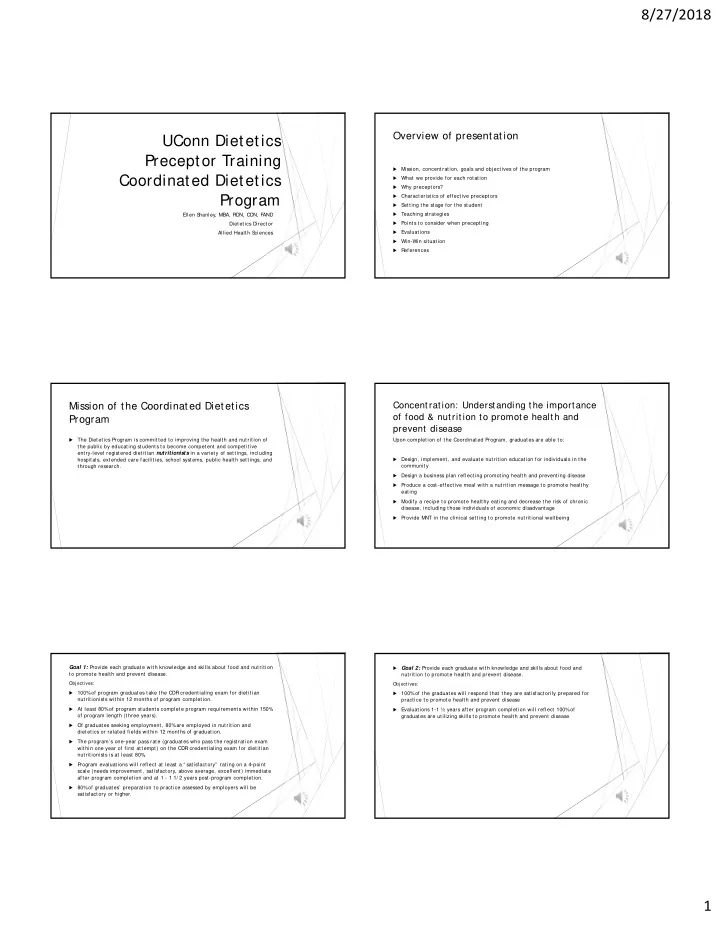
8/27/2018 Overview of presentation UConn Dietetics Preceptor Training Mission, concentration, goals and obj ectives of the program Coordinated Dietetics What we provide for each rotation Why preceptors? Characteristics of


slide-1
SLIDE 1

8/27/2018 1 UConn Dietetics Preceptor Training Coordinated Dietetics Program

Ellen Shanley, MBA, RDN, CDN, F AND Dietetics Director Allied Health Sciences

Overview of presentation

Mission, concentration, goals and obj ectives of the program

What we provide for each rotation

Why preceptors?

Characteristics of effective preceptors

Set t ing t he st age for t he st udent

Teaching st rat egies

Point s t o consider when precept ing

Evaluations

Win-Win situation

References

Mission of the Coordinated Dietetics Program

The Dietetics Program is committed to improving the health and nutrition of the public by educating students to become competent and competitive ent ry-level regist ered diet itian nutritionists in a variety of settings, including hospitals, ext ended care facilit ies, school syst ems, public healt h set t ings, and through research.

Concentration: Understanding the importance

  • f food & nutrition to promote health and

prevent disease

Upon completion of the Coordinated Program, graduates are able to:

Design, implement , and evaluat e nut rit ion educat ion for individuals in t he community

Design a business plan reflecting promoting health and preventing disease

Produce a cost-effective meal with a nutrition message to promote healthy eating

Modify a recipe to promote healthy eating and decrease the risk of chronic disease, including t hose individuals of economic disadvantage

Provide MNT in the clinical setting to promote nutritional wellbeing Goal 1: Provide each graduat e wit h knowledge and skills about food and nutrition to promote health and prevent disease. Obj ectives:

100%

  • f program graduates take the CDR credentialing exam for dietitian

nutritionists within 12 months of program completion.

At least 80%

  • f program students complete program requirements within 150%
  • f program length (three years).

Of graduates seeking employment, 80% are employed in nutrition and dietetics or related fields within 12 months of graduation.

The program’s one-year pass rat e (graduates who pass t he regist rat ion exam within one year of first attempt) on t he CDR credent ialing exam for diet itian nutritionists is at least 80% .

Program evaluations will reflect at least a “ satisfactory” rating on a 4-point scale (needs improvement , sat isfact ory, above average, excellent ) immediate after program completion and at 1 - 1 1/ 2 years post-program completion.

80%

  • f graduates’ preparation to practice assessed by employers will be

satisfactory or higher.

Goal 2: Provide each graduate with knowledge and skills about food and nutrition to promote health and prevent disease.

Obj ectives:  100%

  • f the graduates will respond that they are satisfactorily prepared for

practice to promote health and prevent disease

Evaluations 1-1 ½ years after program completion will reflect 100%

  • f

graduates are utilizing skills to promote health and prevent disease

slide-2
SLIDE 2

8/27/2018 2

Each rotation

Course syllabus

Evaluation

Please ask if you have any quest ions about t hese

Why Preceptors?

Medical education is an apprenticeship model

Classroom learning and practice

Precept or

 “ An experienced practitioner who provides role support and learning experiences

for student learners. A preceptor works with the learner for a defined period of time and assists the learner in acquiring new competencies required for safe, ethical and quality practice.” 1

 Instructor, supervisor, and evaluator

1 Precepting accessed

https:/ / www.radford.edu/ content/ dam/ colleges/ wchs/ DNP/ Preceptors% 20Files/ Prec epting.pdf

Key Points to Consider

“ Precepting is a new skill that is learned over time with support & mentoring…

Effective and confident preceptors model lifelong learning and professional growth for students … and create a safe, flexible learning environment

Timely, specific feedback and st udent evaluat ion are key element s of t he precept ing role” 2

2 Precepting 101: Teaching S

trategies and Tips for S uccess for Preceptors Accessed https:/ / onlinelibrary.wiley.com/ doi/ full/ 10.1111/ j mwh.12520

Characteristic of Effective Preceptors

“ Those willing to give of themselves.

Those willing t o share knowledge, yet encourage self-learning and independence.

Those who are humble, able to put the spotlight on the students.

Those who are nonj udgment al, allowing all st udent s t o be t hemselves, who help t he st udent s’ qualities t o shine.

Those who use positive, rather than negative reinforcement.

Those who are flexible, allowing st udent s t o do t hings t heir way, even if t hat isn’ t the teachers’ way.” 1

More Characteristics to Consider

Positive, enthusiastic attitude

Provide appropriate, frequent feedback

Show respect for the student

Challenge student to perform

Question student and promote higher level thinking

Provide appropriate structure3

3 Allen-Chabot, A. M. (2006, May 25). Teaching in the Clinical Setting: Strategies for

Success.

slide-3
SLIDE 3

8/27/2018 3

Getting off on the right foot

Determine a meeting time and communicate if you want the intern to prepare in anyway prior to the first meeting

Learn about t he st udent ’s prior experiences, skills, and knowledge

Tell the student about your experiences and how you like to teach

Ask the student how he/ she likes to learn

Review rotation competencies and ask if he/ she has any questions

Orient and introduce the student to the site

The Right Atmosphere

Be specific

 Tell the student exactly what you want and expect 

Communicate throughout the rotation

 Make it positive whenever possible  If something needs correcting tell the student in a timely manner and be specific

with expectations  Be patient

 Promote a positive learning environment  The student may have learned how to do something differently from another

preceptor

 Many times there are many ways that are correct

Teaching S trategies

Expert

Conveys information directly t o t he student 

Modeling (role modeling)

Preceptor demonstrates

Oft en done wit h beginning student s and when showing advanced skills 

Observation

Preceptor & student can observe each other

Provide feedback when observing student 

Direct questioning

S tudent can develop crit ical t hinking skills

Don’ t put student on t he spot in front of ot hers 

Think aloud method

Fosters crit ical t hinking and reasoning skills

Encourages student to verbalize thoughts and rationalize decision-making

Teaching S trategies (continued)

Coaching

 Preceptor provides verbal cues during performance 

Facilitator

 Provide opportunities for student to self-evaluate and ask questions 1, 4

4 Approaches to effective Preceptor Teaching: accessed

https:/ / pharmacy.ucsd.edu/ faculty/ ExperientialEducation/ docs/ Slides_8_09_14.pdf

Points to Consider When Precepting

Where is the intern in his/ her training

Plan for increasing intern responsibility 

Assist the intern in setting realistic goals

Communicate exactly what you expect from the intern and the level of independence

S hould t he int ern make decisions and t hen let you know? 

Evaluation is important to provide throughout

Formative assessment occurs t hroughout t he rot at ion. A cont inual dialogue should occur t hroughout t he rot at ion so t he student knows what he/ she needs t o work on

S ummat ive evaluat ion t akes place at t he end of t he rot at ion and t he student is compared to a norm

Evaluations need to be as obj ective and unbiased as possible. We are all human but we need t o not have personal feelings influence t he evaluat ion nor can we have a specific incident overshadow the evaluat ion of t he ent ire rot at ion.

Continuous Feedback

St udent s really do like feedback and should know how t hey’ re doing

What should you tell the student?

 What they have done well  What they need to improve 

Have the student plan a course of action

Daily and timely

No surprises at t he final evaluat ion

slide-4
SLIDE 4

8/27/2018 4

Charlotte Meucci, RD, CDE, CDN, Outpatient Cardiac Dietitian at Hartford Hospital

Typically a 2 week rotation

Explain j ob dut ies t o t he st udent ; what is expect ed of t hem

What is a typical day

Provide handout (overview of cardiology diagnosis and what is done in the Cent er)

Explains that she give feedback and is trying to improve their skills; explains t hat t hey are her pat ient s and she is responsible and will linger t o make sure they handle the situation correctly

Two-way communication

Tour and introduce them to the staff

Importance of the staff and the interprofessional team

Interaction with patient

Intern reviews chart

Asks int ern what t hey found out from t he chart- see if t hey missed anything

Intern interviews patient

 Pat ient history, food recall, who is involved 

Privately meets with interns and asks intern what they got from the interview

 Makes sure the intern gets what they need and if missing anything lets them know 

Intern completes education

Through every st ep Charlot t e quest ions and provides feedback

Evaluations

1 - NOVICE - requires frequent supportive and occasional directive cues; identifies principles but needs direction to identify application 2 - BEGINNER - requires a supportive or directive cue occasionally; applies principles accurately with occasional cues; works at acceptable standards 3 - COMPETENT - demonstrates sound knowledge and effective use of entry level skills; seeks assist ance aft er invest igating pot ent ial solut ions Competent to be hired for entry-level practice

Benefits of Precepting WIN-WIN

Y

  • u should be more productive

Have interns work on proj ects you have not be able to do

Int erns have fresh eyes and have recent ly been exposed to current teachings

Optimistic fresh outlook

Keep you young!

Keep you on your t oes!

Future employees and are well trained

Continuing Professional Education

If you are an RDN, you may be eligible for CPE credits. Since June 1, 2017, CDR has allowed CPE credits for precepting. Y

  • u are able to receive up to 3

CPEUs per year and up to 15/ 5 years.

 1-25 hours of contact = 1 CPEU  26-50 hours of contact = 2 CPEUs  50 or greater hours = 3 CPEUs 

Posted on the website from CDR are

 F

AQ

 Log Form  Verification  Professional Leadership Description

slide-5
SLIDE 5

8/27/2018 5

References

Allen-Chabot, A. M. (2006, May 25). Teaching in the Clinical S etting: S trategies for Success.

Benedictine University Dietetic Internship 2017-2018 S ite Preceptor Handbook. Accessed http:/ / www.ben.edu/ college-of-education-and-healt h- services/ nutrition/ upload/ BenU-S ite-Preceptor-Handbook-2017-2.pdf

Kendall, A, Brown, S . (2010). MS

  • DI Preceptor Training Program.

Precepting accessed https:/ / www.radford.edu/ content/ dam/ colleges/ wchs/ DNP/ Preceptors% 20Files/ P recepting.pdf

Precepting 101: Teaching Strategies and Tips for Success for Preceptors Accessed https:/ / onlinelibrary.wiley.com/ doi/ full/ 10.1111/ j mwh.12520

Schneid, S. Approaches to Effective Preceptor Teaching. Accessed Approaches to Effective Preceptor Teaching Steve Schneid, MHPE