7/11/2019 Financial Disclosures Romosozumab: Newly Approved - - PowerPoint PPT Presentation

7 11 2019
SMART_READER_LITE
LIVE PREVIEW

7/11/2019 Financial Disclosures Romosozumab: Newly Approved - - PowerPoint PPT Presentation

7/11/2019 Financial Disclosures Romosozumab: Newly Approved Anabolic Therapy -Consulting & talks: Zuellig pharma, -Advisory Board: Roche Diagnostics -DSMB (not bone): Eli Lilly Dennis M. Black, PhD Professor Epidemiology and


slide-1
SLIDE 1

7/11/2019 1

1

Romosozumab: Newly Approved Anabolic Therapy

Dennis M. Black, PhD Professor Epidemiology and Biostatistics, UCSF

Financial Disclosures

  • Consulting & talks: Zuellig pharma,
  • Advisory Board: Roche Diagnostics
  • DSMB (not bone): Eli Lilly

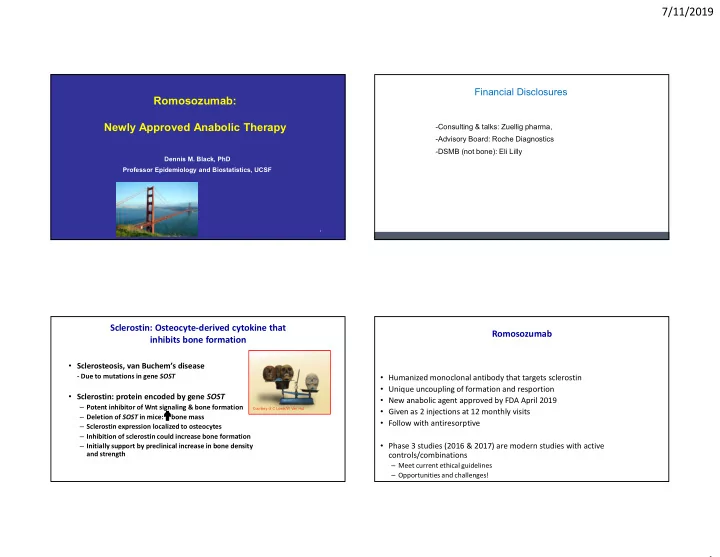
Sclerostin: Osteocyte-derived cytokine that inhibits bone formation

  • Sclerosteosis, van Buchem’s disease
  • Due to mutations in gene SOST

Courtesy of C Lowik/W Van Hul

  • Sclerostin: protein encoded by gene SOST

– Potent inhibitor of Wnt signaling & bone formation – Deletion of SOST in mice:  bone mass – Sclerostin expression localized to osteocytes – Inhibition of sclerostin could increase bone formation – Initially support by preclinical increase in bone density and strength

Romosozumab

  • I
  • Humanized monoclonal antibody that targets sclerostin
  • Unique uncoupling of formation and resportion
  • New anabolic agent approved by FDA April 2019
  • Given as 2 injections at 12 monthly visits
  • Follow with antiresorptive
  • Phase 3 studies (2016 & 2017) are modern studies with active

controls/combinations

– Meet current ethical guidelines – Opportunities and challenges!

slide-2
SLIDE 2

7/11/2019 2

Phase 2 Study of Sclerostin Antibody (Romozosumab) in Postmenopausal Women with Low BMD

McClung et al, NEJM 2014

Phase 2 Study Study Design

McClung et al, NEJM 2014

% Change in Bone Turnover Markers: P1NP and CTX Uncoupling of Bone Turnover

P1NP (Formation) CTX (Resorption)

McClung et al, NEJM 2014

Romosozumab TPTD ALN PBO

Lumbar Spine BMD

slide-3
SLIDE 3

7/11/2019 3

Total Hip and Femoral Neck BMD

Phase III Trial of Romosozumab vs. Pbo (Year 1) Followed by Open Label Denosumab (Year 2) (FRAME)

  • 24 month study of 7,180

women

  • Year 1: Romo vs. placebo
  • Year 2: Denosumab in all
  • Romo/denosumab vs.

placebo/denosumab over 2 years

  • Co-Primary endpoints:
  • New vertebral fractures at 12

months and 24 months

Cosman NEJM 2016

Cosman F et al. N Engl J Med 2016;375:1532-1543

Change in BMD Over 2 Years

Cosman NEJM 2016

Vertebral Fracture Incidence over 12 and 24 Months

Cosman NEJM 2016

slide-4
SLIDE 4

7/11/2019 4

Cosman F et al. N Engl J Med 2016;375:1532-1543

Clinical and Non-vertebral Fracture Incidence

  • ver 12 and 24 Months

Cosman NEJM 2016

Non-vertebral Fracture Any Clinical Fracture

HR=0.64 (0.46,0.89) P=.008 HR=0.75 (0.53,1.05) p=0.10 HR=0.75 (0.57,0.97) Adj p=0.06 HR=0.67 (0.52,0.87) Adj P=0.10

Fracture Efficacy Summary

  • Significant reductions for vertebral fractures at 12 and 24 months (primary)
  • Clinical and non-vertebral fracture reductions nominally significant at 12 and 24 months

p>.05 after adj for mult. comparisons, 3 of 4 > 0.05

  • All 24 month comparisons against active control (PBOD’Mab)
  • Subgroup analysis (post-hoc): larger reductions outside of S. America.

Non-vertebral fractures, 12 months Not S. America (57%) HR=0.58 (0.37, 0.89)

  • S. America (43%)

HR=1.25 (0.68, 2.27) Phase III Trial of Romosozumab vs. Alendronate (1 year) Followed by Open Label Alendronate (year 2) (ARCH)

Saag NEJM 2016

  • 36 month study of 4093

women

  • Year 1: Romo vs. ALN
  • Active control
  • Year 2+: All on ALN
  • Romo/ALN vs. ALN over 3-4

years

  • Co-Primary endpoints:
  • New vertebral fractures

at 24 mos

  • Clinical fractures after

330 fx.

Percentage Change from Baseline in Bone Mineral Density

Saag KG et al. N Engl J Med 2017;377:1417-1427

Saag NEJM 2016

slide-5
SLIDE 5

7/11/2019 5

Incidence of New Vertebral, Clinical, and Nonvertebral Fracture Romo/ALN Compared to 2 years ALN

Saag KG et al. N Engl J Med 2017;377:1417-1427

Saag NEJM 2016

Incidence of Clinical and Non-Vertebral Fracture. Control group=Alendronate

Saag KG et al. N Engl J Med 2017;377:1417-1427

Saag NEJM 2016

HR=0.81 (0.66,0.99) HR=0.73 (0.61,0.88)

Hip Fractures: HR=0.62 (0.42,0.92), p=0.02

Fracture Efficacy Summary

  • Significant reductions for vertebral fractures at 12 (primary) and 24 months vs

2 years of ALN

  • Clinical fractures at 48 months (after 330 events, primary).

Non-vertebral fractures also significantly reduced 48 months

  • All comparisons against active control (Alendronate) for entire study

Adverse Events in the 2 Phase 3 Romo Studies

Cosman F et al. N Engl J Med 2016;375:1532-1543

Cosman NEJM 2016

Denosumab Combo (FRAME, n=7157) Alendronate Combo (ARCH, n=4054)

Saag NEJM 2017

slide-6
SLIDE 6

7/11/2019 6

Adverse Events in the Phase 3 Romo Studies

Cosman F et al. N Engl J Med 2016;375:1532-1543

Cosman NEJM 2016

Denosumab Combo (FRAME, n=7157) Alendronate Combo (ARCH, n=4054)

Saag NEJM 2017

Saag KG et al. N Engl J Med 2017;377:1417-1427

Adverse Events and Safety

  • Overall AE occurrence similar in Romo vs. controls
  • Binding antibodies seen in 15%, neutralizing abs in 0.6% but no detectable

impact on efficacy or safety

  • Some injection-site reactions
  • ONJ and AFF: a few cases including in Romo alone group. More in ALN.
  • Supports that ONJ and AFF are not solely due to over suppression of turnover
  • Cardiovascular adverse events larger concern

Cosman NEJM 2016 Saag NEJM 2017

Denosumab Combo (FRAME, n=7157) Alendronate Combo (ARCH, n=4054)

Cardiovascular Events in the Phase 3 Romo Studies

A small study in 245 men also showed a small numeric imbalance (NS) of CV events in Romo (4.9%) vs Placebo (2.5%)

Lewiecki JCEM 2018

Saag KG et al. N Engl J Med 2017;377:1417-1427

Interpretation of Cardiovascular Safety

Summary

  • No excess events in Romo vs. placebo in FRAME 2016 trial
  • Slight increase in ischemic and cerebrovascular events in Romo vs. ALN in ARCH 2017 trial (decrease

in heart failure). None were statistically significant. Potential Explanations

  • 1. Random Difference
  • 2. ALN (comparator to Romo) decreases cardiovascular events, especially cerebrovascular
  • Evidence varies in individual ALN studies or meta-analyses
  • 3. Romo increases (slightly) cardiovascular event risk

Interpretation by Regulators

  • FDA: after initial review, asked for more information on cardiovascular. Approved 2019, but with

black box warning*

  • European: initial review (6/25/19). Did not approve due to cardiovascular concerns. Sponsors can

reapply.

*may increase the risk of heart attack, stroke and cardiovascular death and should not be used in patients who have had a heart attack or stroke within the previous year or very high risk.

slide-7
SLIDE 7

7/11/2019 7

Saag KG et al. N Engl J Med 2017;377:1417-1427

Romosozumab

Unique aspects

  • Increase in formation and decrease in resorption.

Uncoupling of bone turnover.

  • Large increases in BMD at spine and especially at

hip

  • Fast initiation of effect

Lewicki JCEM, 2018

Saag KG et al. N Engl J Med 2017;377:1417-1427

Making Choices Among Anabolic Therapies: Romosozumab vs. (Abaloparatide or Teriparatide)

Administration

  • Monthly in-office injections 12 monthly (Romo) vs. daily self-injections for 18-24

mos (TPTD, abalo)

  • Cost
  • Patient or physician preference

Safety

  • PTH/analogs: possible osteosarcoma (unlikely)
  • Romo: Possible but small increase in cardiovascular events

Efficacy

  • All reduce vertebral and non-vertebral, but no head-to-head studies
  • Larger early increase in hip BMD for Romo vs. Teriparatide (also vs. Abalo) and

may be considered for patients at very risk of hip or non-vertebral fx.