7/03/2019 Using GIS tools to assess the Apia Water SkyEye Pacific - - PDF document

7 03 2019
SMART_READER_LITE
LIVE PREVIEW

7/03/2019 Using GIS tools to assess the Apia Water SkyEye Pacific - - PDF document

7/03/2019 Using GIS tools to assess the Apia Water SkyEye Pacific Background Catchments Post Tropical Cyclone Gita Ebony-Jean Lafotanoa- Taavili SkyEye Pacific Pacific GIS and Remote Sensing Conference Area of Interest Project Background


slide-1
SLIDE 1

7/03/2019 1

Using GIS tools to assess the Apia Water Catchments Post Tropical Cyclone Gita

Ebony-Jean Lafotanoa-Ta’avili SkyEye Pacific Pacific GIS and Remote Sensing Conference

SkyEye Pacific Background

  • Following Category 1 Cyclone Gita and its

accompanying damage, the Ministry of Natural Resources (MNRE) through UNDP recruited SkyEye to conduct Spatial Imagery Acquisition to inform their post cyclone assessments

  • Project Aim: To provide context in the form of

spatial imagery and quantifiable data to facilitate investigation into the cause, impacts, and future risks in light of Tropical Cyclone Gita

  • Project Duration: 27th February 2018 - 30th April
  • 2018. Extended to 18thMay 2018

Project Background Area of Interest

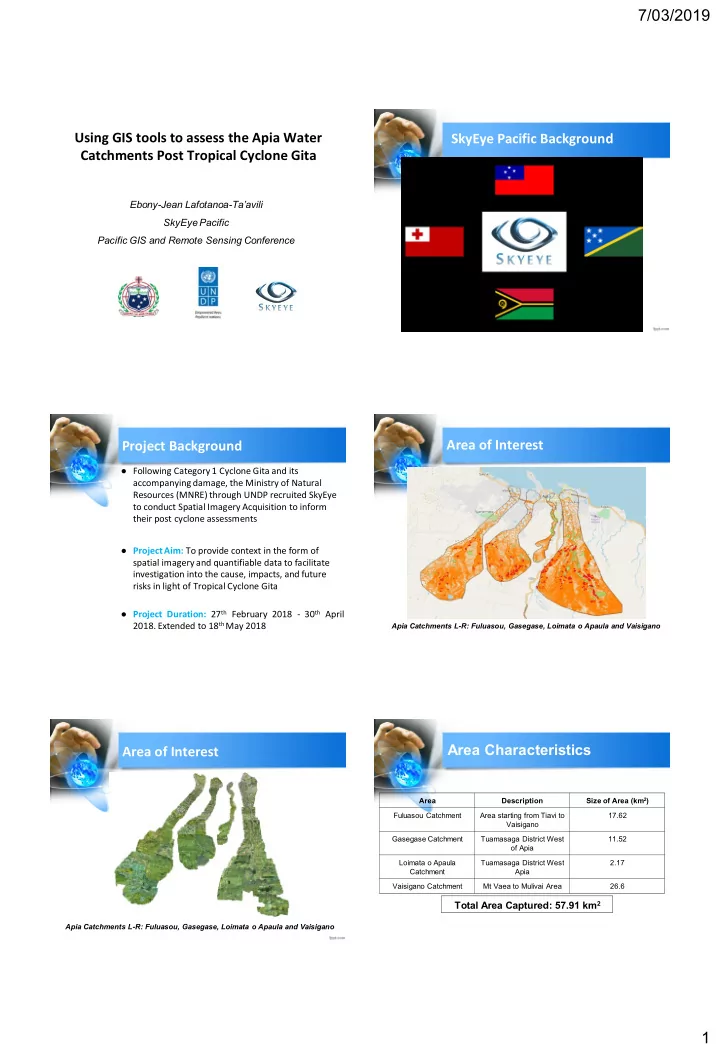
Apia Catchments L-R: Fuluasou, Gasegase, Loimata o Apaula and Vaisigano

Area of Interest

Apia Catchments L-R: Fuluasou, Gasegase, Loimata o Apaula and Vaisigano

Area Characteristics

Total Area Captured: 57.91 km2

Area Description Size of Area (km2) Fuluasou Catchment Area starting from Tiavi to Vaisigano 17.62 Gasegase Catchment Tuamasaga District West

  • f Apia

11.52 Loimata o Apaula Catchment Tuamasaga District West Apia 2.17 Vaisigano Catchment Mt Vaea to Mulivai Area 26.6

slide-2
SLIDE 2

7/03/2019 2

Project Deliverables/Outputs

Output 1: Digital Imagery and Point Cloud Data for 2018:Orthorectified, corrected to control points for, resampled to the same resolution Output 2: Capacity Building: Training of relevant staff in the use of products as a monitoring, assessment and reporting tool and the use of SkyEye products for future works Output 3: Project Reporting: Produce a Report on works undertaken, findings, analysis, recommendations.

Methodology

  • 1. Data Collection/Equipment
  • Undertook aerial mapping of catchment areas using DJI Phantom 4

Pro Drone and Sensefly Ebee Fixed Wing Drone. Resolution: Between 2 and 8 cm GSD

  • 2. Data Processing/Tools used
  • Software:

Pix4D Mapper Global Mapper 19 QGIS 2.18.18

  • 3. Processing & Analysis
  • Analyse vegetation, tree damage, landslides, roads and development,

generate terrain, surface and water network models

  • Orthorectified images (adjusted for camera tilt, perspective to get

true aerial view and therefore be able to measure true distances), rectified images to GCPs

Methodology Highlights

For Accurate Comparison:

  • SkyEye images resampled to 2015 resolution (20cm GSD) to allow

accurate comparison between the two. Area in Vaisigano: 2015 vs 2018

Methodology Highlights

Fuluasou River: 2015 vs 2018

More Examples:

Methodology Highlights

Vaisigano River Example: 2015 vs 2018

Methodology Highlights

Combining and Compressing Data for easier handling and use - taking into account Local Capacity:

  • Combining and compressing using ecw format of

2015 Aerial Imagery into single imagery per catchment for easier use

  • Compressing 2018 Orthorectified Imagery using ecw

format for easier use/handling

  • Combining and compressing of MNRE Lidar data per

catchment to .LAZ format for easier handling/use

slide-3
SLIDE 3

7/03/2019 3

Methodology Highlights

  • Combining and compressing of 2018 Point Cloud

Data for easier handling and use Data Package:

  • Packaged data all processed data into an easy to

use QGIS (Open Source) Desktop Package for easy

  • f use

Lastly...

  • Regarding the use of Spatial Data: Set up a central

portal for storage and access of water catchment spatial data for ease of access and easier/effective data management.

  • Local Knowledge: SkyEye being a local company,

we experienced the flooding and understand what is at stake. Knowing the local area enables faster response time to complete the project but also faster response in terms of local support.

Fa’afetai lava