6th Grade Equations & Inequalities 2015-12-01 www.njctl.org - - PDF document

6th grade
SMART_READER_LITE
LIVE PREVIEW

6th Grade Equations & Inequalities 2015-12-01 www.njctl.org - - PDF document

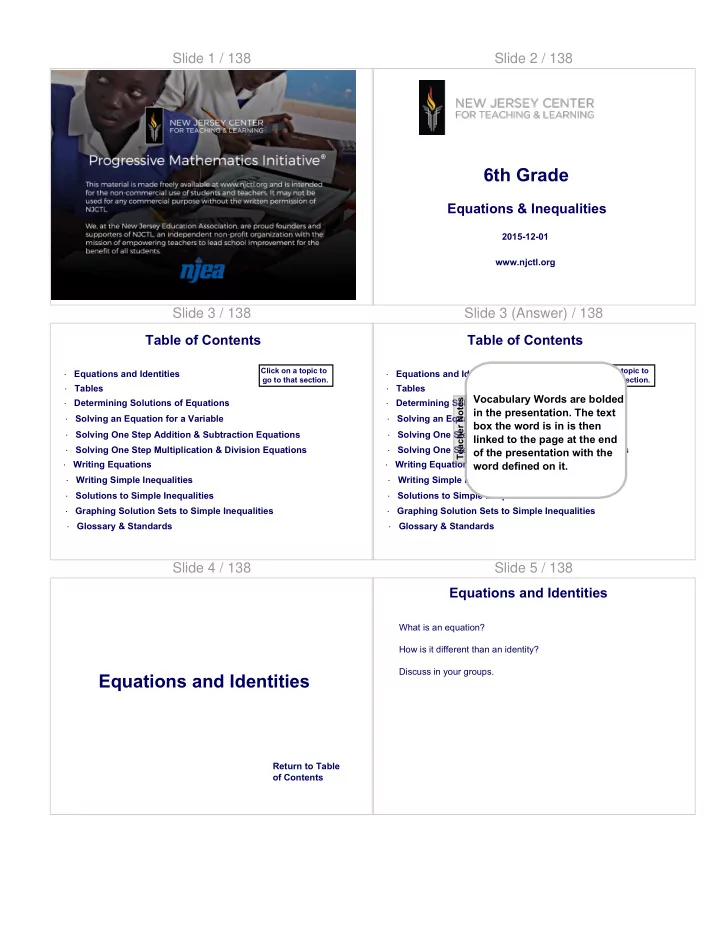
Slide 1 / 138 Slide 2 / 138 6th Grade Equations & Inequalities 2015-12-01 www.njctl.org Slide 3 / 138 Slide 3 (Answer) / 138 Table of Contents Table of Contents Click on a topic to Click on a topic to Equations and Identities


slide-1
SLIDE 1

Slide 1 / 138 Slide 2 / 138

6th Grade

Equations & Inequalities

2015-12-01 www.njctl.org

Slide 3 / 138 Table of Contents

Click on a topic to go to that section.

· Equations and Identities · Tables · Solving an Equation for a Variable · Solving One Step Addition & Subtraction Equations · Glossary & Standards · Determining Solutions of Equations · Solving One Step Multiplication & Division Equations · Writing Simple Inequalities · Solutions to Simple Inequalities · Graphing Solution Sets to Simple Inequalities · Writing Equations

Slide 3 (Answer) / 138 Table of Contents

Click on a topic to go to that section.

· Equations and Identities · Tables · Solving an Equation for a Variable · Solving One Step Addition & Subtraction Equations · Glossary & Standards · Determining Solutions of Equations · Solving One Step Multiplication & Division Equations · Writing Simple Inequalities · Solutions to Simple Inequalities · Graphing Solution Sets to Simple Inequalities · Writing Equations

[This object is a pull tab]

Teacher Notes

Vocabulary Words are bolded in the presentation. The text box the word is in is then linked to the page at the end

  • f the presentation with the

word defined on it.

Slide 4 / 138

Equations and Identities

Return to Table

  • f Contents

Slide 5 / 138 Equations and Identities

What is an equation? How is it different than an identity? Discuss in your groups.

slide-2
SLIDE 2

Slide 5 (Answer) / 138 Equations and Identities

What is an equation? How is it different than an identity? Discuss in your groups.

[This object is a pull tab]

Math Practice

This activity addresses MP3. Additional Questions to Ask:

  • Do you agree with their reasoning?

Why or why not?

  • Can you repeat to someone else what

they said?

  • Is there anything you could add on to

their answer?

Slide 6 / 138 Equations and Identities

An equation is created when two expressions are set equal to one another such that they are equal for some values of their variables, but not for all. If they are equal for all values of their variables, then that is an identity, not an equation. So, not all mathematical statements which include an equal sign are equations...some are identities.

Slide 7 / 138 Equations and Identities

Here are some identities: 2 + 3 = 5 9 - 2 = 7 2x = 2x 9/3 = 3 These are always true...there are no values that can be assigned to the variables for which these would be untrue.

Slide 8 / 138 Equations and Identities

Here are some equations: x = 5t v = 7 + x a = x - 8 In all these cases, the variables are interdependent. They are

  • nly true for certain sets of variables.

Changing the value of the variable on the right side of the equation, changes the possible values of the variables on the left side...and vice versa. These are equations (not identities) since knowing the value of

  • ne variable changes the possible value(s) of the other(s).

Slide 9 / 138

Tables

Return to Table

  • f Contents

Slide 10 / 138 Writing Equations

Tim's age is equal to Kathy's plus 8 T = K + 8 Tim is eight years older than Kathy. Write an equation for Kathy's age. click for mathematical equation click for equation in words Write an equation in words. Then translate that into a mathematical equation.

slide-3
SLIDE 3

Slide 10 (Answer) / 138 Writing Equations

Tim's age is equal to Kathy's plus 8 T = K + 8 Tim is eight years older than Kathy. Write an equation for Kathy's age. click for mathematical equation click for equation in words Write an equation in words. Then translate that into a mathematical equation.

[This object is a pull tab]

Math Practice

Slides 10-12 addresses MP2 Additional Questions to Ask:

  • How could you represent the problem

with symbols & numbers?

  • Why would you choose certain

variables to represent a certain value?

  • Is there more than one way to

represent an expression? an equation?

Slide 11 / 138 Writing Equations

Tim's age is equal to Kathy's plus 8 T = K + 8 Tim is eight years older than Kathy. Write an equation for Kathy's age. click for mathematical equation click for equation in words Write an equation in words. Then translate that into a mathematical equation.

Slide 11 (Answer) / 138 Writing Equations

Tim's age is equal to Kathy's plus 8 T = K + 8 Tim is eight years older than Kathy. Write an equation for Kathy's age. click for mathematical equation click for equation in words Write an equation in words. Then translate that into a mathematical equation.

[This object is a pull tab]

Math Practice

Slides 10-12 addresses MP2 Additional Questions to Ask:

  • How could you represent the problem

with symbols & numbers?

  • Why would you choose certain

variables to represent a certain value?

  • Is there more than one way to

represent an expression? an equation?

Slide 12 / 138 Writing Equations

Bob's height equals double Fred's height less 6 B = 2F - 6 click for mathematical equation click for equation in words Bob is 6 inches less than twice the height of Fred. Write an equation for Bob's height. Write an equation in words. Then translate that into a mathematical equation.

Slide 13 / 138

Write an equation in words. Then translate that into a mathematical equation.

Writing Equations

Speed equals distance divided by time s = d/t Speed is equal to the distance traveled in an amount of time. click for equation in words click for mathematical equation

Slide 14 / 138 Tables and Expressions

Let's use this table to find some solutions to the equation s = d/t; where s represents speed (in meters/second), d represents distance (in meters) and t represents time (in seconds). d (m) t (s) s (m/s) 30 2 60 4 90 6 120 2 240 4 360 6 We've entered the distance traveled and the time it took to travel that distance in two

  • f the columns.

Use the equation (s = d/t) to find the speeds and fill in the blank column. s = d/t

Math Practice

slide-4
SLIDE 4

Slide 15 / 138 Tables and Expressions

Note that in the first three sets of answers, the object was moving at a speed of 15 m/s. The final three sets of answers are for an object traveling four times faster, at 60 m/s. d (m) t (s) s (m/s) 30 2 15 60 4 15 90 6 15 120 2 60 240 4 60 360 6 60 But, in all cases, knowing the value of two of the three variables determines the values of the third. s = d/t

Slide 16 / 138

Determining Solutions of Equations

Return to Table

  • f Contents

Slide 17 / 138

A solution to an equation is a number that makes the equation true. In order to determine if a number is a solution, replace the variable with the number and evaluate the equation. If the number makes the equation true, it is a solution. If the number makes the equation false, it is not a solution.

Determining the Solutions of Equations Slide 18 / 138

Which of the following is a solution of the equation from the solution set? x + 7 = 9 {2, 3, 4, 5} Write the equation four times. Each time replace x with one of the possible solutions and simplify to see if it is true. 2 + 7 = 9 3 + 7 = 9 4 + 7 = 9 5 + 7 = 9 9 = 9 10 = 9 11 = 9 12 = 9 Yes No No No Answer: 2 is the solution to x + 7 = 9

Determining the Solutions of Equations Slide 19 / 138

Which of the following is a solution of the equation? y - 12 = 8 {17, 18, 19, 20} Write the equation four times. Each time replace y with one of the possible solutions and simplify to see if it is true. 17 - 12 = 8 18 - 12 = 8 19 - 12 = 8 20 - 12 = 8 5 = 8 6 = 8 7 = 8 8 = 8 No No No Yes Answer: 20 is the solution to y - 12 = 8

Determining the Solutions of Equations Slide 20 / 138

1 Which of the following is a solution to the equation? x + 17 = 21 {2, 3, 4, 5}

slide-5
SLIDE 5

Slide 20 (Answer) / 138

1 Which of the following is a solution to the equation? x + 17 = 21 {2, 3, 4, 5}

[This object is a pull tab]

Answer

4 Slide 21 / 138

2 Which of the following is a solution to the equation? m - 13 = 28 {39, 40, 41, 42}

Slide 21 (Answer) / 138

2 Which of the following is a solution to the equation? m - 13 = 28 {39, 40, 41, 42}

[This object is a pull tab]

Answer

41 Slide 22 / 138

3 Which of the following is a solution to the equation? 12b = 132 {9, 10, 11, 12}

Slide 22 (Answer) / 138

3 Which of the following is a solution to the equation? 12b = 132 {9, 10, 11, 12}

[This object is a pull tab]

Answer

11 Slide 23 / 138

4 Which of the following is a solution to the equation? 3.5 + d = 7.5 {2.5, 3, 3.5, 4}

slide-6
SLIDE 6

Slide 23 (Answer) / 138

4 Which of the following is a solution to the equation? 3.5 + d = 7.5 {2.5, 3, 3.5, 4}

[This object is a pull tab]

Answer

4 Slide 24 / 138

Solving an Equation for a Variable

Return to Table

  • f Contents

Slide 25 / 138

Like in any game there are a few rules. There are three rules which will allow you to solve any one-step equation.

The Rules for Solving Equations Slide 26 / 138

Here are the three rules. Let's examine them, one at a time.

  • 1. To "undo" a mathematical operation, you must perform the

inverse operation.

  • 2. You can do anything you want (except divide by zero) to one

side of an equation, as long as you do the same thing to the

  • ther.
  • 3. You can always switch the left and right sides of an equation.

The Rules Slide 27 / 138

  • 1. To "undo" a mathematical operation, you must do the opposite.

We learned earlier that for every mathematics operation, there is an inverse operation which undoes it: when you do both

  • perations, you get back to where you started.

When the variable for which we are solving is connected to something else by a mathematical operation, we can eliminate that connection by using the inverse of that operation.

The Rules Slide 28 / 138

  • 2. You can do anything you want (except divide by zero) to one

side of an equation, as long as you do the same to the other side. If the two expressions on the opposite sides of the equal sign are equal to begin with, they will continue to be equal if you do the same mathematical operation to both of them. This allows you to use an inverse operation on one side, to undo an operation, as long as you also do it on the other side. You can just never divide by zero (or by something which turns out to be zero) since the result of that is always undefined.

The Rules

slide-7
SLIDE 7

Slide 29 / 138

  • 3. You can always switch the left and right sides of an equation.

Once an equation has been solved for a variable, it'll be a lot easier to use if that variable is moved to the left side. Mathematically, this has no effect since the both sides are equal. But, it's easier to use the equation if the side for which you are solving is on the left and values are substituted on the right.

The Rules Slide 30 / 138

When solving equations, the goal is to isolate the variable on one side of the equation in order to determine its value (the value that makes the equation true). x + 7 = 32 The goal: get "x" by itself on one side of the equal sign.

Solving Equations Slide 31 / 138

For each equation, write the inverse operation needed to solve for the variable. a.) y + 7 = 14 subtract 7 b.) a - 21 = 10 add 21 c.) 5s = 25 divide by 5 d.) x = 5 multiply by 12 12

click

Inverse Operations

click click click

Slide 31 (Answer) / 138

For each equation, write the inverse operation needed to solve for the variable. a.) y + 7 = 14 subtract 7 b.) a - 21 = 10 add 21 c.) 5s = 25 divide by 5 d.) x = 5 multiply by 12 12

click

Inverse Operations

click click click

[This object is a pull tab]

Math Practice

These questions address MP5 Additional Questions to Ask:

  • What made you choose the inverse
  • peration for the original operation?
  • Is there more than one operation that

would work?

  • How could you explain to someone the

process you used to make your choice

  • f inverse operation?

Slide 32 / 138

5 What is the inverse operation needed to solve this equation? 7x = 49 A Addition B Subtraction C Multiplication D Division

Slide 32 (Answer) / 138

5 What is the inverse operation needed to solve this equation? 7x = 49 A Addition B Subtraction C Multiplication D Division

[This object is a pull tab]

Answer

D

slide-8
SLIDE 8

Slide 33 / 138

6 What is the inverse operation needed to solve this equation? x - 3 = 12 A Addition B Subtraction C Multiplication D Division

Slide 33 (Answer) / 138

6 What is the inverse operation needed to solve this equation? x - 3 = 12 A Addition B Subtraction C Multiplication D Division

[This object is a pull tab]

Answer

A Slide 34 / 138

7 What is the inverse operation needed to solve this equation? x 5 A Addition B Subtraction C Multiplication D Division

= 8

Slide 34 (Answer) / 138

7 What is the inverse operation needed to solve this equation? x 5 A Addition B Subtraction C Multiplication D Division

= 8

[This object is a pull tab]

Answer

C Slide 35 / 138

8 What is the inverse operation needed to solve this equation? 25 + x = 30 A Addition B Subtraction C Multiplication D Division

Slide 35 (Answer) / 138

8 What is the inverse operation needed to solve this equation? 25 + x = 30 A Addition B Subtraction C Multiplication D Division

[This object is a pull tab]

Answer

B

slide-9
SLIDE 9

Slide 36 / 138

Solving One Step Addition & Subtraction Equations

Return to Table

  • f Contents

Slide 37 / 138

HINTS: To solve equations, you must work backwards through the order of

  • perations to find the value of the variable.

Remember to use inverse operations in order to isolate the variable

  • n one side of the equation.

Whatever you do to one side of an equation, you MUST do to the

  • ther side!

One Step Equations Slide 38 / 138

Example: y + 9 = 16

  • 9 -9 The inverse of adding 9

y = 7 is subtracting 9 Remember - whatever you do to one side of an equation, you MUST do to the

  • ther!!!

One Step Equations Slide 39 / 138 One Step Equations

Try These! Solve each equation. x - 8 = -2 +8 +8 x = 6 2 = x - 6 +6 +6 8 = x

click click

Slide 40 / 138 One Step Equations

Try These! Solve each equation. x + 2 = -14

  • 2 -2

x = -16 7 = x + 3

  • 3 -3

4 = x

click click

Slide 41 / 138 One Step Equations

Try These! Solve each equation. 15 = x + 17

  • 17 -17
  • 2 = x

x + 5 = 3

  • 5 -5

x = -2

click click

slide-10
SLIDE 10

Slide 42 / 138

9 Solve. x - 6 = 11

Slide 42 (Answer) / 138

9 Solve. x - 6 = 11

[This object is a pull tab]

Answer

17 Slide 43 / 138

10 Solve. j + 15 = 34

Slide 43 (Answer) / 138

10 Solve. j + 15 = 34

[This object is a pull tab]

Answer

49 Slide 44 / 138

11 Solve. 23 + t = 100

Slide 44 (Answer) / 138

11 Solve. 23 + t = 100

[This object is a pull tab]

Answer

67

slide-11
SLIDE 11

Slide 45 / 138

12 Solve. w - 225 = 300

Slide 45 (Answer) / 138

12 Solve. w - 225 = 300

[This object is a pull tab]

Answer

525

Slide 46 / 138

13 Solve. 37 + x = 57

Slide 46 (Answer) / 138

13 Solve. 37 + x = 57

[This object is a pull tab]

Answer

20

Slide 47 / 138

14 Solve. y - 17 = 51

Slide 47 (Answer) / 138

14 Solve. y - 17 = 51

[This object is a pull tab]

Answer

68

slide-12
SLIDE 12

Slide 48 / 138

15 Solve. n - 15 = 23

Slide 48 (Answer) / 138

15 Solve. n - 15 = 23

[This object is a pull tab]

Answer

38

Slide 49 / 138

Solving One Step Multiplication & Division Equations

Return to Table

  • f Contents

Slide 50 / 138

Example: 6m = 72 6 6 The inverse of multiplying by 6 m = 12 is dividing by 6 Remember - whatever you do to one side of an equation, you MUST do to the

  • ther!!!

One Step Equations Slide 51 / 138 One Step Equations

Try These! Solve each equation. 3x = 15 3 3 x = 5

  • 4x = -12
  • 4 -4

x = 3

  • 25 = 5x

5 5

  • 5 = x

click click click

Slide 52 / 138 One Step Equations

Try These! Solve each equation. x 2 x = 20 = 10 (2) (2) x

  • 6

x = -216 = 36 (-6) (-6)

click click

slide-13
SLIDE 13

Slide 53 / 138

16 Solve. 115 = 5x

Slide 53 (Answer) / 138

16 Solve. 115 = 5x

[This object is a pull tab]

Answer

23 Slide 54 / 138

17 Solve. = 12 x 9

Slide 54 (Answer) / 138

17 Solve. = 12 x 9

[This object is a pull tab]

Answer

108 Slide 55 / 138

18 Solve. 51 = 17y

Slide 55 (Answer) / 138

18 Solve. 51 = 17y

[This object is a pull tab]

Answer

3

slide-14
SLIDE 14

Slide 56 / 138

19 Solve. 3 = x 7

Slide 56 (Answer) / 138

19 Solve. 3 = x 7

[This object is a pull tab]

Answer

21 Slide 57 / 138

20 Solve. 108 = 12r

Slide 57 (Answer) / 138

20 Solve. 108 = 12r

[This object is a pull tab]

Answer

9 Slide 58 / 138

21 Solve. 33 = 11m

Slide 58 (Answer) / 138

21 Solve. 33 = 11m

[This object is a pull tab]

Answer

3

slide-15
SLIDE 15

Slide 59 / 138

22 Solve. 23 = x 5

Slide 59 (Answer) / 138

22 Solve. 23 = x 5

[This object is a pull tab]

Answer

115 Slide 60 / 138

Writing Equations

Return to Table

  • f Contents

Slide 61 / 138

We already know how to translate words into expressions. We just need to learn what the equal sign would be represented by. Think of situations where you would use an equals sign.

Writing Equations Slide 62 / 138 Equals

List words that indicate equals.

Slide 62 (Answer) / 138 Equals

List words that indicate equals.

[This object is a pull tab]

Answer

Total Comes to The same as The same value as Is, are, was, were, will be Sold for

slide-16
SLIDE 16

Slide 63 / 138

23 Which equation represents seven minus five is six less than a number. A 7 = 5 + n -6 B 75 = 6 - n C 7 - 5 = n - 6 D 7 - 5 = 6 - n

Slide 63 (Answer) / 138

23 Which equation represents seven minus five is six less than a number. A 7 = 5 + n -6 B 75 = 6 - n C 7 - 5 = n - 6 D 7 - 5 = 6 - n

[This object is a pull tab]

Answer

C Slide 64 / 138

24 Which equation represents six less than a number comes to the sum of three and seven. A n - 6 = 3 + 7 B 6 - n = 3 + 7 C 7 - 3 = n + 6 D 3 + 6 = n - 7

Slide 64 (Answer) / 138

24 Which equation represents six less than a number comes to the sum of three and seven. A n - 6 = 3 + 7 B 6 - n = 3 + 7 C 7 - 3 = n + 6 D 3 + 6 = n - 7

[This object is a pull tab]

Answer

A Slide 65 / 138

25 Which equation represents ten times a number totals sixty plus twenty. A 10n + 60 = 20 B n10 = 6 + 20 C 60 + 20 + 10 = n D 10n = 60 + 20

Slide 65 (Answer) / 138

25 Which equation represents ten times a number totals sixty plus twenty. A 10n + 60 = 20 B n10 = 6 + 20 C 60 + 20 + 10 = n D 10n = 60 + 20

[This object is a pull tab]

Answer

D

slide-17
SLIDE 17

Slide 66 / 138

26 Which equation represents twenty plus four is the same as the product of fourteen and a number. A 24 = 14n B 14n = 2 + 4 C 20 + 4 = 14n D 20 + 4 x 14 = n

Slide 66 (Answer) / 138

26 Which equation represents twenty plus four is the same as the product of fourteen and a number. A 24 = 14n B 14n = 2 + 4 C 20 + 4 = 14n D 20 + 4 x 14 = n

[This object is a pull tab]

Answer

C Slide 67 / 138

You will now use your knowledge of writing equations to write an equation for real-life scenarios. George is buying video games online. The cost of the video is $30.00 per game. He spent a total of $120.00. How many games did he buy in all? Lets pull out the pieces of information, and put them in place.

Writing Equations Slide 67 (Answer) / 138

You will now use your knowledge of writing equations to write an equation for real-life scenarios. George is buying video games online. The cost of the video is $30.00 per game. He spent a total of $120.00. How many games did he buy in all? Lets pull out the pieces of information, and put them in place.

Writing Equations

[This object is a pull tab]

Math Practice

Slides 66-68 addresses MP4 Additional Questions to Ask:

  • What information in the problem do you

need to model to answer the question?

  • What variables are you going to use to

model the different information?

  • What situations similar to this one can

we solve by writing an equation?

Slide 68 / 138

George is buying video games online. The cost of the video is $30.00 per game. He spent a total of $120.00. How many games did he buy in all? Notice that the video games are "per game". We are never told how many games he bought. So we use a variable to represent the number of games. Lets use "g". · $30.00 per game translates to 30g · He spent a total of $120.00 translates to = 120 · How many games did he buy in all? means that we are solving for "g". We know that total means equals. This is the question we need to answer.

click

click

Writing Equations Slide 69 / 138

30

cost of

  • ne video

game

number

  • f games

120

totals

amount he spent

Lets put it all together and solve the equation.

Writing Equations

=

g

slide-18
SLIDE 18

Slide 69 (Answer) / 138

30

cost of

  • ne video

game

number

  • f games

120

totals

amount he spent

Lets put it all together and solve the equation.

Writing Equations

=

g

[This object is a pull tab]

Answer

g = 4 He bought 4 video games. Slide 70 / 138

27 Alice has the 5 newest DVDs, which is 4 less than the amount Jon has. Which equation represents the number

  • f DVDs Jon has.

A n + 5 = 4 B 5 = n - 4 C 5 - 4 = n D 4 - n = 9

Slide 70 (Answer) / 138

27 Alice has the 5 newest DVDs, which is 4 less than the amount Jon has. Which equation represents the number

  • f DVDs Jon has.

A n + 5 = 4 B 5 = n - 4 C 5 - 4 = n D 4 - n = 9

[This object is a pull tab]

Answer

B Slide 71 / 138

28 Now solve the equation... Alice has the 5 newest DVDs, which is 4 less than the amount Jon has. Which equation represents the number

  • f DVDs Jon has.

Slide 71 (Answer) / 138

28 Now solve the equation... Alice has the 5 newest DVDs, which is 4 less than the amount Jon has. Which equation represents the number

  • f DVDs Jon has.

[This object is a pull tab]

Answer

9 Slide 72 / 138

29 Jasmine, who bought $5 worth of candy, spent $3 more than Leah spent. Which equation represents the amount that Leah spent? A x - 3 = 5 B 5 = x + 3 C 5 + x = 3 D 3x = 5

slide-19
SLIDE 19

Slide 72 (Answer) / 138

29 Jasmine, who bought $5 worth of candy, spent $3 more than Leah spent. Which equation represents the amount that Leah spent? A x - 3 = 5 B 5 = x + 3 C 5 + x = 3 D 3x = 5

[This object is a pull tab]

Answer

B Slide 73 / 138

30 Now solve the equation... Jasmine, who bought $5 worth of candy, spent $3 more than Leah spent. Which equation represents the amount that Leah spent?

Slide 73 (Answer) / 138

30 Now solve the equation... Jasmine, who bought $5 worth of candy, spent $3 more than Leah spent. Which equation represents the amount that Leah spent?

[This object is a pull tab]

Answer

2 Slide 74 / 138

31 Kate got a 93 on her quiz retake. That is 14 points higher than her original grade. Part A Select an answer from each group to create an equation that can be used to determine g, the

  • riginal grade.

g = A + B - C x D / E 14 F 93

G 14 H 93

Slide 74 (Answer) / 138

31 Kate got a 93 on her quiz retake. That is 14 points higher than her original grade. Part A Select an answer from each group to create an equation that can be used to determine g, the

  • riginal grade.

g = A + B - C x D / E 14 F 93

G 14 H 93

[This object is a pull tab]

Answer

B, E, H g - 14 = 93 Slide 75 / 138

32 Kate got a 93 on her quiz retake. That is 14 points higher than her original grade. Part B What is the value of g, the original grade?

slide-20
SLIDE 20

Slide 75 (Answer) / 138

32 Kate got a 93 on her quiz retake. That is 14 points higher than her original grade. Part B What is the value of g, the original grade?

[This object is a pull tab]

Answer

79 Slide 76 / 138

33 Two brothers put their money together to buy a $19 video game. One contributed $8. Part A Select an answer from each group to create an equation that can be used to determine d, the number of dollars the other brother contributed. d = A + B - C x D / E 19 F 8

G 19 H 8

Slide 76 (Answer) / 138

33 Two brothers put their money together to buy a $19 video game. One contributed $8. Part A Select an answer from each group to create an equation that can be used to determine d, the number of dollars the other brother contributed. d = A + B - C x D / E 19 F 8

G 19 H 8

[This object is a pull tab]

Answer

A, F, G d + 8 = 19 Slide 77 / 138

34 Two brothers put their money together to buy a $19 video game. One contributed $8. Part B What is the value of d, the number of dollars the

  • ther brother contributed?

Slide 77 (Answer) / 138

34 Two brothers put their money together to buy a $19 video game. One contributed $8. Part B What is the value of d, the number of dollars the

  • ther brother contributed?

[This object is a pull tab]

Answer

11 Slide 78 / 138

35 James is 3 times as old as Thomas, who is 8 years

  • ld.

Part A Select an answer from each group to create an equation that can be used to determine j, James' age. = A 3 B 8 C j D + E x F 8 G j

H 3 I 8 J j

slide-21
SLIDE 21

Slide 78 (Answer) / 138

35 James is 3 times as old as Thomas, who is 8 years

  • ld.

Part A Select an answer from each group to create an equation that can be used to determine j, James' age. = A 3 B 8 C j D + E x F 8 G j

H 3 I 8 J j

[This object is a pull tab]

Answer

A, E, F, J 3 + 8 = j Slide 79 / 138

36 James is 3 times as old as Thomas, who is 8 years

  • ld.

Part B What is the the age of James, j?

Slide 79 (Answer) / 138

36 James is 3 times as old as Thomas, who is 8 years

  • ld.

Part B What is the the age of James, j?

[This object is a pull tab]

Answer

24 Slide 80 / 138

37 Kellie bought 8 towels and spend $39.60. Each towel costs the same amount. Part A Select an answer from each group to create an equations that can be used to determine t, the price, in dollars, of 1 towel. t = A + B - C x D / E 8 F 39.60

G 8 H 39.60

From PARCC EOY sample test calculator #1

Slide 80 (Answer) / 138

37 Kellie bought 8 towels and spend $39.60. Each towel costs the same amount. Part A Select an answer from each group to create an equations that can be used to determine t, the price, in dollars, of 1 towel. t = A + B - C x D / E 8 F 39.60

G 8 H 39.60

From PARCC EOY sample test calculator #1

[This object is a pull tab]

Answer

C, E, H t x 8 = 39.60 Slide 81 / 138

38 Kellie bought 8 towels and spend $39.60. Each towel costs the same amount. Part B What is the price, in dollars, of 1 towel?

From PARCC EOY sample test calculator #1

slide-22
SLIDE 22

Slide 81 (Answer) / 138

38 Kellie bought 8 towels and spend $39.60. Each towel costs the same amount. Part B What is the price, in dollars, of 1 towel?

From PARCC EOY sample test calculator #1

[This object is a pull tab]

Answer

4.95 Slide 82 / 138

Writing Simple Inequalities

Return to Table

  • f Contents

Slide 83 / 138 Symbols

What do these symbols mean? Less Than Less Than

  • r Equal To

Greater Than Greater Than

  • r Equal To

click to reveal

Slide 84 / 138

An inequality is a statement that two quantities are not equal. The quantities are compared by using one of the following signs: Symbol Expression Words < A < B A is less than B > A > B A is greater than B < A < B A is less than or equal to B > A > B A is greater than or equal to B

Inequality Slide 85 / 138

When am I ever going to use it? Your parents and grandparents want you to start eating a healthy

  • breakfast. The table shows the nutritional requirements for a healthy

breakfast cereal with milk. Healthy Breakfast Cereals (per serving) Fat Less than 3 grams Protein More than 5 grams Fiber At least 3 grams Sugar At most 5 grams Suppose your favorite cereal has 2 grams of fat, 7 grams of protein, 3 grams of fiber and 4 grams of sugar. Is it a healthy cereal?

Inequality

Answer & Math Practice

Slide 86 / 138

Is a cereal with 3 grams of fiber considered healthy? Healthy Breakfast Cereals (per serving) Fat Less than 3 grams Protein More than 5 grams Fiber At least 3 grams Sugar At most 5 grams

Inequality

Answer

slide-23
SLIDE 23

Slide 87 / 138

Is a cereal with 5 grams of sugar considered healthy? Healthy Breakfast Cereals (per serving) Fat Less than 3 grams Protein More than 5 grams Fiber At least 3 grams Sugar At most 5 grams

Inequality

Answer

Slide 88 / 138

When you need to use an inequality to solve a word problem, you may encounter one of the phrases below. Important Words Sample Sentence Equivalent Translation is more than Trenton is more than 10 miles away. d > 10 is greater than A is greater than B. A > B must exceed The speed must exceed 25 mph. The speed is greater than 25 mph. s > 25

Inequality Slide 89 / 138

Here are some more expressions you may encounter: Important Words Sample Sentence Equivalent Translation cannot exceed Time cannot exceed 60 minutes. Time must be less than or equal to 60 minutes. t < 60 is at most At most, 7 students were late for class. Seven or fewer students were late for class. n < 7 is at least Bob is at least 14 years

  • ld.

Bob's age is greater than or equal to 14. B > 14

Inequality Slide 90 / 138

How are these inequalities read? 2 + 2 > 3 Two plus two is greater than 3 2 + 2 ≥ 4 Two plus two is greater than or equal to 4 2 + 2 < 5 Two plus two is less than 5 2 + 2 ≤ 5 Two plus two is less than or equal to 5 2 + 2 ≤ 4 Two plus two is less than or equal to 4 2 + 2 > 3 Two plus two is greater than or equal to 3

Read Inequalities Slide 91 / 138 Writing Inequalities

Let's translate each statement into an inequality. x is less than 10 20 is greater than or equal to y x < 10 words inequality statement translate to 20 > y

Slide 92 / 138 Try These

  • 1. 14 is greater than a
  • 2. b is less than or equal to 8
  • 3. 6 is less than the product of f and 20
  • 4. The sum of t and 9 is greater than or equal to 36
slide-24
SLIDE 24

Slide 92 (Answer) / 138 Try These

  • 1. 14 is greater than a
  • 2. b is less than or equal to 8
  • 3. 6 is less than the product of f and 20
  • 4. The sum of t and 9 is greater than or equal to 36

[This object is a pull tab]

Answer

  • 1. 14 > a
  • 2. b ≤ 8
  • 3. 6 < 20f
  • 4. t + 9 ≥ 36

Slide 93 / 138

  • 5. 7 more than w is less than or equal to 10
  • 6. 19 decreased by p is greater than or equal to 2
  • 7. Fewer than 12 items
  • 8. No more than 50 students
  • 9. At least 275 people attended the play

Try These Slide 93 (Answer) / 138

  • 5. 7 more than w is less than or equal to 10
  • 6. 19 decreased by p is greater than or equal to 2
  • 7. Fewer than 12 items
  • 8. No more than 50 students
  • 9. At least 275 people attended the play

Try These

[This object is a pull tab]

Answer

  • 5. 7 + w ≤ 10
  • 6. 19 - p ≥ 2
  • 7. n < 12
  • 8. s < 50
  • 9. p > 275

Slide 94 / 138

$7.50 7.5 at least > An employee earns e A store's employees earn at least $7.50 per hour. Define a variable and write an inequality for the amount the employees may earn per hour. Let e represent an employee's wages.

Writing Inequalities Slide 95 / 138

39 Write an inequality for the sentence: m is greater than 9 A m < 9 B m < 9 C m > 9 D m > 9

Slide 95 (Answer) / 138

39 Write an inequality for the sentence: m is greater than 9 A m < 9 B m < 9 C m > 9 D m > 9

[This object is a pull tab]

Answer

C

slide-25
SLIDE 25

Slide 96 / 138

40 Write an inequality for the sentence: 12 is less than or equal to y A 12 < y B 12 < y C 12 > y D 12 > y

Slide 96 (Answer) / 138

40 Write an inequality for the sentence: 12 is less than or equal to y A 12 < y B 12 < y C 12 > y D 12 > y

[This object is a pull tab]

Answer

B Slide 97 / 138

41 Write an inequality for the sentence: The grade, g, on your test must exceed 80% A g < 80 B g < 80 C g > 80 D g > 80

Slide 97 (Answer) / 138

41 Write an inequality for the sentence: The grade, g, on your test must exceed 80% A g < 80 B g < 80 C g > 80 D g > 80

[This object is a pull tab]

Answer

C Slide 98 / 138

42 Write an inequality for the sentence: y is not more than 25 A y < 25 B y < 25 C y > 25 D y > 25

Slide 98 (Answer) / 138

42 Write an inequality for the sentence: y is not more than 25 A y < 25 B y < 25 C y > 25 D y > 25

[This object is a pull tab]

Answer

B

slide-26
SLIDE 26

Slide 99 / 138

43 Write an inequality for the sentence: The total, t, is fewer than 15 items. A t < 15 B t < 15 C t > 15 D t > 15

Slide 99 (Answer) / 138

43 Write an inequality for the sentence: The total, t, is fewer than 15 items. A t < 15 B t < 15 C t > 15 D t > 15

[This object is a pull tab]

Answer

A Slide 100 / 138

44 Write an inequality for the sentence: k is greater than or equal to twenty A k < 20 B k < 20 C k > 20 D k > 20

Slide 100 (Answer) / 138

44 Write an inequality for the sentence: k is greater than or equal to twenty A k < 20 B k < 20 C k > 20 D k > 20

[This object is a pull tab]

Answer

D Slide 101 / 138

45 Cirrus clouds form more than 6,000 meters above

  • Earth. Choose an inequality to represent h, the

height, in meters, of cirrus clouds. A h < 6000 B h < 6000 C h > 6000 D h > 6000

From PARCC EOY sample test non-calculator #20

Slide 101 (Answer) / 138

45 Cirrus clouds form more than 6,000 meters above

  • Earth. Choose an inequality to represent h, the

height, in meters, of cirrus clouds. A h < 6000 B h < 6000 C h > 6000 D h > 6000

From PARCC EOY sample test non-calculator #20

[This object is a pull tab]

Answer

C

slide-27
SLIDE 27

Slide 102 / 138

46 Let x represent any number in the set of even integers greater than 1. Which inequality is true for all values of x? A x < 0 B x > 0 C x < 4 D x > 4

From PARCC PBA sample test calculator #3

Slide 102 (Answer) / 138

46 Let x represent any number in the set of even integers greater than 1. Which inequality is true for all values of x? A x < 0 B x > 0 C x < 4 D x > 4

From PARCC PBA sample test calculator #3

[This object is a pull tab]

Answer

B Slide 103 / 138

Solutions to Simple Inequalities

Return to Table

  • f Contents

Slide 104 / 138

Remember: Equations have one solution. Solutions to inequalities are NOT single numbers. Instead, inequalities will have more than one value for a solution. This would be read as, "The solution set is all numbers greater than or equal to negative 5."

Solution Sets

1 2 3 4 5 6 7 8 9 10

  • 1
  • 2
  • 3
  • 4
  • 5
  • 6
  • 7
  • 8
  • 9
  • 10

Slide 104 (Answer) / 138

Remember: Equations have one solution. Solutions to inequalities are NOT single numbers. Instead, inequalities will have more than one value for a solution. This would be read as, "The solution set is all numbers greater than or equal to negative 5."

Solution Sets

1 2 3 4 5 6 7 8 9 10

  • 1
  • 2
  • 3
  • 4
  • 5
  • 6
  • 7
  • 8
  • 9
  • 10

[This object is a pull tab]

Math Practice

This slide addresses MP6 Additional Questions to Ask:

  • Why is it no longer enough to

represent the solution with just a point?

  • How can we represent the entire

solution to the problem?

  • Why is it important to not generalize

the solution to one point?

Slide 105 / 138

Let's name the numbers that are solutions to the given inequality. r > 10 Which of the following are solutions? {5, 10, 15, 20} 5 > 10 is not true So, 5 is not a solution 10 > 10 is not true So, 10 is not a solution 15 > 10 is true So, 15 is a solution 20 > 10 is true So, 20 is a solution Answer: {15, 20} are solutions to the inequality r > 10

Solution Sets

slide-28
SLIDE 28

Slide 106 / 138

30 ≥ 5d; {4,5,6,7,8} 30 ≥ 5d 30 ≥ 5(4) 30 ≥ 20 30 ≥ 5d 30 ≥ 5(5) 30 ≥ 25 30 ≥ 5d 30 ≥ 5(6) 30 ≥ 30 30 ≥ 5d 30 ≥ 5(7) 30 ≥ 35 30 ≥ 5d 30 ≥ 5(8) 30 ≥ 40

Solution Sets

Which of the following numbers are solutions to the given inequality.

Slide 106 (Answer) / 138

30 ≥ 5d; {4,5,6,7,8} 30 ≥ 5d 30 ≥ 5(4) 30 ≥ 20 30 ≥ 5d 30 ≥ 5(5) 30 ≥ 25 30 ≥ 5d 30 ≥ 5(6) 30 ≥ 30 30 ≥ 5d 30 ≥ 5(7) 30 ≥ 35 30 ≥ 5d 30 ≥ 5(8) 30 ≥ 40

Solution Sets

Which of the following numbers are solutions to the given inequality.

[This object is a pull tab]

Answer

{4,5,6}

Slide 107 / 138

47 Which of the following are solutions to the inequality: x > 11 {9, 10, 11, 12} Select all that apply. A 9 B 10 C 11 D 12

Slide 107 (Answer) / 138

47 Which of the following are solutions to the inequality: x > 11 {9, 10, 11, 12} Select all that apply. A 9 B 10 C 11 D 12

[This object is a pull tab]

Answer

C, D Slide 108 / 138

48 Which of the following are solutions to the inequality: m < 15 {13, 14, 15, 16} Select all that apply. A 13 B 14 C 15 D 16

Slide 108 (Answer) / 138

48 Which of the following are solutions to the inequality: m < 15 {13, 14, 15, 16} Select all that apply. A 13 B 14 C 15 D 16

[This object is a pull tab]

Answer

A, B

slide-29
SLIDE 29

Slide 109 / 138

49 Which of the following are solutions to the inequality: x > 34 {32, 33, 34, 35} Select all that apply. A 32 B 33 C 34 D 35

Slide 109 (Answer) / 138

49 Which of the following are solutions to the inequality: x > 34 {32, 33, 34, 35} Select all that apply. A 32 B 33 C 34 D 35

[This object is a pull tab]

Answer

D Slide 110 / 138

50 Which of the following are solutions to the inequality: 3x > 15 {4, 5, 6, 7} Select all that apply. A 4 B 5 C 6 D 7

Slide 110 (Answer) / 138

50 Which of the following are solutions to the inequality: 3x > 15 {4, 5, 6, 7} Select all that apply. A 4 B 5 C 6 D 7

[This object is a pull tab]

Answer

C, D Slide 111 / 138

51 Which of the following are solutions to the inequality: 6y < 42 {6, 7, 8, 9} Select all that apply A 6 B 7 C 8 D 9

Slide 111 (Answer) / 138

51 Which of the following are solutions to the inequality: 6y < 42 {6, 7, 8, 9} Select all that apply A 6 B 7 C 8 D 9

[This object is a pull tab]

Answer

A, B

slide-30
SLIDE 30

Slide 112 / 138

Graphing Solution Sets to Simple Inequalities

Return to Table

  • f Contents

Slide 113 / 138

Since inequalities have more than one solution, we show the solution two ways. The first is to write the inequality. The second is to graph the inequality on a number line. In order to graph an inequality, you need to do two things:

  • 1. Draw a circle (open or closed) on the number that is your

boundary.

  • 2. Extend the line in the proper direction.

Graphing Inequalities Slide 114 / 138

Determining Whether to Use an Open or Closed Circle An open circle on a number shows that the number is not part of the solution. It serves as a boundary only. It is used with "greater than" and "less than". The word equal is not included. < > A closed circle on a number shows that the number is part of the solution. It is used with "greater than or equal to" and "less than or equal to". < >

Graphing Inequalities The Circle Slide 114 (Answer) / 138

Determining Whether to Use an Open or Closed Circle An open circle on a number shows that the number is not part of the solution. It serves as a boundary only. It is used with "greater than" and "less than". The word equal is not included. < > A closed circle on a number shows that the number is part of the solution. It is used with "greater than or equal to" and "less than or equal to". < >

Graphing Inequalities The Circle

[This object is a pull tab]

Teacher Notes The hand gestures/visuals below can assist students in remembering when to use an open or closed circle. < & > make ≤ & ≥ make The finger that represents the "equal to" fills in the circle.

Slide 115 / 138 Determining Which Direction to Extend the Line

Extend Line to the Left: If the variable is smaller than the number, then you extend your line to the left (since smaller numbers are on the left). Extend the line to the left in these situations: # > variable variable < # Extend Line to the Right: If the variable is larger than the number, then you extend your line to the right (since bigger numbers are

  • n the right).

Extend the line to the right in these situations: # < variable variable > #

Slide 115 (Answer) / 138 Determining Which Direction to Extend the Line

Extend Line to the Left: If the variable is smaller than the number, then you extend your line to the left (since smaller numbers are on the left). Extend the line to the left in these situations: # > variable variable < # Extend Line to the Right: If the variable is larger than the number, then you extend your line to the right (since bigger numbers are

  • n the right).

Extend the line to the right in these situations: # < variable variable > #

[This object is a pull tab]

Teacher Notes You can also point this out to the students: Notice that < and ≤ look like an arrow pointing left and that > and ≥ look like an arrow pointing right. But what if the variable isn't on the left? Do the opposite of where the inequality symbol points.

slide-31
SLIDE 31

Slide 116 / 138

When graphing inequalities, ask yourselves each question below. What is the number in the inequality? What kind of circle should be used? In what direction does the line go?

Graphing Inequalities Slide 116 (Answer) / 138

When graphing inequalities, ask yourselves each question below. What is the number in the inequality? What kind of circle should be used? In what direction does the line go?

Graphing Inequalities

[This object is a pull tab]

Math Practice

These questions addresses MP1. Additional Questions to Ask:

  • What is the problem asking?
  • How could you start the problem?

Slide 117 / 138

Step 1: Rewrite this as x < 1. Step 2: What kind of circle? Because it is less than, it does not include the number 1 and so it is an open circle.

  • 1
  • 2
  • 3
  • 4
  • 5

1 2 3 4 5

Graphing Inequalities

x is less than 1

Slide 118 / 138

Step 4: Draw a line, thicker than the horizontal line, from the dot to the

  • arrow. This represents all of the numbers that fulfill the inequality.

Step 3: Draw an arrow on the number line showing all possible

  • solutions. Numbers greater than the variable, go to the right.

Numbers less than the variable, go to the left.

  • 1
  • 2
  • 3
  • 4
  • 5

1 2 3 4 5 x < 1

Graphing Inequalities

  • 1
  • 2
  • 3
  • 4
  • 5

1 2 3 4 5

Slide 119 / 138

1 2 3 4 5 6 7 8 9 10

  • 1
  • 2
  • 3
  • 4
  • 5
  • 6
  • 7
  • 8
  • 9
  • 10

You try Graph the inequality x > 2 Graph the inequality

  • 3 > x

click 2 on the number line for answer click -3 on the number line for answer

Graphing Inequalities

1 2 3 4 5 6 7 8 9 10

  • 1
  • 2
  • 3
  • 4
  • 5
  • 6
  • 7
  • 8
  • 9
  • 10

Slide 119 (Answer) / 138

1 2 3 4 5 6 7 8 9 10

  • 1
  • 2
  • 3
  • 4
  • 5
  • 6
  • 7
  • 8
  • 9
  • 10

You try Graph the inequality x > 2 Graph the inequality

  • 3 > x

click 2 on the number line for answer click -3 on the number line for answer

Graphing Inequalities

1 2 3 4 5 6 7 8 9 10

  • 1
  • 2
  • 3
  • 4
  • 5
  • 6
  • 7
  • 8
  • 9
  • 10

[This object is a pull tab]

Extra Note

Notice that the inequality symbol is pointing right but the arrow is pointing left. This is because the variable is on the right side.

slide-32
SLIDE 32

Slide 120 / 138

Try these. Graph the inequalities.

  • 1. x > -3
  • 2. x < 4
  • 1
  • 2
  • 3
  • 4
  • 5

1 2 3 4 5

  • 1
  • 2
  • 3
  • 4
  • 5

1 2 3 4 5

Graphing Inequalities Slide 120 (Answer) / 138

Try these. Graph the inequalities.

  • 1. x > -3
  • 2. x < 4
  • 1
  • 2
  • 3
  • 4
  • 5

1 2 3 4 5

  • 1
  • 2
  • 3
  • 4
  • 5

1 2 3 4 5

Graphing Inequalities

[This object is a pull tab]

Answer

  • 1
  • 2
  • 3
  • 4
  • 5

1 2 3 4 5

  • 1
  • 2
  • 3
  • 4
  • 5

1 2 3 4 5

1. 2.

Slide 121 / 138

Try these. State the inequality shown. 1. 2.

Graphing Inequalities

  • 1
  • 2
  • 3
  • 4
  • 5

1 2 3 4 5

  • 1
  • 2
  • 3
  • 4
  • 5

1 2 3 4 5

Slide 121 (Answer) / 138

Try these. State the inequality shown. 1. 2.

Graphing Inequalities

  • 1
  • 2
  • 3
  • 4
  • 5

1 2 3 4 5

  • 1
  • 2
  • 3
  • 4
  • 5

1 2 3 4 5

[This object is a pull tab]

Answer

  • 1. x < 5
  • 2. x > -1

Slide 122 / 138

52 This solution set would be x ≥ -4. True

False

1 2 3 4 5 6 7 8 9 10

  • 1
  • 2
  • 3
  • 4
  • 5
  • 6
  • 7
  • 8
  • 9
  • 10

Slide 122 (Answer) / 138

52 This solution set would be x ≥ -4. True

False

1 2 3 4 5 6 7 8 9 10

  • 1
  • 2
  • 3
  • 4
  • 5
  • 6
  • 7
  • 8
  • 9
  • 10

[This object is a pull tab]

Answer

False

slide-33
SLIDE 33

Slide 123 / 138

  • 1
  • 2
  • 3
  • 4
  • 5

1 2 3 4 5

53 A x > 3 B x < 3 C x < 3 D x > 3 State the inequality shown.

Slide 123 (Answer) / 138

  • 1
  • 2
  • 3
  • 4
  • 5

1 2 3 4 5

53 A x > 3 B x < 3 C x < 3 D x > 3 State the inequality shown.

[This object is a pull tab]

Answer

D

Slide 124 / 138

5 6 7 8 9 10 11 12 13 14 15

54 A 11 < x B 11 > x C 11 > x D 11 < x State the inequality shown.

Slide 124 (Answer) / 138

5 6 7 8 9 10 11 12 13 14 15

54 A 11 < x B 11 > x C 11 > x D 11 < x State the inequality shown.

[This object is a pull tab]

Answer

A

Slide 125 / 138

55 A x > -1 B x < -1 C x ≤ -1 D x ≥ -1 State the inequality shown.

  • 1
  • 2
  • 3
  • 4
  • 5

1 2 3 4 5

Slide 125 (Answer) / 138

55 A x > -1 B x < -1 C x ≤ -1 D x ≥ -1 State the inequality shown.

  • 1
  • 2
  • 3
  • 4
  • 5

1 2 3 4 5

[This object is a pull tab]

Answer

C

slide-34
SLIDE 34

Slide 126 / 138

56 A

  • 4 < x

B

  • 4 > x

C

  • 4 ≤ x

D

  • 4 ≥ x

State the inequality shown.

  • 1
  • 2
  • 3
  • 4
  • 5

1 2 3 4 5

Slide 126 (Answer) / 138

56 A

  • 4 < x

B

  • 4 > x

C

  • 4 ≤ x

D

  • 4 ≥ x

State the inequality shown.

  • 1
  • 2
  • 3
  • 4
  • 5

1 2 3 4 5

[This object is a pull tab]

Answer

C

Slide 127 / 138

57 A x > 0 B x < 0 C x ≤ 0 D x ≥ 0 State the inequality shown.

  • 1
  • 2
  • 3
  • 4
  • 5

1 2 3 4 5

Slide 127 (Answer) / 138

57 A x > 0 B x < 0 C x ≤ 0 D x ≥ 0 State the inequality shown.

  • 1
  • 2
  • 3
  • 4
  • 5

1 2 3 4 5

[This object is a pull tab]

Answer

B

Slide 128 / 138

A store's employees earn at least $7.50 per hour. Define a variable and write an inequality for the amount the employees may earn per hour. Graph the solutions. Let e represent an employee's wages.

1 2 3 4 5 6 7 8 9 10

  • 1
  • 2
  • 3
  • 4
  • 5
  • 6
  • 7
  • 8
  • 9
  • 10

Slide 128 (Answer) / 138

A store's employees earn at least $7.50 per hour. Define a variable and write an inequality for the amount the employees may earn per hour. Graph the solutions. Let e represent an employee's wages.

1 2 3 4 5 6 7 8 9 10

  • 1
  • 2
  • 3
  • 4
  • 5
  • 6
  • 7
  • 8
  • 9
  • 10

[This object is a pull tab]

Answer & Math Practice $7.50 7.5 An employee earns e at least >

This questions addresses MP8. Additional Questions to Ask:

  • What do you remember about solving other

problems that can help you solve this one?

slide-35
SLIDE 35

Slide 129 / 138

58 The sign shown below is posted in front of a roller coaster ride at the Wadsworth County Fairgrounds. If h represents the height of a rider in inches, what is a correct translation

  • f the statement on this

sign?

From the New York State Education Department. Office of Assessment Policy, Development and

  • Administration. Internet. Available from www.nysedregents.org/IntegratedAlgebra; accessed 17, June, 2011

All riders MUST be at least 48 inches tall.

A h < 48 B h > 48 C h ≤ 48 D h ≥ 48

Slide 129 (Answer) / 138

58 The sign shown below is posted in front of a roller coaster ride at the Wadsworth County Fairgrounds. If h represents the height of a rider in inches, what is a correct translation

  • f the statement on this

sign?

From the New York State Education Department. Office of Assessment Policy, Development and

  • Administration. Internet. Available from www.nysedregents.org/IntegratedAlgebra; accessed 17, June, 2011

All riders MUST be at least 48 inches tall.

A h < 48 B h > 48 C h ≤ 48 D h ≥ 48

[This object is a pull tab]

Answer

D Slide 130 / 138

Glossary & Standards

Return to Table

  • f Contents

Slide 130 (Answer) / 138

Glossary & Standards

Return to Table

  • f Contents

[This object is a pull tab]

Teacher Notes

Vocabulary Words are bolded in the presentation. The text box the word is in is then linked to the page at the end

  • f the presentation with the

word defined on it.

Slide 131 / 138

Back to Instruction

Equation

A mathematical statement, in symbols, that two things are exactly the same (or equivalent).

4x+2 = 14 3y + 2 = 11 11 - 1 = 3z + 1 7x = 21

(where x = 3) (where z = 3) (where y = 3)

a.k.a. function d = rt

Slide 132 / 138

Back to Instruction

Identity

An equation that has infinitely many solutions.

3(x - 1) = 3x - 3

3x - 3 = 3x - 3

  • 3x -3x
  • 3 = -3

7(2x + 1) = 14x + 7 14x + 7 = 14x + 7

  • 14x -14x

7 = 7

3x - 1 = 3x + 1

  • 3x -3x
  • 1 = +1
slide-36
SLIDE 36

Slide 133 / 138

Back to Instruction

Inequality

A comparison of two numbers that are not, or may not, be equal.

larger

smaller

larger

smaller

Greater than Less than

Greater than or equal to Less than

  • r equal

to

Slide 134 / 138

Back to Instruction

Inverse Operation

The operation that reverses the effect of another operation.

Addition

Subtraction Multiplication Division + _ x ÷ 11 = 3y + 2

  • 2
  • 2

9 = 3y ÷ 3 ÷ 3 3 = y

  • 5 + x = 5

x = 10 + 5 + 5

Slide 135 / 138

Back to Instruction

Solution

A value you can put in place of a variable that would make the statement true. x + 4 = 9 Solution: x = 5 The answer to a math problem. 3y = 6 Solution: y = 2 Slide 136 / 138

Back to Instruction

Solution Set

A set of values that can make a statement true.

The #s in a solution set are written in curly brackets.

{ } 2y = 16 y = {8} 3 < y < 7 {4,5,6,7} y= Slide 137 / 138

Back to Instruction

Variable

A letter or symbol that represents a changeable or unknown value.

4x + 2

variable

x = ?

2x = 6

x x

Slide 138 / 138

Throughout this unit, the Standards for Mathematical Practice are used. MP1: Making sense of problems & persevere in solving them. MP2: Reason abstractly & quantitatively. MP3: Construct viable arguments and critique the reasoning of

  • thers.

MP4: Model with mathematics. MP5: Use appropriate tools strategically. MP6: Attend to precision. MP7: Look for & make use of structure. MP8: Look for & express regularity in repeated reasoning. Additional questions are included on the slides using the "Math Practice" Pull-tabs (e.g. a blank one is shown to the right on this slide) with a reference to the standards used. If questions already exist on a slide, then the specific MPs that the questions address are listed in the Pull-tab.

slide-37
SLIDE 37

Slide 138 (Answer) / 138

Throughout this unit, the Standards for Mathematical Practice are used. MP1: Making sense of problems & persevere in solving them. MP2: Reason abstractly & quantitatively. MP3: Construct viable arguments and critique the reasoning of

  • thers.

MP4: Model with mathematics. MP5: Use appropriate tools strategically. MP6: Attend to precision. MP7: Look for & make use of structure. MP8: Look for & express regularity in repeated reasoning. Additional questions are included on the slides using the "Math Practice" Pull-tabs (e.g. a blank one is shown to the right on this slide) with a reference to the standards used. If questions already exist on a slide, then the specific MPs that the questions address are listed in the Pull-tab.

[This object is a pull tab]

Math Practice