6/21/2019 Epidemiology and Public Health Society, Gender and Health - - PDF document

6 21 2019
SMART_READER_LITE
LIVE PREVIEW

6/21/2019 Epidemiology and Public Health Society, Gender and Health - - PDF document

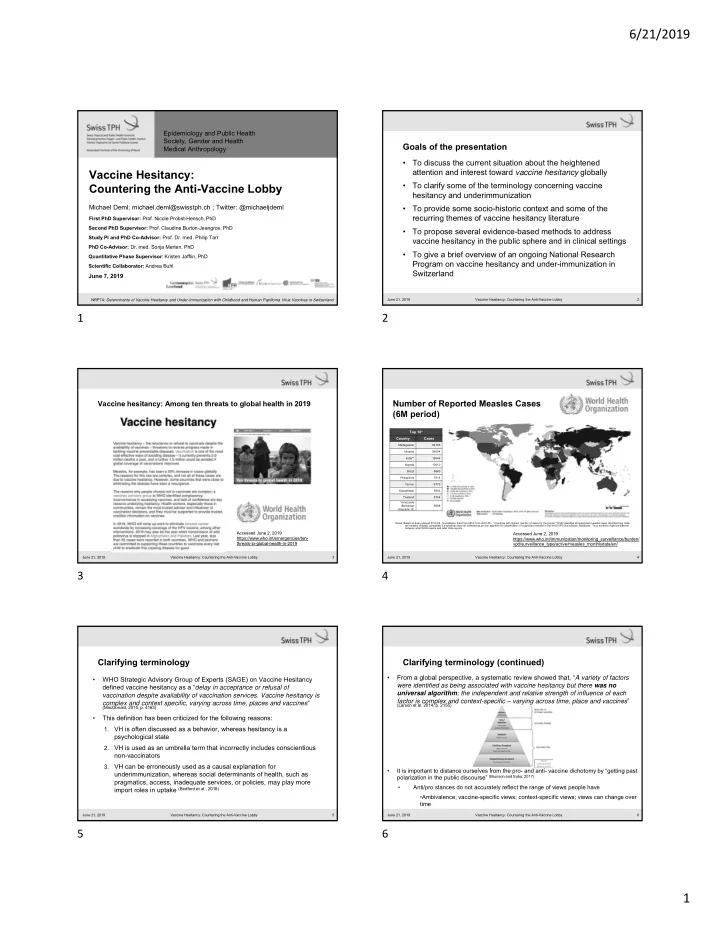
6/21/2019 Epidemiology and Public Health Society, Gender and Health Goals of the presentation Medical Anthropology To discuss the current situation about the heightened attention and interest toward vaccine hesitancy globally Vaccine


slide-1
SLIDE 1

6/21/2019 1

Epidemiology and Public Health Society, Gender and Health Medical Anthropology

Vaccine Hesitancy: Countering the Anti-Vaccine Lobby

Michael Deml; michael.deml@swisstph.ch ; Twitter: @michaeljdeml

First PhD Supervisor: Prof. Nicole Probst-Hensch, PhD Second PhD Supervisor: Prof. Claudine Burton-Jeangros, PhD Study PI and PhD Co-Advisor: Prof. Dr. med. Philip Tarr PhD Co-Advisor: Dr. med. Sonja Merten, PhD Quantitative Phase Supervisor: Kristen Jafflin, PhD Scientific Collaborator: Andrea Buhl

June 7, 2019

NRP74: Determinants of Vaccine Hesitancy and Under-Immunization with Childhood and Human Papilloma Virus Vaccines in Switzerland

Goals of the presentation

  • To discuss the current situation about the heightened

attention and interest toward vaccine hesitancy globally

  • To clarify some of the terminology concerning vaccine

hesitancy and underimmunization

  • To provide some socio-historic context and some of the

recurring themes of vaccine hesitancy literature

  • To propose several evidence-based methods to address

vaccine hesitancy in the public sphere and in clinical settings

  • To give a brief overview of an ongoing National Research

Program on vaccine hesitancy and under-immunization in Switzerland

June 21, 2019 Vaccine Hesitancy: Countering the Anti-Vaccine Lobby 2

Vaccine hesitancy: Among ten threats to global health in 2019

June 21, 2019 Vaccine Hesitancy: Countering the Anti-Vaccine Lobby 3

Accessed June 2, 2019 https://www.who.int/emergencies/ten- threats-to-global-health-in-2019

June 21, 2019 Vaccine Hesitancy: Countering the Anti-Vaccine Lobby 4

Number of Reported Measles Cases (6M period)

Top 10* Country Cases

Madagascar 84765 Ukraine 56094 India** 19544 Nigeria 10610 Brazil 8663 Philippines 7518 Yemen 6779 Kazakhstan 5902 Thailand 5784 Venezuela (Bolivarian Republic of) 5668 Notes: Based on data received 2019-05 - Surveillance data from 2018-10 to 2019-03 - * Countries with highest number of cases for the period **WHO classifies all suspected measles cases reported from India as measles clinically compatible if a specimen was not collected as per the algorithm for classification of suspected measles in the WHO VPD Surveillance Standards. Thus numbers might be different between what WHO reports and what India reports.

Accessed June 2, 2019 https://www.who.int/immunization/monitoring_surveillance/burden/ vpd/surveillance_type/active/measles_monthlydata/en/

Clarifying terminology

  • WHO Strategic Advisory Group of Experts (SAGE) on Vaccine Hesitancy

defined vaccine hesitancy as a “delay in acceptance or refusal of vaccination despite availability of vaccination services. Vaccine hesitancy is complex and context specific, varying across time, places and vaccines”

(MacDonald, 2015, p. 4163)

  • This definition has been criticized for the following reasons:

1.

VH is often discussed as a behavior, whereas hesitancy is a psychological state

2.

VH is used as an umbrella term that incorrectly includes conscientious non-vaccinators

3.

VH can be erroneously used as a causal explanation for underimmunization, whereas social determinants of health, such as pragmatics, access, inadequate services, or policies, may play more import roles in uptake (Bedford et al., 2018)

June 21, 2019 Vaccine Hesitancy: Countering the Anti-Vaccine Lobby 5

Clarifying terminology (continued)

  • From a global perspective, a systematic review showed that, “A variety of factors

were identified as being associated with vaccine hesitancy but there was no universal algorithm; the independent and relative strength of influence of each factor is complex and context-specific – varying across time, place and vaccines”

(Larson et al. 2014, p. 2155)

  • It is important to distance ourselves from the pro- and anti- vaccine dichotomy by “getting past

polarization in the public discourse” (Brunson and Sobo, 2017)

  • Anti/pro stances do not accurately reflect the range of views people have
  • Ambivalence; vaccine-specific views; context-specific views; views can change over

time

June 21, 2019 Vaccine Hesitancy: Countering the Anti-Vaccine Lobby 6

1 2 3 4 5 6

slide-2
SLIDE 2

6/21/2019 2

Social trends and other considerations

  • The term VH is ambiguous and its common use does not generally take into account larger

socio-medical trends. Peretti-Watel et al. (2015) propose a framework that “considers VH a kind of decision-making process that depends on people’s level of commitment to healthism/risk culture and on their level of confidence in the health authorities and mainstream media” (p. 2)

  • Patient adherence to ‘healthism’ (Greenhalgh & Wessely, 2004)
  • Consumerism of healthcare (Tomes, 2001; O’Hara, 2013)
  • Increase in patient autonomy and the shift away from doctor paternalism (Armstrong, 2014)
  • Experiential and lay knowledge in patient decisions (Caron-Flinterman et al., 2005)
  • Skepticism toward health authorities, perceptions of the influence of pharma industry in

scientific knowledge production and profit-seeking (Epstein, 1996, Salmon et al., 2015; Ward, 2017)

  • The prevalence and popularity of complementary and alternative medicine (CAM) in Western

countries (Barnes et al., 2008, Kemmppainen et al., 2018, Hart, 2017, Attwell et al. 2018)

  • Social networks and their influence on vaccination perspectives (Brunson, 2013)
  • Multitude of information, particularly via the press, the Internet, and social media 

‘information overload,’ ‘misinformation,’ and increased levels of anxiety and indecision (Kata,

2010, Betsch and Sachse, 2012; Yaqub et al., 2014, Wang et al., 2015, Sobo et al., 2016) June 21, 2019 Vaccine Hesitancy: Countering the Anti-Vaccine Lobby 7

Example of ‘weaponized’ information on Twitter

June 21, 2019 Vaccine Hesitancy: Countering the Anti-Vaccine Lobby 8

So, what can scientists and healthcare professionals do?

June 21, 2019 Vaccine Hesitancy: Countering the Anti-Vaccine Lobby 9

New York Times Editorial Board, 2019. How to Inoculate Against Anti-Vaxxers. January 19, 2019.

In the public arena

June 21, 2019 Vaccine Hesitancy: Countering the Anti-Vaccine Lobby 10

WHO's Best Practice Guidance: "How to respond to vocal vaccine deniers in public"

In clinical practice

  • “To date, there has been no evidence to suggest that education-only

interventions were effective in improving VC” (Gagneur et al. 2018, p. 2)

  • “[Motivational interviewing] is a patient-centered communication style used

to enhance the patient’s internal motivation for attitudinal change by exploring and solving inherent ambivalences” (ibid, p. 2) 4 main principles:

1.

Empathizing with the client

2.

Identifying the discrepancy between current and desired behavior

3.

Addressing resistance without antagonizing while maintaining communication and allowing people to explore their own views

4.

Supporting people’s confidence in their ability to change 5 core communication skills: 1) open questions, 2) affirmations, 3) reflective listening, 4) summarizing, and 5) informing/advising only if permission is granted

June 21, 2019 Vaccine Hesitancy: Countering the Anti-Vaccine Lobby 11

National Research Program 74

  • National study, 4 years (2017 – 2021)
  • Two research phases: Mixed-methods approach

1) Qualitative phase (German and French-speaking CH)

  • Semi-structured interviews
  • Parents
  • Providers (“CAM” and “biomedical”)*
  • *Novel part of our study: exploring CAM/biomedical provider distinction

and its relationship to VH with qualitative methodologies

  • Observation of medical consultations
  • Discourse analysis: Vaccine information sources and Internet sites

2) Quantitative phase (German, French, and Italian-speaking CH)

  • PACV15 - Telephone survey(Opel et al. 2013) + other questions based on qualitative findings
  • Year 4 – Pilot Intervention
  • Likely concerning biomedical providers and their communication practices and approaches
  • Will not seek to implement mandatory vaccination

June 21, 2019 Vaccine Hesitancy: Countering the Anti-Vaccine Lobby 12

7 8 9 10 11 12

slide-3
SLIDE 3

6/21/2019 3

National Research Program 74 Study Objectives

1) to provide a detailed characterization of the medical, demographic, geographical and sociocultural determinants of vaccine hesitancy and under-immunization in Switzerland 2) to explore and quantify the determinants of vaccine hesitancy and under- immunization with childhood and human papilloma virus vaccines in Switzerland 3) to use the knowledge gained as the necessary background to design and submit a pilot intervention and to design an effective intervention randomized clinical trial to address vaccine hesitancy in Switzerland (to be conducted after completion of this research)

June 21, 2019 Vaccine Hesitancy: Countering the Anti-Vaccine Lobby 13

Preliminary Qualitative Results

June 21, 2019 Vaccine Hesitancy: Countering the Anti-Vaccine Lobby 14

Vaccine hesitancy-acceptance spectrum

Completely anti-vaccine Completely pro-vaccine Biomedical Providers CAM Providers Parents who consult biomedical providers Parents who consult CAM providers Parents who consult both CAM and biomedical providers

Excerpts from an interview with a former travel doctor

Researcher: During these consultations with parents, particularly for the catchup vaccines, who made the decision? Was it the mom, the dad, the child? Did the child have their say in the decision? Doctor: The child, no. They never asked their child, well particularly for the small children when they would travel as a family. (…) In standard couples, it was mostly the mother. In the ‘alternative’ couples, it was more the father. (…) It could be super emotional because whatever I would say, it would make the mother afraid for her children. However, the one who was really determined was the father, with his preconceived notions and I wasn’t going to change his mind. So, yeah, that could sometimes even create tension for the couple, when one changed her mind and the other said, ”No, no, we’ve always said we would [not vaccinate].”

June 21, 2019 Vaccine Hesitancy: Countering the Anti-Vaccine Lobby 15

More excerpts from an interview with a former travel doctor

Researcher: Would you be interested in training in ways that you can broach vaccination, in a way that would be more convincing? Doctor: In my current job, not really, because it’s no longer an issue. But, when I used to work as a travel doctor, I think that would have really helped, yes. Researcher: So really about the communicative aspects? How to talk about it? Doctor: Yes! Like how to present it because I’m not so sure [unfinished sentence]. Because, now that I think about it, I realize that I used to explain it by scaring parents a little bit [laughs]. Researcher: Ok [laughs]. Doctor: This is the risk, bla-bla-bla. And I’m not so sure anymore, actually, that that is what is going to convince the parents.

June 21, 2019 Vaccine Hesitancy: Countering the Anti-Vaccine Lobby 16

Quantitative Phase Methods and Sample Sizes

  • 120 (+) participating medical providers (CAM and biomedical) to assist with

recruitment

  • 21 medical students  recruitment in provider offices
  • Estimated sample size of 1,350 parents of children 0-11 years old for

childhood vaccinations

  • Estimated sample size of 722 adolescents/young adults (females 15-26

years old) and their parents for the HPV vaccination

  • All participants will also be asked to provide us with copies of vaccination

certificates so that we can compare vaccine hesitancy scores and other variables to vaccination uptake Data Collection: November 2018  December 2019

June 21, 2019 Vaccine Hesitancy: Countering the Anti-Vaccine Lobby 17 June 21, 2019 Vaccine Hesitancy: Countering the Anti-Vaccine Lobby 18

Map: courtesy of medical student Joanna Sonderegger

13 14 15 16 17 18

slide-4
SLIDE 4

6/21/2019 4

Quantitative Questionnaires

Questionnaires are administered over the telephone and have been translated from English into German, French, and Italian

1.

Items from the PACV 15, demographic questions, information sources on vaccination, health-seeking behaviors, risk perception, exercising agency in healthcare decisions (i.e. ‘healthism’), self-reported health, CAM usage, perceived control over exposure to vaccine preventable diseases, knowledge about the HPV vaccine, access to the HPV vaccine, roles of Cantonal vaccine programs, and a validated moral value questionnaire

2.

Study objective 2: to explore and quantify the determinants of vaccine hesitancy and under-immunization with childhood and human papilloma virus vaccines in Switzerland

June 21, 2019 Vaccine Hesitancy: Countering the Anti-Vaccine Lobby 19

Conclusions

  • Vaccine hesitancy and under-immunization are complex, multifaceted, and

historically situated social phenomena with medical and public health consequences

  • Vaccine hesitancy is composed of a spectrum of attitudes towards

vaccinations

  • Vaccine hesitancy ≠ anti-vaccination
  • Remember: when responding to vaccine hesitancy, you represent the

legitimacy of the institutions of science, medicine, and health authorities

  • Trust and emotions largely shape how people make health decisions
  • Addressing vaccine hesitancy and under-immunization on social and

individual levels will require that health systems ensure equitable access to vaccination and that healthcare professionals are able to provide tailored messages that make sense to people in ways that align with their values and worldviews

June 21, 2019 Vaccine Hesitancy: Countering the Anti-Vaccine Lobby 20 June 21, 2019 Vaccine Hesitancy: Countering the Anti-Vaccine Lobby 21

Thank you!

Philip Tarr, Co-Chairman University Dept. of Medicine Chief, Infectious Diseases Service; Project PI; Kantonsspital Baselland, Bruderholz (philip.tarr@unibas.ch) Constanze Pfeiffer, Sonja Merten, Swiss TPH, University of Basel Kristen Jafflin, Institut für Soziologie, University of Basel, Swiss TPH Andrea Buhl, University of Basel Dedicated group of medical students from the University

  • f Basel

Claudine Burton-Jeangros, Sociology, University of Geneva Benedikt Huber, Pédiatrie Intégrative, Kantonsspital Fribourg Bernhard Wingeier, Daniel Krüerke, Klinik Arlesheim Mirjam Mäusezahl-Feuz, Bundesamt für Gesundheit BAG/OFSP Andreas Zeller, Universitäres Zentrum für Hausarztmedizin beider Basel Christoph Berger, Co-Chefarzt, Infektiologie, Kinderspital Zürich, Präsident Eidg. Kommission für Impffragen (EKIF) Suzanne Suggs, Social Marketing, Università della Svizzera Italiana, Lugano

References

Armstrong, D. 2014. Actors, patients and agency: a recent history. Sociology of Health & Illness, 36, 163-174. Attwell, K., Ward, P.R., et al. 2018. “Do-it-yourself”: Vaccine rejection and complementary and alternative medicine (CAM). Social Science & Medicine, 196, 106-114. Barnes, P.M., Bloom, B., et al. 2008. Complementary and Alternative medicine use Among Adults and Children: United States, 2007. National Health Statistics Reports. U.S. Department of Health and Human Services: Centers for Disease Control and Prevention National Center for Health Statistics. Beck, U. and Ritter, M. 1992. Risk society: towards a new modernity, London, Sage Publications. Bedford, H., Attwell, K., et al. 2018. Vaccine hesitancy, refusal and access barriers: The need for clarity in terminology. Vaccine, 36, 6556-6558. Benin, A.L., Wisler-Scher, D.J., et al. 2006. Qualitative analysis of mothers' decision-making about vaccines for infants: the importance of trust. American Academy of Pediatrics, 117, 1532-1541. Betsch, C., Brewer, N.T., et al. 2012a. Opportunities and challenges of Web 2.0 for vaccination decisions. Special Issue: The Role of Internet Use in Vaccination Decisions, 30, 3727-3733. Betsch, C. and Sachse, K. 2012b. Dr. Jekyll or Mr. Hyde? (How) the Internet influences vaccination decisions: Recent evidence and tentative guidelines for online vaccine communication. Special Issue: The Role of Internet Use in Vaccination Decisions, 30, 3723-3726. Brunson, E.K. and Sobo, E.J. 2017. Framing Childhood Vaccination in the United States: Getting Past Polarization in the Public Discourse. Human Organization, 76, 38-47. Caron-Flinterman, J.F., Broerse, J.E.W., et al. 2005. The Experiential Knowledge of Patients: A New Resource for Biomedical Research? Social Science & Medicine, 60, 2575-2584. Epstein, S. 1996. Impure Science: AIDS, Activism, and the Politics of Knowledge, Berkeley, University of California Press. Gagneur, A., Gosselin, V., et al. 2018a. Motivational interviewing: A promising tool to address vaccine hesitancy. Vaccine, 36, 6553-6555. Gagneur, A., Lemaître, T., et al. 2018b. A postpartum vaccination promotion intervention using motivational interviewing techniques improves short-term vaccine coverage: PromoVac study. BMC Public Health, 18, 811. Greenhalgh, T. and Wessely, S. 2004. ‘Health for me’: a sociocultural analysis of healthism in the middle classes. British Medical Bulletin, 69, 197-213. Hart, J. 2017. Complementary and Alternative Medicine Use and Initiatives in Europe. Alternative and Complementary Therapies, 24, 32-34. Kata, A. 2010. A Postmodern Pandora's Box: Anti-Vaccination Misinformation on the Internet. Vaccine, 28, 1709-1716. Kemppainen, L.M., Kemppainen, T.T., et al. 2018. Use of complementary and alternative medicine in Europe: Health-related and sociodemographic determinants. Scandinavian journal of public health, 46, 448-455. Larson, H.J., Jarrett, C., et al. 2014. Understanding vaccine hesitancy around vaccines and vaccination from a global perspective: A systematic review of published literature, 2007–2012. Vaccine, 32. MacDonald, N.E. 2015. Vaccine hesitancy: Definition, scope and determinants. Vaccine, 33, 4161-4164.

  • NYTimes. 2019. How to Inoculate Against Anti-Vaxxers. The New York Times, January 19, 2019.

O'Hara, G. 2013. The Complexities of ‘Consumerism’: Choice, Collectivism and Participation within Britain's National Health Service, c.1961–c.1979. Social History of Medicine, 26, 288-304. Opel DJ, Taylor JA, Zhou C, Catz S, Myaing M, Mangione-Smith R. The relationship between parent attitudes about childhood vaccines survey scores and future child immunization status: A validation

  • study. JAMA Pediatrics. 2013;167(11):1065-71.

Peretti-Watel, P., Larson, H.J., et al. 2015. Vaccine Hesitancy: Clarifying a Theoretical Framework for an Ambiguous Notion. PLoS Currents, 7, ecurrents.outbreaks.6844c80ff9f5b273f34c91f71b7fc289. Salmon, D.A., Dudley, M.Z., et al. 2015. Vaccine Hesitancy: Causes, Consequences, and a Call to Action. American Journal of Preventive Medicine, 49, S391-S398. Schmid, P., MacDonald, N.E., et al. 2018. Commentary to: How to respond to vocal vaccine deniers in public. Vaccine, 36, 196-198. Sobo, E.J., Huhn, A., et al. 2016. Information Curation among Vaccine Cautious Parents: Web 2.0, Pinterest Thinking, and Pediatric Vaccination Choice. Medical Anthropology, 35, 529-546. Tomes, N. 2001. Merchants of Health: Medicine and Consumer Culture in the United States, 1900-1940. The Journal of American History, 88, 519-547. Wang, E., Baras, Y., et al. 2015. “Everybody just wants to do what's best for their child”: Understanding how pro-vaccine parents can support a culture of vaccine hesitancy. Vaccine, 33, 6703-6709. Ward, P.R. 2017. Improving Access to, Use of, and Outcomes from Public Health Programs: The Importance of Building and Maintaining Trust with Patients/Clients. Frontiers in Public Health, 5, 22.

  • WHO. 2019. Ten threats to global health in 2019 [Online]. Available: https://www.who.int/emergencies/ten-threats-to-global-health-in-2019 [Accessed February 18, 2019 2019].

Yaqub, O., Castle-Clarke, S., et al. 2014. Attitudes to vaccination: A critical review. Social Science & Medicine, 112, 1-11.

June 21, 2019 Vaccine Hesitancy: Countering the Anti-Vaccine Lobby 22 June 21, 2019 Vaccine Hesitancy: Countering the Anti-Vaccine Lobby 23

PACV Questions

Qualitative Study Participants

June 21, 2019 Vaccine Hesitancy: Countering the Anti-Vaccine Lobby 24

Providers Romandie Deutschschweiz Total Biomedical* 11 9 20 CAM* 7 10 17 Total 18 19 37 Parents Romandie Deutschschweiz Total No vaccine hesitancy; vaccine adherence 2 4 6 Expressed vaccine hesitancy 12 10 22 Total 14 14 28 Medical Consultation Observations Romandie Deutschschweiz Total Biomedical* 6 5 11 CAM* 10 8 18 Total 16 13 29

19 20 21 22 23 24