4/9/2018 Sedative-Hypnotics & the Sedative-Hypnotics & the - - PDF document

4 9 2018
SMART_READER_LITE
LIVE PREVIEW

4/9/2018 Sedative-Hypnotics & the Sedative-Hypnotics & the - - PDF document

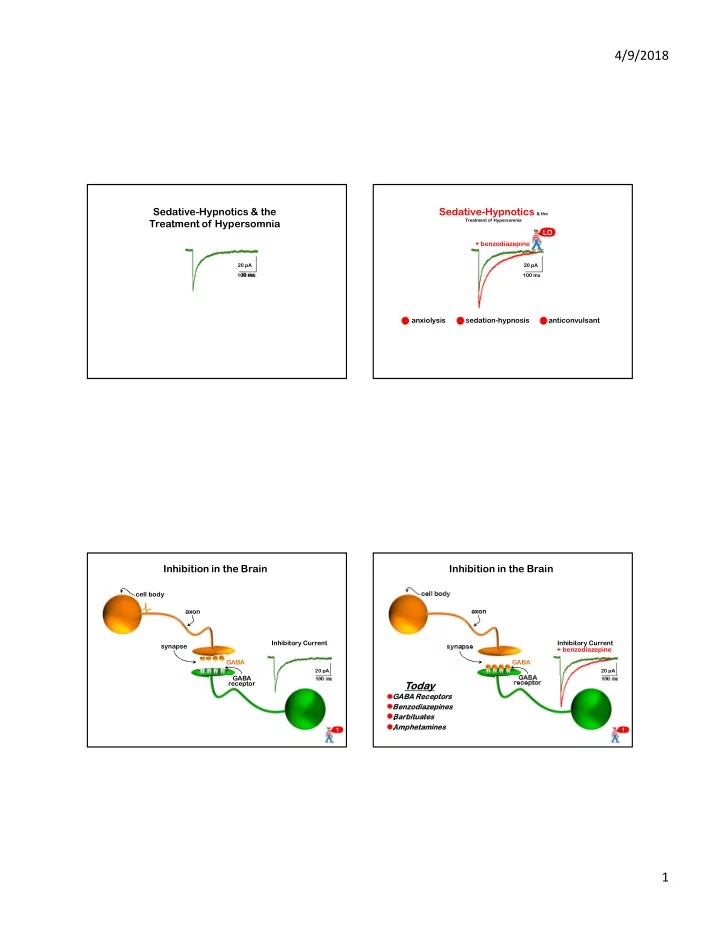
4/9/2018 Sedative-Hypnotics & the Sedative-Hypnotics & the Treatment of Hypersomnia Treatment of Hypersomnia LO + benzodiazepine 20 pA 20 pA 20 pA 100 ms 100 ms 100 ms anxiolysis sedation-hypnosis anticonvulsant Inhibition in


slide-1
SLIDE 1

4/9/2018 1

100 ms 20 pA 100 ms 20 pA

Sedative-Hypnotics & the Treatment of Hypersomnia

100 ms 20 pA

+ benzodiazepine

sedation-hypnosis anticonvulsant anxiolysis

Sedative-Hypnotics & the

Treatment of Hypersomnia

LO

Inhibition in the Brain

Inhibitory Current

100 ms 20 pA

cell body synapse GABA receptor axon GABA

1

Inhibition in the Brain

Inhibitory Current

100 ms 20 pA

+ benzodiazepine cell body synapse GABA receptor axon GABA

Today

GABA Receptors Benzodiazepines Barbituates Amphetamines

1

slide-2
SLIDE 2

4/9/2018 2

Two Types of GABA Receptors

GABA GABA

GABAA GABAB

chloride binding site

potassium/calcium

20 pA 100 ms

Inhibitory Current

  • utside of neuron

inside of neuron

epilepsy addiction anxiety & depression

2nd m.

3 2

ionotropic metabotropic

GABAA Receptor

  • utside of neuron

inside of neuron

GABAA Receptor (from above)

5 subunits chloride pore (i.e. pentameric)

a a b b g

20 pA 100 ms

Inhibitory Current Inhibitory Current + benzodiazepine

20 pA 100 ms

GABAA Receptor (from above)

benzo binding site GABA binding site

GABA BDZ

5 subunits chloride pore (i.e. pentameric)

4

a b g d

subunits

slide-3
SLIDE 3

4/9/2018 3

Allosteric Modulation

modulation achieved by binding of a drug to a site distinct from the site required for activation. definition:

  • Rudolph & Knoflach, 2011

GABA GABA + pos mod GABA + neg mod GABA + antag Relative GABA- induced current 2.0 0.5 1.0

  • Rudolph & Knoflach, 2011

a a b b g GABA BDZ

types: positive (agonism) negative (inverse agonism) antagonist (blocker) benzodiazapines bCCE Flumazenil

5 6 7 anesthesia death

Benzodiazepines

there are many Diazepam (Valium) among the first (launched 1963). 4 benzodiazepines are among the 200 most commonly prescribed drugs in the U.S. Alprazolam (Xanax) Clonazepam (Klonopin) Diazepam (Valium) Lorazepam (Ativan) actions are dose-dependent:

anxiolysis sedation hypnosis

CNS effects dose

most sedative hypnotics (e.g. barbituates)

Benzodiazepines + alcohol

from Patrice Guyenet, UVA Pharm Dept.

BUT

they lower the lethal dose

  • f other CNS depressants

(e.g. alcohol) benzos by themselves do not: cause fatalities produce anesthesia 9 8

Benzodiazepines

there are many Diazepam (Valium) among the first (launched 1963). 4 benzodiazepines are among the 200 most commonly prescribed drugs in the U.S. Alprazolam (Xanax) Clonazepam (Klonopin) Diazepam (Valium) Lorazepam (Ativan) actions are dose-dependent:

anxiolysis sedation hypnosis

CNS effects

anesthesia death

8 16 24

time (hours)

ideal hypnotic ideal anxiolytic

from Patrice Guyenet, UVA Pharm Dept.

Problems pharmacokinetics side effects

Benzodiazepines

there are many Diazepam (Valium) among the first (launched 1963). 4 benzodiazepines are among the 200 most commonly prescribed drugs in the U.S. Alprazolam (Xanax) Clonazepam (Klonopin) Diazepam (Valium) Lorazepam (Ativan) actions are dose-dependent:

anxiolysis sedation hypnosis

CNS effects

anesthesia death

8 16 24

time (hours)

Benzodiazepines

from Patrice Guyenet, UVA Pharm Dept.

redistribution metabolism

Problems pharmacokinetics side effects flurazepam
slide-4
SLIDE 4

4/9/2018 4

11

Benzodiazepine Metabolism

metabolized by the liver (CYPs) pharmacokinetics highly variable

25 50 75 100 T1/2 (hours)

Goodman & Gilman, 2011

40 80 25 50 75 100 Age (years) T1/2 (hours)

from Patrice Guyenet, UVA Pharm Dept.

short-acting (t1/2<6hrs) intermediate- acting (t1/2: 6-24hrs) long-acting (t1/2>24hrs)

age-dependent can be sex-dependent

  • ver-sedation can occur with ‘standard doses’

Greenblatt et al., 2000

10

Benzodiazepines: Effect Selectivity

anesthesia death anxiolysis sedation hypnosis

CNS effects

8 16 24

time (hours)

Benzodiazepines ideal hypnotic ideal anxiolytic

CNS effects

12

a a b b g GABAA Receptor (from above)

benzo binding site GABA binding site

a1-6 b1-3 g1-3 d

subunits

Inhibitory Current + benzodiazapene

20 pA 100 ms

5 subunits chloride pore (i.e. pentameric)

a1 a2 a3 a5

  • ther

a Subunits and Selectivity a1 a2 a3 a5

Sedation Anxiolysis Muscle Relaxation Anti- Convulsant

the good

Amnesia Addiction

the bad

Tan et al., 2011

slide-5
SLIDE 5

4/9/2018 5

a2 a Subunits and Selectivity a1 a2 a3 a5 a1 a3 a5

Rudolph & Knoflach, 2011

a1-selective agents

20-fold higher affinity for receptors containing a1 subunits

a Subunits and Selectivity a1 a2 a3 a5 a1

‘Z compounds’ technically non-benzos good for insonmia

Rudolph & Knoflach, 2011

(zolpidem)

Cl CH3 O

diazepam

O2N Cl H O

clonazepam imidazopyridine

13 14

a2 a Subunits and Selectivity a1 a2 a3 a5

a2-selective agents

non-sedating anxiolytics hopefully soon…

Rudolph & Knoflach, 2011

Benzodiazepines: Therapeutic Uses

maximize therapy, minimize side-effects

anesthesia death anxiolysis sedation hypnosis 8 16 24 time (hours) ideal hypnotic

sedation-hypnosis

true benzodiazepines

Triazolam (closest to ‘ideal hypnotic’) Flurazepam (less ‘early morning insomnia’)

Z compounds

Zolpidem (Ambien) Zaleplon (Sonata) Eszopiclone (Lunesta)

anxiolysis

most benzos with medium- to long-T1/2 work a2-selective benzos are actively being developed

associated with prominent autonomic signs (e.g. panic disorders)

severe anxiety:

high-potency benzos used

Lorazepam (Ativin) Alprazolam (Xanax) Clonazepam (Klonopin)

ideal anxiolytic

anticonvulsant

  • nly a few used (e.g. lorazepam, clonazepam, clorozepate)

low doses often used

15 16

slide-6
SLIDE 6

4/9/2018 6

Benzodiazepines: Last Couple of Things

Tolerance

primarily observed with anticonvulsant actions limited tolerance observed with sedative-hypnotic & anxiolytic effects

Dependence/Addiction

estimated that 0.1-0.2% of adult population abuse or are dependent upon benzos (300,000-600,00 people in the U.S.) GABA receptors live in the VTA (ventral tegmental area)

modulating GABA receptor activity in the VTA hypothesized to increase dopamine release

Benzodiazepine blocker

Flumazenil (Romazicon) benzodiazepine stupor potential risk of seizures physical dependence is usually mild follows general rule of drug dependence:

higher dosage = more severe withdrawal longer t1/2 = less severe withdrawal 17 18

Sedative-Hypnotics & the

Treatment of Hypersomnia

Barbituates

a a b b g GABA binding site

Directly bind to GABA binding site (at high doses)

activates channel and causes chloride conductance

High doses are fatal

anesthesia death anxiolysis sedation hypnosis

CNS effects dose Benzodiazepines

most sedative hypnotics (e.g. barbituates)

Once extensively used as sedative-hypnotics. Now largely replaced by the much safer benzos.

noteworthy exceptions:

Pentobarbital (insomnia, pre-op sedation, seizures) Phenobarbital (seizures) Thiopental (induction/maintenance of anesthesia)….short-lasting

BAR

19 alcohol 20

Amphetamine

Resembles catecholamines but more lipid soluble (can cross BBB)

catecholamines: norepinephrine, dopamine, serotonin 21

norepinephrine amphetamine

NH2

slide-7
SLIDE 7

4/9/2018 7

Amphetamine

Ma huang ‘looking for trouble’

Resembles catecholamines but more lipid soluble (can cross BBB)

indirectly-acting sympathomimetic amine amphetamine and related drugs stimulate release of: dopamine stimulates reward mechanisms, causes psychosis/addiction norepinephrine increased vigilance, anorexia serotonin increased vigilance, anorexia CNS norepinephrine hypertension, strokes, arrhythmias sympathetic nerve terminals catecholamines: norepinephrine, dopamine, serotonin 21

cell body synapse GABA receptor axon GABA

Amphetamine: Mechanism

22

cell body synapse axon norepinephrine

Amphetamine: Mechanism

22

axon terminal

NET (NE Transporter) norepinephrine transporter 2) VMAT2 (vesicular monoamine vesicle

Amphetamine: Mechanism

Catecholamine uptake via plasmalemmal transporter Packaged in vesicles for subsequent release

slide-8
SLIDE 8

4/9/2018 8

22

axon terminal

NET (NE Transporter) norepinephrine amphetamine reverse transport

amphetamine is a weak lipophilic base (pKa = 9.9)

Amphetamine: Mechanism

Catecholamine uptake via plasmalemmal transporter Packaged in vesicles for subsequent release

plus amphetamine

Reverse transport leads to catecholamine release Alkalinization shuts down vesicular catecholamine sequestration vesicle

Powerful CNS stimulant

d-isomer 3-4 times more potent than l-isomer

d-amphetamine: Dextroamphetamine (Dexedrine, Dextrostat)

Lisdexamfetamine (Vyvanse): inactive, prodrug of d-amphetamine

Adverse/toxic effects

Usually result from overdosage Acute toxic effects usually an extension of therapeutic effects.

restlessness, dizziness, tenseness, insomnia

Amphetamine

Clinical uses:

Hypersomnia (Excessive Daytime Sleepiness [EDS]) narcolepsy (0.03-0.06% of the US population)

  • bstructive sleep apnea

shift-worker disorder (EDS affects >30% of night-shift workers) Attention Deficit Hyperactivity Disorder

Cardiovascular/GI side effects

Alternatives

Modafinil (Provigil): promotes wakefulness, reduces EDS in narcoleptics

mechanism(s) not well-understood (but activates wake-promoting neurons) little/no cardiovascular/cognitive side effects (main side effect = headaches) may be used to reduce cocaine dependence 23 24

Inhibition in the Brain Benzodiazepines: positive allosteric modulators of GABAA R’s

a a b b g

GABA BDZ

20 pA 100 ms

Benzodiazepines: dose- dependent effects Benzodiazepines: T1/2’s highly variable Benzodiazepines: ideal hypnotic VS anxiolytic Benzodiazepines: a subunits

Sedative-Hypnotics & the Treatment of Hypersomnia Sedative-Hypnotics & the Treatment of Hypersomnia

Barbituates: directly activate GABAA R’s

a a b b g

BDZ

20 pA 100 ms

BAR

Benzodiazepines: dose- dependent effects Amphetamine: catecholamine release

slide-9
SLIDE 9

4/9/2018 9

Sedative-Hypnotics & the Treatment of Hypersomnia

questions: markbeen@virginia.edu

suggested reading

Basic & Clinical Pharmacology, 12th ed. (chapter 22)

Bertram G. Katzung, Susan B. Masters, Anthony J. Trevor

Pharmacological Basis of Therapeutics, 12th ed. (Chapter 17)

Goodman & Gilman