
SLIDE 1
4.4 Coordinate Systems
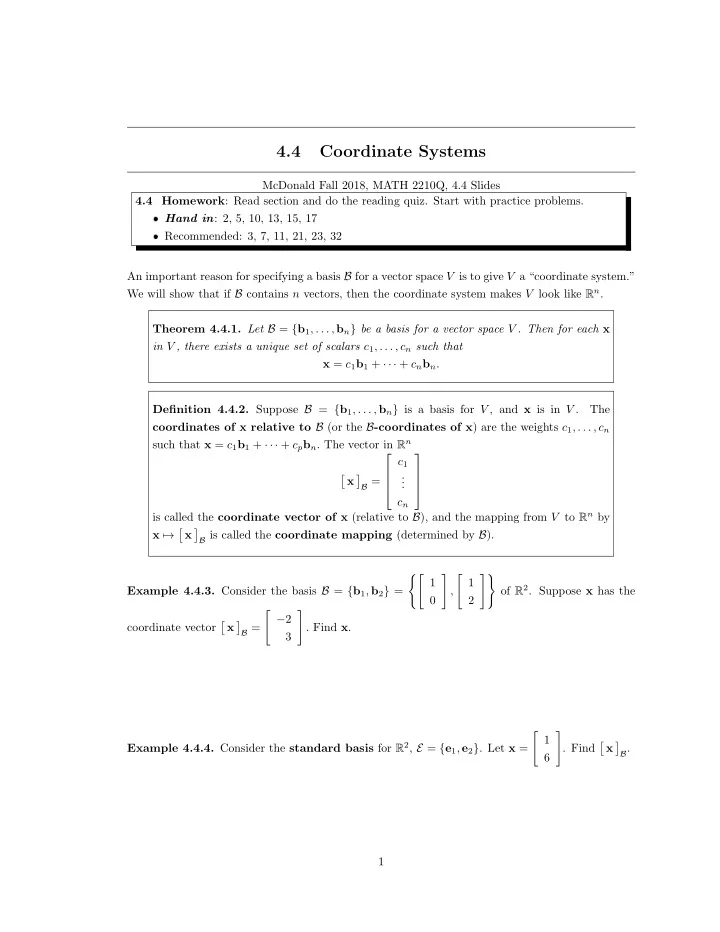
McDonald Fall 2018, MATH 2210Q, 4.4 Slides 4.4 Homework: Read section and do the reading quiz. Start with practice problems. ❼ Hand in: 2, 5, 10, 13, 15, 17 ❼ Recommended: 3, 7, 11, 21, 23, 32 An important reason for specifying a basis B for a vector space V is to give V a “coordinate system.” We will show that if B contains n vectors, then the coordinate system makes V look like Rn. Theorem 4.4.1. Let B = {b1, . . . , bn} be a basis for a vector space V . Then for each x in V , there exists a unique set of scalars c1, . . . , cn such that x = c1b1 + · · · + cnbn. Definition 4.4.2. Suppose B = {b1, . . . , bn} is a basis for V , and x is in V . The coordinates of x relative to B (or the B-coordinates of x) are the weights c1, . . . , cn such that x = c1b1 + · · · + cpbn. The vector in Rn
- x
- B =
c1 . . . cn is called the coordinate vector of x (relative to B), and the mapping from V to Rn by x →
- x
- B is called the coordinate mapping (determined by B).
Example 4.4.3. Consider the basis B = {b1, b2} =
- 1
- ,
- 1
2
- f R2. Suppose x has the
coordinate vector
- x
- B =
- −2
3
- . Find x.
Example 4.4.4. Consider the standard basis for R2, E = {e1, e2}. Let x =
- 1
6
- . Find
- x
- B.