The Coordinate Plane Table of Contents Introduction Vocabulary - - PDF document

the coordinate plane
SMART_READER_LITE
LIVE PREVIEW

The Coordinate Plane Table of Contents Introduction Vocabulary - - PDF document

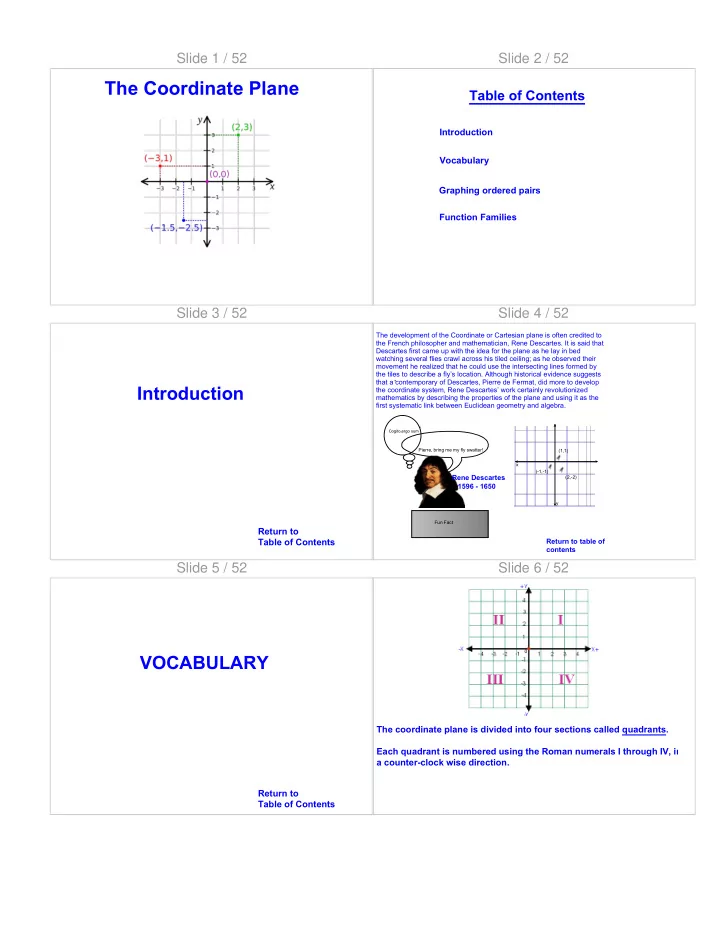
Slide 1 / 52 Slide 2 / 52 The Coordinate Plane Table of Contents Introduction Vocabulary Graphing ordered pairs Function Families Slide 3 / 52 Slide 4 / 52 The development of the Coordinate or Cartesian plane is often credited to the


slide-1
SLIDE 1

Slide 1 / 52

The Coordinate Plane

Slide 2 / 52 Table of Contents

Introduction Vocabulary Graphing ordered pairs Function Families

Slide 3 / 52

Introduction

Return to Table of Contents

Slide 4 / 52

x (-1,-1) y (1,1) (2,-2)

The development of the Coordinate or Cartesian plane is often credited to the French philosopher and mathematician, Rene Descartes. It is said that Descartes first came up with the idea for the plane as he lay in bed watching several flies crawl across his tiled ceiling; as he observed their movement he realized that he could use the intersecting lines formed by the tiles to describe a fly’s location. Although historical evidence suggests that a contemporary of Descartes, Pierre de Fermat, did more to develop the coordinate system, Rene Descartes’ work certainly revolutionized mathematics by describing the properties of the plane and using it as the first systematic link between Euclidean geometry and algebra.

" Pierre, bring me my fly swatter! The well known quote;

"Cogito,ergo sum"

(I think,therefore I am) is attributed to Rene Descartes. Cogito,ergo sum

"

Rene Descartes 1596 - 1650

Fun Fact

Return to table of contents

Slide 5 / 52

VOCABULARY

Return to Table of Contents

Slide 6 / 52

The coordinate plane is divided into four sections called quadrants. Each quadrant is numbered using the Roman numerals I through IV, in a counter-clock wise direction.

slide-2
SLIDE 2

Slide 7 / 52

c

The Coordinate plane is also called the Cartesian plane. One way to remember how the quadrants are numbered is to write a big "C" on top of the plane. The "C" will begin in quadrant I and end in quadrant IV. Slide the "C"

  • nto the

coordinate plane

Slide 8 / 52

The quadrants are formed by two intersecting number lines called axes. The horizontal line is the x-axis. The vertical line is the y-axis. x - axis y - axis

Slide 9 / 52

The point at which the x and y axes intersect is called the origin. The coordinates of the origin are (0, 0).

Origin (0, 0)

Slide 10 / 52

Points can be plotted on the plane using one coordinate from each

  • f the axes.

These sets are called ordered pairs. The x coordinate always appears first in these pairs. The y coordinate appears second.

(x, y)

Slide 11 / 52

( +,+) (-,+)

(-,-) (+,-)

Each of the quadrants can be identified by the properties of the numbers that fall within their plane. Remember the ordered pairs are always of the form (x, y)

Slide 12 / 52

1 What points are in quadrant II ? A B C D E F G H B A C D E F G

slide-3
SLIDE 3

Slide 13 / 52

2 What points are in quadrant I ? A B C D E F G H B A C D E F G

Slide 14 / 52

3 What points are in quadrant IV ? A B C D E F G H B A C D E F G

Slide 15 / 52

4 What points are in quadrant III ? A B C D E F G H B A C D E F G

Slide 16 / 52

5 What point is closest to the origin? A B C D E F G H B A C D E F G

is

Return to table of contents

Slide 17 / 52

Graphing Ordered Pairs

Return to Table of Contents

Slide 18 / 52

To graph an ordered pair, such as (3,2): · start at the origin (0,0) · move left or right on the x-axis depending on the first number · then move up or down from there depending on the second number · plot the point (3,2)

slide-4
SLIDE 4

Slide 19 / 52

To graph (-3, 4): Start at the origin and then move 3 left, up 4 (-3, 4)

Slide 20 / 52

To graph (-3, -2): Start at the origin and then move 3 left, down 2 (-3, -2)

Slide 21 / 52

To graph (5, -3): Start at the origin and then move 5 right, down 3 (5, -3)

Slide 22 / 52

Place the star on (2,8) in quadrant I Place the triangle on (-4, 4) in quadrant II Place the square on (-7, -3) in quadrant III Place the circle on (1, -4) in quadrant IV

Slide 23 / 52

Place the circle on (-7,-5) Place the star on (4,9) Place the triangle on (-6,2) Place the square on (3,-9) In which quadrant is the circle?

Slide 24 / 52

Match the coordinate points below with points A-F on the coordinate plane. Move each rainbow circle to check your answers.

A F E D B C

(2,-2) (9,0) (0,6) (5,7) (-3,2) A E

B D C

F (-9,-4)

slide-5
SLIDE 5

Slide 25 / 52 6

The point (-5, 4) is located in quadrant_____. A I B II C III D IV

Slide 26 / 52 7

The point (7, -2) is located in quadrant _____. A I B II C III D IV

Slide 27 / 52 8

The point (4, 5) is located in quadrant ____. A I B II C III D IV

Slide 28 / 52 9

The quadrant where the x & y coordinates are both negative is quadrant ___. A I B II C III D IV

Slide 29 / 52 10

When plotting points in the Cartesian Plane, you always start at ____. A the x - axis B the origin C the y-axis D the Coordinate Plane E (0,0)

Slide 30 / 52

F A B C D E List the coordinates of each point A B C D E F

slide-6
SLIDE 6

Slide 31 / 52

List the coordinates of each point A B C D E F A B C D E F

Slide 32 / 52

List the coordinates of each point A B C D E F A B C D E F

Slide 33 / 52

Remember to: *Read the question carefully and think about the answer. *Answer all parts of the question. *Show your work and explain your answer. You can answer the questions using words, tables, diagrams or pictures.

Open ended Questions Slide 34 / 52 Slide 35 / 52

y-axis: vertical number line that extends indefinitely in both directions from zero. (Up- positive Down- negative) x-axis: horizontal number line that extends indefinitely in both directions from zero. (Right- positive Left- negative) Origin: the point where zero on the x-axis intersects zero on the y-axis. The coordinates of the origin are (0,0).

II I III IV

Vocabulary Review

Coordinate Plane: the two dimensional plane or flat surface that is created when the x-axis intersects with the y-axis. Also known as a coordinate graph and the Cartesian plane. Quadrant: any of the four regions created when the x-axis intersects the y-axis. They are usually numbered with Roman numerals.

Slide 36 / 52 11

If the x-coordinate is positive, the point to be plotted will be in quadrant _____. A I B I & II C I & IV D II

slide-7
SLIDE 7

Slide 37 / 52 12

If the y-coordinate is positive, the point to be plotted will be in quadrant _____. A I B I & II C I & IV D II

Slide 38 / 52 13

If the x - coordinate is negative and the y-coordinate is positive, the point to be plotted will be in quadrant _____. A I B I & II C I & IV D II

Slide 39 / 52 14

If the x - coordinate is positive and the y-coordinate is negative, the point to be plotted will be in quadrant _____. A I B II C III D IV

Slide 40 / 52 15

Point A is located at (-3, 2) True False

A

Slide 41 / 52 16

Point A is located at (-5, 1) True False

A

Slide 42 / 52 17

Point A is located at (-2, 3) True False

A

slide-8
SLIDE 8

Slide 43 / 52 18

Point A is located at (-2, 0) True False

A

Slide 44 / 52

Function Families

A family of functions is a group of functions with shared traits. The parent function is the most basic function in a family. Return to Table of Contents

Slide 45 / 52

Linear Functions The parent function for all linear functions is y = x Complete the table, plot the points and then connect them. y = x

X Y

  • 3
  • 2
  • 1

1 2 3

Put arrows at the end of the line to indicate the line goes on forever. PULL

Slide 46 / 52

X Y

  • 4
  • 3
  • 2
  • 1

1 2 3 4

Absolute Value Functions Fill in the table for y = l x l Then plot the points and connect them. PULL

Slide 47 / 52

PULL Quadratic Functions Complete the table for y = x2 Then plot the points and connect them

X Y

  • 3
  • 2
  • 1

1 2 3

Slide 48 / 52

PULL Match the correct equation with the graphed function y = x y = x2 y = l x l

slide-9
SLIDE 9

Slide 49 / 52

19 The function graphed is y = x Yes No

Slide 50 / 52

20 The function graphed is y = x2 Yes No

Slide 51 / 52

21 The function graphed is y = l x l Yes No

Slide 52 / 52