
SLIDE 1
1
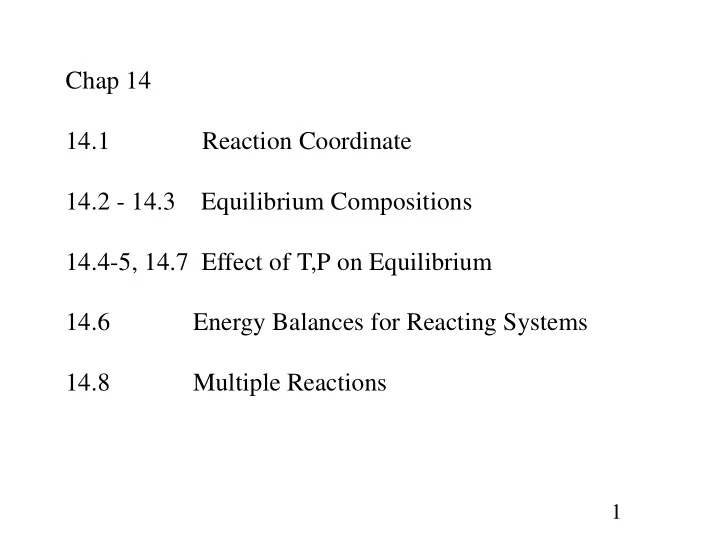
Chap 14 14.1 Reaction Coordinate 14.2 - 14.3 Equilibrium Compositions 14.4-5, 14.7 Effect of T,P on Equilibrium 14.6 Energy Balances for Reacting Systems 14.8 Multiple Reactions
Chap 14 14.1 Reaction Coordinate 14.2 - 14.3 Equilibrium - - PowerPoint PPT Presentation
Chap 14 14.1 Reaction Coordinate 14.2 - 14.3 Equilibrium Compositions 14.4-5, 14.7 Effect of T,P on Equilibrium 14.6 Energy Balances for Reacting Systems 14.8 Multiple Reactions 1 14.1 Reaction Coordinate CH 4 +
1
Chap 14 14.1 Reaction Coordinate 14.2 - 14.3 Equilibrium Compositions 14.4-5, 14.7 Effect of T,P on Equilibrium 14.6 Energy Balances for Reacting Systems 14.8 Multiple Reactions
2
14.1 Reaction Coordinate CH4 + H2O = CO + 3 H2 νi
Note: Elliott and Lira νi is stoichiometric number - USE THIS Felder and Rousseau νi is stoichiometric coefficient βi is stoichiometric number Reaction Coordinate dξ = dni /νi
dn dn
1 1 2 2
ν ν =
3
At reaction equilibria, Gibbs energy minimized: ni
f
ni
i
viξ + =
4
5
Standard State - denoted with superscript o T of system Specified Po, usually 1 bar or 1 atm Composition State of aggregation 14.2 Equilibrium Constraint
6
Standard State Gibbs Energy of Rxn at T.
7
14.3 Equilibrium Constant for Gas Phase Reaction
8
9
Modification of Example 14.3 CO + 2H2 --> CH3OH n · CO2 1 = n · H2 3 = 500 K 10 bar
10
Relation of Kinetic Constants to Ka for elementary reaction.
11
14.4 Temperature effects on . van’t Hoff Eqn (14.25) (14.26) GT
∆ ∂ ∂ ( / ) D D G RT T H RT
T
2
∆ ∆ ∆ G RT H RT dT G RT
T
T R
R
= − +
2
∆ ∆ ∆ H H C dT
T
T T
R
= +z
12
Standard Heat of Reaction (14.27) HR
viHR i
,
≡ vi HfR i
,
νi HfR i
,
products
νi HfR i
,
reac ts tan
– = =
13
14
Eqn 14.26 becomes
∆ ∆ ∆ ∆ ∆ ∆ ∆ ∆ ∆ ∆ H H a T T b T T c T T d T T J aT b T c T d T
T
R R R
= + − + − + − + − = + + + + ( ) ( ) ( ) ( ) 2 3 4 2 3 4
2 2 3 3 4 4 2 3 4
∆ ∆ ∆ ∆ ∆ G RT J RT a R T bT R cT R dT R I
− − − − + ln 2 6 12
2 3
15
Example 14.5 C2H4 + H2O = C2H5OH Kcalc.xls
16
Shortcut van’t Hoff (14.31) Example 14.6 (repeat Ex14.5 by shortcut method) C2H4 + H2O = C2H5OH
ln K K G RT G RT H R T T
a aR T
R
− = − −
∆ ∆ ∆ 1 1
17
18
ξ at equilibrium Temperature exothermic reaction endothermic reaction Qualitative behavior of equilibrium conversion for exothermic and endothermic reactions.
19
15.6 Energy Balances for Reacting Systems Method 1 n · i
in components
CP i
, TR Tin
dT n · i
components
CP i
, TR Tout
dT – Q · W ·
S
ξ · HR
– + + =
20
Method 2 where and Hinn · in Houtn · out – Q · W ·
S
+ + = Hinn · in n · i
in components
H ∆
fR i ,
TR Tin
dT + = Houtn · out n · i
components
H ∆
fR i ,
TR Tout
dT + =
21
Adiabatic Reactors Example 14.7 1/2 N2 + 3/2 H2 → NH3 Feed 25°C, 100 bar, stoichiometric feed. Find outlet T, ξ for reaction (provided we get it started). n · i
in components
CP i
, TR Tin
dT n · i
components
CP i
, TR Tout
dT – ξ · HR
– =
22
23
Graphical Energy Balance n · i
in components
CP i
, TR Tin
dT n · i
components
CP i
, TR Tout
dT – ξ · HR
– = Tout Tin ξ · HR
m · CPm
≈
24
ξ at equilibrium Temperature exothermic reaction slope m · CPm HR
–
Tout ξ
25
14.7 Pressure Effects (Doesn’t change Ka) 14.8 Multiple Reactions Example 14.8 solved by Excel
26
Summary Relation of ξ to Ka. Relation of Ka to ∆GT
Calculation of ∆GT
Calculation of ∆G298
Calculation of ∆H298
Determination of equilibria for multiple reactions.