4/25/10 CSCI 130 Introduction to Engineering Computing Class - - PDF document

4 25 10
SMART_READER_LITE
LIVE PREVIEW

4/25/10 CSCI 130 Introduction to Engineering Computing Class - - PDF document

4/25/10 CSCI 130 Introduction to Engineering Computing Class Meeting #27 The Last Class Meeting of the Semester!! Creating GUIs in Matlab Review of Course Learning Goals 11 Creating GUIs in Matlab GUI = graphical user interface


slide-1
SLIDE 1

4/25/10 1

11 CSCI 130 Introduction to Engineering Computing Class Meeting #27

 Review of Course Learning Goals

The Last Class Meeting of the Semester!!

 Creating GUI’s in Matlab

22

Creating GUI’s in Matlab

GUI = graphical user interface (similar to userforms in VBA) Typical applications: ρ select sources of data ρ carry out engineering/scientific calculations ρ make option choices ρ set values ρ display results, including graphs directly on GUI

33

Creating GUI’s in Matlab

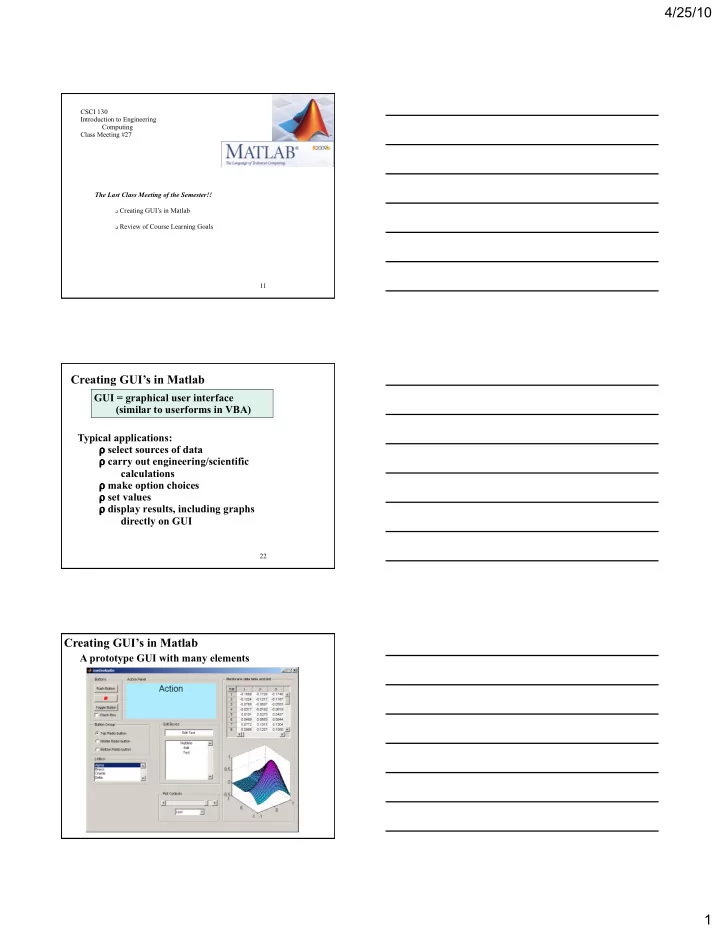
A prototype GUI with many elements

slide-2
SLIDE 2

4/25/10 2

44

Creating GUI’s in Matlab

Matlab provides a tool to aid in the design

  • f GUI’s GUIDE

Pick a template for your GUI

Launch GUIDE from the Command window

55

Creating GUI’s in Matlab

Initial blank template

66

Creating GUI’s in Matlab

Tools you can place on the GUI: Placing tools on the GUI is easy, just drag and drop with the mouse The more difficult step is associating program code with the tools GUIDE helps with that by creating a skeleton code the first time you save the GUI figure You must design and select the tools you require

slide-3
SLIDE 3

4/25/10 3

77

Creating GUI’s in Matlab

For example, place 3 option buttons (also called radio buttons) in a button group (like a VBA frame)

88

Creating GUI’s in Matlab

Add a set of axes for displaying a graph

99

Creating GUI’s in Matlab

Add a slider for setting the value of a numerical parameter and a listbox for making a choice from a list

slide-4
SLIDE 4

4/25/10 4

1010

Creating GUI’s in Matlab

Once you have placed your selected tools on the GUI, you adjust their appearance using the Property Inspector (like the Properties window in VBA)

activate the Property Inspector from the View menu select an element

  • n the GUI

Inspector shows properties for that element 1111

Creating GUI’s in Matlab

Change the desired properties of the element

Background color Title Button group with properties adjusted

1212

Creating GUI’s in Matlab

Complete the detailed work to adjust the properties of all elements on the GUI

slide-5
SLIDE 5

4/25/10 5

1313

Creating GUI’s in Matlab

Choose Run from the Tools menu in the GUI figure window

1414

Creating GUI’s in Matlab

When you first Run the GUI, it appears and an initial set of functions are written in the Matlab editor 1515

Creating GUI’s in Matlab

You now have to add the code to make the GUI do what you want Many of the code sections are “callbacks” – these are like event handlers in VBA where the code executes in response to an action or event, such as moving a slider or selecting an item in a listbox.

slide-6
SLIDE 6

4/25/10 6

1616

Creating GUI’s in Matlab

Skeleton callbacks for the slider and listbox

Code goes in here that responds to action 1717

Creating GUI’s in Matlab

The main issue then is to learn how to create the code necessary to the operation of the GUI Apart from studying background information from Matlab Help, look at examples that relate to what you are trying to accomplish – here is an example: 1818

Creating GUI’s in Matlab

This GUI allows for statistical exploration of sunspot data

slide-7
SLIDE 7

4/25/10 7

1919

Creating GUI’s in Matlab

This is what it looks like in the GUIDE editor

2020

Creating GUI’s in Matlab

Example callback from code for change in data table selection Find code that is similar to your needs and adapt it. 2121

Creating GUI’s in Matlab

Sunspot GUI in action

slide-8
SLIDE 8

4/25/10 8

2222

Creating GUI’s in Matlab

There are many other examples available

  • - here a just a few in Matlab Help

2323

Review of Course Learning Goals

1. Problem Solving

  • Learn to apply the "engineering method" to the solution
  • f quantitative

problems

  • Develop the ability to evaluate engineering formulas,

carrying units and appropriate precision through calculations 2. Spreadsheet Techniques

  • Develop efficient spreadsheet skills
  • Learn to set up and interpret "what-if" and case study

scenarios

  • Learn to organize and layout spreadsheet solutions to

engineering problems 2424

Review of Course Learning Goals

3. Programming Fundamentals

  • Learn how information is represented by different data

types

  • Learn program-flow algorithm structure and modularity
  • Learn to use features of object-oriented programming

4. Elementary Numerical and Statistical Methods

  • Develop the ability to solve single nonlinear algebraic

equations using elementary numerical methods, such as bisection, false position or Newton’s method

  • Learn to solve sets of linear and nonlinear algebraic

equations

  • Learn to carry out regression calculations
slide-9
SLIDE 9

4/25/10 9

2525

Review of Course Learning Goals

5. Software Tools

  • Develop skills with and knowledge of the following

software tools: Excel 2007 & Visual Basic for Applications (VBA) Matlab R2009b 2626

Course Summary and Review of Objectives course title: Introduction to Engineering Computing purpose: get you started

  • pen doors

gain some experience build reference materials challenge: keeping your knowledge and skills alive look for opportunities to use the computing tools introduced in this course not just when required by instructors come back for help in future semesters (and later!) my door is always open be prepared when computing tools will be required don’t sit there using your calculator (for hours) when, with a little effort, you could get the job done on the computer (and, in minutes) don’t be discouraged that you haven’t achieved mastery

2727

A couple key final points: You should judge how much you have learned in this

  • course. That learning is a shared responsibility between

you and your instructors. If you learned a lot, as a team, we succeeded. If you learned very little, we failed. Although you can judge how much you learned, it will be difficult for you to know whether what you learned is on target. But you will be able to assess that with time. Good luck on the final exam! [ and, of course, Go Buffs!! ]