4.2 Null Spaces Column Spaces and linear Transformations McDonald - - PDF document

4 2 null spaces column spaces and linear transformations
SMART_READER_LITE
LIVE PREVIEW

4.2 Null Spaces Column Spaces and linear Transformations McDonald - - PDF document

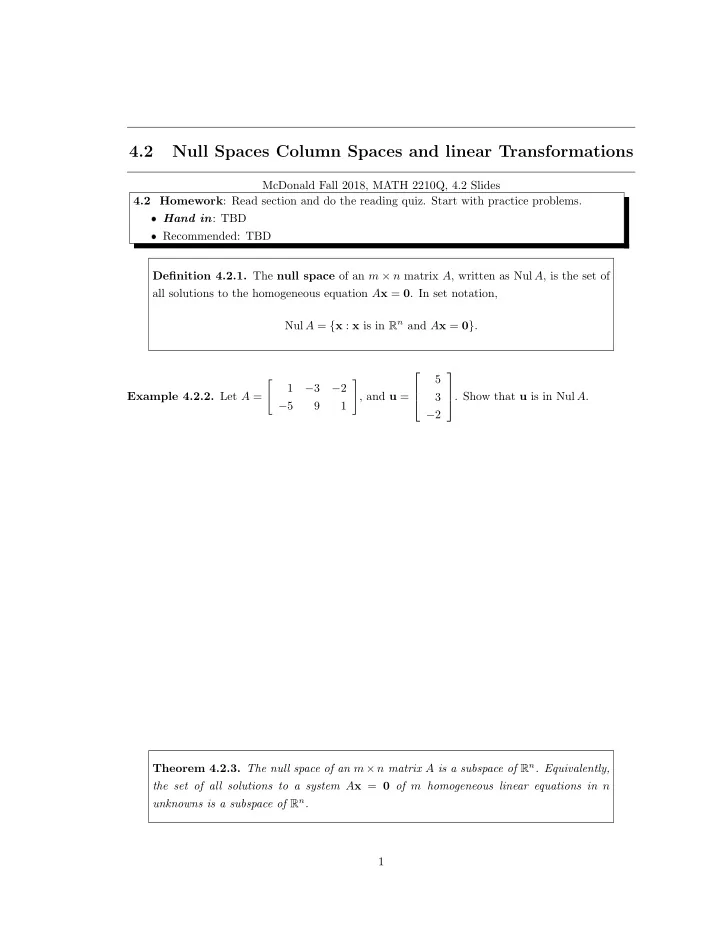
4.2 Null Spaces Column Spaces and linear Transformations McDonald Fall 2018, MATH 2210Q, 4.2 Slides 4.2 Homework : Read section and do the reading quiz. Start with practice problems. Hand in : TBD Recommended: TBD Definition 4.2.1. The


slide-1
SLIDE 1

4.2 Null Spaces Column Spaces and linear Transformations

McDonald Fall 2018, MATH 2210Q, 4.2 Slides 4.2 Homework: Read section and do the reading quiz. Start with practice problems. ❼ Hand in: TBD ❼ Recommended: TBD Definition 4.2.1. The null space of an m × n matrix A, written as Nul A, is the set of all solutions to the homogeneous equation Ax = 0. In set notation, Nul A = {x : x is in Rn and Ax = 0}. Example 4.2.2. Let A =

  • 1

−3 −2 −5 9 1

  • , and u =

   5 3 −2   . Show that u is in Nul A. Theorem 4.2.3. The null space of an m × n matrix A is a subspace of Rn. Equivalently, the set of all solutions to a system Ax = 0 of m homogeneous linear equations in n unknowns is a subspace of Rn. 1

slide-2
SLIDE 2

Example 4.2.4. Let H be the set of all vectors in R4 whose coordinates satisfy the equations x1 − 2x2 + 5x3 = x4 and x3 − x1 = x2. Show that H is a subspace of R4. Example 4.2.5. Find a spanning set for the null space of the matrix A =    −3 6 −1 1 −7 1 −2 2 3 −1 2 −4 5 8 −4    . Remark 4.2.6. These points will be useful later on:

  • 1. The method in Example 4.2.14 gives a spanning set that’s automatically linearly independent.
  • 2. When Nul A contains nonzero vectors, the number of vectors in the spanning set of Nul A

equals the number of free variables in the equation Ax = 0. 2

slide-3
SLIDE 3

Definition 4.2.7. The column space of an m × n matrix A, written as Col A, is the set

  • f all linear combinations of the columns of A. If A = [ a1

· · · an ], then Col A = Span{a1, . . . , an}. Remark 4.2.8. A typical vector in Col A can be written as Ax for some x, since the notation Ax stands for a linear combination of the columns of A. In other words Col A = {b : b = Ax for some x in Rn} Example 4.2.9. Find a matrix A such that W = Col A. W =         6a − b a + b −7a    : a, b in R      Theorem 4.2.10. The column space of an m × n matrix A is a subspace of Rm. Theorem 4.2.11. The column space of an m × n matrix A is all of Rm if and only if the equation Ax = b has a solution for each b in Rm. 3

slide-4
SLIDE 4

How are the null space and column space of a matrix related? In the next example, we’ll see that the two spaces are very different. If you’re interested, Section 4.6 reveals some surprising connections. Example 4.2.12. Consider the following matrix. A =    2 4 −2 1 −2 −5 7 3 3 7 −8 6    . (a) If the column space of A is a subspace of Rk, what is k? (b) If the null space of A is a subspace of Rk, what is k? (c) Find a nonzero vector in Col A, and a nonzero vector in Nul A. (d) Is u = (3, −2, −1, 0) in Nul A? Could it be in Col A? (e) Is v = (3, −1, 3) in Col A? Could it be in Nul A? 4

slide-5
SLIDE 5

Definition 4.2.13. A linear transformation T from a vector space V into a vector space W is a rule that assigns to each vector x in V one and only one vector T(x) in W such that for all u, v in V and real number c, (i) T(u + v) = T(u) + T(v) (ii) T(cu) = cT(u) The kernel (or null space) of T is the set of all u in V such that T(u) = 0. The range

  • f T is the set of all vectors in W of the form T(x) for some x in V .

Example 4.2.14. Let T : R3 → R2 be given by T(x) = Ax. What are the kernel and range of T? A =

  • −1

−5 7 2 7 −8

  • .

5

slide-6
SLIDE 6

Example 4.2.15. Let V be the space of all differentiable functions whose derivatives are continuous, and W be the space of all continuous functions. Show that D : V → W by f → f ′ is a linear

  • transformation. What is the kernel of D? What is the range?

6