Representing sets Topic 11 Another data abstraction here the - - PDF document

representing sets topic 11
SMART_READER_LITE
LIVE PREVIEW

Representing sets Topic 11 Another data abstraction here the - - PDF document

Representing sets Topic 11 Another data abstraction here the representation choice is no so obvious. Trade-offs of different Sets and their Representation choices can be seen. Set collection of distinct objects. How define? Set


slide-1
SLIDE 1

1

Fall 2008 Programming Development Techniques 1

Topic 11 Sets and their Representation

2.3.3 October 2008

Fall 2008 Programming Development Techniques 2

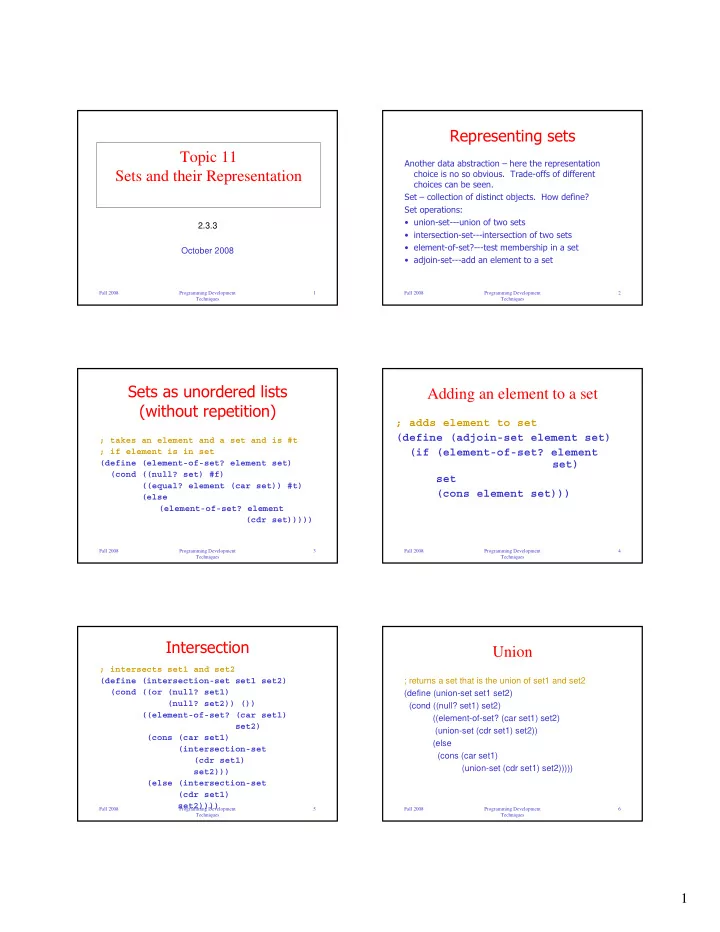
Representing sets

Another data abstraction – here the representation choice is no so obvious. Trade-offs of different choices can be seen. Set – collection of distinct objects. How define? Set operations:

  • union-set---union of two sets
  • intersection-set---intersection of two sets
  • element-of-set?---test membership in a set
  • adjoin-set---add an element to a set

Fall 2008 Programming Development Techniques 3

Sets as unordered lists (without repetition)

; takes an element and a set and is #t ; if element is in set (define (element-of-set? element set) (cond ((null? set) #f) ((equal? element (car set)) #t) (else (element-of-set? element (cdr set)))))

Fall 2008 Programming Development Techniques 4

Adding an element to a set

; adds element to set (define (adjoin-set element set) (if (element-of-set? element set) set (cons element set)))

Fall 2008 Programming Development Techniques 5

Intersection

; intersects set1 and set2 (define (intersection-set set1 set2) (cond ((or (null? set1) (null? set2)) ()) ((element-of-set? (car set1) set2) (cons (car set1) (intersection-set (cdr set1) set2))) (else (intersection-set (cdr set1) set2))))

Fall 2008 Programming Development Techniques 6

Union

; returns a set that is the union of set1 and set2 (define (union-set set1 set2) (cond ((null? set1) set2) ((element-of-set? (car set1) set2) (union-set (cdr set1) set2)) (else (cons (car set1) (union-set (cdr set1) set2)))))

slide-2
SLIDE 2

2

Fall 2008 Programming Development Techniques 7

Orders of growth for this representation

  • element-of-set? --- θ(n)
  • adjoin-set --- θ(n)
  • intersection-set --- θ(n2)
  • union-set --- θ(n2)

Could speed some of these operations if we change the representation of set. Try a representation where set elements listed in increasing order.

Fall 2008 Programming Development Techniques 8

Sets as ordered lists (of numbers, ascending order)

; Advantage is that now this operation ; can be written more efficiently ; returns #t if element is in the ; ordered set of numbers (define element-of-set? element set) (cond ((null? set) #f) ((= element (car set)) #t) ((< element (car set)) #f) (else (element-of-set? element (cdr set)))))

Fall 2008 Programming Development Techniques 9

intersection-set (bigger speed-up)

; returns an order set that is the ; intersection of ordered set1 and set2 (define (intersection-set set1 set2) (cond ((or (null? set1) (null? set2)) ()) ((= (car set1) (car set2)) (cons (car set1) (intersection-set (cdr set1) (cdr set2))))

Fall 2008 Programming Development Techniques 10

(continued)

((< (car set1) (car set2)) (intersection-set (cdr set1) set2)) (else (intersection-set set1 (cdr set2)))))

Fall 2008 Programming Development Techniques 11

Orders of growth

  • All four operations have order of growth equal to θ(n)
  • Operations element-of-set? and adjoin-set

have been speeded up by a factor of 2

Fall 2008 Programming Development Techniques 12

We can do even better!

  • Arrange set elements in the form of an ordered binary

tree. Binary tree

  • Entry – element at that spot
  • Left subtree – all elements are smaller than entry
  • Right subtree – all elements are greater than entry
slide-3
SLIDE 3

3

Fall 2008 Programming Development Techniques 13

Notice: more than one representation for any list

  • {1, 2, 4, 5, 6, 8, 10}
  • (5 (2 (1 () ()) (4 () ())) (8 (6 () ()) (10 () ()))
  • (2 (1 () ()) (4 () (8 (6 (5 () ())) () (10 () ()))))
  • (4 (2 () ()) (6 (5 () ()) (8 () 10)
  • (4 (2 (1 () ())) (5 () (6 () (8 () (10 () ())))))

Fall 2008 Programming Development Techniques 14

Sets as (labeled) binary trees

; we can represent binary trees as lists ; make a tree from an entry and a left ; and right child (define (make-tree entry left-child right-child) (list entry left-child right-child)) ; selectors for a tree (define (entry tree) (car tree)) (define (left-branch tree) (cadr tree)) (define (right-branch tree) (caddr tree))

Fall 2008 Programming Development Techniques 15

element of set

; takes an element and a set represented ; as a binary tree – returns #t if element ; is in set (define (element-of-set? element set) (cond ((null? set) #f) ((= element (entry set)) #t) ((< element (entry set)) (element-of-set? element (left-branch set))) (else (element-of-set? element (right-branch set)))))

Fall 2008 Programming Development Techniques 16

adjoin set

; takes an element and a set represented as ; a binary tree. Adds element into the set (define (adjoin-set element set) (cond ((null? set) (make-tree element () ())) ((= element (entry set)) set) ((< element (entry set)) (make-tree (entry set) (adjoin-set element (left-branch set)) (right-branch set)))

Fall 2008 Programming Development Techniques 17

(continued)

(else (make-tree (entry set) (left-branch set) (adjoin-set element (right-branch set))))))

Fall 2008 Programming Development Techniques 18

Properties of tree represention

  • If the trees are kept balanced, order of growth of

element-of-set? and adjoin-set is θ(log n)

  • Operations intersection-set and union-set

can be implemented to have order of growth θ(n), but the implementations are complicated

slide-4
SLIDE 4

4

Fall 2008 Programming Development Techniques 19

Comparison: orders of growth (θ)

Operation unordered

  • rdered tree

element-of-set? n n log n adjoin-set n n log n intersection-set n2 n n union-set n2 n n