3GB3 C HAPTER 4: G AME W ORLDS D EFINITION : W HAT IS A GAME WORLD ? - - PDF document

3gb3 c hapter 4 g ame w orlds
SMART_READER_LITE
LIVE PREVIEW

3GB3 C HAPTER 4: G AME W ORLDS D EFINITION : W HAT IS A GAME WORLD ? - - PDF document

3GB3 C HAPTER 4: G AME W ORLDS D EFINITION : W HAT IS A GAME WORLD ? Artificial universe, imaginary place in which events of the game occur - Football (Game, magic circle, no gameworld ) - Chess (Is a game world, but not


slide-1
SLIDE 1

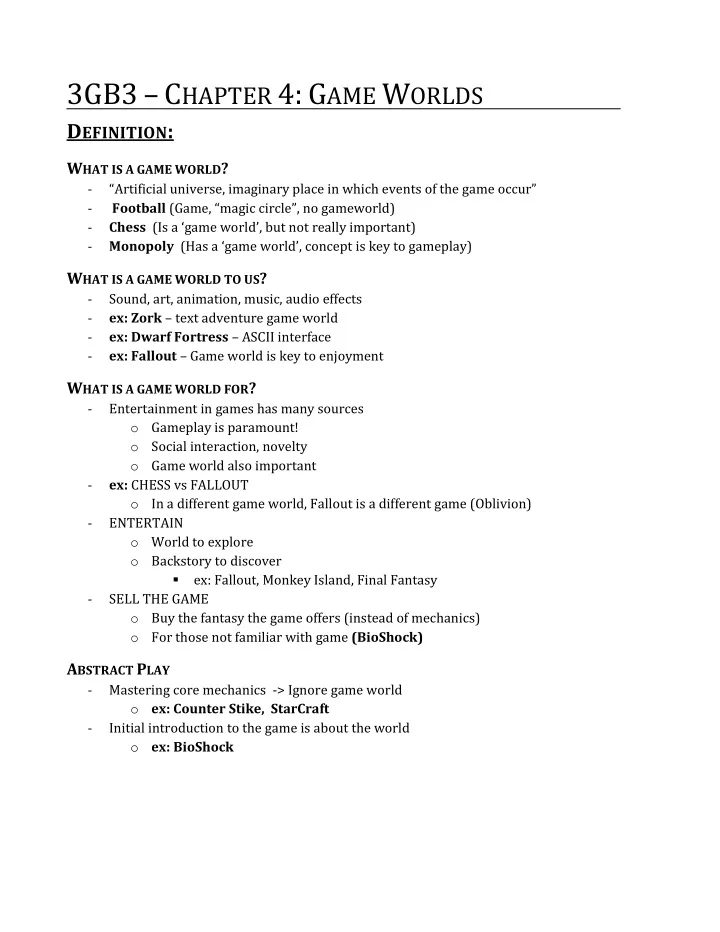
3GB3 – CHAPTER 4: GAME WORLDS

DEFINITION:

WHAT IS A GAME WORLD?

  • “Artificial universe, imaginary place in which events of the game occur”
  • Football (Game, “magic circle”, no gameworld)
  • Chess (Is a ‘game world’, but not really important)
  • Monopoly (Has a ‘game world’, concept is key to gameplay)

WHAT IS A GAME WORLD TO US?

  • Sound, art, animation, music, audio effects
  • ex: Zork – text adventure game world
  • ex: Dwarf Fortress – ASCII interface
  • ex: Fallout – Game world is key to enjoyment

WHAT IS A GAME WORLD FOR?

  • Entertainment in games has many sources
  • Gameplay is paramount!
  • Social interaction, novelty
  • Game world also important
  • ex: CHESS vs FALLOUT
  • In a different game world, Fallout is a different game (Oblivion)
  • ENTERTAIN
  • World to explore
  • Backstory to discover
  • ex: Fallout, Monkey Island, Final Fantasy
  • SELL THE GAME
  • Buy the fantasy the game offers (instead of mechanics)
  • For those not familiar with game (BioShock)

ABSTRACT PLAY

  • Mastering core mechanics -> Ignore game world
  • ex: Counter Stike, StarCraft
  • Initial introduction to the game is about the world
  • ex: BioShock
slide-2
SLIDE 2

DIMENSIONS:

  • Physical
  • Temporal
  • Environmental
  • Emotional
  • Ethical
  • “Realism” (quality, not a dimension)

DESIGNING A GAME WORLD:

  • ASK FOR IDEAS FIRST
  • Drawing pictures first?
  • Only a starting point, don’t overdevelop!
  • Game world must support the core mechanic
  • Characterize the world in terms of dimensions

PHYSICAL DIMENSION

  • World occurs in a simulated space
  • Player moves as avatar in this space
  • ex: Zork (text adventure) still has a ‘physical space’

SPATIAL DIMENSIONALITY (OF GAMEPLAY)

  • 2D
  • Side scrollers

ex: Mario

  • Overhead

ex: Diablo

  • Can still use 3D graphics for 2D gameplay ex: DukeNukem: Manhattan, SimCity
  • 2.5 D
  • World consists of 2D “layers”
  • ex: StarCraft
  • Flight layer
  • “Hieght” terrain (visual only, practically just 2D with dead areas
  • ex: Battletoads? Ninja Turtles?
  • 3D
  • ‘Inside’ the space instead of ‘watching’ the space
  • Excellent for game relying on exploration
  • 4D
  • Implemented as an ‘alternate version’ of the 3D world
  • ex: Soul Reaver, Prey, LOTR (Frodo w/ ring on)
  • Making a Decision (what does the dimension contribute)
  • ex: Zelda (old vs new)
  • ex: Prince of Persia (old vs new)
  • ex: Worms vs Worms 3D
slide-3
SLIDE 3

SCALE

  • Absolute Size
  • Relative Size of objects
  • Abstract Game World
  • Shapes and sizes made to fit gameplay ex: Tetris
  • Verisimilitude
  • Requires high accuracy ex: Flight Sim, Racing, Sports
  • First Person
  • Makes sense to scale world to fit player
  • Exception: Keys Objects (ammo, health)
  • Isometric
  • Real-World Scale doesn’t quite work
  • ex: StarCraft – Long range weapons
  • Practically tech should be accurate and insane distances
  • Cannot fit this realistically into a battlefield
  • Thus utilize RELATIVELY longer range
  • ex: StarCraft - Building Size
  • Scale correct means too small to see
  • Outdoor-Indoor Distortion
  • Don’t want to take 20 mins to cross a town
  • Time Distortion
  • ex: StarCraft Aircraft
  • Again, solution is ‘relatively’ faster

BOUNDARIES

  • Game worlds must have an ‘edge’ (non-infinite memory)
  • Attempt to preserve immersion
  • Natural to gameplay
  • ex: Racing, Football, Arenas
  • Indoor Settings
  • Indoor locations naturally a finite space
  • Outdoor Settings
  • Island

ex: Morrowind, Mario64

  • Impassable terrain ex: Mountains, etc
  • World-Wrap

ex: Civilization, Spore

  • Unrestricted edges
  • “Leaving the area of engagement” ex: StarFox
  • Simply stick @ ‘invisible wall’

ex: Ocean boundaries

  • Inhibiting mechanic ex: Morrowind, Boderlands
slide-4
SLIDE 4

TEMPORAL DIMENSION

  • Turn Based
  • Game is idle when nothing happens
  • Turn-structure determines passage of time (if applicable) ex: Civ
  • Theatrical Time Passage
  • Implemented for atmosphere/realism
  • Generally feels artificial

ex: ???

  • Functional
  • Time passage affects game world/processes
  • ex: Morrowind, Baldur’s Gate, WarCraft3

VARIABLE TIME

  • Game time is NOT Real time
  • Time ‘jumps’ like a movie to preserve gameplay
  • ex: RTS soldiers don’t sleep at night
  • Bad simulation, better gameplay
  • ex: The Sims
  • Speed up time while all asleep
  • Reduce time available in day to add ‘pressure’ to get things done

ANOMALOUS TIME

  • Time scale is different between simultaneous activities
  • ex: Warcraft 3
  • Time to chop wood similar to time to create a building
  • No disruption because very separate activities

PLAYER-ADJUSTABLE

  • Sports Games
  • Cannot change time/play because reduces reality
  • Adjust total time of game periods/quarters
  • Flight Simulations
  • Long periods of doing nothing
  • Set to ‘8x speed’ to prevent boredom
  • Pokemon Emulators
  • Reduce boring walking-time
slide-5
SLIDE 5

ENVIRONMENTAL DIMENSION

  • Appearance & Atmosphere
  • What’s in the space defined by the physical dimension

CULTURAL CONTEXT

  • Culture of the people in the game-world
  • Beliefs, attitudes, morality, back-story
  • Reflected by manmade objects, character actions
  • Often influences art style & interface
  • ex: Starcraft: Zerg vs Terran interface
  • ex: Prototype: Web of Intrigue
  • Includes Backstory
  • Often relevant to establish character motivations ex: Call of Duty
  • Must serve the game
  • ex: Elder Scrolls V: DragonShouts
  • Sometimes culture comes naturally

ex: SimCity = Western Architecture

  • Sometimes it needs to be designed

ex: Elder Scrolls

PHYSICAL SURROUNDINGS

  • Artistic Phase
  • Design game objects:

Jewlery, Cups, Magic Items, Clothing, etc…

  • ex: BioShock -- Distinctive art style
  • ex: Fallout 3 -- PipBoy 3000
  • What to include?
  • Objects
  • Religious society likely to have temples
  • Warlike societies have war-vehicles, weapons
  • Natural World
  • Birds, animals
  • Plants
  • Weather/Climate effects
  • Prevents the feel of a ‘sterile’ world
  • Indoor
  • Light sources

ex: BioShock

  • Purpose of areas

ex: Dead Space & Bathrooms

  • Sounds & Sights
  • Provides an important tone/mood
  • ex: Dead Space, Mario (light harted), Splinter Cell
  • LEVEL OF DETAIL
  • Realism desired, technical limitations, time constraints
  • ex: Sports games and stadium fans
slide-6
SLIDE 6
  • ex: Monkey Island
  • “Should” be able to pick up or interact with everything
  • Practically only interact with items of gameplay importance
  • ex: God Games
  • Black & White: Male, Female, Children
  • ActRaiser: ‘Citizens’
  • “Include as much detail as you can UNTIL it harms gameplay”
  • ex: Starcraft (not 10’000s of unit)
  • DEFINING A STYLE
  • Style of things IN the world
  • ex: BioShock – architecture, retro, etc
  • ex: Fallout - barren, decaying, etc
  • Style of how you VIEW the world
  • ex: Fallout vs Enslaved
  • ex: Cell Shading
  • OVERUSED SETTINGS
  • Movie-inspired
  • Sci-Fi, Fantasy, D&D
  • ex: Red Dead Redemption, BioShock
  • Under-used setting, well executed
  • ex: Interstate ’76
  • Try to make YOUR version unique
  • ex: Mass Effect

 Backstory supports look & feel of game  Interplay between races  Humanities role in the galaxy

  • INSPIRATION
  • Take pictures, keep clippings, portfolio of interesting ideas/themes
slide-7
SLIDE 7

EMOTIONAL DIMENSION

  • Games are now like movies
  • Emotions of NPCs
  • Emotions of the Player
  • Multiplayer

Emotions from social interaction

  • Single player

Emotions from story & gameplay

INFLUENCING PLAYER’S FEELINGS

  • Risk/Reward
  • Natural response to completing a challenge
  • Augment this response
  • Achievements (XBOX)
  • Loot (WoW)
  • Beware Frustation
  • Difficult levels
  • Making something “close-contest” is exciting
  • Greed, Power & Control
  • MMORPGs (amass loot)
  • Construction/Management Sims (amass wealth)
  • Black & White (be God)
  • Suspense, surprise & fear
  • Survival horror

ex: Dead Space, Resident Evil, Silent Hill

  • Love, grief, shame, jealousy, anger
  • Character/NPC interactions
  • Identify with a character
  • Put something important at stake
  • NOTE: Don’t Overdo It!
  • “Save the world” is hard to identify with
  • Fate of People instead of Fate of the World

LIMITATIONS OF “FUN”

  • Design for ENTERTAINMENT, not “fun”
  • Movie with sad ending can still be enjoyed
  • Understand that most gamers want FUN however
  • Don’t put creative agenda before player enjoyment

DON’T USE FORMULA-EMOTIONS

  • Cliché
  • Easy to recognize
  • Find a skilled writer/novelist
slide-8
SLIDE 8

ETHICAL DIMENSION

  • Game designer sets the moral code for that world
  • What actions let you ‘win’ the game
  • ex: Call of Duty -> Kill people
  • What actions should you ‘avoid’
  • ex: Left4Dead -> Bad team behavior
  • Game world ethics are different than real-world ethics
  • Killing, theft, etc…

MORAL DECISION MAKING

  • Implicit moral code
  • Our team vs Their team
  • Explicit moral choices
  • BioShock (save or harvest)
  • Usually reward ‘good’ over ‘bad’
  • Tough moral choices
  • Fallout 3 (no right decision)
  • Mass Effect
  • Evil Main Character
  • Fallout 3 -> Game world responds with consequences
  • RISK OF REWARING EVIL BEHAVIORS
  • ex: Custer’s Revenge (goal to rape a Native American Woman)
  • ex: FarCry 2
  • Explain ethical dimensions early

VIOLENCE IN GAMES

  • Inherent to majority of games
  • ISSUE:
  • Graphic, gross violence
  • Game world resembles real world
  • ex: GTA vs Left4Dead (non-human)
  • Violence should server gameplay
slide-9
SLIDE 9

REALISM

  • Realism differs within a game
  • ex: Half-Life
  • Accurately reproduce weapons in-game
  • Carry way too many weapons?
  • Abstract Game
  • Consider which element of reality you want to include
  • ex: Zelda (food, sleep, day/night, blood)
  • Simulation
  • Consider what real elements you can remove
  • ex: NHL 2k? (referee line of sight?)
  • Every decision needs to:
  • Serve the ‘entertainment’
  • Server the ‘realism goals’