SLIDE 1 11-752, LTI, Carnegie Mellon
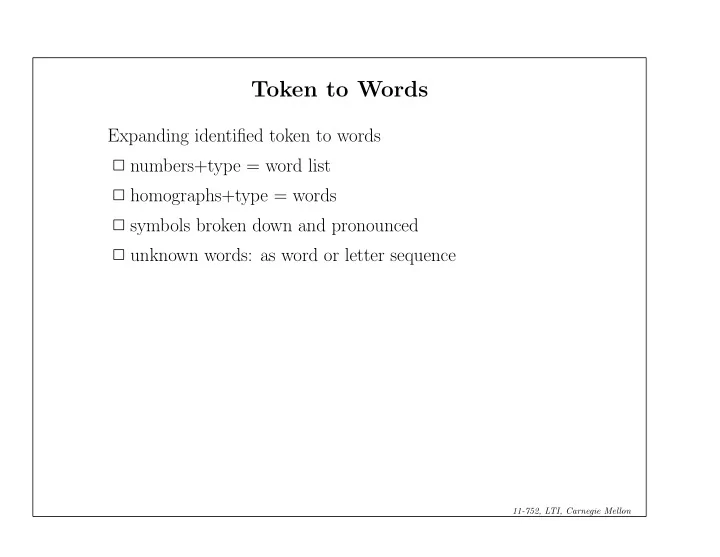
Token to Words
Expanding identified token to words ✷ numbers+type = word list ✷ homographs+type = words ✷ symbols broken down and pronounced ✷ unknown words: as word or letter sequence
SLIDE 2
(define (token_to_words token name) (cond ((string-matches name "[0-9]+’s") ;; e.g. 1950’s (item.set_feat token "token_pos" "year") (append (builtin_english_token_to_words token (string-before name "’s")) (list ’((name "’s")(pos nnp))))) ((string-matches name "[0-9]+-[0-9]+") ;; e.g. 12-14 ;; split into two numbers ;; identify type of one number (ordinal/cardinal) ;; expand with ‘‘to’’ between them ) .... (t ;; just a simply word (builtin_english_token_towords token name))))
SLIDE 3
Example token rule for “$120 million”
(define (token_to_words token name) (cond ((and (string-matches name "\\$[0-9,]+\\(\\.[0-9]+\\)?") (string-matches (item.feat token "n.name") ".*illion.?")) (append (english_token_to_words token (string-after name "$")) (list (item.feat token "n.name")))) ((and (string-matches (item.feat token "p.name") "\\$[0-9,]+\\(\\.[0-9]+\\)?") (string-matches name ".*illion.?")) (list "dollars")) (t (english_token_to_words token name)))
SLIDE 4 11-752, LTI, Carnegie Mellon
Text modes
If we know the type of text being synthesizing (e.g. email, Latex, HTML) we can tailor the processing. ✷ mode specific tokenizing ✷ using tokens to direct synthesis (emphasis, selecting voices etc.) ✷ mode specific lexical items. ✷ mode specific syntactic forms. Explicit markup and/or Custom models
SLIDE 5 11-752, LTI, Carnegie Mellon
Festival text modes
Customizable modes for synthesis. Each mode can have ✷ A (Unix) filter program to extract/delete information ✷ An init function on entering the mode. ✷ An exit function on exiting the mode.
SLIDE 6
An example text mode for email A filter to extract , from line, subject and body from email message #!/bin/sh # Email filter for Festival tts mode # usage: email_filter mail_message >tidied_mail_message grep "^From: " $1 echo grep "^Subject: " $1 echo sed ’1,/^$/ d’ $1
SLIDE 7
setup mode specific token functions (define (email_init_func) "Called on starting email text mode." (set! email_previous_t2w_func token_to_words) (set! english_token_to_words email_token_to_words) (set! token_to_words email_token_to_words)) (define (email_exit_func) "Called on exit email text mode." (set! english_token_to_words email_previous_t2w_func) (set! token_to_words email_previous_t2w_func))
SLIDE 8
(define (email_token_to_words token name) "Email specific token to word rules." (cond ((string-matches name "<.*@.*>") (append (email_previous_t2w_func token (string-after (string-before name "@") "<")) (cons "at" (email_previous_t2w_func token (string-before (string-after name "@") ">")))))
SLIDE 9
((and (string-matches name ">") (string-matches (item.feat token "whitespace") "[ \t\n]*\n *")) (voice_don_diphone) nil ;; return nothing to say ) (t ;; for all other cases (if (string-matches (item.feat token "whitespace") ".*\n[ \n]*") (voice_rab_diphone)) (email_previous_t2w_func token name))))
SLIDE 10
(set! tts_text_modes (cons (list ’email ;; mode name (list ;; email mode params (list ’init_func email_init_func) (list ’exit_func email_exit_func) ’(filter "email_filter"))) tts_text_modes))
SLIDE 11
From: Alan W Black <awb@cstr.ed.ac.uk> Subject: Example mail message Date: Wed, 27 Nov 1996 15:32:54 GMT Alan W. Black writes on 27 November 1996: > > > I’m looking for a demo mail message for Festival, but can’t seem to > find any suitable. It should at least have some quoted text, and > have some interesting tokens like a URL or such like. > > Alan Well I’m not sure exactly what you mean but awb@cogsci.ed.ac.uk has an interesting home page at http://www.cstr.ed.ac.uk/~awb/ which might be what you’re looking for. Alan > PS. Will you attend the course? I hope so bye for now
SLIDE 12 11-752, LTI, Carnegie Mellon
Reading addresses
Smith, Bobbie Q, 3337 St Laurence St, Fort Worth, TX 71611-5484, (817)839-3689 Anderson, W, 445 Sycamore Way NE, Lincoln, NE 98125-5108, (212)404-9988
SLIDE 13 11-752, LTI, Carnegie Mellon
Mark-up languages
✷ Building special text modes might be too difficult ✷ Need general method for general markup: – breaks, voice changing – pronunciations, date/time identifies ✷ All synthesizers include this but are incompatible ✷ Proposal of general method: – SGML/XML based – basic tags only – cf. JSML, VoiceXML
SLIDE 14
<?xml version="1.0"?> <!DOCTYPE SABLE PUBLIC "-//SABLE//DTD SABLE speech mark up//EN" "Sable.v0_2.dtd" []> <SABLE> <SPEAKER NAME="male1"> The boy saw the girl in the park <BREAK/> with the telescope. The boy saw the girl <BREAK/> in the park with the telescope. Some English first and then some Spanish. <LANGUAGE ID="SPANISH">Hola amigos.</LANGUAGE> <LANGUAGE ID="NEPALI">Namaste</LANGUAGE> Good morning <BREAK /> My name is Stuart, which is spelled <RATE SPEED="-40%"> <SAYAS MODE="literal">stuart</SAYAS> </RATE> though some people pronounce it <PRON SUB="stoo art">stuart</PRON>. My telephone number is <SAYAS MODE="literal">2787</SAYAS>. I used to work in <PRON SUB="Buckloo">Buccleuch</PRON> Place, but no one can pronounce that. By the way, my telephone number is actually <AUDIO SRC="http://att.com/sounds/touchtone.2.au"/> <AUDIO SRC="http://att.com/sounds/touchtone.7.au"/> <AUDIO SRC="http://att.com/sounds/touchtone.8.au"/> <AUDIO SRC="http://att.com/sounds/touchtone.7.au"/>.
SLIDE 15 11-752, LTI, Carnegie Mellon
SABLE: for marking emphasis
What will the weather be like today in Boston? It will be <emph>rainy</emph> today in Boston. When will it rain in Boston? It will be rainy <emph>today</emph> in Boston. Where will it rain today? It will be rainy today in <emph>Boston</emph>.
SLIDE 16 11-752, LTI, Carnegie Mellon
But we need a richer markup
✷ SABLE is quite limited: – Now embodied in SSML, VoiceXML and JSML ✷ Concept to speech is richer: – translation and generation systems – Syntactic, Semantic – Anaphoric, Rhetorical, Speech act etc. ✷ Mark up should be: – abstract not low-level – e.g type=question not – pitch rise at end
SLIDE 17 11-752, LTI, Carnegie Mellon
Data: four domains
nantc : press-wire news data classifieds : real estate ads from on-line newspapers pc110 : palmtop mailing list (e-mail like) rfr : rec.food.recipes USENET messages Corpus nantc ads pc110 rfr total # tokens 4.3m 415k 264k 209k # NSWs 377k 180k 72k 46k % NSW 8.8% 43.4 27.3 22.0
SLIDE 18
EXPN abbreviation, contractions adv, N.Y, mph, gov’t alpha LSEQ letter sequence CIA, D.C, CDs ASWD read as word CAT, proper names MSPL misspelling geogaphy NUM number (cardinal) 12, 45, 1/2, 0.6 NORD number (ordinal) May 7, 3rd, Bill Gates III NTEL telephone (or part of) 212 555-4523 NDIG number as digits Room 101, N NIDE identifier 747, 386, I5, PC110, 3A U NADDR number as street address 5000 Pennsylvania, 4523 Forbes M NZIP zip code or PO Box 91020 B NTIME a (compound) time 3.20, 11:45 E NDATE a (compound) date 2/2/99, 14/03/87 (or US) 03/14/87 R NYER year(s) 1998 80s 1900s 2003 S MONEY money (US or otherwise) $3.45 HK$300, Y20,000, $200K BMONY money tr/m/billions $3.45 billion PRCT percentage 75%, 3.4% O SLNT not spoken, word boundary word boundary or emphasis character: T M.bath, KENT*REALTY, really , ***Added H PUNC not spoken, phrase boundary non-standard punctuation: “...” in E DECIDE...Year, “***” in $99,9K***Whites R FNSP funny spelling slloooooww, sh*t URL url, pathname or email http://apj.co.uk, /usr/local, phj@teleport.com NONE token should be ignored ascii art, formating junk
SLIDE 19 11-752, LTI, Carnegie Mellon
Data: NSW distributions
Domains nantc classifieds pc110 rfr ASWD 83.49 28.64 64.60 72.36 LSEQ 9.10 3.00 22.60 2.11 EXPN 7.41 68.36 12.80 25.53 Domains nantc classifieds pc110 rfr NUM 66.11 58.26 43.77 97.90 NYER 19.06 0.70 0.51 0.27 NORD 9.37 3.37 4.45 0.11 NIDE 2.24 5.83 37.41 0.47 NTEL 1.25 25.92 1.32 0.02
SLIDE 20 11-752, LTI, Carnegie Mellon
Hand labeling
✷ Each NSW presented in context – Three words either side ✷ One letter choice of TAG – or explicit expansion – splits “WinNT” → “Win” “NT” ✷ Test of inter-labeler agreement – 3 labelers nantc, 2268 samples, κ = 0.81 – 9 labelers ads, 622 samples, κ = 0.84 ✷ Labeling held as XML markup
Today I bought a Sony<W NSW="LSEQ"> NP-F530,</W><W NSW="SPLT"><WS NSW="NUM"> 1350</WS><WS NSW="EXPN">maH.</WS></W> Like your<W NSW="NIDE"> 550</W> it is slightly larger than the native<W NSW="LSEQ"> IBM</W> battery pack. It’s been<W NSW="NUM"> 3</W> hours now on it’s first charge - I am charging in the <W NSW="LSEQ"> PC110. </W>
SLIDE 21 11-752, LTI, Carnegie Mellon
Can we find NSWs?
✷ Tokens not in lexicon ✷ Plus – single character tokens – “punctuation” – common abbreviations (in lexicon) ✷ Misses homographic abbreviations/standard words – “sun”, “Jan” – also domain specific ones, “kit” and “named” Domain Detection Precision//Recall Dependent? Algorithm nantc ads pc110 rfr No non-lexical 55/79 96/79 80/65 76/82 No + sct + abbrevs 44/93 95/91 70/90 73/96 Yes ++ abbrevs 39/93 92/92 60/91 46/97
SLIDE 22 11-752, LTI, Carnegie Mellon
Theoretical models
✷ Source-channel model: ˆ w = argmax p(w|o) (1) = argmax p(o|w)p(w) (2) ✷ Direct approach: ˆ w = argmax p(w|o) (3)
SLIDE 23 11-752, LTI, Carnegie Mellon
Architecture
Split Tokens Splitter Classifier Word Lattices Best Words Language Model Tokens Tokenizer Text
pls wash your WS99 coff. cup w/n−grams :)
Tag Expanders ASWD NUM EXPN Tagged Tokens
SLIDE 24 11-752, LTI, Carnegie Mellon
Splitting
✷ whitespace separated tokens isn’t fine enough ✷ Further splitting is required: 1500km → 1500 km and/or → and / or WinNT → Win NT ✷ Ideally deterministic, domain independent ✷ Simple regular expressions
SLIDE 25 11-752, LTI, Carnegie Mellon
Splitting
NANTC classifieds pc110 RFR Recall 98.89 94.96 87.66 98.88 Precision 74.41 87.32 81.68 89.51 Split Correct 92.54 85.99 74.11 89.54 Total Correct 98.45 95.19 92.97 98.40 Misses: – ESANDWICH, 3400sq.ft, xjack, 11/2 “False” positives: – 1-3pm, w/d, R-Ariz, PC-110
SLIDE 26 11-752, LTI, Carnegie Mellon
Tag classification
Assign EXPN, NUM, NORD etc to NSWs: ✷ domain independent features: – all caps, no vowels, numeric etc. ✷ domain dependent features: – alphabetic sub-classifier for EXPN, ASWD and LSEQ Tested CART and Maximum Entropy models
SLIDE 27 11-752, LTI, Carnegie Mellon
Alphabetic tag sub-classification
NSW tag t for alphabetic observations o NATO: ASWD, PCMCIA: LSEQ, frplc: EXPN ✷ p(t|o) = pt(o|t)p(t) p(o) where t ∈ [ASWD, LSEQ, EXPN]. ✷ pt(o|t) estimated by a letter trigram model pt(o|t) =
N
✷ p(t) prior from data or uniform ✷ normalized by p(o) =
SLIDE 28 11-752, LTI, Carnegie Mellon
Alphabetic tag sub-classification
LLM features are fed into overall classifier through 6 features Token p(ASWD|o) p(LSEQ|o) p(EXPN|o) pmax tmax diff 1-2 mb 0.0001 0.0038 0.9962 0.9962 EXPN 0.9924 Grt 0.0024 0.0000 0.9976 0.9976 EXPN 0.9952 NBA 0.0017 0.9983 0.0000 0.9983 LSEQ 0.9966 Cust 0.5456 0.0000 0.4544 0.5456 ASWD 0.0912
SLIDE 29 11-752, LTI, Carnegie Mellon
Using LLM features alone
Domain NANTC ads pc110 RFR Baseline 83.9[ASWD] 80.53[EXPN] 63.77[ASWD] 69.98[ASWD] Uniform 88.92 98.5 90.83 97.36 Unigram 95.72 98.74 92.27 97.92
SLIDE 30 11-752, LTI, Carnegie Mellon
Full tag classification
Accuracy NANTC ads pc110 RFR No LLM Feats 97.7 92.7 90.9 97.3 All LLM feats 98.1 93.5 91.8 96.8
SLIDE 31 11-752, LTI, Carnegie Mellon
Algorithmic expansions
✷ SLNT, NONE: expand to nothing ✷ ASWD, PUNC: expand to themselves ✷ LSEQ: as letters ✷ NUM: expands integers, floats, roman to string of words ✷ NORD: expands to ordinals ✷ NYER: as number pairs (except 00 and 000) ✷ NADDR, NZIP, NTEL, NDATE, NTIME: specific ex- panders ✷ NIDE: letters as letters, numbers as pairs ✷ MONEY, BMONY: as currency ✷ PRCT: as NUM with “percent” ✷ EMAIL, URL: treated ASWD (though should not be) ✷ MSPL, FNSP, OTHER: treated ASWD (though should not be), never predicted
SLIDE 32 11-752, LTI, Carnegie Mellon
EXPN expansions
How to find the expansion of an abbreviation: – “wbfpl” → “wood burning fireplace” – “BR” → “bedroom” – “Fl” → “Florida” or “Floor” Not simple lists: – 32 different abbrevs for “bedroom” – Productive: SQH, SB, Newingtn In supervised case use labelled expansions error rate: without language model 6.7% without language model 4.8%
SLIDE 33 11-752, LTI, Carnegie Mellon
What about unsupervised case?
✷ Assume expanded form somewhere in corpus ✷ Build letter deletion model from known EXPNs – CART predicts prob of letter deletion (88% accuracy) – convert CART to WFST – compute [SW ◦ A ◦ NSW]−1 (4) – build a WFST for weighted lattice of possible expansions of a potential NSW.
SLIDE 34 11-752, LTI, Carnegie Mellon
Unsupervised prediction of expansions
- 1. All singleton SWs + bigrams > 3 times: 33% error rate
- 2. as 1 plus standard abbrevs: 24%
- 3. as 2 but
– expand on training set – use language model – select most frequent expansion alone : 19.9%
– select best 2 and reestimate probs: 19.9%
SLIDE 35 11-752, LTI, Carnegie Mellon
Further issues in EXPN expansions
- 1. Need better model of expansion:
OEPN OPEN PERENNIAL DALLIN DAVID ALLAIN MASHPEE MARSH PROPERTIES SEAVIEW SEASONAL VIEWS WIGET WITHGUESTS
- 2. Current ignoirng case (unsupervised)
- 3. What is likely to be abbreviated
– p(t|w): BTW → because the windows
SLIDE 36 11-752, LTI, Carnegie Mellon
Language Modeling
✷ Grand schemes: – trigger models – maximum entropy ✷ Simple smoothed backed off trigrams ✷ Applied to pseudo-words: ... lives at 123 Norman St. ... ... lives at NADDR Norman St. ...
SLIDE 37 11-752, LTI, Carnegie Mellon
Baseline results
LDC tools : LDC text conditioning tools Festival : 1.4.0 released text analyzer LDC tools Festival TER WER TER WER nantc – 2.88 1.00 1.38 classifieds – 30.81 30.09 33.48 pc110 – 22.36 14.37 32.62 rfr – 9.06 6.28 16.19
SLIDE 38 11-752, LTI, Carnegie Mellon
Domain dependent model
✷ domain independent splitter ✷ CART tag classifier with letter language model features ✷ EXPNs by WFST ✷ Language model festival m4 TER WER TER WER nantc 1.00 1.38 0.39 0.82 classifieds 30.09 33.48 7.00 9.71 pc110 14.37 32.62 3.66 9.25 rfr 6.28 16.19 0.94 2.07
SLIDE 39 11-752, LTI, Carnegie Mellon
Removing components
m4.nolm: no language model (most prob EXPN) m4.noef: no letter language models feats m4.noefln: no LM and no LLM feats m4 m4.nolm m4.noef m4.noeflm TER WER TER WER TER WER TER WER nantc 0.39 0.82 0.39 0.81 0.38 0.78 0.38 0.78 classifieds 7.00 9.71 6.82 9.70 7.55 10.39 7.41 10.42 pc110 3.66 9.25 3.63 9.25 3.93 10.90 3.90 10.90 rfr 0.94 2.07 0.93 2.06 0.88 2.07 0.88 2.07
SLIDE 40 11-752, LTI, Carnegie Mellon
Giving truth
m4.nosplt: uses hand labeled splits m4.nost: uses hand labeled splits and actual tags m4 m4.nosplt m4.nost TER WER TER WER TER WER nantc 0.39 0.82 0.20 0.44 0.03 0.06 classifieds 7.00 9.71 5.40 6.35 3.15 4.24 pc110 3.66 9.25 2.58 4.61 0.49 0.75 rfr 0.94 2.07 0.59 1.11 0.16 0.24
SLIDE 41 11-752, LTI, Carnegie Mellon
Cross-domain models
m4.domin: nantc models m4.dominE: nantc models with domain EXPNs festival m4 m4.domin m4.dominE TER WER TER WER TER WER TER WER nantc 1.00 1.38 0.39 0.82 0.39 0.82 0.39 0.82 classifieds 30.09 33.48 7.00 9.71 25.20 29.11 19.69 21.18 pc110 14.37 32.62 3.66 9.25 12.35 18.69 12.09 18.07 rfr 6.28 16.19 0.94 2.07 2.71 4.66 2.32 4.14
SLIDE 42 11-752, LTI, Carnegie Mellon
Unsupervised domain models
Building models from unlabeled data ✷ Label tokens with nantc CART tag classifier ✷ Relabel alphabetics with best LLM prediction ✷ Build EXPN expander from plain text and labeled EXPNs ✷ Build words with best EXPN expansion ✷ Build LM from full expanded words ✷ Run with multiple EXPNs and LM to choose TER WER m4 7.00 9.71 us1.lm 12.50 13.40 us1.nolm 12.64 13.50 us2.EXPNlist 10.58 13.51 m4.dominE 19.69 21.18
SLIDE 43 11-752, LTI, Carnegie Mellon
NSW model for new domains
✷ Models for specific domains ✷ Standard text analyzers fail ✷ Can build models from unlabeled data 57 ST E/1st & 2nd Ave Huge drmn 1 BR 750+ sf, lots of sun &
- clsts. Sundeck & lndry facils. Askg
$187K, maint $868, utils
- incld. Call Bkr Peter 914-428-9054.
SLIDE 44 11-752, LTI, Carnegie Mellon
Results
✷ Marked up databases ✷ Tools to help label databases ✷ Tools and methods for building models ✷ 4 domain models ✷ Text expander better than LDC or Festival ✷ Tools and methods for building unsupervised models
SLIDE 45 11-752, LTI, Carnegie Mellon
But what if there are no spaces?
✷ Chinese, Japanese etc. don’t use whitespace ✷ But still need to to tokenize
SLIDE 46 11-752, LTI, Carnegie Mellon
Some techniques
Requires lexicon of words ✷ Take longest match in lexicon (that gives partition) ✷ or find ˆ w = argmax
w
p(w|) (5) ✷ Lattice of all possible partitions and find most probable
SLIDE 47 11-752, LTI, Carnegie Mellon
Number pronunciation
In languages with gender, declensions etc. 1 ni˜ no → un ni˜ no (one boy) 1 ni˜ na → una ni˜ na (one girl) 1 hermano → un hermano (one brother) 1 hermana → una hermana (one sister) Can’t just look at a/o ending letter 1 pais → un pais (one country) 1 ra’iz → una ra’iz (one root) Slavic languages have many variations for numbers making it harder.
SLIDE 48 11-752, LTI, Carnegie Mellon
End of Text Analysis
From strings of characters to lists of words ✷ Tokenize string of chars ✷ Chunk into utterance sized chunks ✷ Identify token types (homographs, numbers etc) ✷ Expand tokens with token to word rules