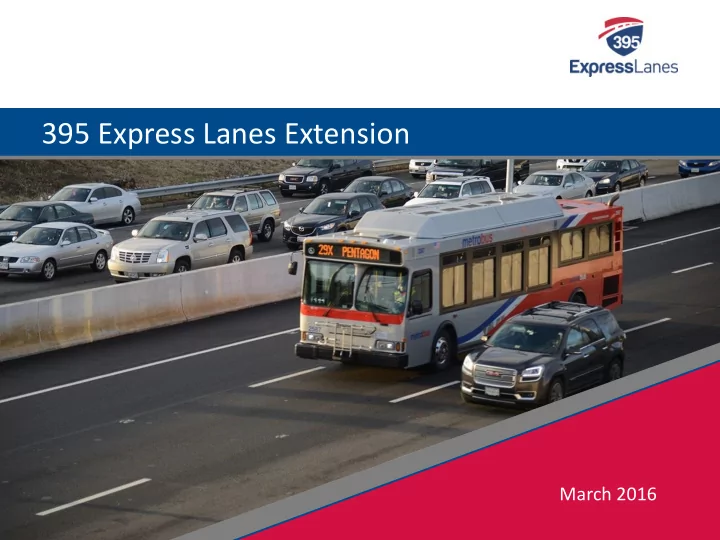
395 Express Lanes Extension March 2016 Building a network of - - PowerPoint PPT Presentation
395 Express Lanes Extension March 2016 Building a network of Express Lanes Project overview Add capacity on I-395 with Support 1,500 jobs and Generate guaranteed transit addition of a third HOV lane generate more than $500 funding by
Building a network of Express Lanes
Project overview
Support 1,500 jobs and
generate more than $500 million of economic activity
Enhance HOV service by
reducing violations and improve travel times
Improve travel on regular lanes by taking more cars off
the road and lanes
Provide new travel choices
by extending toll option to the D.C. line
Generate guaranteed transit funding by dedicating portion
- f annual toll revenue
Add capacity on I-395 with
addition of a third HOV lane and active traffic management
Guaranteed funding source for transit
Benefits of using Public-Private Partnership
- Private financing means scarce taxpayer
dollars can be used for other needs
- Private money enables projects to get off
the ground more quickly
- Key project risks like cost overruns can be
transferred to the private company
- Private companies can pay for the long-
term operations and maintenance
Project would be funded by private sector as part of existing partnership
with VDOT for 95 Express Lanes Project will be designed to dedicate a portion of annual toll revenue to fund transit improvements in the corridor
Going Express benefits transit
Source: A National Perspective on High-Occupancy Toll (HOT) Lanes, American Association of State Highway and Transportation Officials, December 2015 KRC Research, Survey of 1,700 area drivers, September 2015
More than one third
- f new transit riders
previously drove alone across these cities on average
Miami
- Average bus travel speed on I-95 Express Lanes increased from 18
to 55 mph
- Travel time decreased from 25 to 8 minutes
- Average weekday ridership increased 57% from 2008--2010 to
- Aug. 2011
- 53% of riders said tolling affected their decision to use transit
Los Angeles
- On-time performance increased for bus rapid transit on I-110
Metro ExpressLanes
- Average daily peak period ridership increased by 52% in the AM
peak and 41% in the PM peak after USDOT-funded service was added
- Ridership increased again by 29% in the AM peak and 25% in the
PM period after tolling began Minneapolis
- Bus speeds increased and bus travel times decreased after I-35W
converted to HOT lanes Seattle
- Speeds in the SR-167 HOT lanes have remained around 60 mph
- n average to the benefit of bus riders in the lanes
Additional benefits to Arlington & Alexandria
Residents traveling for vacation or pleasure enjoy new options for
- ut-of-town trips
Providing new transportation options and improving regional mobility Travel and environmental benefits
A study in Orange County, California found that its toll roads save drivers
- Over $182 million a year from the travel
time saved as a result of reduced traffic congestion during just the daily peak periods
- Over 2 million gallons of gasoline per year
as a result of improved fuel efficiency
- Over $7 million per year in total savings
from improved fuel efficiency
Source: Economic Benefits of Toll Roads Operated by the Transportation Corridor Agencies
Helps local businesses attract and keep customers and draw new visitors to the area Enhanced transportation networks help Arlington and Alexandria remain competitive for new businesses and talent
Minimizing impacts to the community
3rd lane constructed within existing HOV footprint Eligible communities can elect for new sound walls Will not require taking of any homes or businesses No interchange construction except at Eads Street No lane closures during peak hours
No impacts to most interchanges
Strong public support
Virginia Express Lanes
- 35-40 minutes average time savings per
daily commute
- 2.5 hours maximum time savings for
- ne trip (Springfield to Stafford)
- 17.5 minutes average time savings per
trip on I-95 regular lanes
- 1.5 minutes average time to detect an
incident on Express Lanes
- 6 minutes average response time for
- ur dedicated Express Assist
- 15% reduction in accidents on HOV
Lanes since conversion to Express Lanes
ECONOMIC BENEFITS1 TIME SAVINGS2 TRANSIT/HOV BENEFITS SAFETY
- $5.3 billion generated in economic
activity
- 28,000 jobs supported
- $765 million in DBE/SWaM contracts
- 20,000+ HOV trips per weekday
- 34% of weekday trips on 95 Express
Lanes are HOV/carpools
- 515 bus trips per weekday trips on 95
Express Lanes
1 George Mason University, 2008 & 2012. 2Traffic Analysis Sept 2016 Quarter
TRAVEL TIMES: Express Lanes vs. unreliable regular lanes
50 100 150 200 250
Apr May Jun Jul Aug Sep Oct
GP Travel Time EL Travel Time Worst GP Travel Time
Source: Regional Integrated Transportation Information System (RITIS)
Minutes of Travel
FULL LENGTH PEAK 95 SOUTHBOUND EXPRESS AND GENERAL PURPOSE LANES1
36 41 39 47 36 30 30 37 32 29 20 30 40 50
Monday Tuesday Wednesday Thursday Friday I-95 Northbound General Purpose Lanes Travel Times
September 2014 September 2015
Minutes of Travel
Source: Regional Integrated Transportation Information System (RITIS)
Improving travel times in regular lanes Faster speeds, reduced travel time for all I-95 drivers
How Express Lanes work
- Carpools, buses and motorcycles travel toll-free
- Other drivers have new option to pay a toll for a
faster trip
- Dynamic tolls adjust based on real-time traffic to
keep drivers moving in the Express Lanes
- Current toll prices displayed on signs before entry
points
- Maintains highway speeds and federal required
performance standards of 55 mph
- E-ZPass required for all drivers – HOV travels free
with E-ZPass Flex
- Rules of the road are in effect 24/7
395ExpressLanes.com
RESOURCE FOR LATEST INFORMATION
Downloadable map and project brochure Sign-up for email updates Ask questions; provide feedback Apply for community grant program How the current Express Lanes work
Community grant program
Awarded more than $560,000 to
- rganizations in Northern Virginia
Supports initiatives like neighborhood cleans-ups, vegetable gardens, rain barrel systems, safety lights for bikes and community landscaping 395 grant program launched Jan. 2016
What to expect
We will keep you informed every step of the way
- Individual meetings with homeowner and
community groups
- Multiple large-scale public meetings
- Outreach to communities, government
- fficials and business leaders
- Ongoing updates and opportunities to
provide input using a multi-channel approach What’s next
- Preliminary design
- Transit subsidy study
- Multimodal study by DRPT
- Environmental assessment
to begin including noise and traffic studies
- Initial public meetings