3/7/2017 17 th Multidisciplinary Management of Cancers: A Case based - - PDF document

3 7 2017
SMART_READER_LITE
LIVE PREVIEW

3/7/2017 17 th Multidisciplinary Management of Cancers: A Case based - - PDF document

3/7/2017 17 th Multidisciplinary Management of Cancers: A Case based Approach Clinical Vignette # 1 56 yo healthy Caucasian male with a strong family history of cancer undergoes routine PSA screening, was found to have PSA elevated to 16.2


slide-1
SLIDE 1

3/7/2017 1

17th Multidisciplinary Management of Cancers: A Case‐based Approach

Panel Discussion: Genitourinary Cancers

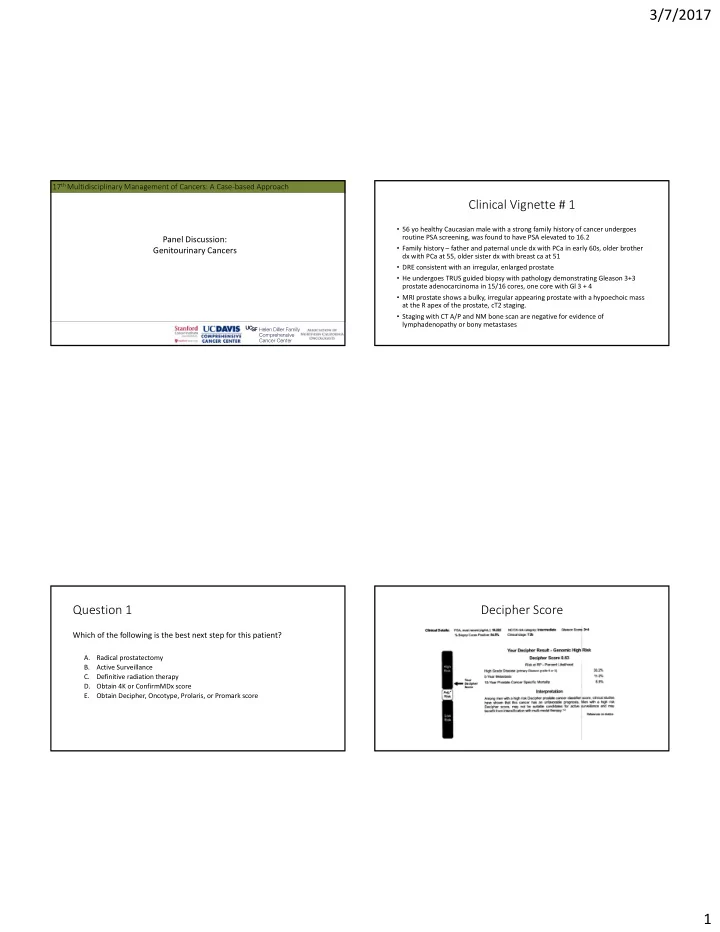
Clinical Vignette # 1

  • 56 yo healthy Caucasian male with a strong family history of cancer undergoes

routine PSA screening, was found to have PSA elevated to 16.2

  • Family history – father and paternal uncle dx with PCa in early 60s, older brother

dx with PCa at 55, older sister dx with breast ca at 51

  • DRE consistent with an irregular, enlarged prostate
  • He undergoes TRUS guided biopsy with pathology demonstrating Gleason 3+3

prostate adenocarcinoma in 15/16 cores, one core with Gl 3 + 4

  • MRI prostate shows a bulky, irregular appearing prostate with a hypoechoic mass

at the R apex of the prostate, cT2 staging.

  • Staging with CT A/P and NM bone scan are negative for evidence of

lymphadenopathy or bony metastases

Question 1

Which of the following is the best next step for this patient?

A. Radical prostatectomy B. Active Surveillance C. Definitive radiation therapy D. Obtain 4K or ConfirmMDx score E. Obtain Decipher, Oncotype, Prolaris, or Promark score

Decipher Score

slide-2
SLIDE 2

3/7/2017 2

Clinical Vignette #1 cont

  • Decipher score is obtained to guide primary management of his

disease

  • Patient successfully completed his definitive therapy and presents in

follow‐up 4 months post‐operatively

  • Pathology shows Gleason 4+4 pattern, negative margins, +seminal

vesicle invasion, +extracapsular extension; 10 sampled lymph nodes negative for involvement

  • PSA remains undetectable

Question 2

What is the next best step for this patient?

A. Adjuvant ADT B. Adjuvant radiation therapy with EBRT C. Observation only D. Adjuvant EBRT with concurrent ADT E. Either B or C

slide-3
SLIDE 3

3/7/2017 3

Clinical Vignette # 1 Cont

  • Patient tolerates adjuvant EBRT with concurrent ADT well
  • He continues to maintain routine follow‐up
  • PSA remains undetectable
  • Inquires about whether there is anything else he should do at this

time

Question 3

What else would you recommend to the patient at this time?

A. Restaging with CT A/P and NM bone scan B. PSA screening monthly C. PSA screening every 6 months D. Referral to genetics counselor for consideration of genetic testing E. Both C and D

Clinical Vignette # 2

  • 62 yo M h/o HTN and metastatic prostate cancer diagnosed 1.5 years ago with Gl

5+4 pattern with widespread bony metastasis and several prominent retroperitoneal lymph nodes s/p ADT + docetaxel X 6 cycles followed by maintenance on ADT alone who now presents with a rising PSA

  • PSA prior to initiation of therapy – 26; PSA nadir on therapy = 0.8, current PSA = 5

with PSADT = 3 months

  • He complains of worsening R hip pain and fatigue
  • Restaging CT A/P demonstrates new R iliac crest sclerotic lesion, multiple lumbar

mets from prior, and one new 2cm hypoattenuating liver lesions c/w metastasis

  • Bone scan demonstrates several new areas of uptake c/w progressive metastatic

disease, including the R iliac crest

Question 1

  • What other diagnostic work‐up could be considered?
  • A. Measurement of other serum tumor markers (CGA, NSE, PAP, LDH, CEA)
  • B. Biopsy of the liver metastasis
  • C. Molecular analysis of original tumor sample
  • D. Restage with advanced imaging modality – PSMA PET, 11‐choline, etc.
slide-4
SLIDE 4

3/7/2017 4

Question 2

What is the next best step for treatment of this patient?

  • A. Docetaxel 75mg/m2 every 3 weeks
  • B. Abiraterone acetate + prednisone
  • C. Enzalutamide
  • D. Cabazitaxel 25mg/m2 every 3 weeks
  • E. Carboplatin AUC = 5
  • F. Both B and C
  • G. Both A and E
  • H. Both D and E

Clinical Vignette # 3

  • 51 yo Caucasian female h/o DM2 presents with hematuria X 3 months
  • CT A/P reveals a 9cm R renal mass
  • PET/CT for staging is otherwise negative
  • Patient undergoes R radical nephrectomy. Pathology demonstrates

8cm papillary RCC, Furhman grade 3, with evidence of renal vein invasion

  • She recovers well from surgery and shows no evidence of disease on

first scans post‐operatively

Question 1

What is the next best step for this patient?

A. Cabozantinib adjuvant therapy B. Sunitinib adjuvant therapy C. Observation only D. Nivolumab adjuvant therapy E. Pazopanib adjuvant therapy

Clinical Vignette # 4

  • 48yo M h/o DM2 is incidentally found to have a 5 cm L renal mass
  • Staging with PET/CT demonstrates 2 pulmonary metastases. One is in

the RUL measuring 1.2 cm and the other is in the LUL measuring 1.5 cm in largest dimension.

  • He undergoes L nephrectomy
  • Pathology shows clear cell subtype renal cell carcinoma
slide-5
SLIDE 5

3/7/2017 5

Question 1

Which initial therapy would you recommend for this patient?

  • A. Sunitib
  • B. Nivolumab
  • C. Referral to surgery for possible metastatectomy
  • D. Referral to radiation therapy for SBRT to metastatic sites
  • E. Interferon

Clinical Vignette # 5

  • 62yo F h/o hypothyroidism and DM2 c/b CKD (EGFR = 58) presents

with persistent hematuria

  • Cystoscopy performed demonstrates a fungating mass at the dome of

the bladder extending to the R ureteral orifice

  • TURBT was performed subsequently, demonstrating transitional cell

carcinoma with muscle invasion

  • Staging scans with CT abdomen/pelvis and CT chest do not

demonstrate evidence of lymphadenopathy or metastatic disease

slide-6
SLIDE 6

3/7/2017 6

Question 1

What therapy would you recommend the patient undergoes?

A. Radical cystectomy B. Neoadjuvant chemotherapy with ddMVAC (sub carboplatin) X 4 cycles followed by radical cystectomy C. Neoadjuvant chemotherapy with gemcitabine/carboplatin X 4 cycles followed by radical cystectomy D. Definitive chemoradiation therapy E. Neoadjuvant atezolizumab X 4 cycles followed by radical cystectomy F. Atezolizumab and definitive radiation therapy G. Radiation therapy alone

Clinical Vignette #5 cont…

  • She receives 4 cycles of neoadjuvant ddMVAC followed by radical

cystectomy with neobladder reconstruction.

  • Pathology demonstrates pT3b transitional cell urothelial carcinoma

with 1/17 lymph nodes positive for disease

  • She recovers from surgery relatively well, but requires continued self

catheterization complicated by an uncomplicated UTI.

slide-7
SLIDE 7

3/7/2017 7

Question 1

What is the next best step in this patient?

  • A. Adjuvant carboplatin and gemcitabine
  • B. Adjuvant MVAC (sub carboplatin)
  • C. Adjuvant docetaxel
  • D. Adjuvant radiation therapy to pelvic lymph nodes
  • E. Adjuvant atezolizumab
  • F. Surveillance

Clinical Vignette # 6

  • 28yo healthy male presents after palpating a growing lump in his R

testicle X 2 months

  • AFP is negative; B‐hCG = 2,543; LDH = 122. Testicular ultrasound

shows a solid mass in his R testicle

  • He undergoes R orchiectomy with pathology showing pT1, pure

seminoma histology

  • Post‐operatively, his tumor markers normalize. CT A/P and chest Xray

are negative for evidence of metastatic disease

Question 1

  • What would you recommend next for the patient?

A. Carboplatin AUC = 7 X 1 cycle B. Surveillance per guidelines C. Adjuvant radiation therapy

Clinical Vignette #6 cont.

  • Patient is followed with surveillance guidelines and remains

asymptomatic with negative tumor markers 1.5 years post‐operatively

  • CT A/P reveals 2 enlarged lymph nodes in the retroperitoneum

measuring 3.3cm and 4.5cm, respectively

  • Chest Xray does not show evidence of metastatic disease
  • PET/CT confirms high SUV uptake in lymph nodes identified by CT A/P
  • Biopsy confirms recurrence of his seminoma
slide-8
SLIDE 8

3/7/2017 8

Question 2

  • What would you recommend as next therapeutic option for this

patient?

  • A. Chemotherapy with BEP X 3‐4 cycles
  • B. Chemotherapy with EP X 4 cycles
  • C. Salvage radiation therapy
  • D. Retroperitoneal lymph node dissection