3/15/2017 Disclosures I have no disclosures. Herpesviruses 38 th - - PDF document

3 15 2017
SMART_READER_LITE
LIVE PREVIEW

3/15/2017 Disclosures I have no disclosures. Herpesviruses 38 th - - PDF document

3/15/2017 Disclosures I have no disclosures. Herpesviruses 38 th Annual Advances in Infectious Diseases March 2017 Jennifer Babik, MD, PhD Assistant Clinical Professor Division of Infectious Diseases, UCSF Learning Objectives Common


slide-1
SLIDE 1

3/15/2017 1 Herpesviruses

Jennifer Babik, MD, PhD Assistant Clinical Professor Division of Infectious Diseases, UCSF

38th Annual Advances in Infectious Diseases March 2017

Disclosures

  • I have no disclosures.

Learning Objectives

  • 1. To recognize the key clinical features of the most

common herpes virus infections seen in the inpatient and outpatient setting.

  • 1. To develop a framework for diagnosis and

management of common herpes virus infections

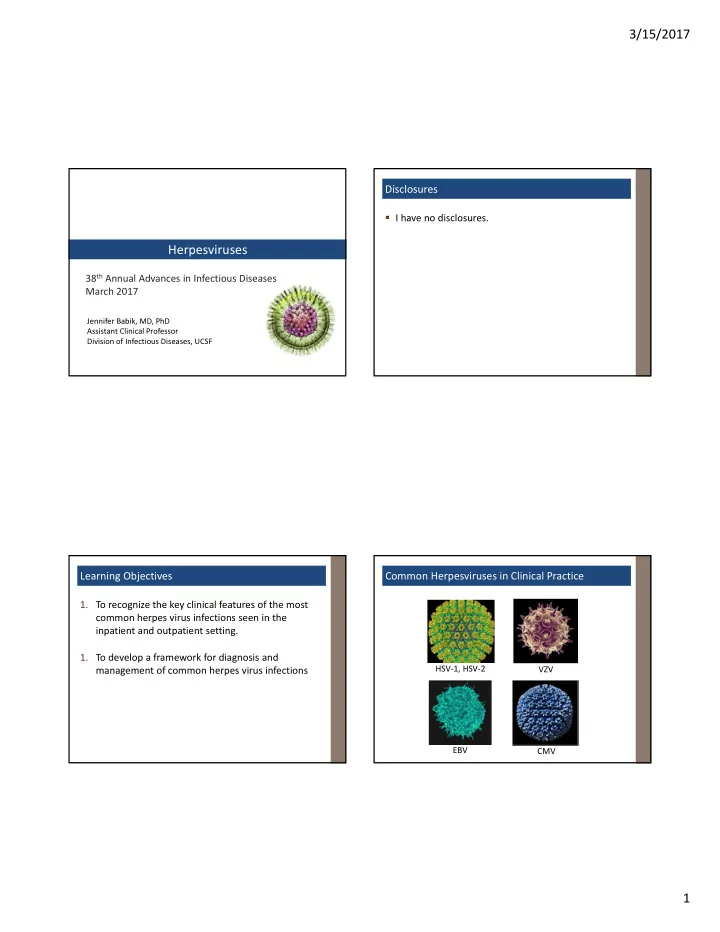
Common Herpesviruses in Clinical Practice

HSV‐1, HSV‐2 VZV EBV CMV

slide-2
SLIDE 2

3/15/2017 2

Case #1

A 28 year old man presents with fever and severe sore throat after returning from his honeymoon. He has mild anterior cervical LAN and the oral exam shown. The rest of his exam is normal. Tests for Group A Strep, acute HIV, and EBV are negative.

Photo courtesy of Matt Russell.

  • 1. Throat swab for VZV DFA
  • 1. Throat swab for HSV culture
  • 2. Throat swab for CMV PCR
  • 3. Tonsillar biopsy to r/o lymphoma

The next best test is: Oral HSV: Primary Infection

  • Children/young adults, HSV‐1
  • Symptomatic in 10‐30%:
  • Gingivostomatitis
  • Pharyngitis/tonsillitis ‐ may not have vesicles!
  • Systemic sx (can look like mono)
  • Duration of symptoms 10‐14d
  • Oral antivirals  duration of symptoms
  • Acyclovir 200mg PO 5x/day (7 days)
  • Famciclovir 500mg PO bid (7 days)
  • Valacyclovir 1gm PO bid (7 days)

Ardino and Porter, J Oral Pathol Med 2008; 37:107. McMillan et al, Pediatr Infect Dis J 1993; 12:280. Ireland, Oxford Dictionary

  • f Dentisty 2010. Cernik et al, Arch Intern Med 2008; 168:1137.

Case #2

A 30 year old man presents to clinic complaining of “fever blisters” for the past 24 hours. He has moderate pain but mostly feels a great degree of stress and embarrassment about the lesions. This is his 5th episode in the last year.

Photo courtesy of Laura Pincus.

slide-3
SLIDE 3

3/15/2017 3 Oral antivirals

  • 1. Shorten the time for lesions to heal
  • 2. Are effective as suppressive therapy
  • 3. Both #1 and #2
  • 4. Have no treatment effect

Recurrent Oral HSV: Herpes Labialis

  • Almost always HSV‐1
  • Recurrences in 20‐40% of HSV‐1 (+)
  • 1.5 recurrences/year
  • Triggers:
  • Fever, URI
  • UV light exposure (sun)
  • Emotional stress, fatigue
  • Immunosuppression
  • Oral/facial surgery or trauma
  • Menstruation

Cernik et al, Arch Intern Med 2008; 1168:1137. Ardino and Porter, J Oral Pathol Med 2008; 37:107.

Oral HSV Reactivation in Immunocompromised Oral HSV: Treatment

Episodic therapy

  •  time to heal by 0.5‐2.5 days (does not abort lesions)
  • Antivirals:
  • Acyclovir 200mg PO 5x/day x 5 days
  • Famciclvoir 1500mg PO x 1
  • Valacyclovir 2gm PO bid x 1 day

Suppressive therapy

  •  recurrences by 40‐50% (if ≥4‐6 recurrences/year)
  • Not known if can  oral HSV‐1 shedding or transmission
  • Antivirals:
  • Acyclovir 400mg PO bid
  • Famciclovir 500mg PO bid
  • Valacyclovir 500‐1000mg PO daily

Cernik et al, Arch Intern Med 2008; 168:1137.

slide-4
SLIDE 4

3/15/2017 4

Oral HSV: Take Home Points

  • Primary HSV‐1 can be a cause of pharyngitis in young

adults (and may not present with vesicles)

  • HSV PCR of a lesion is the most sensitive diagnostic

test for mucocutaneous herpes infections

  • Oral antivirals have a modest treatment effect: they

can shorten healing time and be used as suppressive therapy to prevent recurrences

Case #3

A 22 year old man has fever, lymphadenopathy, and painful blisters at the base of his penis. He is diagnosed with primary genital herpes. HSV‐2 is detected

  • n culture of one of the lesions.

He wants to know how likely this is to recur in the next 12 months.

Photo courtesy of Laura Pincus.

The likelihood of recurrence in the next 12 mo:

  • 1. 10%
  • 2. 30%
  • 3. 50%
  • 4. >70%

Genital Herpes: Epidemiology and Transmission

  • HSV‐1 versus HSV‐2:
  • HSV‐1 now accounts for >50% of 1˚ GH
  • HSV‐1 = HSV‐2 clinically
  • But HSV‐2 recurrence rate is 
  • Most transmission occurs from:
  • People unaware they have GH (<25% know they have it)
  • Asymptomatic shedding (25% of days)

Bernstein et al, Clin Infect Dis 2013;56:344. Gupta et al, Lancet 2007; 370:2127. Horowitz et al, J Amer Coll Health 2010; 59:69. Mark et al, J Infect Dis 2008; 198:1. Sacks et al, Antiviral Res 2004; 63S1:S19..

slide-5
SLIDE 5

3/15/2017 5

*Another strong predictor of recurrence risk is severity of primary infection

Benedetti et al, Annals Int Med 1994; 121:847. Benedetti et al, Annals Int Med 1999; 131:14. Photo courtesy of Laura Pincus

Recurrent Genital Herpes

HSV primary infection % with a recurrence within 1 year # recurrences in 1st year HSV‐1 20‐50% 1 HSV‐2 70‐90% 4‐5

Classic “scalloped” border

Test Sensitivity Specifcity Important points

Genital HSV: Diagnostics

Mosely et al, J Clin Microbiol 1981; 13:913. Wald et al, J Infect Dis 2003; 188:1345. Van Wagoner and Hook, Curr Infect Dis Rep 2012; 14:175. Lafferty et al, J Clin Microbiol 1987; 25:323.

PCR ~90% overall 99% Most sensitive test if available DFA Vesicle 70‐90% Ulcer 30% Crusted 10% 99% Rapid (hours) Slight  sensitivity c/w culture Culture Vesicle 70‐90% Ulcer 30‐40% Crusted 20‐30% 100% Moderate sensitivity Takes 1‐2 days

Screening for HSV‐2 By Serology?

  • New 2016 US Preventative Task Force Recs  No!
  • Why not?
  • Sensitivity 99% but specificity only 83%
  • As many false positives as true positives
  • When might serology be useful?
  • Recurrent genital symptoms and (‐) HSV cultures/PCR

USPSTF, JAMA 2016, 316:2525.

Treatment Regimens: First episode

  • Efficacy
  •  duration of symptoms by 2‐4 days
  • No impact on recurrence rate
  • Regimens
  • Acyclovir 400mg PO tid or 200mg PO 5x/day (7‐10 days)
  • Valacyclovir 1gm PO bid (7‐10 days)
  • Famciclovir 250mg PO tid (7‐10 days)

CDC, STD Treatment Guidelines 2015. Mertz et al, JAMA 1984; 252:1147.
slide-6
SLIDE 6

3/15/2017 6

Efficacy:

  • Start in prodrome or <1 day of symptoms
  • Can abort lesions in 20‐30% or  symptoms by 1‐2 days
  • Does not reduce rate of transmission to uninfected partners

Regimens

  • Acyclovir 400mg PO tid or 800mg PO bid (5 days)
  • Acyclovir 800mg PO tid (2 days)
  • Valacyclovir 500mg PO bid (3 days)
  • Valacyclovir 1gm PO daily (5 days)
  • Famciclovir (options for 1, 2, 5 days)

Episodic Therapy: Recurrent Episodes

CDC, STD Treatment Guidelines 2015. Strand et al, Sex Transm Infect 2002; 78:435.

Suppressive Therapy for Genital Herpes

  • Efficacy:
  •  recurrences by 70‐80% and  shedding
  •  transmission to negative partner by ~50% (but absolute RR of ~2%)
  • When to use?
  • CDC: consider if “frequent” episodes (? ≥ 6) or discordant couples
  • SF City Clinic: offers to most with a new diagnosis of HSV‐2
  • Antivirals:
  • Acyclovir 400mg bid, famciclovir 250mg bid, valacyclovir 500‐1000mg

daily

  • Discuss a trial off therapy qyear

CDC, STD Treatment Guidelines 2015. Corey et al, N Engl J Med 2004; 350:11.

Genital Herpes: Take Home Points

  • HSV‐1 and HSV‐2 are clinically identical, but HSV‐2 is

much more likely to recur

  • Most transmission occurs in patients who are

asymptomatic or are unaware they have genital herpes

  • HSV culture and DFA are the diagnostic methods of

choice

  • Oral antivirals can shorten symptom duration, abort

lesions entirely, and can be used as suppressive therapy to decrease the number of recurrences as well as transmission

Case #4

55 year old man is brought in by his neighbor for bizarre behavior for 12

  • hours. He is found to be febrile and

has a witnessed seizure in the ED. MRI is shown. He is started on vancomycin, ceftriaxone, and acyclovir and is tapped 24 h later. Lumbar puncture:

  • 50 WBC (89% lymphs), 50 RBC, protein 80, glucose 78
  • CSF culture is NGTD
  • PCR is negative for HSV and VZV
slide-7
SLIDE 7

3/15/2017 7

What Would You Do With His Antibiotics?

  • 1. Stop acyclovir
  • 2. Change acyclovir to ganciclovir
  • 3. Continue acyclovir

The HSV PCR May Be Negative Because:

  • 1. He got 24 hours of acyclovir
  • 2. It’s not a sensitive test
  • 3. It’s early in the disease course

HSV Encephalitis

  • Epidemiology/Clinical:
  • Accounts for 10‐20% of encephalitis
  • >90% due to HSV‐1, most reactivation (HSV2 rare, in ICH)
  • Fever, personality change, seizures, focal neuro findings
  • CSF studies:
  • WBCs: lymphocytic pleocytosis (median 130 cells)
  • RBCs: elevated <500
  • Mildly  protein (median 80 mg/dl), normal glucose

Whitley et al, JAMA 1982, 247:312. Whitley et al, JAMA 1989, 262:234. Tang et al, Clin Infect Dis 1999, 29:803. Domingues et al, Clin Infect Dis 1997, 25:86.

Can be normal in up to 15%

HSV Encephalitis: Diagnosis and Rx

  • CSF PCR:
  • 96% sensitive, 99% specific
  • May have false (‐) in the first 3d  if suspicion is high re‐tap
  • ACV has little effect on PCR (+) within the first 5 days of therapy
  • MRI: temporal/frontal lobe involvement in 90%
  • Treatment:
  • ACV 10mg/kg IV q8h x 14‐21 days
  • Can check HSV PCR at d14 to define duration

DeBiasi and Tyler, Clin Microbiol Rev 2004, 17:903. Tyler, Herpes 2004, 11 Suppl 2: 57A

slide-8
SLIDE 8

3/15/2017 8

HSV Aseptic Meningitis

  • 1st episode in primary genital HSV‐2 (women>men)
  • Recurrences:
  • 20‐30% of patients will have at least 1 recurrence
  • Mollaret’s = repeated self‐limited episodes +/‐ skin lesions
  • Antivirals needed?
  • Consider ACV 10 mg/kg q8h or valacyclovir 1gm PO tid x 7‐

14d (some data for benefit in immunocompromised)

  • Suppressive therapy not effective to prevent recurrences

Tyler, Herpes 2004, 11 Suppl 2: 57A. Aurelius et al, Clin Infect Dis 2012, 54: 1304. Berger and Houff, Arch Neurol 2008, 65:596. Noska et al, Clin Infect Dis 2015;60:237.

HSV Neuro Complications: Take‐Home

  • HSV encephalitis is usually caused by HSV‐1 and

affects the frontal/temporal lobes

  • CSF HSV PCR is very sensitive for HSV encephalitis:
  • There can be false (‐) within the first 3 days of symptoms
  • ACV has little effect on sensitivity within the first 5 days
  • HSV meningitis is a complication of primary genital

herpes from HSV‐2 and can be recurrent

Case #5

64 y/o man on prednisone 20mg/d for AIHA presents with a painful progressive rash on his left leg in the L4 and L5 dermatomes. He is admitted with concern for disseminated zoster. Acyclovir is started but he still has new lesions on day 2

The Most Likely Diagnosis Is:

  • 1. Disseminated zoster
  • 2. Resistant zoster
  • 3. Uncomplicated localized zoster
  • 4. Herpetic whitlow
slide-9
SLIDE 9

3/15/2017 9

Zoster: Key Clinical Features

  • 80% have prodrome (lasts 2‐3 days)
  • New vesicles appear for 2‐4 days

(antivirals  new lesions by 1‐2 days)

  • Overlap into adjacent dermatomes in

20% (normal variation in innervation)

  • PHN: pain lasting >3 months after

zoster episode, occurs in 10‐20%

Dworkin et al, Clin Infect Dis 2007; 44 (Suppl1): S1.

To confirm the dx, the most sensitive test is:

  • 1. VZV DFA
  • 2. VZV culture

Test Sensitivity Specifcity Take home points

Cutaneous VZV: Diagnostics

Dworkin et al, CID 2007; 44 (Suppl1): S1. Helgason et al, Eur J Gen Pract 1996; 2:12. Kalman and Laskin, Am J Med 1986, 81:775.

PCR 95% 99% Most sensitive test Not always available DFA 90% 95% Rapid if in‐house (hours) Test of choice in most places Culture 60‐75% 100% Takes 1‐2 weeks to grow Usually not done

*Zoster is often a clinical diagnosis (90% accurate?). May need additional diagnostics if immunocompromised, severe/disseminated, atypical, or not responding to Rx.

Review: Diagnosis of HSV vs VZV

Lesion swab HSV VZV Culture

+ ‐‐

DFA

+ +

PCR

+ +

slide-10
SLIDE 10

3/15/2017 10

Which is the Best Choice to  the Risk of PHN?

  • 1. Prednisone
  • 2. Valacyclovir
  • 3. Valacyclovir and prednisone

Zoster Treatment: Antivirals

  • Benefits of therapy
  •  duration new lesion formation by 1‐2 days
  •  severity and duration of acute pain and rash
  •  risk of PHN (inhibits viral replication, neural damage)
  • Who to Treat?
  • ≥50 years, mod‐severe pain/rash, immunocompromised
  • Consider in all as benefit ( PHN) likely outweighs risk

Dworkin et al, Clin Infect Dis 2007; 44 (Suppl1): S1. Chen et al, Cochrane Database Syst Rev 2010; Issue 12.

Antiviral Options

  • Drug options:
  • Acyclovir 800 mg PO 5x/day, valacyclovir 1gm PO tid,

Famciclovir 500mg PO tid

  • Duration 7‐10 days
  • Immunocompromised: treat until all lesions crusted given

risk of relapse

  • When to admit patients for IV acyclovir?
  • Disseminated disease or CNS/eye complications
  • Severely immunocompromised patients with localized

disease (to prevent dissemination)

  • Consider in VZV ophthalmicus (V1 zoster)

Dworkin et al, Clin Infect Dis 2007; 44 (Suppl1): S1.

Timing of Therapy

  • Timing:
  • All RCTs initiate therapy within 72 hours
  • Starting at >72h hasn’t been well studied (?benefit up to 7d)
  • If a patient presents at >72 hrs, would still treat if:
  • Presence of new vesicles (indicates ongoing viral replication)
  • Cutaneous, motor, ocular, neurologic complications
  • Advanced age, severe pain (since these are risks for PHN)
  • Immunocompromised
  • V1 zoster (VZV ophthalmicus)

Dworkin et al, Clin Infect Dis 2007; 44 (Suppl1): S1.

slide-11
SLIDE 11

3/15/2017 11

Steroids in Acute Zoster

  • 3 RCTs all show that addition of steroids to ACV:
  • Accelerated healing, reduced pain, improved QOL
  • But no decrease in PHN
  • So when to consider steroids?
  • Moderate to severe pain
  • Facial nerve paralysis
  • No contraindications to steroid use
  • Regimen: Prednisone 60 mg/d then taper over 10‐21 d

Wood et al, N Eng J Med 1994; 330:896. Whitley et al, Annals Int Med 1996; 125:376. Esmann et al, Lancet 1987; 330:126. Chen et al, Cochrane Database Syst Rev 2010; Issue 12.

Case #5

75 y/o man with well controlled HIV presents to clinic with a rash over his R eye in the V1 distribution associated with conjunctival injection.

How Would You Treat Him?

  • 1. High dose PO valacyclovir and close follow‐up
  • 2. Admission and IV acyclovir

VZV Ophthalmicus

  • Defined as zoster in the V1 distribution
  • Without Rx, 50% will develop eye complications
  • Conjunctivitis
  • Anterior uveitis
  • Necrotizing retinitis
  • Keratitis
  • Corneal ulcer
  • Orbital apex syndrome

Harding et al, Br J Ophthalmol 1987.

slide-12
SLIDE 12

3/15/2017 12

VZV Ophthalmicus: Management

  • Ophtho consult for those with:
  • Eye symptoms
  • Lesions on the tip or side of the nose
  • Immunocompromised
  • Antivirals:
  • Treat all patients irrespective of duration of symptoms
  • Use intravenous ACV in immunocompromised or with eye

involvement

Dworkin et al, Clin Infect Dis 2007; 44 (Suppl1): S1

Case #6

A 59 year old man with SLE on cellcept and prednisone (10 mg/day) presents with diffuse vesicular rash. VZV DFA is positive and he is started on high dose acyclovir. He still has new lesions on HD#4.

What Would You Do?

  • 1. Continue ACV and monitor for visceral involvement
  • 2. Change to foscarnet given concern for resistance

Disseminated VZV

  • = lesions outside the primary or

adjacent dermatomes

  • Usually immunocompromised,
  • ccurs by viremic spread to skin
  • Patients may have new lesions

for up to 2 weeks

  • Patients are at high risk for

pneumonitis, hepatitis, DIC

Cohen, NEJM 2013, 369:255. Pergam et al, Am J Transplantation 2013.

Treatment

  • Total duration 7‐14 days
  • Use IV for at least 7 days (and

until all lesions are crusted)

slide-13
SLIDE 13

3/15/2017 13

VZV Encephalitis

  • Clinical:
  • Usually occurs in immunocompromised patients
  • Rash present in only 2/3 of cases
  • CSF profile:
  • Lymphocytic pleocytosis (median 110 cells/mm3)
  • Elevated protein, glucose normal to slightly low
  • Positive VZV PCR (sensitivity 80‐100%, specificity 98%)
  • Positive VZV IgG (more sensitive than PCR, especially if chronic)
  • Treatment: Acyclovir 10‐15 mg/kg IV q8 h for 10‐14 days

Gilden et al, NEJM 2000. Pahud et al, J Infect Dis 2011, 203:316. Tunkel et al, CID 2008, 47:303.

VZV: Take Home Points

  • DFA or PCR are the diagnostic methods of choice for

cutaneous zoster

  • Steroids provide no additional benefit to antivirals in

 risk of PHN

  • Admit patients for IV acyclovir if they are severely

immunocompromised or have disseminated/CNS disease

Case #7

47 year old M with no PMH is admitted with fever and respiratory distress. CT shows prominent GGO. HIV Ab test is positive and CD4 is 56. BAL is performed and is positive for PCP. BAL is also positive for CMV

  • culture. Plasma CMV PCR is

positive at 970 IU/mL.

What Antibiotics Should You Start?

  • 1. TMP‐SMX alone
  • 2. TMP‐SMX plus ganciclovir
  • 3. TMP‐SMX plus acyclovir
  • 4. TMP‐SMX plus IVIG
slide-14
SLIDE 14

3/15/2017 14

Approach to CMV Infections

Immunocompetent Primary infection Asymptomatic or heterophile (‐) mononucleosis Diagnosis by serology Supportive Rx only

Navalpotro et al, J Clin Virol 2006; 35:193. Wreghitt et al, Clin Infect Dis 2003; 37:1603.

Immunocompromised Primary or reactivation

  • Asymptomatic viremia
  • CMV syndrome
  • End‐organ disease

Diagnosis by tissue biopsy, blood PCR, culture Usually anti‐CMV therapy Define the Host

CMV Infection in Immunocompromised Patients

Asymptomatic Viremia Asymptomatic Plasma CMV PCR (+) Treatment depends

  • n host

CMV Syndrome Fever plus bone marrow suppression (leukopenia and/or thrombocytopenia) Plasma CMV PCR (+) Treat all patients End‐Organ Disease

  • Neuro: Encephalitis, Retinitis
  • Pneumonitis
  • GI: Colitis>Esophagitis
  • Others: hepatitis, nephritis,

myocarditis, pancreatitis Plasma CMV PCR (+) (GI can be compartmentalized) Treat all patients

CMV Infection

CMV in HIV+ Patients

  • Asymptomatic viremia in up to 35% pts w/CD4<200
  • Most common end‐organ disease:
  • Retinitis
  • GI (colitis > esophagitis)
  • Pneumonitis is rare: BAL+ for CMV in ~50% of

patients (without CMV pneumonitis)

Durier et al, Clin Infect Dis 2013;57:147. Deayton et al, Lancet 2004; 363: 2116. Hayner et al, Chest 1995;107;735. Miles et al, Chest 1990;97;1072. CDC/NIH/HIVMA Guidelines for the prevention and treatment of OIs in HIV‐infected adults, 2015.

CMV End‐Organ Disease

CMV Colitis

  • Fever, diarrhea (+/‐ bloody), abd pain
  • Dx by colonoscopy with path, IHC
  • Blood PCR can be negative

CMV Pneumonitis

  • Fever, mild to severe resp failure
  • CT shows diffuse bilateral GGO
  • Dx by BAL: culture, path
  • Blood PCR usually positive
slide-15
SLIDE 15

3/15/2017 15

CMV Treatment

  • IV vs PO?
  • IV ganciclovir if severe, viral load >1 million copies/mL,

poor oral absorption

  • PO valganciclovir okay for mild‐moderate disease
  • IVIG?
  • Case‐by‐case basis for severe pneumonitis
  • How long to treat?
  • 2‐3 weeks and until PCR negative
  • Consider secondary prophylaxis in selected patients

Razonable et al, Am J Transplant 2013; 13:93. Asberg et al (VICTOR study group), Am J Transplant 2007; 7:2106.

CMV: Take‐Home Points

  • Define your host: immunocompetent or

immunocompromised (HIV vs transplant/other)

  • Determine which type of CMV infection your patient has:
  • Asymptomatic viremia
  • CMV syndrome
  • End‐organ disease
  • HIV+ patients are a special category:
  • Commonly have asymptomatic viremia
  • Can have severe end‐organ disease (retinitis, GI most common)
  • Rarely have pneumonitis despite frequent +BAL for CMV

Case #8

22 y/o woman presents with fever, sore throat, and cervical lymphadenopathy for 2 days. Heterophile antibody test is negative.

The Sensitivity of Heterophile Ab in 1st Week is:

  • 1. 25%
  • 2. 50%
  • 3. 75%
  • 4. >90%
slide-16
SLIDE 16

3/15/2017 16

EBV

  • 75% of US is seropositive by age 18
  • Clinical:
  • Incubation period 4‐6 weeks
  • <18 y/o: Most are asymptomatic or nonspecific illness
  • >18 y/o: Most are symptomatic
  • Infectious mononucleosis = classic triad of sore throat,

cervical lymphadenopathy, fever

Balfour et al, J Infect Dis 2013; 207:80.

Diagnosis of IM: CBC with Differential

  • Absolute lymph count > 4,000 x 106/L
  • Sensitivity 84%
  • Specificity 94%
  • Atypical lymphs >10%
  • Sensitivity 75%
  • Specificity 92%

Luzuriaga and Sullivan, N Engl J Med 2010; 362:21. Vouloumanou et al, Curr Opin Hematol 2012; 19:14. Biggs et al, Laryngoscope 2013, 123:2401.

Diagnosis of IM: Heterophile Antibody (Monospot)

Patient’s blood: IgM against viral antigens

+

Sheep or horse RBCs Agglutination X‐reactivity

  • Sensitivity: 90‐95% after 1st week, but only 75% in the 1st week
  • Specificity: 94%
  • *No longer recommended by the CDC given false (+) and (–)*

Luzuriaga and Sullivan, N Engl J Med 2010; 362:21.

Diagnosis of IM: EBV Serologies

Luzuriaga and Sullivan, N Engl J Med 2010; 362:21.

IgM VCA IgG VCA IgG EBNA Acute Infection + +/− − Prior Infection − + +

  • Sensitivity 85‐90%
  • Specificity >95%
slide-17
SLIDE 17

3/15/2017 17

Mononucleosis: Treatment

  • Steroids?  Not for all, maybe in select cases
  • Cochrane review 2015: “insufficient evidence to the

efficacy of steroids for symptom control…lack of research

  • n the side effects and long‐term complications”
  • Consider short course to treat severe complications (e.g.,

upper‐airway obstruction)

  • Antivirals?  NO, multiple RCTs show no benefit

Luzuriaga and Sullivan, N Engl J Med 2010; 362:21. Rezk et al, Cochrane Database Syst Rev 2015, issue 11. Balfour et al, J Clin Virol 2007; 39:16.

EBV Take Home Points

  • Diagnosis of IM:
  • Usually a clinical diagnosis
  • Elevated ALC and atypical lymphs can be an important clue

to diagnosis

  • Monospot testing is only 75% sensitive in the 1st week and

is no longer a recommended test

  • Serology is 85‐90% sensitive
  • Treatment is supportive in most cases

Thank You!

  • Questions?